Jiangnan Yuge: A Diplomat's Ningbo Cuisine
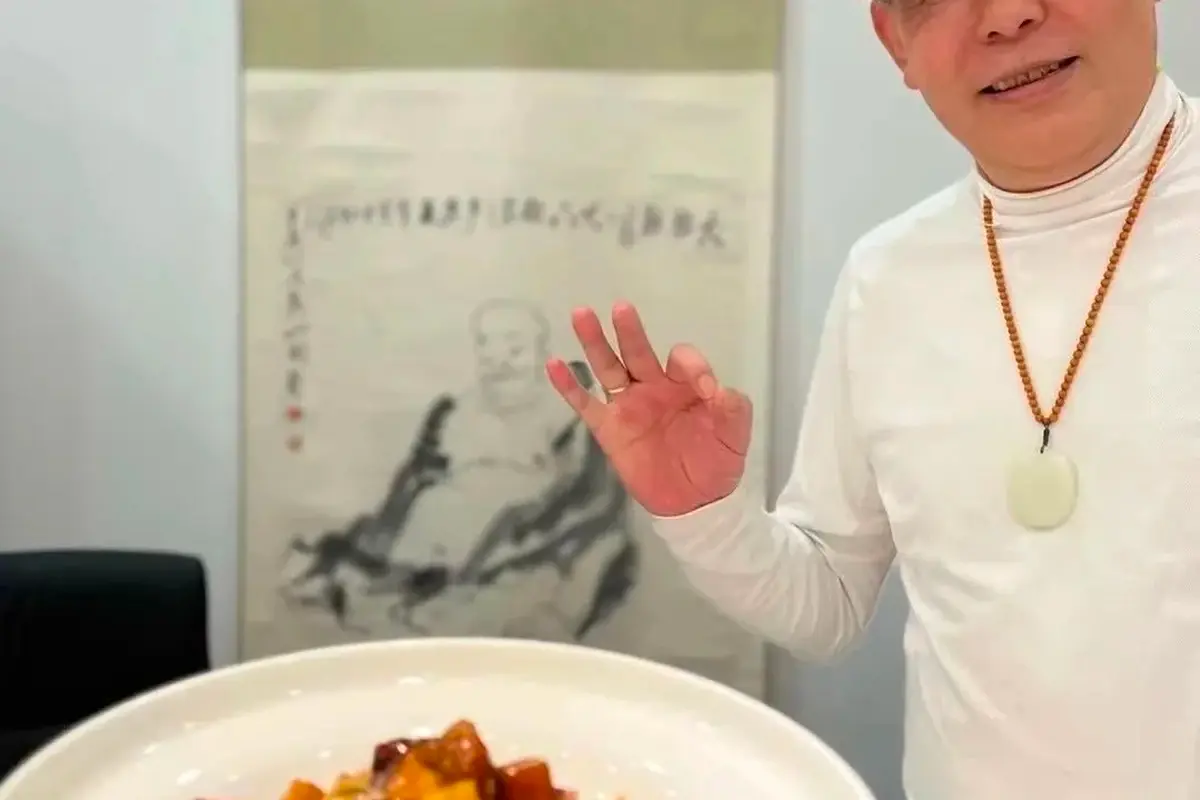
The owner of Jiangnan Yuge, Cai Guofang (known affectionately as 'Laoye')
[Friends]
Some culinary big shots run a restaurant with a simple logic: one more good dish means one more good friend. People who dine there think the same. When a well-traveled epicurean friend visits Hangzhou, as the city's unofficial nineteen-rank sesame paste food recommender, I nervously ask: care for some Zhejiang local cuisine? The owner, Cai Guofang (known affectionately as 'Laoye'), is a former diplomat. Whether at his flagship 'Jiangnan Yuge' or his second brand 'Hao Cai Hao Cai', dining at Laoye's means being surrounded by refined conversation—it's the norm. The more intimate, the more relaxed. If a stranger needs a recommendation, I'd say: 'Laoye, the helmsman of Jiangnan Yuge, steadfastly upholds tradition, crafting a unique coastal flavor with the philosophy of "good wine, good ingredients," presenting dishes with authenticity.' That sounds official, but once I pair it with a few hasty phone snaps of the food, you'll know it's all heartfelt.
Rich Flavors Make Good Friends
I sigh that Ningbo cuisine, with its tough-guy tenderness, is unparalleled in Hangzhou—Jiangnan Yuge is the top brand.
Regulars can recite the signature dishes by heart: shredded radish with white pomfret, a must at every table; winter bamboo shoots braised with potherb mustard, a seasonal gift of crispness; blue crabs in soy paste, rich and luscious, with an ice-cream-like texture; taro soup with crispy pork lard—sizzling and fragrant! Even the emaciated arhat painted by Wu Shanming on the wall behind the chair seems ready to leap out to join the feast, though it might turn into a chubby arhat from all the wine and meat. At Laoye's, unforgettable Ningbo dishes come as naturally as breathing.
Laoye's Jiangnan Yuge is a gathering place for the elite. It's less about his diplomatic finesse and more that great people are drawn to these captivating, bold flavors.
Once, Yao Runlian, president of the Macao Culinary Association, insisted on visiting. A connoisseur, he knew this former diplomat's Ningbo cuisine was an unforgettable taste of the East China Sea. President Yao brought along the same bacalhau (salted cod) used at Macao state banquets, bridging the savory-saltiness of Macao and Hangzhou tables. Laoye said he had dreamed of a shrimp dish the previous night, calling it 'Dream Shrimp'—a brand-new creation where lemon fragrance penetrates a crisp shell, like a lover's backward glance. This off-menu item was being tested in the kitchen; he urged me to sneak a few for President Yao to sample.
Lemon Sautéed Shrimp
Though Ningbo cuisine appears rugged, its cooking is clever, pairing well with drinks. Right now, until spring, the true deity of Ningbo braised vegetables—'Tiancai Xin' (a special local green)—stir-fried with thick slices of yellow-mud bamboo shoots makes a plate of greens that's heaven-sent. New dishes keep arriving, but the yellow croaker quick-fish, pig trotters fish balls, and winter melon with intestines have already filled me. The crab soup with Tiancai Xin, the vegetable god that arrives late in winter, makes me unable to stop spooning. Pour some of Jiangnan Yuge's own yellow wine, and let it meld with the swimming crabs into a sweet heartwarming taste. That heart is Laoye's spirit of hospitality.
In almost every season when East China Sea delicacies hit the market, Ningbo locals have a new drinking 'flavor enhancer.' Cuttlefish roe braised with cured pig trotters, bean curd skin wrapped yellow croaker, thousand-sheet tofu with pickled vegetables... Even just the dried sand eel, demanding the perfect 'neither wet nor dry' texture, can drive food lovers into a delicious daze. I'm eating Laoye's home-made tender pickled bamboo shoots, scooping up plump, sticky edamame, picking up crispy shrimp roe scrambled eggs with chopsticks, and dipping Fenghua taro in shell-free crab paste... all the while surrounded by Laoye's constant toasts, like flowing water.
Jiangnan Yuge uses top-notch ingredients. I was originally stubborn about dieting, but one look at the seasonal fresh dishes on the table and I crumble. That year, Shanghai's Baoye came to Hangzhou, and teacher Chen Li gathered friends—a grand feast full of witty banter. White shrimp with roe, I laughed and ate. Table topics shifted from human origins to ancient Chinese civilizations, as rich as fermented wave-fresh delicacies. The heavy dishes kept coming! Fish ball and pig trotter with yellow croaker quick-fish claypot, shredded radish and vermicelli crab pot, sour soup beef claypot—all served in generous, hearty Ningbo hospitality portions. I was so startled I slid my stool back a bit. But after tasting, I felt no sense of fullness; savored the subtleties, each distinct in delicacy. That's the essence of Jiangnan Yuge's increasingly refined cooking. The imaginative pairings in the claypots: one moist with umami, one umami with moisture, another fresh-moist without grease... light and comforting.
Yellow Croaker Quick-Fish with Pig Trotter Claypot
The soul of Jiangnan Yuge lies in the details—time, sun, and wind—and in Laoye's new menu. Fermented rice paste steamed yellow croaker has a rare, refreshing fermented rice aroma. White mushroom (white maiden fish) quick-fish roasted with eggplant offers a surprising umami amid the meltiness. Salted cuttlefish roe braised with Lianzhou cured pig trotters I tried for the first time; the two umamis multiply—I almost wanted to crunch the cuttlefish bones and eat them. Soy sauce crab, fish sauce stir-fried crab, seaweed-battered fried fish fillets—they might look new, but already have the steadiness of classic dishes.
Gourmet and writer Lin Weihui once casually said, 'If you pick the right partner, even salted fish and cabbage can taste good.' Laoye took that hint, and head chef Sen Ge created a dish called 'Wind-belt fish (dried hairtail) braised with cabbage.' Reportedly, the pepper and garlic in it are 'garlic you can still kiss after eating.' Chef Ah Sen says Jiangnan Yuge's cooking is especially simple—it's all about the quality of ingredients. I can't tell if he's proud or modest. Taro soup debuted just before the start of autumn: the pork cracklings are diced the same size as the taro, and one spoonful delivers sticky softness wrapped in crispy pork fat, filling the mouth with autumnal richness.
In the famous food critic Shen Ye's 'A Personal Ranking,' there's a dish of shredded hairtail '鮳' meat. A few years ago, I finally had the chance to try it at Jiangnan Yuge, paired with eight-treasure sauce noodles, fulfilling a wish. As Shen Ye said, shredded hairtail, being dry and skinny, actually dries better than the oily, thick ones. '鮳' refers to any small dried fish, like 'dragon head 鮳'; only large dried seafood is called '干'. Braised together with red-braised pork, it's a dish that hangs by a thread of umami—once you taste it, you can't stray.
A Single Chuān Wū is Enough to Gather a Party
Shen Ye's gatherings are always hard to get a seat at, and I was honored to join a Chuān Wū feast, discovering the essence beyond the mackerel tail.
Chuān Wū is actually mackerel. Laoye, a true Ningbo native who grew up eating mackerel, says: 'It must be the blue-spotted mackerel caught around the Qingming Festival when they migrate back to Xiangshan, at the junction of salt and fresh water. Only locals call it Chuān Wū.' Gourmet and artist Eyebrow Teacher told me he doesn't really like mackerel—except for one season, around Qingming. 'Pomfret nose, mackerel tail' is a hidden menu item for veteran foodies. If a kid who knows this gets kidnapped, the parents can only pray the kidnapper doesn't know its value, otherwise they'd have to add several zeros to the ransom.
Steamed Chuān Wū with Ham and Bamboo Shoots
'Fragrant and rich' is the most fitting praise I've heard for Chuān Wū. Qing Dynasty Ningbo literati Quan Zuwang described mackerel in his 'Miscellaneous Poems on Siming Local Products: Catkin Social (Mackerel)': 'Spring comes right at She Day, willow catkins fly to send the mackerel. But do not eat it past its time; even a fine carriage won't capture its fragrance and richness.' He couldn't help but caution food lovers: to savor the 'pure product,' it must be in the third lunar month; after that, 'the taste greatly deteriorates!'
Laoye, a true Ningbo native who grew up eating mackerel, is also obsessed with Chuān Wū: 'It must be the blue-spotted mackerel caught around Qingming when they migrate back to Xiangshan, where salt and fresh water meet. Only locals call it Chuān Wū. In recent years, I try to eat it every year at this time.' At 4 a.m. on Qingming Day, he sets out early for the fishing pier. As a meticulous restaurateur and diner, securing Chuān Wū on Qingming Day itself is full of ritual for him.
Laoye's hometown is Xiangshan. He says fishermen have always known this secret, but in earlier years they didn't think much of it—legend has it that yellow croakers were even used as farm fertilizer back then. In recent years, more and more people treasure it. Laoye is hospitable; before returning, he always announces it on his social media circle, then rushes back to Hangzhou with a dozen or so decent-sized fresh fish. Almost every time, he invites his close gourmet friend Eyebrow Teacher.
'When you lay a blue-spotted mackerel flat, its head and tail curve upward—a trait ordinary mackerels don't have.' Laoye knows that a fine Chuān Wū on the table speaks for itself.
An unchilled Chuān Wū has an extraordinary color: bright eyes, red gills, glossy dark pattern body, and vivid blue spots on its back. When cut, the flesh reveals a slight reddish hue. Mackerel that pass through Xiangshan Bay, washed by freshwater, undergo a magical change in texture, but other sea areas where salt and fresh water meet don't have this effect. Outside this bay, the fish's flesh turns white, that hint of red disappears, and the freshness and tenderness differ greatly.
Actually, 'Chuān Wū' was originally written as '鰆鯃', and fishermen simplified it over time. Local elders have a tale: there's a Chuān Wū cave in Ninghai Bay that connects directly to Maotou Ocean. Chuān Wū lay eggs in this cave, then grow up in Maotou Ocean before migrating back through Xiangshan Bay to Ninghai Bay. So they say Ninghai Bay's Chuān Wū has a unique growth, truly hard to come by. 'Miss it, and you'll have to wait another year!'
Qing Dynasty poet Sun Shilun once said, 'The waters have a social fish,' referring to mackerel. I think that name makes sense. Mackerel migrate in spring, driven by hormones, their backs shimmering blue—like special attire for meeting a sweetheart at a ball. During this time, the mackerel goes by the stage name 'Chuān Wū.' After mating, their bodies return to the dark gray of ordinary mackerel. In some places, they're called Spanish mackerel, swallow fish, plank mackerel, mackerel, green arrow.
Just a simple 'home-style braise' with a little ginger and garlic for aroma. Eyebrow Teacher likes to add a touch of celery and a bit of soy sauce to enhance the flavor—that's a taste that makes you forget everything. He says this fish needs slightly stronger seasonings so that the aroma and flavor explode instantly in the fish meat. For saltiness, pickled vegetable heads and salted vegetables are top choices. If a Wenzhou native cooks it, they'll braise it until fragrant and then reduce the sauce.
One year, Laoye decided to cook one fish two ways: he took the head and tail, simmered them in a soup with pickled greens (xian ji), and quick-salted the middle section for half an hour, then steamed it with the pickled greens' liquid.
Good food is worth the wait.
After this treatment, the steamed Chuān Wū looked and tasted superb: starting from the belly, the color gradually deepened. With chopsticks, gently cut the belly flesh, lift it into the mouth—fragrant, mellow, soft, melting without needing to chew. After finishing the belly, flake the meat near the back and mix it with the pickled greens soup—that's another kind of satisfying sensation.
For the soup version, besides xian ji, seasonal shredded bamboo shoots are added. An old Ningbo saying goes: 'Three days without xian ji soup, and your calves turn weak and wobble.'
Take a small bowl, fill it with xian ji, bamboo shoots, and fish meat, then top up with broth, eat them together, and finally drink the soup. The sour fragrance of xian ji, the sweet crispness of bamboo shoots, and the fresh smoothness of Chuān Wū—that's 'penetrating to the bone.'
A day away from Jiangnan Yuge feels like three springs apart. Spring describes the lingering longing for that savory-umami flavor, encompassing everything, even the pickled vegetables of spring.
I joke with Laoye and Chef Sen that as a child, when my appetite was poor, what I craved most was 'rotten-foot pickled greens'—the mushy pickled vegetables at the bottom of the jar. Its sour-stinky smell was an irresistible spell; it could be cooked with anything and tasted better than MSG.
Xian Ji Sour Soup Beef
As they say, beauty is in the eye of the beholder. Garlic also has a stinky foot smell, but those who love it call it garlicky fragrance. And the fiber of rotten-foot pickled greens is silky and incredibly soft. Among the 'sour-stinky' fans in Jiangsu and Zhejiang, Ningbo people adore xian ji most, its texture much like 'rotten-foot pickled greens.' Cooked in a big yellow croaker soup, it can make the freshness soar. Locals often joke that without it, you'd feel 'sour-watery' at the bottom, meaning too weak to walk.
Once, Brother Gou from Ifeng, gourmet Yan Tao, master chef Alan Yu, and others came from afar. Thanks to a bunch of old handsome stinky guys (chòu nán rén), I got to enjoy a stinky feast! Stinky tofu sashimi is a classic; this time, a brand-new tempura version of stinky mandarin fish, Changxing stinky vegetables steamed with stinky tofu, braised turnip in the style of Ningbo braised vegetables... even tender green toon tips were served. With them around, the table was so stinky it became fragrant for miles.
Watching these 'stink-chasing gentlemen' so enthusiastic, I quietly nibbled on a small East China Sea Coilia with spring flavor, bit into the crispy-outside-springy-inside mudskipper, sucked on sesame snails, and ate mini soup dumplings even smaller than the courtesan Su Xiaoxiao. I thought: Since you've come all the way to Hangzhou, I won't fight you chòu nán rén for these dishes.
Whenever the big shots laugh and chat, I like to drift off in my own little reverie, like Alice in a wonderland of umami. Jiangnan Yuge's 'Fragrance Drifting a Thousand Miles' is another forbidden zone that stink lovers wallow in—the stinky pickled mustard, its scent so enchanting, like stepping into a spider's silk cave. Then, look at the cuttlefish roe and Lipu taro wrapped in She inkstone ink sauce—softly fragrant, fresh and sticky... Jiangnan Yuge's ink-scented pork has long been a famous salty-umami dish, praised even by renowned food documentary director Chen Xiaoqing. It's said that Song Dynasty antique ink was once a folk remedy for diarrhea and wound healing. I looked at my pitch-black mouth after eating a few pieces of ink-scented pork—I couldn't tell if what lay ahead was god, demon, or monster, but I just wanted to sink into it. And the final bowl of old duck taro soup fished me back to the human world, returning to clarity.
Cuttlefish Roe with Ink Sauce and Lipu Taro
Laoye says stinky tofu cures dementia and mouth ulcers. 'Eel Cylinder Fairy Chicken,' verified through 'Compendium of Materia Medica' and Ningbo folklore, says eel cylinder treats lung consumption, and stewing it in chicken broth boosts the effect. Yesterday's fish maw from home was brought here to stew with yellow croaker, complementing the improved Xiangshan three-yellow chicken soup from the pot next door. You can imagine the beauty benefits—probably more tender than 'Eastward White' (a poetic reference to dawn). Laoye asked me to write him an inscription. I thought, he must treat me to a meal. In my craving, I drew the vertical stroke of the character '神' (immortal) into the shape of an eel!
Handwritten: 'Unparalleled Eel Cylinder Fairy Chicken'
Laoye's philosophy of 'using salt to elevate freshness' lingers like a melody, and the more you eat, the more you grasp it. Though I was already full to the brim, when the 'Eel Cylinder Pounded Shrimp Simmered in Fairy Chicken Soup' arrived, I boldly grew an extra stomach. Laoye mysteriously said: the inspiration for this dish comes from the ancestral Ningbo method of making eel cylinder, called eel cylinder mixed with scallions. The wind-dried eel is cut into about 10cm sections, boiled in chicken broth, then taken out and cooled. Whenever you crave it, take the eel section, remove the skin and bones, and mix it with Beijing scallions, cilantro, sesame oil, and cooking wine.
Eel Cylinder Pounded Shrimp Stewed in Chicken Soup
As Chinese cuisine leaps forward, it grows more inclusive. Ningbo cuisine, too, sails between mountains and seas, with a trend toward clearer, fresher flavors in every detail. The newly made light quick-fish, Laoye says, is Xiangshan skinfish, akin to pre-Qingming white pomfret (locals called 'white edge') and Chuān Wū. The skinfish of late summer and early autumn is at its best only in Xiangshan waters. I devoured two large pieces, thinking it could be the premium 'fish meal' of our East China Sea coast—season-limited, a bit luxurious. My beloved swimming crab vermicelli claypot, winter melon with chopped fish balls, and oil-sautéed shrimp all gently touched my heart, and the fermented rice dumplings were like 'dragon pearls in hiding.'
I sigh that the rest of my life really should be squandered on more good meals with good friends—Laoye truly understands.
Do you like Ningbo cuisine?
'A friend is another self.'
Food Bless You!
Advisor for 'Once Upon a Bite'
Host of 'Divine Table'
Producer of 'Wild China Eats' and '369 Days Worth Living'


