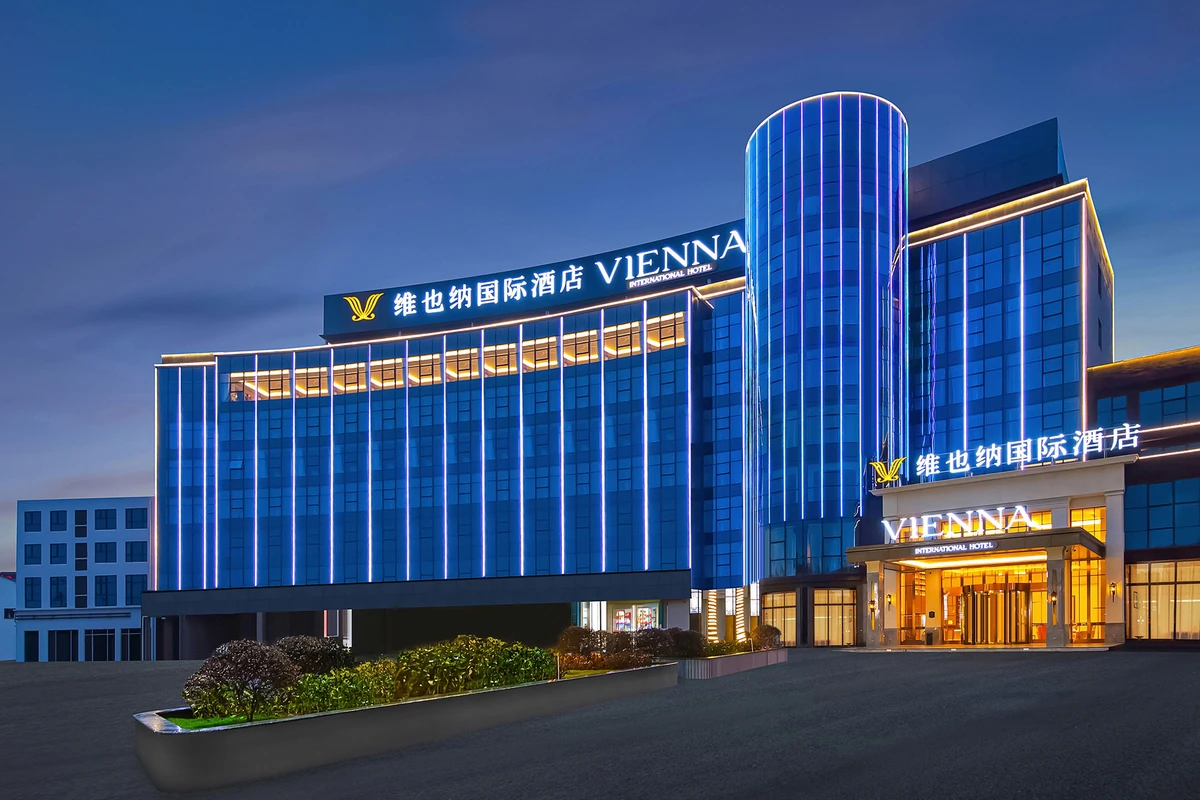
Vienna International Hotel Tops 1,500 Properties, Cracking the Upper-Midscale Scale Code
Image source: Vienna International Hotel
As China's accommodation sector upgrades and the middle class expands, the upper-midscale hotel market has entered a high-speed growth phase. Leading brands like Vienna International Hotel and Atour Hotel have each surpassed 1,000 properties, while smaller players push for scale. Yet, under the trend of quality-focused growth, scaling up in this segment is far slower than it seems. For top brands, however, crossing the 1,000-hotel milestone opens broader waters. Vienna International Hotel recently announced it has exceeded 1,500 properties, covering 34 provinces and over 350 cities, with a total of more than 213,000 rooms, firmly placing it among the industry leaders. Its new Vienna International Hotel Classic Edition is the latest product tailored for a portfolio of this size, and it has become a powerful engine driving the brand's high-quality growth.
According to the "2024 China Hotel Investment White Paper," 5,833 new chain hotels opened across the country in 2023, adding 499,000 rooms—far exceeding the same period in 2022. Upper-midscale hotels saw significant growth, with openings increasing across various provinces and city tiers. Clearly, upper-midscale hotels have become a key link in China's hotel chainification process, a trend vividly reflected in the scale deployment of top brands. Take Vienna International Hotel, for example. As a major player in the upper-midscale market, its 1,500-plus properties are not mere copies but the result of a strategic layout grounded in regional breadth and market depth. A look at its property distribution reveals several characteristics:
First, broad coverage and deep regional cultivation. Vienna International has long completed its expansive exploration of China. Beyond the relatively mature hotel markets of South China and Central China, it also has a significant presence in Southwest and Northwest China. For example, there are 133 hotel projects in the Sichuan and Tibet area of the Southwest region alone. The brand has also continuously cultivated regional markets, achieving multiple properties in multiple cities. In the Greater Bay Area, for instance, it has 273 properties across nearly 30 cities, including 46 in Shenzhen alone, and over 25 each in Dongguan, Foshan, and Guangzhou. The brand has built strong visibility and influence across many regional markets.
Second, complementary presence in first- and second-tier cities and strategic points in lower-tier cities. On one hand, Vienna International Hotel pursues refined, in-depth deployment in core cities of tier-three and above, aligned with urban planning and economic development. In Wuhan and Changsha, for example, there are 32 and 48 properties respectively, scattered across different districts to form a solid network. On the other hand, the brand also plants flags in lower-tier markets, capturing prime commercial locations in these cities to open new markets. It has projects in hot destinations like Zibo and Tianshui, and properties in numerous ethnic minority autonomous prefectures.
This layout strategy has given Vienna International Hotel distinct scale advantages. First, profound market recognition. As part of the Vienna hotel brand series, Vienna International Hotel carries 30 years of brand heritage and has been deeply engaged in the upper-midscale segment for over a decade, building a solid market foundation. The rollout of thousands of properties further amplifies brand influence. Second, a well-targeted expansion logic. The brand's growth path is remarkably steady, driven by market insight, careful planning for different city tiers, and controlled speed—a gradual approach that yields a healthy, sustainable rhythm. Third, rapid replication through multi-property synergy. With over 1,500 properties, Vienna International has woven a dense brand fabric across the country, creating flexible room for new openings and renovation of older ones, thereby enhancing the overall quality of regional properties and guest satisfaction.
The rapid increase in upper-midscale hotel numbers reflects the industrial opportunities brought by economic development and consumption upgrades. In response, both international and domestic hotel groups are ramping up investments to enhance the value proposition of upper-midscale properties. Facing fierce competition, increasingly rational investors have developed a comprehensive set of criteria for evaluating upper-midscale brands. The Vienna International Hotel Classic Edition stands as an excellent benchmark against these criteria:
First, an industry-leading, well-established classic brand. As one investor puts it: "Amid complex investment options, betting on a main track with sufficient scale and a lead player on that track usually means lower trial-and-error costs." This logic is essentially a scrutiny of brand value, and Vienna International Hotel is a time-tested classic. Drawing on the 30-year history of the Vienna hotel brand, it has strong national appeal and precisely targets the mainstream business travel segment. Since its launch in 2012, it has won consistent market acclaim and numerous awards. In 2022 alone, it received honors such as Brand of Influence in Upper-Midscale Hotels (MBI), Most Popular Upper-Midscale Hotel Brand, Upper-Midscale Hotel Brand with Investment Value, and the New Chinese Icon Endeavor Award. The Classic Edition further cements the brand's classic status, quickly attracting a strong following and already spawning flagship properties.
Second, artfully crafted product that reshapes a classic European lifestyle. As a brand with an international vision and cultural inclusiveness, the Classic Edition draws on the core of European classical culture, building a classic European lifestyle from visual, auditory, olfactory, and gustatory dimensions. Visually, it incorporates golden carved floral decorations from European palace door frames into the borders of brand print materials; reimagines Rococo-style plant window art from classical European mansions into a proprietary pattern; and turns the classic arch forms found in European church architecture into shapes for room prompt signs and indoor wayfinding signage. These classical arts are re-expressed in spaces such as the hotel entrance, lobby, guest rooms, and restaurant. The brand's new uniform design also takes inspiration from the attire of palace attendants in Vienna's imperial court during Empress Sissi's era, blending classic aesthetics with modern practicality.
In terms of sound, the hotel offers customized music programming across six time slots to match the listening needs of guests at different emotional moments. For scent, a bespoke fragrance evokes the ambiance of European royal courts. On the palate, breakfast has been fully upgraded, with a Chinese-Western mix—20% Western and 80% Chinese—and signature items in each category. Chinese dishes follow a "one city, one flavor" approach, using local ingredients to create a sense of place, while the Western selection features Vienna sausage, a representative dish from Austria that nods to the brand's inspiration.
Third, pinpoint cost reduction, holding the key to low costs. Many investors get excited by the premium product when considering an upper-midscale hotel, then lose heart when they see the cost—often over 100,000 yuan per room for interior construction is hard to swallow. The Vienna International Classic Edition has built a "value-for-money" investment model that, besides high-quality product supply, deploys nine actionable cost-control strategies to achieve precise savings. "Precision" here means centering product creation on the "key experiences" of consumers, deconstructing hotel products and services, and spending where it matters while saving where it doesn't, ultimately delivering a high-quality experience for target guests and lower investment for owners.
For example, on the hotel facade, the Classic Edition replaces stone with real stone paint coating. At a unit price of 40 yuan/m² versus 420 yuan/m² for stone, material costs are cut by 90%, while real stone paint is durable, stain- and water-resistant. In guest-room elevator lobbies, the Classic Edition swaps out shadow wood veneer costing 460 yuan/m² for seamless wall fabric at 16 yuan/m² combined with wooden lines at 45 yuan/m, achieving a 77% cost reduction.
This targeted cost control logic, combined with modular design thinking, is applied in lobby walls, guest corridors, bathrooms, integrated laundry and fitness spaces, and other details, resulting in an interior per-room construction cost of just 74,500 yuan and a comprehensive per-room cost of only 125,000 yuan for the Classic Edition.
Fourth, strong operational support to boost revenue. A franchise partnership that doesn't aim for investment return is meaningless. With high-quality products and controlled costs in place, the next step is to increase efficiency and income—and operations are where Vienna International Hotel excels. On one hand, decades of market experience and 1,500 operating properties have forged strong operational DNA. The brand can adapt to projects with different market conditions and property types. Leveraging Jin Jiang Hotels (China)'s platform strengths, including over 190 million members and more than 200,000 corporate clients, it crafts differentiated operational strategies for each hotel, driving steady performance gains. On the other hand, it has built a battle-ready sales force system that links properties, regions, and brand headquarters for performance supervision and marketing support, further strengthening revenue generation. The results are striking. During the May Day holiday this year, for instance, the Vienna International Hotel (Zhengyi Square, Nanxun Ancient Town, Huzhou, Zhejiang) posted a RevPAR of 2,927 yuan on May 2, while 83 cities saw all properties fully booked and 667 hotels recorded occupancy over 100%.
Pursuing scale is in a chain brand's nature, but speed is no longer the sole measure of excellence. In this new era of growth, the scale business has a more rational side. During this year's Two Sessions, developing new quality productive forces was written into the government work report as the top priority for 2024—a path that breaks away from traditional economic growth models and features high quality, high efficiency, and new technologies. When this concept becomes the theoretical guide for the upper-midscale hotel market's quality development, the scale business takes on new traits:
First, high-quality growth is the inexorable trend. Although the upper-midscale segment has maintained rapid growth in recent years, most chain brands have already adjusted their strategies from a singular focus on speed to high-quality development, and growth rates are moderating. To some extent, the current scale pecking order in the market will not change in the short term, and leading brands like Vienna International Hotel will continue to command large market shares. Research shows that for top brands, crossing a certain scale threshold enables both high-quality growth and increased expansion speed, and Vienna International Hotel is one of them. It's clear that in the new growth era, leading upper-midscale brands like Vienna International can leverage existing scale advantages to capture larger market share faster and more steadily.
Second, high-efficiency hotel deployment becomes the new competitive battleground. For upper-midscale hotels, keeping up with the industry's quality drive is tough. It demands not only high-quality product delivery but also growth efficiency that sets a brand apart from its peers. Essentially, this tests a brand's ability to manage the pre-opening cycle and its supply chain capability. Vienna International Hotel, after years of market cultivation, has accumulated rich pre-opening experience and built a full-cycle construction management system. The professional talent pool at headquarters also provides high-level personnel support for hotel rollouts, jointly enabling a rapid path from construction to successful operation. Meanwhile, the new-model supply chain system built by Jin Jiang Global Procurement Platform (GPP) consistently safeguards the brand's nationwide expansion. It not only supports the application of modular design and assembly-style decoration in the Classic Edition's pre-opening model but also connects the supply chain network to clear the "last mile," accelerating deployment. Notably, in November last year, Jin Jiang Hotels (China) further upgraded its organizational structure, establishing complete localized teams for development, operations, engineering, HR, and finance in 11 regions to serve guests and franchisees. Front-line teams were given greater authority, with the 11 regions reporting directly to the CEO of Jin Jiang Hotels (China), making the entire structure flatter and more agile. The logic is to let those who hear the gunfire make decisions, dramatically improving response speed and operational efficiency—in turn giving Vienna International Hotel a further edge in high-efficiency growth.
Finally, innovative thinking as the engine of brand growth. The core of developing new quality productive forces lies in innovation, and brand differentiation stems from it. To lead the pack, top upper-midscale brands must have the ability to continuously implement innovation, something vividly embodied in the Vienna International Hotel Classic Edition. One is innovation in design philosophy. The Classic Edition opens a new horizon of classic aesthetics for the masses, passed down from Western classical art while responding to the needs of local Chinese consumers. For instance, the classical bookcase at the front desk draws inspiration from the Austrian National Library's bookshelves, paying homage to history and civilization. The lobby also features a 24-hour self-service convenience station that connects upward with the decorative bookcase, creating a vertical display space. Modules such as self-pickup lockers for deliveries, smart retail cabinets, and delivery robots can be flexibly combined to meet diverse modern needs. This innovative reconstruction of design philosophy undoubtedly elevates the brand's texture and further lifts its premium value. The second is innovation in cost logic. By meticulously deconstructing user needs and product details, Vienna International Hotel has innovatively distilled nine cost-control strategies and turned them from theory into practice, dispelling the misconception that "good products mean high investment" and meeting investors' demand for high value at the right price.
In "Poor Charlie's Almanack," Peter Kaufman emphasizes that the essence of the scale advantage theory is: the more you produce, the better you can produce it. But as the scale business keeps expanding and industry growth slows, the value of scale must also evolve from quantitative accumulation to professional qualitative transformation. In the context of the upper-midscale hotel market, Vienna International Hotel's growth trajectory follows the same logic. First, it became a frontrunner in the segment through strong brand value and product strength. Now, entering a phase of high-quality development, it has further upgraded product experience and investment models with the Classic Edition, achieving a leap in both brand value and business capability—a move that more realistically matches today's more complex growth era.


