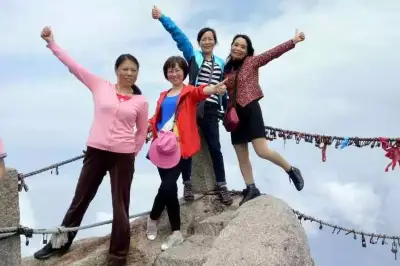
2017 7-Day Family-Friendly Free Travel Special to Mount Tai, Huangshan, and Qingdao (Lots of Beautiful Photos)
Day 1: Sunday, July 23 – Arrive in Tai'an by train at noon, visit Dai Temple in the afternoon.
Day 2: Monday, July 24 – Climb Mount Tai.
Day 3: Tuesday, July 25 – Visit Qufu's Three Confucian Sites.
Day 4: Wednesday, July 26 – Bullet train to Huangshan North, climb Huangshan in the afternoon, stay overnight at a mountain hotel.
Day 5: Thursday, July 27 – Descend Huangshan.
Day 6: Friday, July 28 – Visit Hongcun Village and the Ancient Street.
Day 6: Saturday, July 29 – Fly to Qingdao, visit Zhanqiao Pier and Badaguan Scenic Area.
Day 7: Sunday, July 30 – Visit Qingdao Underwater World (Marine Life Museum) and Qingdao Beer Museum.
Four of us—elderly, middle-aged, and a child—traveled for a total of 9 days including round trip, spending 16,000 yuan.
Planning the trip and preparing for travel
Another summer vacation arrived. Last year we visited Shanghai, Hangzhou, Suzhou, and Zhouzhuang, and my parents and child had a great time. This year we started planning early. Originally we wanted to go to Xi'an in Shaanxi, but starting in June we monitored the weather forecast and saw that temperatures there often exceeded 37°C. Since my father is quite heavy and hates heat, we had to give up that idea. Then we turned our attention to Huangshan. At first we thought of flying directly to Tunxi, but felt that only visiting Huangshan would not be satisfying enough. While choosing travel routes, I found that there is a direct train from Mudanjiang to Tai'an, and from near Tai'an there is a high-speed rail to Huangshan. So we could visit Mount Tai first and then Huangshan. Besides, there is a saying: "After seeing the Five Great Mountains, no other mountain is worth seeing; after seeing Huangshan, no other mountain is worth seeing." If we went straight to Huangshan, we might truly not want to go to Mount Tai later, missing that opportunity. Moreover, climbing Mount Tai could serve as a warm-up for Huangshan. The first half of the itinerary was set, and then we focused on the return trip. I found that there is no direct flight from Huangshan Tunxi to Mudanjiang. The nearest route required a transfer in Qingdao with a half-day layover. So I decided to buy separate tickets: fly to Qingdao first, spend one and a half days there, and then fly back to Mudanjiang. After planning, I used Excel to make a rough table, a habit I formed from the last trip. It not only gives a clear overview of the itinerary but also helps estimate expenses and prepare travel funds.
For supplies, since I love Huangshan's peculiar pines and strange rocks, I felt that using only my phone to take pictures wouldn't do justice to the beauty. So I finally decided to buy a DSLR camera with an 18-200mm lens, so I could capture distant rocks clearly. I say "finally decided" because although I enjoy photography, I always thought it would be too heavy for a woman to carry a DSLR while traveling and climbing. Well, in the end, Huangshan convinced me. Also, because we bought long-distance sleeper tickets to Tai'an, we needed to prepare four meals (train food is expensive and not tasty), so we bought a lot of bread, instant noodles, and self-heating rice. Everything was ready, and we waited for the departure day.
Eagerly awaited by my son, July 22 arrived on time. At 8:52 a.m., my parents, my son, and I boarded the long-distance "green train" and departed on time. It was my son's first time on a long-distance sleeper train, so he was very excited.
After a 26-hour train ride, we arrived smoothly at Tai'an Railway Station. Taxis in Tai'an are very cheap, and they use meters that charge to the nearest jiao, not just whole yuan. After a quick rest at the hotel, we headed to Dai Temple.
We took a group photo in front of Dai Temple (with a selfie stick, not fully complete).
Dai Temple, also called "Dongyue Temple," gets its name from Du Fu's poem "Gazing on Mount Tai": "How is the Dai Peak? Green spreads over Qi and Lu." It was where emperors held ceremonies to worship heaven and earth and to honor the god of Mount Tai. Dai Temple, along with the Forbidden City in Beijing, the Three Confucian Sites in Qufu, and the Outer Eight Temples of the Chengde Mountain Resort, are known as China's four greatest ancient architectural complexes. At Dai Temple: children between 1.2m (inclusive) and 1.5m (exclusive), seniors aged 60 (inclusive) to 70 (exclusive) with a senior card, teachers, provincial or ministerial heroes, model workers, and moral models can buy half-price tickets with valid IDs. I am a teacher, so before the trip I searched online for discount policies at various attractions and found many offer discounts for teachers. I brought my teaching certificate and bought four tickets at the counter, all discounted (my parents are over 60, my son is 12). The ticket office staff recommended an electronic guide (a small device with the names and locations of scenic spots and an earpiece, which narrates information as you walk). I thought it was a good idea since Dai Temple has thousands of years of history worth understanding, so I rented one.
After entering through Zhengyang Gate, there was a large stone on the main path. From afar, I saw many people walking around it. When I got closer, I read that if you can walk around it three times clockwise and three times counterclockwise with eyes closed, and then walk blindly to a tree about 10 meters away and touch it, you will receive blessings from the mountain god for your family's safety.
Dai Temple has many stone steles like this, said to be built by emperors who came to Mount Tai for ceremonies.
Plants in Dai Temple are also special. This tree is called "Slanting Cypress." At first I thought it was named because it grew slanted, but later I found many straight trees also called Slanting Cypress, probably because the grain of the trunk grows diagonally.
From a second-floor platform in Dai Temple, looking into the distance, I could see Mount Tai hidden in the clouds!
Here is a photo of my son; the electronic guide is hanging around his neck.
Mount Tai is a UNESCO World Heritage site for both natural and cultural significance. What attracts me most are the cliffside inscriptions. In Dai Temple, there are many replicas of Mount Tai's inscriptions and some modern ones. I really like this "Hundred Longevity Stones" below.
For dinner, we ordered some Shandong-style boiled peanuts (listed as "Farmer's Joy" on the menu) and other dishes. It was our first time tasting Lu cuisine, and we found it quite tasty.
There are several routes to climb Mount Tai. Tourists usually choose two: one starts from the Hongmen (Red Gate) entrance, south of Dai Temple where we went yesterday. It's a footpath from the foot of the mountain with great scenery and the most concentrated inscriptions, but it requires climbing 6,366 steps. Even a fit person takes over 4 hours. The other route starts from Tianwaicun entrance, where you take a scenic bus to Zhongtianmen (Middle Heaven Gate). From there, you can either take a cable car to Nantianmen (South Heaven Gate) or walk up. Since my parents are older, my father is heavy and has bad knees and waist, we chose the second route.
In the morning, we had some steamed buns and soy milk nearby and then set off for Tianwaicun entrance. I booked tickets for my parents and son on Ctrip, and they entered by scanning their ID cards. I bought my ticket at the counter. Only then did I discover that teachers with a teaching certificate get a discount: the adult ticket including one-way bus fare is normally 155 yuan, but with teacher discount it was 132 yuan.
After boarding the scenic bus at Tianwaicun, we reached the Zhongtianmen parking lot in about 20 minutes. The road was all uphill and winding. Although not as steep as Changbai Mountain's road, it still made my son feel dizzy. Friendly tip: on winding mountain roads, always fasten your seatbelt because the drivers are experienced and drive as fast as possible without speeding.
At Zhongtianmen, we helped my parents onto the cable car to Nantianmen. My son and I decided to climb the steps to Nantianmen to experience the real "ascent" of Mount Tai.
My parents reached Nantianmen in about 8 minutes—so fast! I told my father we'd contact each other in three hours, estimating that my son and I would make it up by then. They wandered around Tianjie (Heavenly Street) in the meantime.
My son and I started climbing. There were many cliff inscriptions on both sides. As a beginner in calligraphy, I liked them and took many photos.
But after climbing for over an hour, we still couldn't see any gate—just endless steps ahead! My son lamented that the mountain god of Mount Tai was mocking us (i.e., giving us endless steps to climb).
Finally, we reached a memorial archway inscribed "Dragon Gate." I wondered if Nantianmen was not far now! My legs were sore. I had lost the mood to take photos. Every time we reached a flatter area, there were stalls selling water (most 5 yuan, Red Bull 15 yuan), cold drinks, and cucumbers. Some larger stalls even put up signs saying "Gas Station." Climbing Mount Tai is no joke; you need to replenish regularly.
After another half hour, we still hadn't seen Nantianmen, but we found a sign for "Eighteen Bends"—so we must be close!
Another half hour later, we reached "Ascension to Immortality Archway." Finally, we could see Nantianmen in the distance. I was exhausted. During the climb, I learned a technique: control your breathing. After climbing several dozen steps, your breath quickens (you start panting). At that point, you should rest for half a minute; otherwise, you'll get dizzy, tired, and short of breath.
My son and I took breaks, drank water, wiped sweat, ate snacks, and rested. After 2 hours and 40 minutes, we finally reached Nantianmen and met my parents waiting there!
Look at the cliff covered with inscriptions, including the golden "Inscription of Mount Tai."
Near the main peak, "Yuhuangding" (Jade Emperor Peak), we finally saw the "Supreme Among the Five Sacred Mountains" carved stone that appears on the 5-yuan note.
My son was very happy when he saw this. He summarized: "I've already been to the 'Three Pools Mirroring the Moon' on the 1-yuan note and the 'Great Hall of the People' on the 100-yuan note. Now I've been to the 'Supreme Among the Five Sacred Mountains' on the 5-yuan note. When can we go to the places on the 10-yuan and 50-yuan notes?" I thought: those are the "Three Gorges" and the "Potala Palace"—too far for people from Northeast China. So I told him, "We'll go if we have the chance. If I don't take you, you can go yourself when you grow up!"
The fog was thick today; the peaks were all in mist. Later I realized it might be clouds because they moved very fast!
We had lunch at Tianjie. Shandong specialties: pancake rolls with scallions were mostly 10 yuan each, noodles also 10 yuan, but the portions were small. An adult needed one bowl of noodles plus one pancake roll to be full.
As the saying goes, "Going up the mountain is easier than coming down." Our legs were sore, so we all took the cable car from Nantianmen back to Zhongtianmen. On the way to the parking lot, I looked back at the peak and realized how high it was! I took a photo with my DSLR zoom lens and spotted a square building between two peaks—it was Nantianmen! I felt grateful that the fog was heavy that day; if I had known how high Nantianmen was, I might not have had the courage to walk up the steps. We bought bus tickets back to Tianwaicun and arrived safely.
This photo is of the Tiandi Archway.
Two days earlier, I booked high-speed rail tickets to Qufu. Tai'an is very close to Qufu. There are long-distance buses from Tai'an to Qufu running from 6:00 a.m. to 7:00 p.m., every 20 minutes, taking about 1.5 hours. My father said taking the train is safer, so I bought high-speed rail tickets. Here's a small incident: I want to praise the Tai'an taxi driver. We had booked a 7:30 a.m. high-speed train on the 25th and called a taxi for 6:30 a.m. Since we arrived in Tai'an by train, Tianwaicun is near the train station. In the taxi, the driver asked us if we had climbed Mount Tai and where we were going. Then she reminded us to check whether our tickets were from Tai'an to Qufu or from Mount Tai to Qufu. I was confused—aren't they the same? Hasn't Tai'an City been renamed Mount Tai City? After asking, I understood: Tai'an Station refers to the old train station, while Mount Tai Station is the new high-speed rail station. -_-|| Most cities have high-speed rail stations named something like "North" or "East," but Tai'an is unique. I checked my phone and confirmed it was indeed "Mount Tai Station." Thanks to the driver's reminder, because Mount Tai Station is 20 minutes away from Tai'an Station, we arrived on time and didn't miss our train.
After a 19-minute high-speed ride, we arrived in Qufu. The Confucius Temple is a major tourist attraction. Although there are many hotels nearby, without booking in advance it's hard to find a room.
South of the entrance to Qufu's ancient city is the ticket office for the Three Confucian Sites. Seniors over 60 enter free with ID; teachers can exchange tickets (free) at the west side of the Confucius Temple entrance with their ID, teaching certificate, and professional title certificate; students get half price. I really feel that Shandong province shows great respect for teachers everywhere! As a teacher, I came to the Confucius Temple with sincere reverence to pay respects to our ancestral master!
Architect Liang Sicheng called the Qufu Confucius Temple a "unique example" in world architectural history. It is a UNESCO World Heritage site, a national key cultural relic protection unit, and a AAAAA scenic area, along with the Forbidden City and Chengde Mountain Resort as one of China's three major ancient architectural complexes.
In front of the Confucius Temple, there is a stone stele saying: "Officials and others dismount here!" Confucius has been revered throughout history. Emperors would get out of their sedan chairs and walk in.
Facing us are three archways: Lingxing Gate, Taihe Yuanqi (Great Harmony), and Zhisheng Temple (Temple of the Ultimate Sage).
Inside the temple, there are guide maps everywhere for visitors.
Near Dazhong Gate, there is a stone stele with what looks like a star chart and a Tai Chi symbol (forgive my shallow knowledge—I don't recognize the first character, just the last two as "utensil" and "chart").
Behind Kuiwen Pavilion, there are 13 stele pavilions, each containing several steles, showing how many high officials and even emperors came to worship over the centuries!
This is the famous Apricot Altar, where it is said Confucius taught over 2,000 years ago!
Finally, we arrived at Dacheng Hall, dedicated to Confucius and ancient sages. Many visitors wore Hanfu and performed rituals in front of the hall.
The photo below shows the "Old Well of Confucius' Residence" in the western courtyard; there is still water in it!
This is a stone stele inscribed by Emperor Qianlong himself!
There were several cute puppet figures in the temple.
I also saw this plant and identified it as chestnuts! (We don't have these in the Northeast.)
After visiting the Confucius Temple, we exited through the west gate and headed north to the Confucius Mansion. Since it was nearly noon, we ate some Shandong-style food on the way: pancake rolls with scallions (plain ones 8 yuan; adding sausage costs extra). The ones in Qufu are different from Mount Tai: at Mount Tai they were pure corn pancakes with paste and a scallion; in Qufu they are flour and egg pancakes (similar to jianbing guozi found elsewhere) wrapped with fried noodles and scallions—really tasty. Forgive me, I was hungry, so I didn't take a photo! However, the prices on this street were a bit high. The next morning, we passed a street vendor near the Confucius Temple gate selling the same pancake rolls for only 6 yuan, twice the portion! So we bought some for my son, and he enjoyed them thoroughly!
I digress. Back to the Confucius Mansion: it is not where Confucius lived, but the residence of his direct descendants—the "Yansheng Duke." So the plaque reads "Sage Mansion."
The mansion feels like an official's residence, or a simplified version of the Forbidden City. The front part was where the Yansheng Duke handled official business and received guests; the rear was the inner residence, off-limits to outsiders. Even the inner residence residents could not easily go out. The two photos below show the water supply facility: male servants poured water into a trough, and maids inside the inner residence collected it from the outlet. This shows the ancient concept of "men and women not touching each other."
Along the central axis from south to north are the Grand Hall, the Second Hall, and the Third Hall, followed by the inner residence gate. After the Grand Hall, a corridor leads to the Second Hall. Inside the corridor are two long red-lacquered benches. According to a tour guide, when the powerful minister Yan Song was impeached and about to be punished, he came to the Confucius Mansion to ask his granddaughter's husband, the Yansheng Duke, to intercede with the emperor. Yan waited on this red bench for two hours, but the Yansheng Duke did not see him. Hence, the bench is called "Elder Minister's Bench" or "Cold Bench."
At the northernmost part of the mansion is the back garden. The picture below, "Five Cypresses Embracing a Scholar Tree," symbolizes children surrounding their parents.
The following "Warning Against Greed" mural is on a wall in the mansion. It depicts a strange ancient beast. It is said the Yansheng Duke painted it to educate his descendants to be honest officials; now it is one of the national anti-corruption education bases.
After visiting the Confucius Mansion, my parents were tired, so we skipped the Confucius Forest to save energy for tomorrow's Huangshan trip. At the exit of the mansion, there is a Confucius Mansion post office with many postcards and souvenirs, and nine stamps of Qufu's Three Confucian Sites that you can use freely. I took out my tickets (which are also postcards) and stamped several as souvenirs, then mailed one to my home!
The Confucius Temple is truly a thousand-year-old architecture with ancient trees everywhere. The photo below shows a ginkgo tree full of ginkgo fruits!
We walked back to the hotel along Banbi Street west of the Confucius Temple and the Mansion. The street is lined with old buildings (some new ones also adopt ancient styles).
Near the Confucius Temple Hotel, we saw a pan-fried bun shop that was listed as one of Qufu's top ten famous eateries, so we decided to have dinner there. It was delicious!
We also ordered a "dijiaokengji" (pot-roasted chicken), said to be one of Qufu's famous dishes. It tasted great.
After dinner, it was almost 6 p.m., but the sun was still high. I took a photo to remember. In Mudanjiang, the sun sets at 7 p.m. Here, it seemed it wouldn't set for another two hours.
We arrived early at Qufu East Station, which is far from Qufu city center. There is a city bus K01 that can take you directly to the Confucius Temple (about 1 hour). We had a high-speed train at around 7:30 a.m., and the bus only starts at 6:30 a.m., so we took a taxi to the station. Let me reveal a little secret: my essential travel tool is a mobile map app. No matter which city I'm in, I can always check routes (by car, walking, or public transit). It's very convenient and prevents getting lost. However, it doesn't cover long-distance buses and scenic area shuttles, so before traveling, it's good to read others' travel notes and guides. My other essential is Ctrip: I book flights, hotels, and tickets there, and when planning, I search for travel notes, guides, and recommended attractions.
To be honest, Ctrip's service is very thorough. I booked a hotel on Huangshan through Ctrip about half a month in advance. On the way from Qufu to Huangshan, I called the hotel to confirm the reservation, worried that if we were slow climbing, the hotel might give our room to someone else. Here's a small hiccup: I had booked under my father's name. After a long time, I forgot. When I called the hotel front desk, I gave my own name, and they didn't find it. But they politely said the order might not have arrived and told me to call back later. So I opened the Ctrip app and submitted an inquiry to customer service. Ten minutes later, I received a call from Ctrip headquarters in Shanghai. They said they had reconfirmed with the hotel, and the booking was successful. Then I realized I had probably given the wrong name. -_-|| I called the Huangshan hotel again, gave my father's name, and they confirmed the room was reserved and told me not to worry—the room was ours for the whole night, no matter what time we arrived. Kudos to both Ctrip and Paiyunlou Hotel!
After a four-and-a-half-hour high-speed ride, we arrived at Huangshan North Station. From reading others' travel notes, I knew that to the right of the station is the tourism transport hub, where you can transfer to the Xin'guo line intercity bus to Tangkou. Indeed, from the platform we could see the transport hub building.
After exiting the station, there were signs guiding us to the bus station.
At the Huangshan tourism transport hub, you can buy tickets to Tangkou, Hongcun, the west gate, and the north gate of Huangshan.
We arrived at 11:51 a.m. and could have bought tickets for 12:20 p.m., but we were a step late—there were only two seats left. So we had to buy tickets for 1:20 p.m. While waiting, we had lunch in the station. It took about an hour to reach Tangkou. At the Tangkou transfer center, we stored our luggage, and each of us carried only a backpack (mainly water and food) for climbing Huangshan. Since my father is impatient, my plan was to take the cable car from Ciguang Pavilion up the mountain, so we could first see the Welcoming Pine, then walk slowly and enjoy the scenery, arriving at Paiyunlou Hotel in the West Sea Scenic Area before dark. We transferred to the scenic area shuttle from Tangkou to Ciguang Pavilion, arriving at the Huangshan ticket office around 3 p.m. Huangshan tickets are sold at the south gate (Ciguang Pavilion and Yungu Temple) and at the north and west gates. Unlike Mount Tai, where you buy tickets first and then take a bus into the scenic area, at Huangshan you first take a bus to your desired entrance, then buy tickets and start climbing. Seniors over 60 and students get half-price tickets; during summer vacation, teachers with a teaching certificate also get half price. Along with the tickets, we also bought cable car tickets up from Ciguang Pavilion.
Once on the cable car, we saw steep cliffs on both sides.
First, I uploaded two maps of Huangshan Scenic Area. Maps are sold in Tangkou (5 yuan each). I had downloaded these two online before the trip.
Arriving at Yuping Station, we first saw the Puguan Pine (Cattail Pine).
After about half an hour's walk, we finally reached the famous Welcoming Pine! The weather was beautiful, with bright afternoon sunlight. The photos taken here were stunning!
I imitated the Welcoming Pine to welcome friends from all directions!
Leaving the Welcoming Pine, we headed toward Aoyu Bei (Turtle Back), Guangming Ding (Bright Summit), and Feilai Shi (Flying Rock). Looking into the distance, although we didn't see spectacular sea of clouds from above, there were high clouds!
Huangshan is said to have 72 peaks, the most famous being Lotus Peak, Bright Summit, and Heavenly Capital Peak, known as the three main peaks. But I think every peak is beautiful, with strange rocks on top and Huangshan pines growing in rock crevices—stone and pine complement each other.
Looking at the distant peaks, doesn't it feel dreamlike?
Walking and gazing, we turned to another side of the mountain, revealing different scenery.
Finally, we saw the first strange rock—the "Mobile Phone Rock" (Dolphin Rock), which looks like an old-fashioned phone with an antenna.
As we walked to the side, the lower part looked like keypad area!
Huangshan pines are incredibly resilient, growing in rocks and even accelerating rock weathering.
Huangshan is so beautiful. Looking down from the top, one feels expansive and has an urge to shout, "Huangshan, I'm here!"
On some steep sections, the stone steps have no handrails; instead, there are iron chains or thick ropes. My father taught my son to walk sideways like a crab when descending steep slopes—placing his foot sideways on the steps and turning his body sideways.
After descending this steep section, we realized it was the famous "Hundred-Step Cloud Ladder"!
After the Hundred-Step Cloud Ladder, we could see in the distance "Aoyu (Turtle) Eating Snails." Can you tell which part is the turtle's head?
Don't worry—with my DSLR zoom lens, I zoomed in to get a clear view!
Less than half an hour later, we followed the path and actually climbed onto the peak of "Aoyu Eating Snails." The photo below shows "Aoyu's Back" (not the more dangerous "Jiyu's Back").
From below, you can see how high my son was standing!
From Aoyu's Back, looking north, we could see Bright Summit in the distance. We were walking slower than expected; I wondered if we could reach the hotel before dark.
Endless long stairs everywhere. It was already past 6 p.m., and the sun was about to set.
Finally, we reached Aoyu Cave. I heard that when busy, Aoyu Cave is used for descending, while the route to Bright Summit goes through "One Line Sky." As the name suggests, that path is steeper. Since it was late and there were few tourists, we passed through Aoyu Cave.
Along the winding mountain path, after another 40+ minutes, we finally climbed to Bright Summit. Luckily, Bright Summit is a great place to watch sunrise and sunset. When we climbed up, it was already crowded. We waited about 5 minutes, and the sun gradually approached the western horizon. So being late had its advantage—we coincidentally saw the beautiful sunset at Bright Summit.
In the distance, the sun passed through clouds, getting lower and lower.
I had just bought my DSLR and wasn't yet proficient with it, so I didn't capture the sunset more beautifully.
After watching the sunset, we continued. On Huangshan's mountain paths, there are almost no vendors; only near hotels can you buy limited food and water. Fortunately, we had prepared sufficient supplies and ate while walking.
By the time we reached Flying Rock, it was already 7:03 p.m. Although not completely dark, the mountain path was quite dark. Huangshan's streetlights are very good. My son joked that streetlights should be considered the fifth scenic feature of Huangshan (the four are strange pines, peculiar rocks, sea of clouds, and hot springs—plus streetlights).
In the distance, Flying Rock is the rock that appears at the beginning of the classic 1980s TV series "Dream of the Red Chamber"!
Zoomed in for a photo. I wonder if the couple in the picture ever gets to see the accidental photo I took of them!
My son wanted to climb onto Flying Rock and touch it, but it was too late, so I told him we would do it next time we come to Huangshan. Every trip should leave some unfinished business as a reason to return!
After 5 hours of walking and stopping, we finally reached our booked hotel at 8 p.m. My son was still energetic, but my parents were exhausted. We quickly washed up and went to sleep.
Special thanks to the hotel: when I booked the room half a month earlier, I called the front desk and asked if three adults and one child could stay in a triple room. Unexpectedly, the thoughtful staff arranged a "triple room" with four beds! What a pleasant surprise—the four of us could each sleep well, and I didn't have to share a bed with my son!
Hotels on Huangshan do not provide disposable toiletries. I understand: climbing the mountain is hard enough; all supplies are carried by porters (out of respect, I didn't take photos of porters or sedan carriers). How tough it is! Being able to rest in such a comfortable hotel on the mountain is already a luxury.
Before sleeping, I suddenly heard loud cicada chirps and saw this creature outside the screen window!
Day 5: Thursday, July 27 – Descend Huangshan
On the 27th, we woke up before 5 a.m. My son and I planned to climb nearby Danxia Peak to watch the sunrise. Later, my mother joined us.
From Paiyunlou to Danxia Peak took less than 20 minutes. Many people were already waiting. We didn't get good spots. Around 5:30 a.m., the sky turned red, but it seemed foggy with thick clouds. The sun was hiding behind the clouds. I thought we wouldn't see the sunrise due to bad weather, but about ten minutes later, the sun emerged from the clouds, and we saw the sunrise as expected (feeling very lucky, since everyone says Huangshan is often rainy and cloudy; we saw both sunset and sunrise!).
Staying on the mountain was wonderful. From the hotel room window, we could see beautiful Huangshan!
After breakfast at the first-floor restaurant at 7 a.m., we resumed our hike. This time we headed toward the back mountain and took the cable car down from Yungu Temple. As travelers say, the front mountain path is steeper, while the back mountain path is gentler. But no matter which side, the path goes up and down constantly—essentially crossing one peak after another.
On the way to the North Sea Scenic Area, we saw Union Pine.
Near the North Sea, my father couldn't walk further, so he rested. My son and I headed toward Qingliangtai (Cool Terrace) to see "Monkey Gazing at the Sea." It took about half an hour to reach the viewing platform. The weather was misty today, but no sea of clouds; we could only see "Monkey Gazing at Taiping." In the photo, far left is Huangshan Taiping.
Back at the North Sea, we walked a short distance south and saw "Brush Holder Mountain."
A bit further, we reached the viewing platform for "Dream Pen Producing Flowers."
From this angle, I captured both Brush Holder Mountain and Dream Pen Producing Flowers in one shot!
Continuing southeast, we arrived at Black Tiger Pine. According to a tour guide (we eavesdropped), taking a photo under Black Tiger Pine makes men vigorous, but women should avoid it or they'll become "tigresses" :)
Near the Twin Trunk Pine, the small bridge was covered with love locks!
This is the famous "Sea-Searching Pine."
Looking into the distance, it is said to be "Eighteen Arhats Facing the South Sea." To be honest, I didn't see it!
But the "Boy Worshipping Guanyin" here was quite distinct!
We didn't go toward Shixin Peak but headed east to the Stone Bamboo Shoot Ridge (Shisun Gang). From there, we could turn back to the Bai'e Ling New Cable Car to Yungu Temple.
Looking back from Stone Bamboo Shoot Ridge, we could see "Immortal Gathering Herbs" far away.
It looks close, right? Here is a distant shot.
At Stone Bamboo Shoot Ridge, several peaks look like bamboo shoots, hence the name.
Returning from Stone Bamboo Shoot Ridge to Harp Pine, we walked south to the Bai'e Ling Cable Car. The plank road in the photo below looks scary, but walking on it didn't feel that way because it's stone and feels safe.
Another shot of beautiful Huangshan!
We started at 8:30 a.m. and took the cable car down to Yungu Temple at nearly 2 p.m. Even though the back mountain path is gentler, we still spent five and a half hours. A note about Huangshan Scenic Area: before coming, I searched for maps online but found that different people drew different route shapes and even different locations for scenic spots. I thought I would draw a standard one after visiting. But once inside Huangshan, I felt completely disoriented (like "being in the mountain"), simply following paths. There aren't many forks, but annoyingly, at every fork there is a sign pointing toward "Welcoming Pine." You don't know how far it is to Welcoming Pine along that direction, nor what other famous spots are on that route. Unlike other scenic areas, Huangshan doesn't have panoramic maps with "You are here" markers. Probably because Huangshan is too vast; no one knows exactly where each scenic spot is, only that it's near "such and such peak." Also, for a first-time visitor, even if you stand at a famous spot, you might not recognize it. I hope the management can improve signage with descriptions, photos, and direction indicators. May Huangshan Scenic Area get better and better!
On the way down from Yungu Temple cable car, I saw these strangely shaped round stones. The beauty of Huangshan is beyond words. Great Huangshan, I will come again!
Near the Yungu Temple parking area, there is a two-story building called "Huangshan Geological Museum," displaying minerals, rocks, and plants from Huangshan.
There is also a video introducing the formation of Huangshan.
My son loved the "Huangshan Strange Rocks Matching Game" here.
We bought tickets for the New Guolin bus back to Tangkou and arrived at the pre-booked hotel.
This hotel's first floor is a restaurant with moderate prices. We had dinner on the 27th and breakfast on the 28th there. The hotel is very close to Tangkou Transfer Center, less than a 10-minute walk.
The decoration was quite unique!
On the 28th at 9 a.m., we set off for Hongcun. There were many buses in front of the hotel heading to Hongcun, but we thought they were unsafe, so we went to the transfer center and took the New Guolin bus. It cost 20 yuan per person to Hongcun, with fixed departure times (50-minute ride).
Hongcun tickets are half price for seniors and students. After booking online, we needed to pick up tickets at the self-service kiosk near the ticket office.
Since we were going directly back to Huangshan city after Hongcun, we stored our luggage at the Hongcun ticket office.
These days, the temperature in Huangshan city reached 39°C. Locals said that every summer there is little rain (it's the summer drought period in the middle and lower reaches of the Yangtze River), but this year was especially hot, causing fewer tourists to visit Huangshan. When we arrived at Hongcun around 10 a.m., it was unbearably hot.
Hongcun is really beautiful. As soon as we arrived, we saw many students painting by the lake, capturing Hongcun's beauty on paper.
Entering the white-walled, black-tiled buildings, I realized that Hongcun's beauty is not just about "small bridges, flowing water, and houses." The Huizhou-style architecture is full of artistic beauty!
Inside the high walls is a courtyard with a skylight. The walls have no windows; the skylight provides lighting. Because the walls are thick, even in 39°C heat, entering the courtyard felt cool. The eaves of the skylight slope inward, so rainwater is effectively collected into the house—the legendary "good water does not flow to others' fields"!
On all the beams and rafters, there are various wood carvings. Now I truly understand the phrase "carved beams and painted rafters." In this respect, Hongcun has more depth than water towns like Zhouzhuang, carrying ancient Chinese civilization and showcasing the transmission of craftsmanship from ancient times to the present.
The photo below shows an ancient painting on the ceiling, depicting the Confucian idea of "encouraging learning."
Tall horse-head walls:
Simple interior furnishings:
Even the doors are carved with wood. The photo below depicts lotus flowers and crabs, symbolizing harmony between husband and wife.
Hongcun has several shops specializing in hairy tofu (maodoufu), a specialty of Huangshan. It tastes similar to the pan-fried stinky tofu sold on Northeast streets, but less smelly and quite tasty!
Hongcun uses an artificial water diversion system that brings water into every household. All the streets in the village are built along the water.
Walking along the water channel, we saw a private kitchen and decided to have lunch there.
The courtyard of Jushan Hall was beautiful!
Unexpectedly, the food in this beautiful private kitchen was the best we had on the trip. Braised pork belly with chestnuts (68 yuan), stir-fried bamboo shoots (38 yuan), and a glass of osmanthus rice wine (15 yuan). The rice wine was sweet and fragrant; even my 12-year-old son couldn't resist a small glass.
After exploring, we walked toward the village entrance and saw a very thick tree.
A close-up shows how thick it is!
After leaving Hongcun, we bought a New Guolin bus ticket back to Huangshan city (24 yuan per person). It took 80 minutes to reach Tunxi District. Taxis in Huangshan city have very low base fares, so we mostly took taxis in Tunxi.
Huangshan Ancient Street is similar to characteristic commercial streets in most tourist cities, but its architecture is still Huizhou style, giving a sense of history.
The decoration of the first-floor food hall was antique. Upon entering, we were given a small bamboo card with a table number. We ordered on the semi-basement level and then sat at the corresponding table to wait for our food. We didn't try the famous "stinky mandarin fish" but ordered a crispy rice with beef, which was delicious.
On the 29th, we took a taxi from the hotel to Huangshan Tunxi Airport (30 yuan). However, the airport staff didn't start work until 8:30 a.m. Our flight was at 10 a.m., so we arrived before 8 a.m. and waited at the door until 8 a.m. when the terminal opened. -_-|| Then we waited another half hour to get boarding passes and check luggage.
After security, in the waiting area, we heard an announcement: "Due to air traffic control (we later learned it was because of the military parade rehearsal on July 30, so air traffic control on the 29th), the flight to Qingdao is delayed; new departure time to be announced." Well, we really came too early for nothing. We waited until after 11 a.m., and the ground staff distributed lunch boxes to each passenger. At 12 p.m., most people had finished lunch, and boarding began.
My son lamented not seeing the sea of clouds on Huangshan, but he saw it from the plane!
Two hours later, we arrived at Qingdao Liuting Airport. We took the airport express bus to a hotel near Zhongshan Road. Although the hotel facilities were simple and the room small, the location was excellent.
A 15-minute walk from the hotel brought us to Zhanqiao Pier.
My son and I also visited Qingdao Post and Telecommunications Museum. On the first floor, there were stamps of various Qingdao scenic spots that you could use for free. The first and fourth floors were mainly for selling goods; exhibits were on the second floor. From this visit, I learned that Qingdao was first occupied by Germany and then by Japan. That explains the European-style architecture near Qingdao Railway Station old town, and why our hotel room was so small.
Then we took a bus to Badaguan Scenic Area. Qingdao has many buses, mostly costing 1 yuan. There are many types: regular unmanned buses, trolleybuses, double-decker sightseeing buses, airport express buses, and even manned buses where you sit first and the conductor comes to collect fare.
Badaguan Scenic Area is actually a villa district built by foreigners during Qingdao's occupation. Each building has a different style. Even the streets are beautiful. Along the way, we saw many couples taking wedding photos.
Actually, the streets near our hotel also had similar European architecture, no less beautiful than Badaguan.
Zhejiang Road Catholic Church is a real church. On Sunday morning, we saw many believers attending mass.
On a sloping street beside the church, there were many beautiful bars and inns. We took some nice photos in the morning when there were fewer people.
After breakfast at the hotel, we started today's itinerary. Qingdao's coastline is beautiful. Near the Qingdao Underwater World (Jellyfish Palace entrance), I took a photo of the coastal rocks.
We bought a combined ticket for Qingdao Underwater World, including the Dream Jellyfish Palace, Marine Mammal Hall, Biological Specimen Museum, and the main Underwater World. Tickets were checked at each section.
While my parents took my son to visit the Underwater World, I went alone to the Qingdao Beer Museum (I later told my husband solemnly that I went there for him).
The Qingdao Beer Museum is built inside the original Qingdao Brewery factory, showing the early brewing process (old factory equipment) and also the current production lines (new factory). It gives a sense of history. With the pre-booked ticket, I scanned a QR code to enter. The ticket also included two glasses of Qingdao beer (one draft, one pure) and a bag of beer snacks.
In the evening, we stayed at a hotel near Qingdao Liuting Airport. On July 31 at 6:35 a.m., we took Shandong Airlines back to Mudanjiang, ending our fun summer vacation trip.
Looking back at the whole trip, we saved a lot of money. First, my son got half-price tickets at most attractions. Second, my parents are both over 60, so they got half-price tickets; when they turn 65, many attractions will be free. Third, during summer break, teachers with a teaching certificate get discounts at many scenic spots. Fourth, booking through Ctrip (flights, hotels, tickets) also offered various discounts. Since we are an ordinary family, travel costs are unavoidable (but of course, with elderly and a child, we stayed in double rooms; for college students, hostels would be more economical). Writing this travelogue to share for other independent travelers.
Travelogue Contents:
1. Day 1: July 23 (Sun) – Arrive in Tai'an by train at noon, visit Dai Temple in the afternoon.
2. Day 2: July 24 (Mon) – Climb Mount Tai.
3. Day 3: July 25 (Tue) – Visit Qufu's Three Confucian Sites.
4. Day 4: July 26 (Wed) – Bullet train to Huangshan North, climb Huangshan in the afternoon, stay overnight at a mountain hotel.
5. Day 6: July 28 (Fri) – Visit Hongcun Village and the Ancient Street.
6. Day 6: July 29 (Sat) – Fly to Qingdao, visit Zhanqiao Pier and Badaguan Scenic Area.
7. Day 7: July 30 (Sun) – Visit Qingdao Underworld World (Marine Life Museum) and Qingdao Beer Museum.
Travel Info:
Hotel Index
Route Index
Flight Index
Website Navigation
Travel Index
Cruise Index
Corporate Travel Index
Membership Cooperation
Distribution Alliance
Friendship Links
Corporate Gift Card Procurement
Insurance Agency
Agency Cooperation
Hotel Membership
Destination and Scenic Area Cooperation
More Cooperation
About Ctrip
About Ctrip
Ctrip Highlights
Contact Us
Careers
User Agreement
Privacy Policy
Business License
Safety Center
Ctrip Content Center
Intellectual Property
Trip.com Group Algorithm Publicity