21-Day Tour of Huangshan, Sanqingshan, Lushan, and Jiuhuashan: Visiting Pines at Huangshan, Worshipping Taoism at Sanqingshan, Seeking Waterfalls at Lushan, and Paying Homage to Buddha at Jiuhuashan
I had long yearned for the peculiar pines and sea of clouds at Huangshan, and had wanted to visit for a long time, but never made the trip until this spring when I finally decided to go. Because of Li Bai's poem "Viewing the Waterfall at Mount Lu" and the movie "Romance on Lushan Mountain," I became fascinated with the beauty of Lushan. While planning the itinerary, I found that Lushan was not far from Huangshan, so I decided to visit both this year. When checking train tickets, I found that the train ride from Jiujiang back to Tianjin was too long, so I chose to return via Nanjing instead. This added Jiuhuashan and Sanqingshan, known as the "Little Huangshan," along the way from Jiujiang to Nanjing. My travel destinations for this year were finally set on several famous mountains along the border of Jiangxi and Anhui provinces. Originally planned to depart after Qingming Festival, but due to the COVID-19 vaccination schedule, the departure date was not confirmed until mid-May.
Expenses (for two people) totaled 19,654.03 yuan, including:
Transportation: 3,251.00 yuan, Accommodation: 6,321.34 yuan, Tickets (including scenic area shuttle, cable cars, etc.): 5,735.80 yuan, Shopping, meals, local transportation, and miscellaneous: 4,345.89 yuan.
Around 10 a.m., we boarded the train to Huangshan and arrived at Huangshan North Station after more than 6 hours. At the Huangshan Tourism Transport Hub on the right side of the exit, we bought bus tickets to Tangkou Town and arrived there in less than an hour.
Tangkou Town, located at the southern entrance of Huangshan, is the main service base and tourist reception center for Huangshan, serving as a transfer point for visitors. The hotel we booked was right next to the Tangkou transfer center, and we arrived in the evening.
Huangshan is shrouded in clouds and fog for more than 200 days a year. In the morning, the sky was covered with thick clouds, and we worried that the mountain would be heavy with fog. But since we had already come and booked a hotel on the mountain, we decided to go up and try our luck.
Huangshan Scenic Area is located in Huangshan City, Anhui Province. Originally named Yishan (Black Mountain) because the peaks and rocks looked dark and green from afar, it was renamed Huangshan during the Tang Dynasty, meaning "Mountain of the Yellow Emperor." Huangshan is one of the Three Sacred Mountains and Five Great Mountains. There are 72 named peaks, with thousands of peaks competing in beauty and countless valleys majestic. The three main peaks—Lotus Peak, Bright Summit, and Heavenly Capital Peak—all rise above 1,800 meters, towering and magnificent, earning it the title "The Most Extraordinary Mountain Under Heaven." As the saying goes, "Having visited the Five Great Mountains, one need not see any other mountains; after visiting Huangshan, one need not see even the Five Great Mountains." This is Xu Xiake's sentiment after two visits to Huangshan and the best praise for the mountain.
Huangshan Scenic Area is divided into the front mountain and the back mountain. The front mountain refers to the area from Ciguang Pavilion to Bright Summit, including the Hot Spring, Jade Screen Pavilion, and Tianhai scenic spots, with main attractions like the Welcoming Pine, Half-Mountain Temple, Heavenly Capital Peak, Jade Screen Pavilion, Lotus Peak, A Glimpse of the Sky, and Mandarin Fish Peak. The back mountain refers to the area from Cloud Valley Temple to Bright Summit, including the North Sea and West Sea scenic areas, with main attractions like Beginning-to-Believe Peak, Lion Peak, Cloud Dispelling Pavilion, West Sea Grand Canyon, Flying-Over Rock, and Pine Valley Nunnery.
We chose the route of going up the mountain via the Cloud Valley cable car and down via the Jade Screen cable car.
After breakfast, we took the scenic area shuttle to the Cloud Valley cable car and then rode the cable car up the mountain. The cable car traveled through the fog, and after more than ten minutes, we arrived at the upper station at White Goose Ridge. Stepping out of the cable car station, the mountain was indeed enveloped in thick fog, and we could only see vague outlines of peaks nearby. Our booked Baiyun Hotel was near Bright Summit. From the cable car station at White Goose Ridge, we had to pass through Beginning-to-Believe Peak, Lion Peak, Bright Summit, and other attractions to reach the hotel. Thus began our Huangshan trip in the dense fog.
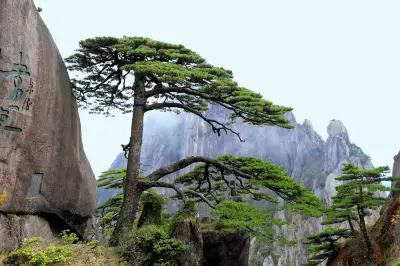
Walking through the mist, we could only see pine trees growing in the cracks of cliffs nearby. Huangshan pines grow in hard granite rocks with tenacious vitality, their branches twisted, crowns flat, lush and vigorous. Each pine tree had its unique natural shape, showing a simple, steady, and majestic air, yet with different expressions, possessing a peculiar beauty.
With dense fog around us, we walked for half an hour and reached Beginning-to-Believe Peak.
Huangshan's Beginning-to-Believe Peak is located east of the North Sea's Scattered Flower Valley, protruding above a deep ravine. It is one of the 36 minor peaks, at an altitude of 1,683 meters. Here, strange rocks compete, peculiar pines stand in abundance, with cliffs on three sides and a thousand-meter drop. Clouds and mist drift, presenting a unique charm. On the west side of the peak's waist, dense tall pines grow along the slope, vigorous and varied, giving rise to the saying: "Without reaching Beginning-to-Believe Peak, you have not seen Huangshan pines."
Beginning-to-Believe Peak is not high, and the fog at the summit alternated between thick and thin. In the moments when the fog cleared, we could see the pines and Bamboo Shoot Ridge shrouded in thin mist.
Bamboo Shoot Ridge is between Beginning-to-Believe Peak and Immortal Peak. Strange rocks on the ridge stand irregularly, like bamboo shoots after rain. When clouds and mist swirl, the pines and rocks on the ridge present a magical scene.
Descending from Beginning-to-Believe Peak, we came across a tall and sturdy ancient pine, with branches imposing like a tiger, and a dark green canopy almost black, resembling a black tiger lying on the slope. Approaching it, we saw the sign next to it, identifying it as the Black Tiger Pine, one of the ten famous Huangshan pines.
Passing the Black Tiger Pine and continuing forward, the fog would gather and disperse. At a viewing platform, a gust of wind just happened to blow away the fog, allowing us to clearly see a Huangshan wonder—the Brush Pen Flowering.
In the Scattered Flower Valley of Huangshan's North Sea scenic area, a solitary peak stands tall, shaped like a writing brush pointing upward. On its tip grows a twisting ancient pine, its branches spreading like a blooming flower, hence the name "Brush Pen Flowering."
Further ahead, passing the Lion Grove Hotel, we reached the Cooling Terrace and the Monkey Gazing at the Sea.
The Cooling Terrace juts out on a precipitous rock open on three sides, known as the First Terrace of Huangshan. In front of it is the Rear Sea with shifting peaks and clouds, and below, stone steps wind in eighteen bends. To the right, jagged stone shoots are arrayed above, offering a panoramic view of the vivid "Eighteen Arhats Paying Homage to the South Sea."
This is an ideal spot for viewing the sea of clouds, but unfortunately, we saw only a vast expanse of white, nothing else.
Monkey Gazing at the Sea is located in front of Lion Peak in the North Sea scenic area of Huangshan, a peculiar rock formation. A stone monkey sits alone on the peak, as if gazing into the distance or leaping to observe the sea of clouds. Amid the swirling mist, Taiping County at the foot of the mountain appeared and disappeared, a fantastical scene witnessed by the monkey. The changing clouds and light create a magnificent and ethereal panorama.
When we reached the viewing platform for Monkey Gazing at the Sea, the fog was very thick. The monkey hid in the dense fog, unwilling to reveal itself. After waiting a while, there was still no sign of the fog dissipating, so we had to descend.
Back at the Cooling Terrace, a gust of wind blew, and the fog gradually parted, revealing the peaks that had been wrapped in clouds and mist.
Seeing the beautiful scene before us, we became excited. But soon, everything was once again shrouded in fog. We returned to the fork in front of Lion Grove Hotel and continued toward Bright Summit.
Bright Summit, at an altitude of 1,860 meters, is the second highest peak of Huangshan. Its top is flat and open. On clear days, one can view the wonders of the East Sea and the peaks of the West Sea, with Heavenly Capital, Lotus, Jade Screen, and Mandarin Fish peaks all in sight. Built on its top is the highest meteorological station in East China—Huangshan Weather Station. It is also one of the best places to watch sunrise and the sea of clouds.
After walking in the fog for more than an hour, constantly ascending and descending, we reached Bright Summit around 2 p.m. At that time, thick fog filled the area, and we could only vaguely see the round ball on top of the weather station building. After a short rest at Bright Summit, we continued downhill.
A dozen minutes downhill from Bright Summit brought us to Baiyun Hotel. The surroundings were still shrouded in fog, and we didn't feel like going anywhere else. We checked in and went to our room to rest, hoping for good weather the next day.
Bright Summit—Huangshan Weather Station
Seeing the peaks around the hotel still enveloped in thick fog in the morning, we were a little disappointed. After breakfast, we stayed in the hotel until after 9 a.m. Noticing the distant sky brightening, we decided to head to the West Sea Grand Canyon.
From the hotel, we could take the internet-famous mini-train directly to the bottom of the canyon, or walk from Bright Summit via Flying-Over Rock and Cloud Dispelling Pavilion to the bottom. We chose to walk to the canyon to see more scenery.
Bright Summit was still white and foggy. On the path from Bright Summit to Flying-Over Rock, we passed a viewing platform called Qunfengding, which offers a broad view. On a clear day, it would be a great place to watch the sea of clouds, but at that moment, we could barely make out the faint shadows of a few pine trees on the rocks. At the Flying-Over Rock viewing platform, all we saw was its blurry silhouette in the fog.
Huangshan's Flying-Over Rock is located northwest of Bright Summit. It is 12 meters high, 8 meters wide, 1.5–2.5 meters thick, and weighs about 360 tons. Its peculiar shape is astonishing. Even more amazing, such a huge rock stands vertically on a flat rock about 12–15 meters long and 8–10 meters wide. The contact surface between the two rocks is very small, as if the upper rock had flown in from the sky, hence the name. Geologists believe this wonder formed during geological changes, truly a masterpiece of nature. The strange stone in the 1987 TV series "Dream of the Red Mansions" (A Dream of Red Mansions) was the Flying-Over Rock.
Flying-Over Rock in the Fog
After a brief stop at the viewing platform, we continued. This was a downhill section. Passing Echo Wall to Cloud Dispelling Pavilion, a ray of light appeared in the distant sky, and the fog gradually dissipated. We could clearly see towering peaks, winding gullies, and dense pines.
After Cloud Dispelling Pavilion, we arrived at the entrance of the West Sea Grand Canyon.
Located in the western part of the Huangshan Scenic Area, the West Sea Grand Canyon is renowned for its strange beauty. Combining seclusion, wonder, steepness, and danger, it features thousand-foot sheer cliffs and majestic valleys, as well as myriad peaks competing in beauty and strange rocks like forests. It is the most beautiful and profound part of the Huangshan Scenic Area, the most representative, stimulating, attractive, and awe-inspiring section, best showcasing nature's incredible craftsmanship and the majestic beauty of the motherland.
It takes over 2 hours to descend from Cloud Dispelling Pavilion to the canyon bottom, all along stone steps. Entering the canyon, we saw numerous strange rocks, mysterious deep valleys, and knife-cut peaks. Giant stone slabs piled up like building blocks, forming fragmented peak clusters in the deep valley. Everywhere is a scene, every scene is unique, views change with each step, and the eyes cannot take it all in.
The front desk clerk at the hotel in Tangkou Town where we stayed yesterday suggested we visit Bu Xian Bridge when the weather was good. After returning to Baiyun Hotel from the West Sea Grand Canyon on the mini-train, it was already after 2 p.m. We rested a bit and then decided to go see Bu Xian Bridge while the weather was clear.
Next to Baiyun Hotel, there is a path leading to Bu Xian Bridge. We followed the path for over 20 minutes and arrived at the West Sea Yaotai viewing platform, from which one can see the entire West Sea Grand Canyon. Next to the platform is a small iron gate. From here, a round trip to Bu Xian Bridge takes about an hour, and walking from here to the bottom of the West Sea Grand Canyon takes 3 hours. The small iron gate closes at 5 p.m. It was nearly 4 p.m. when we arrived. The staff on duty confirmed that we had booked a hotel on the mountain and would only go to Bu Xian Bridge and return, then registered us and let us through, telling us to come back on time. Except for tourists staying on the mountain, most tour groups don't come here, so there were few people on this path. We only met a few young people hiking up from the bottom of the West Sea Grand Canyon. Walking and stopping, after more than 40 minutes, we reached Bu Xian Bridge.
Huangshan's Bu Xian Bridge was completed in 1988. A small arch bridge hangs between two cliffs, with a bottomless abyss below—very steep and charming.
West Sea Yaotai Viewing Platform
West Sea Yaotai Viewing Platform
This spot offered close-up views of the West Sea Grand Canyon from different angles. Because of the different positions and angles, the scenery differed. We stayed at Bu Xian Bridge for a while, then it began to drizzle, so we quickly returned by the same route.
Although the rain stopped in the early morning, the mountain was still shrouded in thick fog. By after 9 a.m., the fog showed no sign of clearing, and the weather forecast predicted thunderstorms for the day, so we had to descend in the dense fog. Departing from Baiyun Hotel, after a dozen minutes we arrived at Mandarin Fish Peak.
Mandarin Fish Peak is a small peak along the route from Jade Screen to North Sea, named for its shape resembling a mandarin fish. It is the first of the 36 minor peaks of Huangshan. On its summit is a triangular Mandarin Fish Cave, with the words "Tian Zao" (Heaven-made) carved above the entrance. The cave is narrow, about 5 meters deep, with light entering from the upper right, revealing a line of blue sky. Exiting the cave, the view opens up to a different world. In front of the peak are several stones that resemble snails from afar, forming scenes like "Mandarin Fish Eating Snails" and "Old Mandarin Fish Laying Eggs." On the back of the peak is a large turtle-shaped rock called "Mandarin Fish Carrying the Golden Turtle."
Mandarin Fish Peak is a must-pass point between the front and back mountains of Huangshan, and a must-visit attraction. Climbing up Mandarin Fish Peak, all we saw was a vast white fog. This is normally a great viewing spot, but at that moment, only a few fog-shrouded pines growing on the summit were visible.
Mandarin Fish Peak in the Fog
Mandarin Fish Peak in the Fog
Passing through Mandarin Fish Cave, a huge giant whale emerged before us in the dense fog. Its round, long, and high body, with a massive raised head, was vivid; the wide-open mouth seemed ready to swallow everything.
There were many people here, mostly tourists who had come up via the Jade Screen cable car that morning, reached Bright Summit, and were now returning. After a short stay, we continued down to a fork: right to Jade Screen Pavilion, left to Lotus Peak. We chose the left path, intending to climb Lotus Peak, the highest peak of Huangshan.
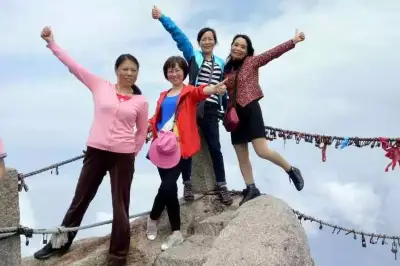
Huangshan's Lotus Peak is located north of Jade Screen Pavilion. It is the highest peak of Huangshan, at an altitude of 1,864.8 meters. Standing at the summit, one can see thousands of peaks competing in beauty and countless ravines filled with mist. On a clear day, one can see Tianmu Mountain to the east, Lushan to the west, and Jiuhuashan and the Yangtze River to the north. After rain, viewing the sea of clouds from all sides is even more spectacular. There is another wonder on the summit: iron chains around the peak covered with locks of all kinds. These are heart-shaped locks placed by young couples or married couples, symbolizing eternal unity.
After walking a steep mountain path, we reached the foot of Lotus Peak and learned that due to weather conditions, Lotus Peak was closed today.
We waited there for a while, but the weather showed no sign of improvement. We had to leave with regret and head to Jade Screen Pavilion, where Huangshan's iconic landmark—the Welcoming Pine—stands to the left of the pavilion.
Jade Screen Pavilion is a place where Huangshan's wonders gather. Behind the pavilion is Jade Screen Peak, with the famous "Jade Screen Reclining Buddha" on its summit, head left and feet right, very lifelike. On the peak rock is inscribed Mao Zedong's cursive poem "How Majestic Are the Rivers and Mountains." This is the best spot to view the Front Sea sea of clouds. On a clear day, one can also see nearby strange rocks like "Immortal Floating on the Sea," "Sheep Crossing the River," "Turtle Looking at the Moon," "Squirrel Jumping to Heavenly Capital," and "Peacock Playing with Lotus," all charming and picturesque.
Huangshan's Welcoming Pine is located to the left of Jade Screen Pavilion, growing out of a rock called Lion Rock. It is 10 meters tall, with a trunk diameter of 0.64 meters, and is at least 800 years old. Two large side branches extend forward from the middle of the trunk, 7.6 meters long, like a hospitable host spreading arms to warmly welcome visitors from afar—graceful and elegant.
The Welcoming Pine is a must-see for Huangshan visitors. When we arrived, it was nearly noon, and many tourists had gathered there, making it very crowded. Everyone scrambled to take photos with the pine. We first found a less crowded spot to rest and eat. Just after finishing our meal, we heard the crowd exclaim. Looking up, we saw that the fog had cleared somewhat, and the Welcoming Pine was clearly visible.
Looking up, the carvings on Jade Screen Peak were clearly visible.
People were reveling in the scene when suddenly a mist rose from the valley, and the Welcoming Pine and Jade Screen Peak, like shy maidens, retreated back into the thick fog. After a while, seeing that the fog still hadn't lifted, we decided to descend via the Jade Screen cable car.
After exiting the lower station of the Jade Screen cable car, we took the scenic area shuttle directly to the Huangshan Hot Spring.
Huangshan Hot Spring has always been as famous as the strange pines, peculiar rocks, and sea of clouds, known as the "Four Wonders" of Huangshan. The spring gushes out from the foot of Purple Cloud Peak, flowing year-round with a constant temperature of around 42°C, a high-altitude hot spring. The water is mainly bicarbonate, extremely clear, odorless, and sweet in taste—both drinkable and bathable. Legend has it that the Yellow Emperor bathed here for 49 days, rejuvenated, and ascended to heaven, earning it the name "Spiritual Spring."
Relaxing in the hot spring water relieved the fatigue of the past few days of mountain climbing. It wasn't until after 8 p.m. that we took the bus back to the hotel in Tangkou Town.
It rained heavily during the night. In the morning, following the front desk clerk's suggestion, we spent the morning visiting Jiulong Waterfall. He helped us book tickets and arranged a car to the waterfall, costing 60 yuan round trip. Jiulong Waterfall is not far from Tangkou Town. Soon the driver dropped us at the entrance, left his phone number, and told us to take our time and call him when we were done.
Huangshan's Jiulong Waterfall is located on the west road up the mountain at Cloud Valley. It is 600 meters long with a drop of 300 meters. The waterfall has nine bends, each bend forming a pool, creating nine waterfalls and nine pools—a magnificent spectacle. During the rainy season, water rushes down the giant cliff, plunging a hundred meters, like a long white silk hanging, as if the Milky Way falls to earth, with extraordinary momentum.
Entering the scenic area, we saw a waterfall dozens of meters long cascading down. The pool below was emerald green, bright and dazzling. Looking up, we could see the Heavenly Capital Peak at the top of the canyon looming through the clouds, majestic and magnificent. Following the stone path upward, accompanied by the sound of flowing water, the surrounding bamboo forests were lush. One waterfall after another, we unconsciously arrived at the ninth waterfall. The water seemed like the Milky Way hanging down, splashing pearls and jade, extremely magnificent.
Returning from Jiulong Waterfall around noon, we asked the front desk clerk to help arrange a car to Hongcun Village. The drive from Tangkou Town to Hongcun took about an hour. We wanted to experience the rural charm of Huizhou-style houses, so we specially booked a guesthouse within the Hongcun scenic area. The guesthouse owner picked us up at the entrance, and after dropping off our luggage, we began exploring Hongcun.
Among the many distinctive Huizhou-style villages in southern Anhui, Hongcun is the most representative. The entire village is built against the mountains and beside the water. Mountains gain greenness from water, water gains vitality from mountains. It combines mountain wilderness charm with water town features, a unique ox-shaped ancient village in the ancient Yixian peach blossom land, known as "the village in Chinese painting." Every household is connected by waterways, with clear streams flowing past each home. Natural scenery and humanistic connotations complement each other, a feature that distinguishes Hongcun from other residential architectural layouts, making it a great wonder of world historical and cultural heritage. The village has well-preserved over 140 Ming and Qing dynasty residences. The Chengzhi Hall features exquisite "three carvings" (wood, stone, brick) and is known as the "civilian Forbidden City."
Hongcun's main attractions are South Lake and Moon Pond, as well as Chengzhi Hall, Shuren Hall, Jingxiu Hall, and many other well-preserved, exquisitely crafted Ming and Qing ancient residences. Strolling leisurely, the tranquil atmosphere was intoxicating.
Hongcun is a must-visit when traveling to Huangshan. Many tour groups come here, filling the small village with tourists. We followed the crowd to visit several ancient residences. Suddenly it started raining, and we had seen enough, so we returned to our lodgings.
Hongcun's night scenery is also beautiful. After dinner, the rain stopped, and we went to see the night view. The village was much quieter without tour groups, only a few independent travelers wandering around. But soon it started raining again, and we hurried back to rest.
The early morning sky cleared, and sunlight gilded the edges of the clouds. Taking advantage of the quiet morning, we went to the village again. Hongcun had just woken up, without the daytime noise. The houses and trees on the shore were quietly reflected on the water. A few villagers were washing things by Moon Pond, and early-rising tourists spoke softly. Everything was peaceful and serene.
The sun hadn't fully risen before it was covered by thick clouds, and the sky turned gloomy again. Today we had to leave for Wuyuan's Huangling Scenic Area. We returned to our lodgings for breakfast, and the owner drove us to the Hongcun bus station. We took a bus from Hongcun to Huangshan North Station (1.5 hours), then a high-speed train to Wuyuan.
Wuyuan County is located in the northeast of Jiangxi Province, at the junction of Jiangxi, Zhejiang, and Anhui provinces. It is one of the six counties of ancient Huizhou, known as the "Hometown of Books" and "Hometown of Tea." It is a nationally famous cultural and ecological tourism county, often called "China's Most Beautiful Countryside."
Wuyuan County has many ancient villages rich in Huizhou culture and is also one of the famous places to view rapeseed flowers. We missed the blooming season, so we chose Huangling, renowned for its "drying crops in the sun." It took about an hour from Wuyuan High-Speed Rail Station to Huangling Scenic Area. We booked the only hotel in the scenic area—Wuyuan Huangling Shaiqiu Meisu (Sun-Drying Autumn Beauty Inn). We checked in at the entrance and took the cable car up. The hotel's electric car was waiting for us at the cable car exit.
Huangling is an ancient Huizhou village nearly 600 years old, with classic Huizhou architecture and typical mountain dwellings. The houses are scattered in a fan-shaped terraced layout around the water mouth. The original villagers have all moved out. After redevelopment, Tian Street (Heaven Street) connects the well-preserved classic ancient buildings like a jade belt, with Huizhou-style shops lining both sides, front shops and back workshops, forming a flowing miniature version of "Along the River During the Qingming Festival."
The hotel rooms are spread across different parts of the scenic area. A warm-hearted hotel butler led us to our room. Our booked room was at the end of Tian Street. After settling in, we went out to Tian Street. It was just past noon, with many tourists on the street. We had lunch on Tian Street, then passed the north archway inscribed with "Tian Street" and walked to the Leixin Bridge. Leixin Bridge, also known as Glass Bridge or High-altitude Plank Road, is the place where Guan Guan and Xie Tong from the TV series "Ode to Joy 2" came to travel.
Leixin Bridge spans between two mountains. The bridge deck is made of wooden planks, with a glass section in the middle. Standing on the bridge, one can overlook the terraced fields on both mountains and the Xiaoweng Village nestled in the valley. At the center of the terraced fields, there is a pond in the valley, locals call it "the dimple of Huangling." During the rapeseed flower season, this is an excellent spot to view the sea of terraced flowers.
Most tour groups turn back at Leixin Bridge. We noticed a path on the opposite side and another bridge below. After asking the staff, we learned that we could circle back from below, so we decided to take a detour.
After crossing Leixin Bridge, there was a viewing platform nearby. Standing there, we could see the ancient Huangling village lying quietly on the mountainside slope, with white walls and black tiles, staggered. Continuing along the path, wildflowers and insects accompanied us. Looking at the green fields and breathing fresh, moist air, we enjoyed this comfort and tranquility in the embrace of nature. Walking and stopping, after descending some steps, we arrived at the bridge we had seen from Leixin Bridge—it was the Woyun Bridge.
After crossing Woyun Bridge, we lingered at a nearby viewing platform for a while, then returned to Tian Street.
Climbing up stone steps led to the ancient Huangling village.
Huangling is a well-preserved Huizhou-style ancient village, with original ancient village features and folk customs. A large area of ancient Huizhou buildings slants steadily along the slope, high and low, interlocking. The entire ancient village, surrounded by flowers and trees, is as serene and beautiful as a fairyland. During the harvest season, the spaces between houses become a world of drying bamboo mats, with colorful crops overlapping with black roofs, a spectacular sight.
Now, to promote tourism, as long as the weather is clear, you can see "drying crops in the sun" year-round in the scenic area. Unfortunately, when we arrived, the sky was overcast, with intermittent drizzle, so we missed the grand scene of "drying autumn."
After touring the ancient village, we descended stone steps to Huangling Huaxi Water Street.
Huangling Huaxi Water Street has rugged terrain and large elevation differences. The narrow stream hits the stones in the channel, almost falling straight down, forming several small waterfalls. The buildings on both sides are traditional Huizhou-style architecture, including both neat brick-and-stone buildings and slightly rustic earth-walled buildings, with diverse styles. Gray walls, green tiles, flying eaves and upturned corners, horse-head walls scattered; wall paintings and brick carvings are exquisite and vivid. "Blue bricks, small tiles, horse-head walls; winding corridors, hanging flower lattice windows" is a true description of Huangling Water Street architecture.
The end of Huaxi Water Street is a yew forest. Many side paths lead back to Tian Street. We took one upward and found ourselves right next to the hotel. Having visited most places, we decided to return to the hotel to rest.
We heard that Huangling's night scenery is beautiful. After dinner, we went out again to enjoy it.
Huangling's night has its own flavor. Strolling along the blue stone paths, we saw beautiful light shows everywhere. In the dense forest, it felt like being in a starry world, with twinkling lights like countless fireflies, a delight to the eyes.
At night, with fewer tourists, the ancient village became quiet. It started drizzling again, so we quickly returned to the hotel.
In the early morning, before the throng of tourists arrived, the ancient village was even more peaceful and serene. After breakfast, we wandered again. Looking into the distance, the layered terraced fields on the slopes were shrouded in morning mist, complementing the black-tiled white-walled Huizhou dwellings, outlining a picturesque rural landscape. Standing there, it felt like being in a fairyland.
Around 10 a.m., more tourists began to arrive. We left Huangling for our next destination—Sanqingshan.
To get from Wuyuan to Sanqingshan, we first took a high-speed train to Shangrao, then transferred to a bus to the Wai Shuangxi cable car station at Sanqingshan. After taking the cable car down, we found a bus heading to Wuyuan High-Speed Rail Station about to depart, arriving at the station around noon. We had pre-booked train tickets online from Wuyuan to Shangrao for after 3 p.m., but upon arrival at the station, we couldn't change to an earlier ticket. We arrived at Shangrao Station around 4 p.m. At the Shangrao East Bus Station to the right of the exit, we learned that there were no more buses to the Wai Shuangxi cable car station that day. So we had to stay in Shangrao overnight and head to Sanqingshan early the next morning.
Our accommodation from last night was close to the station. In the morning, we left our luggage at the hotel and took a bus to Sanqingshan. After about an hour and a half from Shangrao East Bus Station to the Wai Shuangxi cable car station, we asked the driver about the return times and began our Sanqingshan journey.
Sanqingshan, also known as Shaohuashan or Yashan, is located at the junction of Yushan County and Dexing City in Shangrao City, Jiangxi Province. Its name derives from the three peaks—Yujing, Yuxu, and Yuhua—which resemble the Taoist trinity of Yuqing, Shangqing, and Taiqing seated on the mountain. The scenic area features thousands of peaks competing in beauty, lush ancient trees, and year-round clouds and mist, full of immortal spirit. Unique granite pillars and peaks, lifelike granite formations combined with rich ecological vegetation and changing weather phenomena, create a unique landscape unparalleled in the world, presenting fascinating natural beauty, earning it the title "The Most Beautiful Mountain in the World." At the same time, it is a famous Taoist mountain with a thousand years of humanistic influence. Its Taoist history is long, with legend that Ge Hong "built a hut to refine elixirs" here in the Eastern Jin Dynasty. The ancient Taoist architectural complex on Sanqingshan is arranged according to the "Eight Trigrams," ingeniously and unpretentiously, majestic in scale, making it a unique example of ancient Chinese Taoist architectural design, known as the "Open-air Museum of Ancient Chinese Taoist Architecture."
As soon as we stepped out of the cable car and started climbing, it began to drizzle. Fortunately, we had booked Risun Villa, not far from the cable car station. We quickened our pace. After climbing about 20 minutes of steps, we reached the villa as the rain intensified. We checked in and went to our room to rest.
Sanqingshan's hiking routes form two loops in the shape of an "8". Risun Villa is right at the intersection of the two loops, making it a well-located hotel on the mountain. Around 10 a.m., the rain gradually stopped. Today we planned to hike one loop: West Coast Scenic Area, Sanqing Blessed Land Scenic Area, and Sunshine Coast Scenic Area.
Leaving the hotel, the sky was overcast. Many tourists who had just arrived gathered on the platform outside the hotel. From the hotel to the West Coast Scenic Area, we first climbed some steps, then walked along a 4-kilometer-high skywalk.
West Coast, also known as West Sea Plank Road, is the longest, flattest, and most open high-altitude skywalk on Sanqingshan and even in the world. It is the most thrilling and beautiful scenic area of Sanqingshan.
On a clear day, strolling on the high skywalk in the grand canyon, gazing at the distant peaks, one feels relaxed and happy. To the east is endless sheer cliffs, to the west is the deep and mysterious canyon like a sea, and in the distance are continuous mountains and mist. Strange peaks stand in abundance, grotesque rocks are jagged, nature's work is miraculous; the diverse vegetation makes the canyon even more lush, giving a wonderful feeling of "free traveling in the West Sea, happy as an immortal."
Now the mountain was shrouded in thick fog, and we could only dimly see nearby objects. Fortunately, there were blooming azaleas along the plank road to enjoy.
The Yusonglin Service Area is the end of the West Coast Plank Road. From here, continuing forward is the Sunshine Coast Scenic Area, with a side path leading to the Sanqing Blessed Land Scenic Area. Many tourists rested here. We unhesitatingly headed toward Sanqing Blessed Land.
Sanqing Blessed Land Scenic Area carries the heavy Taoist culture of Sanqingshan. The Taoist buildings are arranged according to the landscape orientation and the eight trigrams, blending natural scenery with Taoist philosophy, merging with the natural beauty of Sanqingshan.
Few people came to Sanqing Blessed Land; we hardly met anyone along the way. Squirrels and other small animals accompanied us. It began to rain again as we neared Sanqing Temple. The surrounding scenery was all shrouded in mist.
Sanqing Temple is the landmark Taoist building of Sanqingshan, a blessed land gathering the rich humanistic landscapes of Sanqingshan, and the "open-air museum" of the ancient Taoist architectural complex.
Sanqing Blessed Land Scenic Area
Sanqing Blessed Land Scenic Area
Sanqing Blessed Land Scenic Area
Leaving Sanqing Temple, we continued along stone steps to the Sunshine Coast Scenic Area.
Sunshine Coast Scenic Area, also known as East Coast, is 3,600 meters long, the best place to view the magnificent scenery of eastern Sanqingshan. On a sunny day, walking on the Sunshine Coast, treading on floating clouds, cloaked in mist, feels like roaming in a fairyland. Looking into the distance, the magnificent scenery of high mountains and stone forests is all in view.
Walking on the plank road, the distant peaks were shrouded in clouds and mist, appearing and disappearing. The rain fell harder, the fog thickened, and the surrounding scenery gradually wrapped in thick fog.
Sunshine Coast Scenic Area
Sunshine Coast Scenic Area
Sunshine Coast Scenic Area
Sunshine Coast Scenic Area
Sunshine Coast Scenic Area
Sunshine Coast Scenic Area
Sunshine Coast Scenic Area
After hiking for more than 5 hours, we returned to Risun Villa.
It rained all night. In the morning, the rain cleared and a sea of clouds appeared.
After admiring the sea of clouds from the platform in front of the hotel, we quickly packed up and headed to the other loop of Sanqingshan—South Qing Garden Scenic Area. From Risun Villa, we could go up the steep slope via Yixian Tian (A Glimpse of the Sky) to Yutai and then to South Qing Garden, or take the relatively easier Southeast Plank Road, which is longer. We chose the Southeast Plank Road.
The Southeast Plank Road is a reinforced concrete walkway cantilevered outward, 1.3 to 2 meters wide, about 3,700 meters long. Walking along the cliffside plank road, looking into the distance, gusts of mountain wind blew, fog dissipated, and the peaks emerged, undulating green mountains, the unpredictable wonders giving us a fairyland-like feeling.
From the Southeast Plank Road, we could also overlook the Longevity Garden Scenic Area.
Longevity Garden Scenic Area is located on the southern slope of Sanqingshan, a scenic area themed on auspicious longevity culture. The strange peaks and ingenious rocks in the area are naturally formed, containing traditional Chinese auspicious longevity culture and Taoist self-cultivation principles. The entire scenic area is like a natural bonsai.
In the morning, only the two of us were on the plank road. Captivated by the beautiful scenery, we walked and stopped. After more than an hour, we heard a cacophony of voices ahead. It was the South Qing Garden Scenic Area.
South Qing Garden is one of the most uniquely spectacular natural scenic areas of Sanqingshan, at an altitude of 1,557 meters. The most remarkable sights are several iconic peak formations, such as the Python Emerging from the Mountain and the Goddess of Spring, both lifelike.
South Qing Garden is a must-visit spot on Sanqingshan. Many tourists who had just come up via the Jinsha cable car gathered before the two formations, taking photos. The goddess and the python seemed to play hide-and-seek with the visitors, hiding behind thick clouds one moment, then clearly appearing after a mountain wind.
After seeing the Goddess of Spring and the Python Emerging from the Mountain, we descended from South Qing Garden via Yutai along the steep steps of Yixian Tian. We returned to Risun Villa around 11 a.m., checked out, and took the cable car down.
Yesterday, we asked the shuttle driver and learned that there was a bus to Shangrao at 12 p.m. Returning to the drop-off point, we found that the bus to Shangrao would depart at 12:45. Fortunately, our train to Jingdezhen was after 3 p.m., so we had enough time.
We went back to the hotel to pick up our luggage and asked the hotel owner to roast two Shangrao chicken legs for us. After eating, we headed to the train station, just in time for the train to Jingdezhen.
Jingdezhen is the famous porcelain capital, with a deep ceramic culture. Today, we first visited the Jingdezhen Ancient Kiln Folk Custom Scenic Area to learn about its ceramic culture.
Jingdezhen Ancient Kiln Folk Custom Scenic Area is located at Panlonggang, Fenglushan, Changjiang District, Jingdezhen City, Jiangxi Province, covering an area of 83 hectares. It is a cultural tourism scenic area integrating cultural exhibitions, ceramic experience, and leisure entertainment. It is the only national-level tourism scenic area in China themed on ceramic culture.
From People's Square near our accommodation, we took a bus to the scenic area. After getting off, we walked along a quiet ancient road to the entrance, beginning our close encounter with Jingdezhen's ceramic culture.
The scenic area includes the world's oldest porcelain production line, kilns from the Song, Yuan, Ming, and Qing dynasties, the Fengxian Xianshi Temple (Fire God Temple), the manual porcelain-making process of Jingdezhen from the Ming and Qing dynasties, and traditional fine porcelain masterpieces, allowing a comprehensive understanding of the ancient ceramic culture.
Most interesting is the ancient kiln display area, where one can see different forms of ancient kilns and watch old craftsmen demonstrate traditional hand-making techniques in the porcelain workshops.
Jingdezhen Ancient Kiln Folk Custom Scenic Area—Ancient Porcelain Road
Jingdezhen Ancient Kiln Folk Custom Scenic Area
Jingdezhen Ancient Kiln Folk Custom Scenic Area
Jingdezhen Ancient Kiln Folk Custom Scenic Area
Jingdezhen Ancient Kiln Folk Custom Scenic Area
Jingdezhen Ancient Kiln Folk Custom Scenic Area—Porcelain Workshop
Jingdezhen Ancient Kiln Folk Custom Scenic Area—Porcelain Workshop
Jingdezhen Ancient Kiln Folk Custom Scenic Area—Porcelain Workshop
Jingdezhen Ancient Kiln Folk Custom Scenic Area—Porcelain Workshop
The Dragon Kiln is one of the traditional Chinese ceramic kilns. It is built along the slope of a mountain, shaped like a dragon, hence the name. The dragon kiln is simple in structure, divided into three parts: the kiln head, the kiln bed, and the kiln tail. It usually uses thatch, branches, etc., as fuel. It has low construction cost, large loading capacity, and can fully utilize waste heat. Built on natural slopes, the fire draft is strong, creating a reducing atmosphere suitable for firing celadon and bluish-white porcelain. The dragon kiln made outstanding contributions to the prosperity of Jingdezhen's ceramic industry in the Song Dynasty.
Jingdezhen Ancient Kiln Folk Custom Scenic Area—Song Dynasty Dragon Kiln
Jingdezhen Ancient Kiln Folk Custom Scenic Area—Song Dynasty Dragon Kiln
The Mantou Kiln (Bun-shaped Kiln) is one of the typical kilns used in Jingdezhen during the Song, Yuan, and Ming dynasties, named for its shape similar to a steamed bun (mantou). Some mantou kilns have a horseshoe-shaped kiln bed, hence also called horseshoe-shaped kilns. The firing temperature can reach up to 1,300 degrees Celsius, and a reducing atmosphere can be formed. Through continuous exploration by Jingdezhen kiln workers, the construction and firing techniques of the Yuan and Ming mantou kilns reached the highest level of this type of kiln in traditional Chinese ceramics.
Jingdezhen Ancient Kiln Folk Custom Scenic Area—Yuan Dynasty Mantou Kiln
Jingdezhen Ancient Kiln Folk Custom Scenic Area—Yuan Dynasty Mantou Kiln
The Hulu Kiln (Gourd Kiln) is an abbreviation for the gourd-shaped wood-fired porcelain kiln unique to Jingdezhen. It first appeared in the late Yuan and early Ming dynasties and gradually fell out of use until the egg-shaped kiln (Zhen Kiln) appeared in the early Qing dynasty. The Ming dynasty gourd kiln combined the advantages of the dragon kiln and mantou kiln of the Song and Yuan dynasties, with significant progress in firing techniques, making outstanding contributions to the development of Jingdezhen's porcelain industry in the Ming dynasty and the formation of the Qing dynasty Zhen Kiln.
Jingdezhen Ancient Kiln Folk Custom Scenic Area—Ming Dynasty Gourd Kiln
Jingdezhen Ancient Kiln Folk Custom Scenic Area—Ming Dynasty Gourd Kiln
The Qing Dynasty Zhen Kiln (Zhen Kiln for short) is a unique style of Chinese traditional kiln. The kiln house is a timber-framed structure with a length of 15-20 meters, a volume of about 300 cubic meters, and a maximum height of about 6 meters. It uses pine wood as fuel (hence also called "wood kiln"), with long flames and low ash content, no harmful substances, suitable for firing reducing flames, good for the glaze color of white porcelain, blue-and-white porcelain, and color glazes. The Zhen Kiln is the best-preserved and most valuable ancient porcelain kiln to date.
Jingdezhen Ancient Kiln Folk Custom Scenic Area—Qing Dynasty Zhen Kiln
Jingdezhen Ancient Kiln Folk Custom Scenic Area—Qing Dynasty Zhen Kiln
Jingdezhen Ancient Kiln Folk Custom Scenic Area
Jingdezhen Ancient Kiln Folk Custom Scenic Area
After visiting the Ancient Kiln Folk Custom Scenic Area, we took a taxi to the Fuliang Ancient County Yamen (Five-Rank County Government Office) in Fuliang County.
Fuliang Ancient County Yamen was built during the Daoguang period of the Qing dynasty, 170 years old. It is the only well-preserved feudal county yamen in Jiangnan (south of the Yangtze River) and one of the few surviving ancient county yamens in China. It is known as "China's First County Yamen" and "Number One Yamen in Jiangnan." The architecture combines Huizhou style and Jiangxi style. The entire building faces south, grand in scale, well-proportioned, with connected corridors, blending solemnity and lightness, heaviness and elegance. The preserved buildings on the central axis include the spirit screen, outer gate, ceremonial gate, yamen courtyard, main hall, second hall, and third hall, basically maintaining the original appearance of the county yamen. In the 33rd year of Qianlong's reign, the imperial court granted Fuliang County the rank of "plus five grades" for its county magistrate, making it the highest-ranking county yamen in China. Traveling through the ancient yamen, one can appreciate the "marvelous" architectural art, experience the style of an ancient government office, feel the grandeur and authority of a feudal government, and learn about the history, politics, and culture of feudal society.
Returning from Fuliang Ancient County Yamen to the city center, it was still early, so we decided to visit the Imperial Kiln Factory not far from our accommodation.
In the early Ming dynasty, the Imperial Kiln Factory was established in Jingdezhen, exclusively producing porcelain for the imperial palace and for the emperor to bestow upon officials. Court porcelain began to bear the emperor's reign marks. Due to its privilege, the Imperial Kiln Factory always gathered Jingdezhen's ceramic elites and skilled craftsmen. Although it exclusively fired porcelain for the emperor, objectively it created countless treasures of porcelain culture for the Chinese nation, making it a cradle of ceramic art treasures. Many have been lost overseas, but still many rare ceramic pieces are treasured in the Palace Museum and displayed to domestic and foreign tourists.
Longzhu Pavilion is located on the site of the imperial kiln ruins at Zhushan, Jingdezhen. Since the Ming dynasty, it has been the representative building of the Imperial Kiln Factory and the ruins of the Ming and Qing imperial kilns, thus becoming a symbol of Jingdezhen porcelain and now the city's emblem. The underground around Longzhu Pavilion contains countless valuable cultural relics, including a large number from the Ming and Qing dynasties. The Jingdezhen Longzhu Pavilion Imperial Kiln Porcelain Museum has exhibited selected representative masterpieces over the years.
Yaoli, ancient name "Yaoli" (kiln village), got its name because Jingdezhen is the birthplace of ceramics. As early as the middle of the Tang dynasty, there were handicraft workshops producing ceramics here. Until the early 20th century, when the kilns moved out, "Yaoli" was renamed Yaoli.
Yaoli Scenic Area integrates natural landscapes like mountains, forests, waterfalls, and canyons with cultural landscapes like ancient towns and ancient kiln sites. The scenery combines natural beauty and human culture, primeval, rustic, and quiet. With a suitable climate all year round, it is a green home for nature's baptism, a paradise for exploring antiquity and seeking tranquility, and a place to feel the unity of heaven and man. It is known as "the source of porcelain, the hometown of tea, the sea of forests." Yaoli Scenic Area includes five sub-areas, from northeast to southwest: Wanghu Ecological Tourism Area, Meiling Leisure and Vacation Area, Raonan Ceramic Theme Park, Porcelain and Tea Ancient Town Tourism Area, and Kaolin Mine Ruins Park.
Yaoli is 50 kilometers from downtown Jingdezhen. There are few buses from the city to Yaoli, and the sub-areas are scattered. Porcelain and Tea Ancient Town and Wanghu are more than ten kilometers apart with no shuttle. For convenience, we booked a day tour of Yaoli. The driver agreed on a departure time the night before and picked us up at the hotel early in the morning.
After about an hour's drive, we first arrived at the Raonan Ceramic Theme Park.
Raonan Ceramic Theme Park concentrates the long and splendid ceramic culture of the Donghe River basin in Jingdezhen. It preserves many ancient kiln sites from the Song, Yuan, and Ming dynasties, and numerous ceramic industry relics like ancient mine pits and ancient water-powered trip hammers, of great value for studying ancient ceramic production in Jingdezhen. Among them, the Raonan accumulation is the most representative cross-section of ceramic production remains discovered in the world. Raonan Ceramic Park also fired glazed tiles for the construction of the imperial palace for Ming Taizu (Zhu Yuanzhang), making it the first building porcelain produced in Jingdezhen.
Raonan Ceramic Theme Park
Raonan Ceramic Theme Park
Raonan Ceramic Theme Park
Raonan Ceramic Theme Park
Raonan Ceramic Theme Park
Raonan Ceramic Theme Park
Raonan Ceramic Theme Park is small, and we finished touring it in about an hour. Then, a 10-minute drive took us to the most beautiful part of Yaoli—Wanghu Ecological Tourism Area.
Wanghu Ecological Tourism Area features steep mountains, dense forests, magnificent scenery, including flowing springs, flying waterfalls, strange rocks, caves; ancient camphor groves, primeval forests; integrating mountains, water, rocks, and forests, combining danger, wonder, steepness, and beauty, and incorporating the changing scenery of four seasons into one place. It is an excellent destination for exploring the secluded and mysterious.
Located in the Wanghu Ecological Tourism Area, the Nanshan Waterfall Group consists of four sections: Nanshan Waterfall, Shihua Waterfall, Feilong Waterfall, and Piaojin Waterfall. The group is over 400 meters long with a drop of 220 meters, and the main waterfall is 70 meters wide. One water forms four waterfalls, connecting end to end, from large to small, first rapid then slow, sometimes breaking, sometimes continuous, appearing and disappearing. Each of the four waterfalls has its own scenery.
Wanghu Ecological Tourism Area
Wanghu Ecological Tourism Area
Wanghu Ecological Tourism Area
Wanghu Ecological Tourism Area
Wanghu Ecological Tourism Area
Wanghu Ecological Tourism Area
Wanghu Ecological Tourism Area
Wanghu Ecological Tourism Area
Wanghu Ecological Tourism Area
Wanghu Ecological Tourism Area
Wanghu Ecological Tourism Area
After lunch in Wanghu Ecological Tourism Area, we returned to Yaoli Ancient Town.
Yaoli Ancient Town is one of the first famous historical and cultural towns in Jiangxi Province, with a history of over 2,000 years. A winding, clear Yao River runs through the town from east to west. Along the river, hundreds of Ming and Qing ancient buildings are scattered in an orderly manner, with flying eaves, white walls, and black tiles, set against the green mountains and clear waters. Strolling along the streets paved with blue stones, one feels as if stepping into a historical scroll of Ming and Qing society.
On the way back to Jingdezhen, the driver told us that every Saturday evening, the night market at Taoxichuan Creative Square is very lively. It happened to be Saturday, so we decided to check it out.
Taoxichuan Creative Square is located in the eastern part of Jingdezhen city. It is a new artistic district themed on ceramics, integrating history and modernity, tradition and fashion. It is Jingdezhen's new cultural landmark and new city name card.
In addition to large ceramic exhibition areas and fixed shops, the night market has many small vendors setting up stalls selling all kinds of ceramic works. Prices range from expensive to cheap, and one can slowly browse for things they like.
Taoxichuan Creative Square
Taoxichuan Creative Square
Taoxichuan Creative Square
Taoxichuan Creative Square
Taoxichuan Creative Square
Taoxichuan Creative Square
Taoxichuan Creative Square
Around 8 a.m., we took a train from Jingdezhen to Jiujiang Railway Station. Near the exit, a bus took us to Jiujiang Bus Station, from which we took another bus to Lushan.
Lushan, also known as Kuangshan or Kuanglu, is one of China's ten famous mountains. Lushan has majestic mountains, many sheer cliffs, waterfalls cascading, and clouds swirling. It is renowned for its grandeur, strangeness, steepness, and beauty, earning the title "The Most Beautiful Mountain Under Heaven."
We booked a hotel in Guling Town, located halfway up Lushan Mountain. We took a bus from the bus station to Guling Town. The bus first stopped at the visitor center at the foot of Lushan. The driver told us to buy tickets to enter the scenic area there, then return to the bus to continue to Guling Town. We got off, checked our tickets to enter the scenic area, got back on the bus, and after an hour of driving on winding mountain roads, arrived at Guling Town.
Guling Town, surrounded by mountains on three sides and facing a valley on one side, is the service center for Lushan tourism. It is known as the "Misty Mountain City" and is the political, economic, cultural, and tourism center of Lushan, holding three gold-lettered signs: World Cultural Landscape, World Geopark, and World Excellent Eco-Tourism Scenic Area. By day, one can lean on the railing to view the vast Yangtze River, Poyang Lake, and the Jiujiang cityscape. By night, one can enjoy the bright lights of Lushan and Jiujiang, a utopia for cultivating one's character.
We arrived at Guling Town at noon. The bus stopped near a tunnel entrance not far from the bus station. It was raining heavily, so we called the hotel owner to pick us up.
Around 3 p.m., the rain stopped. We decided to stroll around Guling Town. Our hotel was on Guling Street. Not far from the hotel was the Street Park.
Standing in the Street Park, we looked out at the deep red and green iron roofs, like colorful mushrooms scattered in the green valley. Tranquility and ethereality, cool and warm colors, merged together so beautifully, as if forming a fairy-tale world.
Passing through a tunnel ahead, we walked along the road and arrived at Meilu (Beautiful Villa).
Meilu is a unique human landscape of Lushan, displaying a side of China's turbulent modern history. "Meilu" once served as Chiang Kai-shek's summer official residence, the "beautiful house" where the "First Lady" lived. Its historical trajectory is closely linked to the century's events. It was once a "forbidden garden," wrapped in drifting clouds day and night, enchanting and puzzling. Now Meilu opens its true face, attracting domestic and foreign tourists with its unique charm and allure.
Opposite Meilu is the Zhou Enlai Memorial Hall, but it was under renovation and not open to the public. From the Memorial Hall, old houses with iron roofs were scattered among green trees on both sides of the road—this is the old villa area of Lushan.
Lushan's old villas are mainly concentrated in the East Valley. Since 1895, when British missionary Edward Lawrence opened 800 mu of land in the Changchong River area of Guling for summer resort, over 20 countries including Britain, France, the United States, Germany, and Russia built Western-style buildings here. These buildings are beautifully shaped, with diverse styles and rich cultural deposits, like a UN meeting, and can be called the "World Villa Architecture Art Museum." After liberation, national leaders such as Mao Zedong, Liu Shaoqi, Zhou Enlai, and Zhu De also lived here. "Without seeing the old villas of East Valley, one cannot know the true face of Lushan." The old villas of Lushan take you into the real life scenes of early 20th-century Lushan, letting you understand the origin of Lushan's old villas and experience its history and culture. After a hundred years of vicissitudes, each old villa has its own story, and together they form the story of Lushan.
Strolling along mossy stone steps among the old villas, we unconsciously reached after 6 p.m. We returned to Guling Street for dinner, browsed some shops, then went back to the hotel to rest.
Lushan's sightseeing bus routes are divided into East Line and West Line, connecting all scenic spots on the mountain. We took the bus to the East Line's first stop—Five Elders Peak.
Five Elders Peak is located in the southeast of Lushan. The mountain's summit is cut by a gap into five parallel peaks, which from a distance look like five old men sitting on the ground, hence the name "Five Elders Peak." Viewed from different angles, the peaks have different shapes: some like a poet reciting, some like a warrior singing, some like an old fisherman fishing, some like an old monk meditating. Among the five peaks, the third is the most dangerous, with various strange rocks, majestic and beautiful; the fourth is the highest, with twisted pines on the summit resembling dragons, and below are five minor peaks: Lion Peak, Golden Seal Peak, Stone Boat Peak, Lingyun Peak, and Flagpole Peak. Further down are Guanyin Cliff and Lion Cliff, and behind the valley is Qinglian Temple.
We climbed along stone steps. Thin clouds floated among the mountains. Soon we reached the first peak.
The second peak is very close to the first, but it was shrouded in clouds.
Following the mountain path up and down, when we reached the third peak, a gust of wind tore open a rift in the clouds, revealing blue sky and drifting clouds.
Continuing, we arrived at the highest of the five peaks—the fourth peak. The view opened up before us: blue sky, and clouds like cotton floating between the mountains.
We lingered at the fourth peak for a while, then continued to the fifth peak. Near the fifth peak, there was a fork: upward to the fifth peak, and a downward path leading to Sandiequan (Three-fold Spring). We climbed up to the summit of the fifth peak, where we were surrounded by clouds, with scenery appearing and disappearing in the gaps of the dense mist.
Descending from the fifth peak, we returned to the fork and took the downward path. After more than an hour, we reached the entrance of Sandiequan.
Lushan's waterfall group, mainly consisting of Sandiequan Waterfall, Shimenjian Waterfall, Huanglongtan and Wulongtan Waterfalls, Wangjiapo Double Waterfall, and Yulianquan Waterfall, is known as one of China's most beautiful ten waterfalls.
Sandiequan, also called Sanji Spring or Shuilian Spring, has a drop of 155 meters. Ancient people said, "Among the waterfalls of Kuanglu, Sandie is the best," and it is called "the first wonder of Lushan." The first tier falls straight from a height of over 20 meters; the second tier bends into the pool. To experience the visual impact of Sandiequan up close, one must descend to the bottom to see the third tier.
From the entrance, a cable car can take you to the first tier. We didn't take it but walked down stone steps, accompanied by a stream. After about 40 minutes, we reached the first tier service point, also the cable car terminal. From there, we had to descend another 1,600 steps to reach the bottom and the third tier.
Standing at the third tier and looking up, we saw the splashing water of Sandiequan like ten thousand pearls, flying down from the sky. Standing at the "Waterfall Viewing Pavilion," we could look down at the three tiers. The waterfall sounded like drumming and thunder; the water splashed like jade, falling into the deep valley. Looking up and down each offered its own beauty. Hence the saying, "Without visiting Sandiequan, one is not a true Lushan guest."
From Sandiequan, one can directly descend and exit through Lushan's East Gate to return to Jiujiang city center. But we were staying at Guling Town on the mountain, so we had to climb back up. We climbed 1,600 steps back to the first tier, took the cable car back to the entrance, and then took the sightseeing bus to Hampokou.
Hampokou (Mouth Containing Poyang) is located on Hanpo Ridge, in the middle of Hanpo Peak in the East Valley of Lushan. At the south end of the ridge stands a stone archway with four pillars and three gates, inscribed with "Hampokou" in the center, and "Lake Light" and "Mountain Color" on the left and right respectively. Behind the archway, on the ridge, there is an umbrella-shaped red-pillar, green-tile pavilion called Hanpo Pavilion.
On a clear day, stepping onto Hanpo Pavilion and looking far into the distance, one can take in the lake light and mountain scenery. Spacious space, broad view, low greenery, static mountains, flowing water—all kinds of contrasting beauty complement, reflect, and connect into a whole. Fantasy and magnanimity are the essence and charm of this place.
When we arrived at Hampokou, the mountains were shrouded in mist. Looking up at the western side, the "Plowshare Tip" peak was wrapped in clouds. Opposite, Hanyang Peak and Five Elders Peak to the south were hidden in thick clouds, appearing and disappearing. The vast Poyang Lake was completely blocked by thick fog. Many people gathered in Hanpo Pavilion, waiting for the clouds to disperse. After a while, a gust of wind revealed Hanyang Peak and Five Elders Peak partially. Soon the clouds gathered again, and the peaks retreated into the mist, disappearing from sight. Poyang Lake remained hidden under thick clouds, refusing to show itself.
After planning to visit Lushan, we intended to go to Tianmu Hot Spring at the foot of the mountain. Returning to Guling Town from Hampokou, we asked at the Lushan bus station about the bus to Tianmu Hot Spring. We learned that to go from the mountain to Tianmu Hot Spring, we had to first take a bus back to Jiujiang city, then take another bus to Xingzi Bus Station in Lushan City, and then transfer to a bus to Tianmu Hot Spring. Outside the bus station, we saw private cars waiting for passengers returning to Jiujiang. Chatting with a driver, we learned that the drive from Guling Town to Tianmu Hot Spring took about an hour. If we hired his car, he could pick us up at the hotel and drop us at Tianmu Hot Spring for 150 yuan. Finding it more convenient with luggage, we took his phone number.
Today we planned to visit the West Line attractions of Lushan. In the morning, we took the bus to the first stop—Huajing (Flower Path) beside Rugin Lake.
Rugin Lake is named because its shape resembles a violin. There is an elliptical island in the middle, connected to the shore by a nine-bend bridge. The island is surrounded by green pines, like a green necklace spread on the lake. On the east end of the island stands a Yiqin Pavilion, and on the west end, a waterside pavilion.
Huajing, also known as "Bai Sima Huajing" (White Horse Minister Flower Path), is named after the poet Bai Juyi, who once walked along the path to enjoy flowers. The garden is planted with peach blossoms and various famous flowers. Bai Juyi's famous poem "Peach Blossoms in Dalin Temple" includes the lines: "In the human world, the fourth moon flowers fade, but in the mountain temple, peach blossoms begin to bloom," referring to this place. On the grass, there is a round, umbrella-shaped red-roof pavilion called Huajing Pavilion. Inside, a stone tablet inscribed with the characters "Huajing" (Flower Path) is said to be in Bai Juyi's handwriting.
Large crowds of tourists had not yet arrived, so the path shaded by green trees was especially quiet.