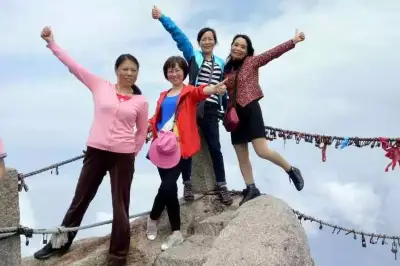
A Journey to Huizhou, the Land of Utter Enchantment
Whenever I open the dusty old photos, the journey of that memory slowly unfolds again, as if I can see myself at that stage. And through years of self-learning, self-growth, and self-reflection, I have come to realize how immature, emotional, simple, and content I was back then. Perhaps it is this simplicity and contentment that has led to my current state of mediocrity. As Taiwanese writer Peng Ming-hui wrote: 'Life is a long-term and continuous process of accumulation.' And as Yun Liya said: 'Enlightenment occurs at a certain height, just like climbing stairs—you need to reach a certain level to see a different view.'
After traveling to many places, meeting many people, and trying many things, if asked what my greatest regret is, it would be reading. I did not read enough when I should have. It was only after wandering and drifting that I gradually realized the importance of reading. Many questions and answers can be found in books, but by the time I understood this belatedly, the opportunity had passed. Life is a journey of self-exploration. Every step counts, and because we cannot foresee or be fully aware, we must cherish the present moment all the more. As Forrest Gump said: 'Life is like a box of chocolates; you never know what you're gonna get.'
No matter what stage of life we reach, we should enjoy that period, fulfill the responsibilities of that stage, neither dwell on the past nor eagerly anticipate the future. Life is fine as it is.
'In this life, I have been utterly enchanted, yet I never dreamed of Huizhou.' This is the immortal verse left by Ming Dynasty playwright Tang Xianzu. And I did not want to leave any regrets either. Although the winter and early spring (November to February) are the seasons with the fewest tourists at Mount Huangshan, you can still pursue the sea of clouds, winter snow, rime, and ice icicles. The best seasons to visit Mount Huangshan are March to May and September to October, when the weather is pleasant—neither too cold nor too hot. However, I chose the summer months of June to August, the peak tourist season, because I wanted to create special memories during a special time. So, in my birthday month of 2012, I embarked on a four-day trip to Huangshan and Hongcun for mountain climbing and leisurely wandering (July 18–21, 2012).
Itinerary: Huangshan — Xieyuda 'Huangshan Maofeng' Tea Company — Tunxi Old Street — Xin'an River Night View — Hongcun
Huangshan: Abbreviated as Hui or Huang, it is a prefecture-level city in Anhui Province. In ancient times it was called Xin'an, Shezhou, and Huizhou. Located at the junction of Anhui, Zhejiang, and Jiangxi provinces, it is known as the 'thoroughfare of three provinces.' It is not only the hometown of Huizhou merchants but also an important birthplace of Huizhou culture. The Xin'an School of Painting, Xin'an Medicine, Huizhou-style architecture, Huizhou Four Carvings, and Huizhou-style bonsai have far-reaching influences. Huizhou opera is the predecessor of Peking opera, and Huizhou cuisine is one of the eight major culinary traditions of China. Mount Huangshan, within the city, is a UNESCO World Natural and Cultural Heritage site. The ancient villages in southern Anhui, Xidi and Hongcun, are World Cultural Heritage sites. It governs three districts: Tunxi, Huangshan, and Huizhou; and four counties: She, Xiuning, Yi, and Qimen. The representative landscapes of Mount Huangshan include the 'Four Wonders and Three Waterfalls.' The Four Wonders are: peculiar pines, grotesque rocks, sea of clouds, and hot springs. The Three Waterfalls are: the Renzi Waterfall, Baizhang Spring, and Jiulong Waterfall. Due to geographical reasons, the mountain is steep, forming a topographical feature of 'majestic front mountain and graceful back mountain.'
'Having seen the Five Sacred Mountains, one has no interest in other mountains; having seen Mount Huangshan, one has no interest in the Five Sacred Mountains.' This was the feeling of Ming Dynasty traveler Xu Xiake after visiting Mount Huangshan twice. And after my visit to Mount Huangshan—'climbing in the rain, watching the sunrise on the mountain, and descending in cool weather'—even my later trip to Zhangjiajie could not compare to the awe I felt at Mount Huangshan.
That time, I booked a self-guided tour on Ctrip. On the first night, I stayed in the old town to prepare for an early start climbing the next day. The weather was unkind, but I still went ahead as planned, rain or shine. However, I changed the ascent plan to taking the cable car up.
After the cable car, it still took several hours of walking to reach the hotel, carrying a backpack with food and clothes for two days. But Mount Huangshan in the rain and mist was still exceptionally beautiful! Tired but happy!
Beginning to Believe Peak (Shixin Peak): 'If you don't reach Beginning to Believe Peak, you don't know the pines of Mount Huangshan.' It is said that a skeptical ancient traveler came here and finally believed that Mount Huangshan was lovely, hence the name. It is 1,668 meters above sea level. It gathers many famous Huangshan pines, including: Welcoming Guide Pine, Black Tiger Pine, Twin Trunk Pine, Dragon Claw Pine, Crouching Dragon Pine, and Sea-Exploring Pine. At the summit, there is a platform where ancient literati often climbed to enjoy the scenery, compose poems, paint, drink, and play the zither, hence it is also known as the 'Qin Terrace.'
Greeting Pine (Yingke Pine): 'If you don't reach the Greeting Pine, you've made a wasted trip.' Only when you reach the Greeting Pine have you truly arrived at Mount Huangshan. Since I climbed in the rain, I had to leave my mark. This pine is at least 800 years old; as shown in the photo, one side of its branches extends outward, as if welcoming visitors from afar. It has become the representative of Huangshan pines and a national treasure. The giant iron painting 'Greeting Pine' displayed in the Anhui Hall of the Great Hall of the People in Beijing is based on its image. It symbolizes a tenacious and resolute pride.
Cooling Villa (Qingliang Bieshu): It is a public reception venue during the peak tourist season at Mount Huangshan Scenic Area.
Stone Inscription: 'Yang Zhi' (仰止). According to research, the phrase 'The high mountain is looked up to; the great road is walked upon' comes from the 'Minor Odes of the Kingdom' in the 'Book of Songs.' It generally means the wedding carriage 'looks up to the high mountain and walks on the broad road,' expressing the joyful mood of the groom. Here, the character '止' is an auxiliary word indicating affirmation.
At night, I stayed in the large dormitory room of a hotel on the mountain. On my birthday, I actually had birthday noodles—instant noodles carried up from the foot of the mountain. It was a special, simple, and meaningful birthday.
According to the weather forecast, the sunrise was around 6:10. People started moving around as early as 3:00. I got up around 4:00, but by the time I arrived, I could no longer find the best spot to watch the sunrise. Early birds need to claim their spots early!
During summer vacation, there were tons of people—truly 'people mountain people sea'!
Bright Summit (Guangming Ding): 'If you don't reach Bright Summit, you don't see the scenery of Mount Huangshan.' Bright Summit is the second highest peak of Mount Huangshan, at 1,860 meters above sea level. It is flat and open, making it one of the best places to watch sunrise and the sea of clouds. Because it is high and open with long sunlight exposure, it is named Bright Summit. The Mount Huangshan Meteorological Station, the highest in East China, is located here.
Monkey Gazing at the Sea (Houzi Guan Hai): In the North Sea Scenic Area, on a flat-topped peak north of Lion Peak, there is a clever stone shaped like a squatting monkey, quietly watching the rolling sea of clouds. It is called 'Monkey Gazing at the Sea.' The peak where this stone is located cannot be climbed by visitors; the best vantage point is at Lion Peak.
Flying-Over Stone (Feilai Shi): Among the peaks at the west end of Pingtian Bridge, there is a huge stone standing on a rock platform. The stone is 12 meters high, 7.5 meters long, and 2.5 meters wide; the platform beneath is 12–15 meters long, 8–10 meters wide, and 1.5–2.5 meters thick, weighing about 360 tons. Its shape is peculiar, with a very small contact area between the two rocks. The upper stone seems to have flown in from beyond the heavens, hence the name 'Flying-Over Stone.' Geologists believe this wonder was formed during geological changes—truly a natural marvel.
Three Penglai Islands (Penglai Sandao): Three small stone peaks of varying heights stand close together. Their tips are like swords, purely stone without soil; on the peaks, peculiar pines stand tall in various shapes. When clouds and mist swirl around, the tips are faintly visible like islands in the sea, and people liken them to the mythical Penglai Fairyland, hence the name 'Three Penglai Islands.'
One-Line Sky (Yixian Tian) at Mount Huangshan: A narrow stone alley formed by two cliffs, with a width of at most 2 meters and at least 0.5 meters. There are over 80 steps in the middle, allowing only one person to pass. Walking inside, looking up at the sky, only a thread of blue sky is visible. Unless it is noon or midnight, the sun and moon cannot be seen, hence the name.
Li Fei from the Qing Dynasty wrote a poem: 'Among the clouds, a stone opens a brocade seam; never allowing slanting sunlight to enter. Who can look up and see the road to the sky? A foot of blue sky, ten thousand feet long.'
At Beginning to Believe Peak, you can see: [Upright Love Pine], [Crouching Dragon Pine], [Black Tiger Pine], [Twin Trunk Pine], [Sea-Exploring Pine], [Child Worshipping Guanyin], [Eighteen Arhats Worshipping the South Sea], [Monkey Gazing at the Sea], etc.
At North Sea Scenic Area, you can see: [Lion Peak], [Flower Scattering Valley], [Dream Pen in Flower], [Twin Trunk Pine], [Crouching Dragon Pine], [Brush Holder Peak], [Jiang Taigong Fishing], etc.
At Xihai Paiyunting Scenic Area, you can see: [Immortal Drying Shoes], [Fairy Playing the Zither], [Offering a Birch and Asking for Forgiveness], [Wu Song Fights the Tiger], [Immortal Walking on Stilts], etc.
At Bright Summit, you can see: [Flying-Over Stone], [Aoyu Peak (Mandarin Fish Peak)], [Alchemy Peak], [Tiandu Peak (Celestial Capital Peak)], [Lotus Peak], [Yuping Peak (Jade Screen Peak)]—including the Eastern Sea Wonders and all the peaks of the Western Sea in full view.
At Yupinglou Scenic Area, you can see: [Greeting Pine], [Farewell Pine], [Accompanying Pine], [Manjusri Terrace], [Yuping Reclining Buddha], [Oxtail Peak], etc. From here, you can get a panoramic view of Tiandu Peak.
At Lotus Pavilion Scenic Spots on the way: [Lotus Peak], [Aoyu Peak], [Turtle and Snake Stones], [Old Monk Watching the Sea], [Hundred-Step Cloud Ladder], [Mandarin Fish Eating Snails], [One-Line Sky], [Mandarin Fish Cave], [Mandarin Fish Carrying Golden Turtle], etc.
Xieyuda is a well-known brand of Huangshan Maofeng tea in Anhui. The Xieyuda brand symbolizes the quality of Huangshan Maofeng. The predecessor of Xieyuda Tea House was 'Xieyuda Tea Firm,' founded in 1875 (the first year of Emperor Guangxu's reign). The founder, Xie Zheng'an, a late Qing tea expert, was recorded in history for creating 'Huangshan Maofeng,' which brought fame to 'Xieyuda Tea Firm.'
Tunxi Old Street: Located in the central part of Tunxi District, backed by mountains to the north and bordered by water to the south. It is 1,272 meters long and 5 to 8 meters wide. It includes one main street, three cross streets, and 18 alleys, with over 300 Huizhou-style buildings built in different periods forming the entire street. White walls, black tiles, horse-head walls, brick carvings, old plaques—a distinct Huizhou style.
Because Tunxi Old Street is located at the confluence of the Heng River, Shuai River, and Xin'an River, it is also known as the flowing 'Along the River During the Qingming Festival.'
Xin'an River Night View
Hongcun: Originally named 'Hongcun' (弘村) because it was expanded into a Taiji-like shape, it was renamed 'Hongcun' (宏村) during the Qianlong reign of the Qing Dynasty. It is a unique ox-shaped ancient village in the peach blossom land of ancient Yi County. It is a representative of Huizhou ancient villages, known as 'the village in a Chinese painting.' First, see the water scenery created by the irrigation system—South Lake and the Moon Pond are the highlights. Second, see the three Huizhou carvings on the buildings: brick carving, stone carving, and wood carving, as delicate as paper-cut. The cultural landscape and natural landscape are well integrated.
The Wang Family Ancestral Hall is a Ming Dynasty ancestral hall built for worshiping ancestors and sages. On the brick carving of the main gate's archway, the two characters '思荣' (Si Rong) are engraved vertically in vermilion. Beside them is a brick carving pattern of 'two dragons chasing a pearl.' Below are four large characters: '世德发祥' (Shi De Fa Xiang).
The Moon Pond (Yue Zhao Lake) is located in the center of Hongcun Village, at the 'stomach' of the ox. It is shaped like a half-moon and commonly called 'Moon Pond' by locals. Built during the Yongle reign of the Ming Dynasty, it lives up to its name, resembling a half moon. In ancient times, the Moon Pond was used for fire prevention, drinking, washing, etc. The lake surface is as smooth as a mirror, always green. The pond is surrounded by bluestone paving, and white walls and black tiles are neatly arranged on all sides. Because this is the place where Zhang Ziyi's character Yu Jiaolong did the water-skimming scene in 'Crouching Tiger, Hidden Dragon,' the Moon Pond is one of Hongcun's most famous attractions.
South Lake (Nan Hu) is located at the southern end of Hongcun, built during the Ming Dynasty with a history of over 400 years. The open water surface is bow-shaped. The painted bridge crossing the lake is where Li Mubai (played by Chow Yun-fat) led his horse across in the film 'Crouching Tiger, Hidden Dragon.'
Summary:
The four-day, three-night itinerary was quite leisurely and comfortable. I bought hiking boots specifically for climbing, which were really useful because the road was slippery from rain, and we walked all the way down. The dried plum vegetable cakes (meigan cai bing) on Tunxi Old Street left a crisp and memorable impression. In addition, on the way to Hongcun, we passed through Zhuangyuan Village (Number One Scholar Village). This trip changed my previous impression of Anhui as poor (my former colleagues and friends all came from poor areas of Anhui). So, you must go out and see for yourself, and avoid making generalizations.
Time occasionally delays life's delivery like a slow mail, turning a thread of memory clear at a certain moment, making the fragments of life beautiful and touching!