A Solo Journey (Part 4) — Exploring Huangshan, Wuyuan, Hongcun, Sanqingshan, Wuyishan, and Guifeng in Ten Days
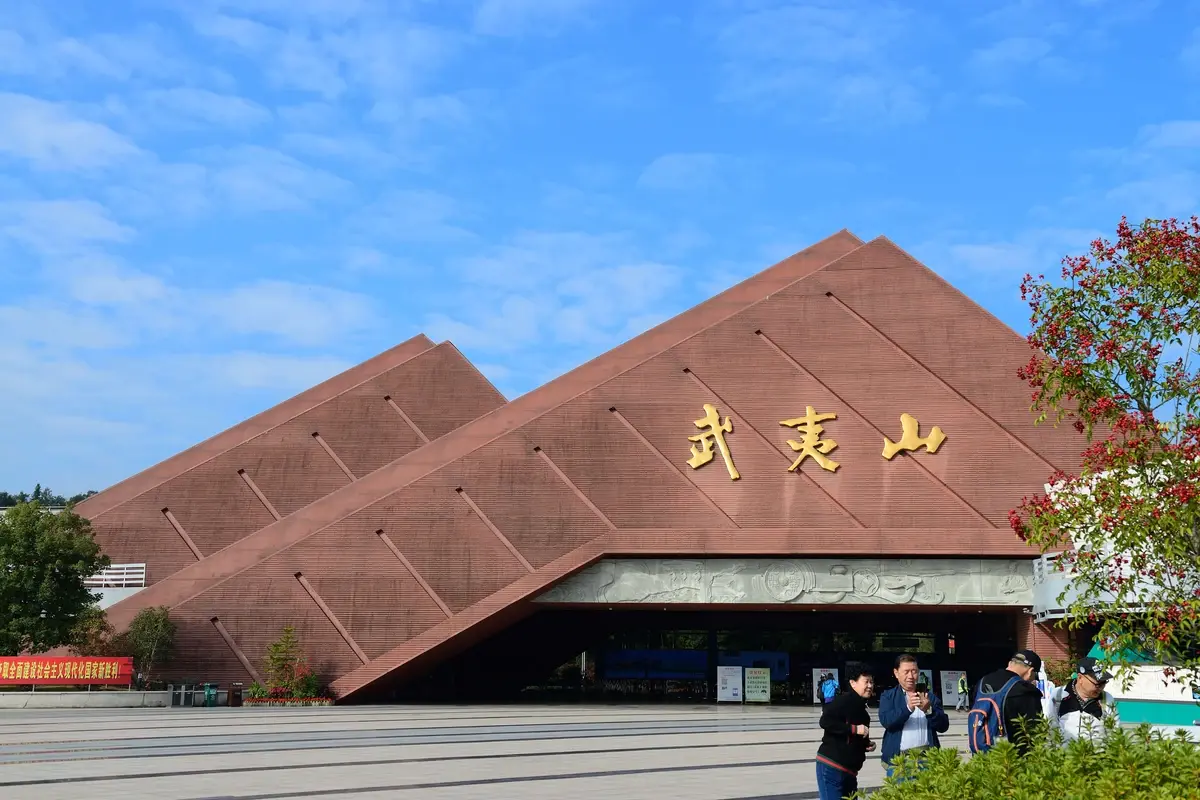
Sunny turning cloudy, temperature 9-14°C. Wuyishan: World Cultural and Natural Heritage, World Biosphere Reserve, National Key Cultural Relics Protection Unit (Wuyishan Cliff Tombs), National Key Scenic Area, National 5A Tourist Attraction, National Nature Reserve, National Water Conservancy Scenic Area, National Ecotourism Demonstration Zone, National Civilized Scenic Tourism Demonstration Site.
Shangrao City and Wuyishan City belong to two provinces, but they are very close—less than half an hour by bullet train (ticket price 24 yuan).
Day 8 (December 1): I didn't have breakfast in Shangrao. I took the 9:20 bullet train and ate after arriving at Wuyishan North Station. Then I found bus No. 7, and 40 minutes later, I arrived at the south gate of Wuyishan Scenic Area. After getting off, I asked the security guard where to stay nearby. He said there were homestays about 500 meters to the right.
I walked a few hundred meters, didn't see any homestay, but found a mountain villa. I asked at the front desk; the room was 260 yuan per night. I said it was a bit expensive. The receptionist said she could give me the best price of 180 yuan, including a rich breakfast. I said okay.
At 10:30, I bought a ticket at the scenic area (half-price ticket 90 yuan, including scenic area transportation) and entered. The Wuyishan Scenic Area covers 35 square kilometers, with scattered attractions. You must take the scenic area shuttle bus to reach them. There are transfer points at each attraction; just tell the staff where you want to go, and they will tell you which bus to take. It's quite convenient.
There was a text in elementary school that said, "If you haven't climbed Tianyou Peak, you can't say you've been to Wuyishan." Tianyou Peak is the most dangerous peak in Wuyishan. The first attraction I visited was Tianyou Peak.
From the south gate departure station, I took the scenic bus for over 10 minutes to reach the Tianyou Peak transfer point.
After getting off, I walked a bit and came to a bridge. Under the bridge was clear stream water teeming with dense fish—some large, about 4-5 jin, some small, finger-sized (later I learned they are called red-eye fish). A few bamboo rafts full of tourists drifted from afar, occasionally accompanied by cheers.
The whole way was uphill, with many attractions along the road: Wuyi Jing She, Cloud Nest, Tea Cave, etc. After more than 20 minutes, I arrived at the foot of Tianyou Peak. Looking up, I saw layers of stone steps, winding and twisting, all the way to the top—reportedly over 900 steps. Before I even started climbing, my legs were already trembling slightly.
A young couple came down from the mountain. The man was carrying a 2- or 3-year-old child. I thought it was difficult for me empty-handed; how did they manage to carry the child up?
I slowly climbed up. About one-third of the way, there was an observation deck near the cliff. Leaning on the railing and looking around, I saw strange peaks standing tall, winding and meandering. Bamboo rafts drifted lightly on the Nine-Bend Stream. The mountains and waters of Wuyishan were all in view, refreshing my mind and heart.
The steeper it got, the more I climbed. In many places, it was at a 90-degree angle. Tourists had to hold the handrails tightly to avoid falling.
Sweating profusely, I finally reached the peak. At the top was Tianyou Temple, with a small shop and a tea room, and it seemed there was a restaurant as well. Behind the temple was a large red bean tree, with small red beans scattered on the ground. On the cliff at the peak, there were many cliff inscriptions from past dynasties, the largest being "First Mountain."
After resting a few minutes, I prepared to descend. It turned out there was a relatively gentle path behind the mountain, just a bit longer (the child must have been carried up this way).
I don't know if the management was brain-dead, but the steps on this path were potholed and uneven; one could easily sprain an ankle if not careful.
I concentrated as I walked down. Ahead, an old man was enjoying himself, singing as he walked. But I dared not get distracted; I couldn't understand a single word. After dozens of minutes, I returned to the transfer point.
I told the staff I wanted to go to Yixiantian (One Line Sky). But the staff pointed me to the wrong bus, and by some twist of fate, I ended up at the Nine-Bend Stream Bamboo Rafting point (I hadn't planned to raft).
There were many food stalls here. I saw it was already past 1 o'clock, so I decided to eat first.
I chose a shop and ordered one dish and one soup. The owner asked if I had been rafting on the Nine-Bend Stream. I said I didn't want to. She said, "If you don't go, you'll definitely regret it." I asked why. She said many attractions are along the Nine-Bend Stream and cannot be seen from the shore. Some also say that if you haven't rafted the Nine-Bend Stream, you haven't been to Wuyishan. Hearing this, after eating, I quickly bought a ticket for 130 yuan.
Another brain-dead scenic spot: the ticket office was a full kilometer away from the bamboo raft pier. I dragged my sore feet and cursed all the way. Each bamboo raft seats 8 people; you have to wait until it's full.
I waited a while until 8 people gathered: me, a young couple, and the rest were middle-aged and elderly folks. All the uncles and aunties were from Beijing, traveling together in several families. The old man who was singing on Tianyou Peak was also among them. I asked him what song he was singing in the morning. He said he was just humming. I said I didn't understand a word, and everyone laughed again.
They recommended me to be the "platoon leader." I said, "I've been promoted twice in three months, but I'm still a platoon leader and can't become a company commander," which made everyone laugh. The bamboo raft was poled by two men, one old and one young. Some rafts had one man and one woman, probably a couple.
The old rafter was very humorous. He briefly introduced the attractions along the shore: here was a filming location for Journey to the West; here was "Three Represents," "Frog with a Laughing Chin," "Hamburger," etc.
There were many attractions on both banks, most of which really couldn't be seen from the shore. They were indeed the essence of Wuyishan. We could also see cliff burials, said to be over 3,000 years old. Good thing I listened to the owner, or I would have regretted it.
The bamboo raft drifted to Jade Maiden Peak. Jade Maiden Peak and Great King Peak faced each other from afar, like a pair of affectionate lovers. The old rafter humorously said, "The eldest and the Great King are lovers, and she is pregnant; the second loves to look in the mirror, vain; the third loves to wear flowers, likes to be the 'other woman.'" This triggered another round of laughter.
The bamboo raft continued drifting to the First Bend, ending the 1-hour-40-minute Nine-Bend Stream bamboo rafting.
After landing, walking up a short distance, I reached Song Street. I couldn't tell if it was ancient or modern architecture. Continuing inward, I arrived at Wuyi Palace.
Inside, there were two supposedly 800-900-year-old osmanthus trees, but I thought if they were really 900 years old, they were definitely malnourished. Haha.
After visiting Wuyi Palace, it was nearly 3 PM. The last scenic bus was at 5 PM, so there was still over an hour left—perfect for visiting Yixiantian.
I hurried to the transfer point and took the bus to Yixiantian. After about 10 minutes, I arrived at the Yixiantian transfer point. Then I walked another 4-5 minutes to reach Yixiantian.
Yixiantian is the most peculiar cave in Wuyishan, known as "the wonders of nature." Outside the cave, it said: "Yixiantian is over 100 meters long, with the narrowest part only 30 cm," warning visitors to gauge their size before entering.
I noticed that almost every scenic area has a Yixiantian, but they are all different. Some are only 10-20 meters long. Few are as long as Wuyishan's or as steep as Sanqingshan's.
Entering the cave, the light was dim. I followed the stone steps upward. In the depths, looking up, I saw a crack in the rock ceiling, as if split by a sharp axe, letting in a ray of light. When I reached the narrowest part, I used both hands and feet, turned sideways, and my backpack and water bottle clanged against the walls.
Since the shuttle buses were about to stop running, there were very few visitors at Yixiantian. I walked a bit fast; no one followed behind, and no one was ahead. Trapped in the pitch-dark crevice, I felt helpless and helpless, really afraid of getting stuck. My heart was quite panicked (people with heart conditions should never try this). Eventually, I squeezed through and felt relieved all over.
I wanted to see if the people behind me were the same, so I waited a few minutes. A girl in her 20s crawled out. I asked, "How did you feel?" She said, "If it had been a bit longer, I might have committed suicide. It's too terrifying alone in there." We waited another 2-3 minutes, and a young man crawled out, gasping for air. He said, "I almost got stuck in there; it was so scary." I asked his weight. He said nearly 150 jin. If he were 160 jin, he might not have made it out. He said crying to heaven and earth wouldn't help inside; thinking about it still scared him. We all felt like survivors of a disaster.
With not much time left before the last shuttle, I hurried down to the transfer point and took the bus back to the south gate.
I heard Old Street had many restaurants, so I went there for dinner. I found bus No. 6 and rode 3-4 stops to get there.
After dinner, I returned to the hotel and continued planning my itinerary. I thought: I've been out for 7-8 days now. The epidemic prevention and control were getting stricter; airports, scenic spots, and stations all required masks, temperature checks, and health code scanning. For safety, I decided to go back first. How to go back? Flying was troublesome; high-speed trains were hard to sit on; I might as well take a special express sleeper. I checked 12306 and found a train departing from Yingtan at 6 PM and arriving in Nanning around 8:20 AM the next day. I immediately booked the ticket (280 yuan). Tomorrow I would continue to visit other attractions in Wuyishan.
Day 9 (December 2): As the staff had said, breakfast was quite rich, with over a dozen varieties. Because of epidemic prevention, each person sat alone at a table, and each variety was a single portion, so the table was completely full.
After breakfast, I stored my luggage at the scenic area's small shop and took the shuttle to Huxiao Rock (Tiger Roaring Rock). I arrived quickly. A tour group of dozens of people came along.
Huxiao Rock got its name from a legend that an immortal once rode a tiger and roared on the rock. Actually, there is a huge cave on the rock; when the wind passes through the cave, it makes a sound similar to a tiger's roar. Main attractions include Tiancheng Buddhist Temple and the Eight Scenes of Huxiao, scattered around the rock. Climbing up Huxiao Rock, there is a Hero Slope that is quite steep; you have to rely on the iron chains beside it to ascend.
Continuing to the top of the rock, a side path led to Dingming Bridge. Dingming Bridge spans a rock crevice only two or three meters wide. On the nearby stone wall, the words "Dingming Bridge" are engraved.
Returning from "Dingming Bridge" and going down, the steps were very steep, much like descending stairs.
Halfway down the mountain, a large group of beautiful pheasants were foraging in the woods, occasionally chirping.
After passing Yu'er Spring (Baby's Talk Spring), the path became gentler, and I soon arrived at Tiancheng Buddhist Temple. This temple is not large, built under the cliff of Huxiao Rock, without a single tile yet sheltered from wind and rain.
After passing Bulangzhou (Not a Wave Boat), I started descending again. Mid-mountain, there was a tea plantation; two tea farmers were working. I asked, "Sir, what kind of tea is this?" One replied, "This is Wuyi Rougui (Wuyi Cinnamon)." Good tea, of course not the spice cinnamon.
At a fork, one path led to the Wuyi Rock transfer point (where I got off), and the other led to the Jade Maiden Peak transfer point. I asked a cleaning lady sweeping the road which path was faster. She told me to take the one to Jade Maiden Peak transfer point because more buses passed by, making it easier to catch one. I followed her advice and walked about 20 minutes down to the transfer point.
I originally planned to visit Dahongpao (Big Red Robe) Scenic Area, but I heard there wasn't much to see and it was far, so I gave up.
At 10:30, I returned to the south gate, picked up my luggage, and immediately took bus No. 7 to Wuyishan High-Speed Rail Station.
Since I had to wait until 6:10 PM the next day to board the train, I might as well use the morning to visit Yiyang Guifeng (Turtle Peak).
I bought a bullet train ticket from Wuyishan to Shangrao (36 yuan), then a train ticket from Shangrao to Yiyang (12 yuan). At 1:30 PM, I arrived in Yiyang.
It was too late to go to Guifeng that day, so I found a hotel near the train station (80 yuan/night). I asked the landlady what interesting places there were. She replied, "In the county, there is the Fang Zhimin Martyrs' Memorial Hall, which you can visit."
Yiyang county is not big. From the train station, take the bus for over 10 minutes to reach the memorial hall.
The memorial hall is a Chinese patriotic education base, documenting the fighting life of martyr Fang Zhimin. Hundreds of students were visiting, reciting in unison an excerpt from Fang Zhimin's "Qingpin" (Innocence). It was my first time reading "Qingpin" and "Lovely China," and I was deeply moved. These are the great contributions of revolutionary martyrs to the liberation of the Chinese people and the communist cause.
Back at the hotel, I said to the landlady, "Tomorrow I need to leave very early. Could you please take care of my luggage? Also, when I come back, could you give me a room to take a shower?" She said, "No problem. Go and enjoy yourself."
Peering at Guifeng Through Thick Fog
Overcast, temperature 9-14°C. Guifeng: National Scenic Area, National AAAAA Tourist Attraction, National Forest Park, National Patriotic Education Base. It is known as "Guifeng on the River, Rare under Heaven" and "Natural Bonsai." Every mountain resembles a turtle, every stone resembles a turtle. It is one of the filming locations for the TV series "Journey to the West."
Day 10 (December 3): I woke up at a little after 6 AM, ate instant noodles, then went to the bus stop near the train station, waiting for the first bus to Guifeng.
Around 7 AM, a man in his 30s came up and asked if I was going to Guifeng. I said yes. He told me to follow him. After walking about 100 meters, he handed me over to the first driver. I was so lucky to meet such a good person (I met many good people on this trip). Because the real departure station was here; the bus went directly to Guifeng from here, and only passed my original stop on the way back, which would have meant waiting an extra 2 hours.
Few people rode the bus in the morning. After more than 40 minutes, the bus arrived at Guifeng Scenic Area.
A few minutes later, the scenic area staff started work.
I bought a ticket (100 yuan), and the staff told me to take the sightseeing car into the scenic area. I found the boarding point alone. The driver was eating breakfast, so I paced around the car. When the driver saw me, he invited me into the car and started the sightseeing car.
Along the way, there were many peaks resembling red giant turtles. After passing an artificial lake, we arrived at the entrance gate of Guifeng Scenic Area, where two giant turtles stood tall on both sides, warmly welcoming visitors. This is called "Double Turtles Welcoming Guests."
To enter the scenic area, I had to pass through "Suochun Cave" (Lock Spring Cave), a natural cave (capable of holding thousands of people). Above the cave entrance was a pavilion called Zhanqi Pavilion (Flag Unfurling Pavilion).
After passing through "Suochun Cave," there was a whole new world. Crossing a small square, I reached the foot of the mountain, surrounded by bamboos.
I climbed up the walking path step by step. A large camphor tree came into view; it would take 7-8 people to embrace it, and it was over 1,000 years old.
Looking up to the left, Old Man Peak appeared faintly in the thick fog. I silently prayed that it wouldn't be like Huangshan.
I arrived at the magical Wusheng Spring (Silent Spring), where the water flowed silently all year round.
From Wusheng Spring to Yixiantian, there were many cliff inscriptions on the precipice, the largest being "Guifeng."
Continuing upward, neighboring attractions like Old Man Peak and Eagle Playing Chicken changed with different angles. Looking closely, the head of the Old Man Peak was connected to the body by only three support points, formed by eons of natural weathering. I couldn't help but admire the wonders of nature.
Further up were Sandieyan (Threefold Rock), Yixiantian, etc. This section was relatively gentle. Plus, I had bought nail clippers last night and trimmed my toenails, so I walked smoothly.
At Sisheng Valley (Four-Sound Valley), the stone wall was engraved with three large characters "Sisheng Gu." If you shout in the valley, you can hear four wonderful continuous echoes. I shouted a few times but only heard three echoes; the fourth might have been scared away. Above, in a stone cave, there was a large bell. It said something about striking it three times for some effect. I didn't believe in superstitions and struck it eight times. The bell sound traveled far, with lingering echoes.
After passing General's Tower, it was all uphill climbing. Halfway up the mountain, there was a service area selling food and drinks. From here, a left path led to Camel Peak Scenic Area. The fog was getting thicker; visibility was less than 50 meters. Distant scenery was blurry.
Scenic area staff were also climbing the mountain. I continued climbing.
After about 20 minutes, I reached the mountaintop. The walk from the scenic gate to the top took about 1 to 1.5 hours.
At the top, thick fog rolled, accompanied by light drizzle, making everything hazy and illusory.
On a slightly flat col, there was a small shop. The owner saw me climbing up in the rain and quickly brought out a stool, found a sheltered spot, and asked me to sit and rest.
I chatted with her about various things. I asked how she got the goods up here. She said she carried each box up herself. I said, "You're amazing." She said it was for a living. After a while, another cleaning aunt came up. I asked how many times she cleaned each day. She said once in the morning and once in the afternoon. I asked her monthly salary; she replied 1,700 yuan. I said it was too little. She said, "It can't be helped; it's also for a living."
After waiting about 40 minutes, the thick fog showed no sign of clearing. I went to see attractions like Tianwailaike (Visitor from Outer Space) and Nantian Yizhu (Single Pillar of the Southern Sky), but they were all obscured by fog. I returned to the small shop. The owner said, "Someone just went up to Golden Bell Peak; you can also take a look."
I climbed to the observation deck of Golden Bell Peak. A few people who had arrived earlier were already descending. Standing at the highest point, looking down the mountain, it was a vast whiteness; looking around, the peaks were completely shrouded in clouds and fog.
I had to get to Yingtan in the afternoon to catch the train, so I couldn't wait any longer. After a brief look at Golden Bell Peak observation deck, I headed down the col.
At the col, there were two paths. The left one was the one I had come up. The right path led to Hero Slope and Camel Peak. I took the right path downward. It was a shortcut, closer to the foot of the mountain, but also steeper and more difficult.
I walked to the Eighteen Arhats rest point. The fog was slowly dissipating. In the distance, Camel Peak, Eighteen Arhats, Zhanqi Peak gradually emerged.
At Hero Slope, the fog had completely dispersed. Guifeng finally revealed its true face. But I regretted not having time to go back to the mountaintop to see it.
I exited "Suochun Cave" and arrived at the boarding point. A few tourists were already on the sightseeing car. I got on; it was still the same driver from the morning. He greeted me and drove to the scenic area gate.
Just before reaching the gate, the driver asked if we had visited Qingshui Lake. We said no. The driver stopped the car and said, "From here, it's the pier." I asked how long the lake tour took. He said about 20 minutes round trip. It turned out that our tickets included a boat ride.
After walking over a hillside, we reached the boarding point. The staff immediately arranged for us to board a boat. We enjoyed a different perspective of Guifeng from the lake.
The boat occasionally startled flocks of Chinese mergansers.
After 20 minutes, we returned to the scenic area exit, ending our visit to Guifeng.
In the afternoon, I took a high-speed train from Yiyang to Yingtan. At 6:10 PM, I boarded the express train to Nanning. On the morning of December 4, I safely returned to Fangchenggang, successfully completing my ten-day trip.
Time: 10 days. Distance: over 4,500 kilometers. Expenses: 4,000 yuan.
Route: Crossing 4 provinces (Zhejiang, Jiangxi, Anhui, Fujian).
Attractions: 4 mountains (Huangshan, Sanqingshan, Wuyishan, Guifeng) and 4 villages (Hongcun, Chengkan, Huangling, Likeng).
Transportation: Airplane, bullet train, high-speed train, regular train, car, small train (track), electric sightseeing car, bamboo raft, etc.
Gains: Enjoyed magnificent scenery, experienced worldly affairs.
Friendly reminders: Make friends widely; more friends, more paths. ID card, mask, mobile phone are indispensable, otherwise you can't move. Prepare a simple itinerary in advance to avoid detours. Bring a thermos in winter to have hot water anytime. In peak season, book a hotel in advance to avoid sleeping on the street.
December 29, 2020, in Fangchenggang