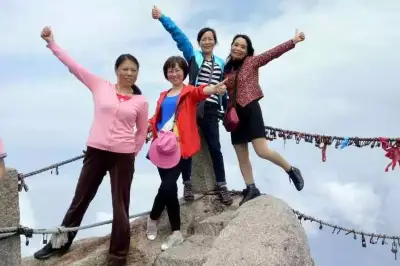
Autumn Trip to Huangshan
At noon on October 18, we arrived at Tangkou Town at the foot of Huangshan and checked into the City Convenient Hotel opposite the Huangshan Scenic Area Transfer Center. We chose this hotel mainly for the convenience of taking the bus up the mountain early the next morning. The rooms at the back of the hotel were spacious, very clean, and reasonably priced.
I had visited Huangshan in 1994 and 2005, but both times I took the cable car up. This time we planned to hike up, but the weather seemed to be playing tricks on us. In the afternoon, it actually started to rain, and we felt a little heavy-hearted. Would the next day's climb be affected?
On the morning of the 19th, we woke up to an overcast sky that hadn't cleared yet. A little after 8, we had breakfast at the restaurant downstairs, left our large luggage at the front desk, and each carried a backpack filled with Mi Lao Tou snacks, cookies, chocolate, mineral water, umbrellas, disposable raincoats, extra clothes, and other provisions. Each of us also took a hiking pole and walked across to the Huangshan Scenic Area Transfer Center to take the bus up the mountain. Although it wasn't a peak holiday period, there were still quite a few tourists. We queued up and soon boarded the bus and set off.
To go up the mountain, people generally enter through the South Gate of Huangshan. One route is from the Mercy Light Pavilion in the front mountain to Jade Screen Tower. This route is steep and the mountain path is difficult to walk. The other route is from Cloud Valley Temple in the back mountain to White Goose Ridge. This route is gentler and more people choose it. Both routes have cable cars to go up the mountain. From the scenic area transfer center to Cloud Valley Temple or Mercy Light Pavilion, you need to take the scenic area shuttle, and then either take the cable car or hike up.
From the transfer center to Cloud Valley Temple, it's about 11 kilometers of mountain road, and we arrived shortly. Although it's called Cloud Valley Temple, the actual temple has long been destroyed and no longer exists. It is just the ticket checkpoint for hiking up and the Cloud Valley Cable Car upper station. Nearby there is also a Huangshan Geopark Museum. All the tourists who came on the same bus went to the cable car station to ride the cable car. Only our family of three chose to hike up.
From Cloud Valley Temple to White Goose Ridge, the scenic spots along the way include Immortal Overturning Table, Entering the Scenic Pavilion, and Immortal Pointing the Way. Due to the rainy and foggy weather, the distant scenery was faintly visible. According to the guide map, this section is about 3 kilometers, but since it's all stone steps and some sections are steep, we felt a bit strained carrying our backpacks. However, when we saw the porters carrying heavy loads and trudging up with difficulty, we thought, what is our little luggage compared to that! Back in the day, when Xu Xiake climbed Huangshan, 'the path wound between rocks, blocked places were chiseled, steep places were stepped, broken places were bridged with wood, and sheer places were connected with ladders.' Compared to them, we are already very comfortable! We took breaks along the way, not forgetting to enjoy the autumn scenery of Huangshan. The higher we went, the thicker the fog became. When we reached White Goose Ridge, it was already past noon, meaning it took us over three hours to walk from Cloud Valley Temple to White Goose Ridge. By cable car, it would have taken only 12 minutes.
Once at White Goose Ridge, the number of tourists increased significantly, and it was very lively. These tour groups had come from the cable car station. The nearby attractions at White Goose Ridge include Black Tiger Pine, Couple Pine, Harp Pine, Stone Shoot Ridge, and Beginning to Believe Peak. We had booked the Xihai Hotel, which was about 2 kilometers away, so we decided to visit some of the sights along the way. However, due to the heavy fog, we couldn't see Stone Shoot Ridge or Beginning to Believe Peak, so we decided to come back the next day.
Around 4 p.m., we arrived at the Xihai Hotel and had a buffet dinner there. We asked the hotel manager about the sunrise time, which was around 6:30 a.m. The night on the mountain was very cold, with temperatures dropping to around 3 degrees Celsius.
On the morning of the 20th, at 5 a.m., I was woken up by the alarm clock. I pulled open the curtains and saw that it was pitch black outside. When I shone a flashlight, I saw that the rain had completely stopped. What a blessing from the weather! We quickly put on the down jackets provided by the hotel and hurried out. The road was very dark, so we carefully walked forward using only the beam of the flashlight, trotting towards Cool Terrace against the cold mountain wind. After passing Beihai Hotel and Shilin Hotel, we heard some people talking in the distance and saw the sky getting brighter. We were worried about missing the sunrise.
After walking about 2 kilometers, we finally arrived at Cool Terrace. By then, a dense crowd of people had already gathered on the terrace, all arriving earlier than us. We found a good viewing spot and looked east. At that moment, on the distant black mountain peaks, a golden ribbon appeared, and the sky gradually turned yellow and bright. In an instant, a red sun burst forth, shooting thousands of golden rays onto the summit of Huangshan, gilding the mountains in a brilliant golden hue. What an exciting moment! Joy was written on everyone's face. Cool Terrace hangs on a precipitous rock with three sides exposed. Below is the vast and misty 'Back Sea,' and to the east is the 'Number One Marvel of Huangshan,' Stone Shoot Ridge, with its jagged stone pillars standing in disarray—the 'Eighteen Arhats Paying Homage to the South Sea' truly captivating!
Afterwards, we climbed the extremely steep Lion Peak, where 'Monkey Gazing at the Sea' was vividly lifelike. The vast sea of clouds unfolded before us like a fantastical natural painting. Descending from Lion Peak, we admired 'Wonderful Brush Producing Flowers,' and then climbed to the top of Beginning to Believe Peak. There, we saw exquisite natural rock formations and pine trees of various postures. Truly, 'If you don't go to Beginning to Believe Peak, you haven't seen Huangshan pines!'
Returning to the hotel for breakfast and checking out, we continued on to the West Sea Grand Canyon. That night, we had booked the Baiyun Hotel near Bright Summit Peak and planned to spend the day visiting Flying Stone, Echo Wall, Cloud Discharging Pavilion, and the West Sea Grand Canyon.
Echo Wall is about 2 kilometers from Xihai Hotel, along flat stone steps but with some slopes. Perhaps because we had climbed all day yesterday, our legs were somewhat tired, but we persisted towards our goal! Echo Wall is a huge cliff on the opposite side of a valley, standing steep as if cut. It is said that if you shout loudly facing the cliff, the echo will resound through the valley. Walking further, we saw from a distance a huge stone standing obliquely on a peak—this was the famous Flying Stone. When we arrived at Flying Stone, there were not many tourists, so we climbed up to the stone. The inclined side of the huge stone faces a bottomless abyss, making it terrifying to stand on the edge!
From Flying Stone, we descended and arrived at Cloud Discharging Pavilion around noon. There were no restaurants or shops along the way to replenish water or food, so we could only eat the provisions we had brought. Cloud Discharging Pavilion is truly a great place to enjoy the scenery. Leaning on the railing and looking out, we could see wondrous sights such as 'Immortal Drying Boots,' 'Fairy Embroidering,' and 'Wu Song Fighting the Tiger' vividly before us. Further ahead, we began to enter the West Sea Grand Canyon. Since hiking to the bottom of the canyon is a one-way trip of about 3 kilometers, all on plank paths along cliffs, very steep, requiring both courage and sufficient stamina, the number of tourists immediately decreased. The canyon has steep cliffs and deep ravines, with many peaks standing tall. Only by experiencing it in person can one truly appreciate the grandeur of the canyon! If I must describe the scenery of the canyon, the adjectives that come to mind are steep, peculiar, and magnificent.
We reached the bottom of the canyon a little after 4 p.m., and our physical strength was almost exhausted. So we took the West Sea sightseeing cable car (small train) up to Tianhai Scenic Area. From the cable car station to the Baiyun Hotel was about a 10-minute walk. Along the way, we saw Turtle Peak from afar. Under the glow of the sunset, the scene of 'Turtle Riding on a Turtle' was clearly visible. That night, we stayed at Baiyun Hotel. The Chinese-style hot pot buffet in the restaurant had a rich variety, which helped us replenish our energy.
The climate of Huangshan in late autumn is still very changeable. On the morning of the 21st, I pulled open the curtains and found that it was raining again, with thick fog all around, obscuring everything. This is how it is when visiting Huangshan—you really have to rely on luck. Fortunately, the weather was good yesterday, and we were able to see the sunrise, sea of clouds, peculiar pines, and strange rocks. Heavenly Capital Peak was still closed for the season. Today we planned to climb Bright Summit Peak and Lotus Peak, then go to Welcoming Pine, and finally take the Jade Screen Cable Car down the mountain. We hoped the rain wouldn't disrupt our plans too much.
From Baiyun Hotel to Bright Summit Peak is about 500 meters, not far, but it requires climbing stone steps. After breakfast, the light rain continued to fall. We put on disposable raincoats and carried umbrellas to head to Bright Summit Peak. Bright Summit Peak is in the central part of Huangshan, at an altitude of 1,841 meters, making it the second highest peak of Huangshan. Rainy days tend to form seas of clouds. Standing on the summit, we saw the peaks of the 'East Sea' and 'West Sea' all hidden in the clouds and fog, appearing and disappearing, like a celestial scene, a magnificent spectacle.
Descending from Bright Summit Peak and heading southwest for half an hour, we arrived at Turtle Peak. The number of tourists here was noticeably larger, probably tour groups that had come up via Jade Screen Cable Car that morning. We descended through the narrow and steep 'One Line Sky' and reached Lotus Pavilion around noon. There we ate the provisions we had brought as lunch, rested a bit, and then continued upward. From here, there are two routes to Welcoming Pine: one via Jade Screen Peak and the other via Lotus Peak. We took the direction of Lotus Peak. Passing through Lotus Cave required climbing close to the rock face. The narrow stone steps were at a 60-degree incline, with a cliff on the left and a bottomless abyss on the right. Clouds were drifting beneath our feet, making our hearts tremble with fear!
After passing Lotus Cave, going upward leads to the main peak of Lotus Peak. Lotus Peak, with an altitude of 1,860 meters, is the highest peak of Huangshan, steep and majestic. However, due to the rain making the paths slippery and the thick fog, climbing it posed some danger, so we gave up on ascending the main peak and went directly to Welcoming Pine Scenic Area. After walking about 2 kilometers, we arrived at Jade Screen Tower Hotel, which is near Jade Screen Cable Car. The number of tourists here was much larger. Not far from the hotel is the famous Welcoming Pine. The tree grows out of a rock, extending its branches as if welcoming guests. It is said to be over a thousand years old. All tourists stop here to take photos.
Around 4 p.m., we took the Jade Screen Cable Car down to Mercy Light Pavilion and checked into the nearby Huangshan Workers' Sanatorium. In the evening, we visited the famous Huangshan Hot Springs to soak, washing away the fatigue of the climb. On the morning of the 22nd, we left Huangshan and took a bus to Hongcun and Xidi.