Grandparents See the World Series—From Tiantai, Zhejiang to the Cradle of Huizhou Culture in Southern Anhui
On October 20, 2020, the grandparents drove from Shanghai to Tiantai, Zhejiang, passing through Yiwu and entering southern Anhui. They focused on visiting Hongcun, Xidi, the Xin'an River Landscape Gallery, Huizhou Ancient City, the Huangshan Scenic Area, and Taiping Lake around Mount Huangshan, and traversed the Southern Anhui Sichuan-Tibet Line, returning to Shanghai smoothly on October 30.
Follow our footsteps and travel with us.
On October 20, the weather was sunny. Left home at 9:10 AM and headed straight for Tiantai, Zhejiang.
Arrived at the Jiashao Bridge Service Area at 11:00 AM, bought two Jiaxing meat zongzi for lunch.
Departed again at noon, traveling via the Shanghai-Kunming Expressway and Changtai Expressway, and checked into Tiantai Taihe Kaiyuan Hotel at 2:00 PM. The journey took about 4 hours, covering 294.7 km, with a toll of 154.53 yuan.
Tiantai Taihe Kaiyuan Hotel is a very good local hotel. This was our second stay; the service and facilities were excellent.
This was our third visit to Tiantai. We had already been to many surrounding attractions, so this time we mainly visited Guoqing Temple, taking it easy.
After a short rest, we went to Shifeng Lake Wetland Park, 4.6 km away.
The park is free and open, with free parking nearby.
The Rufeng Stream, flowers, grass, trees, the arched bridge spanning both banks, the building visible through the main bridge arch, and two couples taking wedding photos—all looked especially beautiful under the setting sun.
For dinner, we went to "Tuzao Tou" again. A popular restaurant with great value for money.
Returned to the hotel to rest.
October 21 was cloudy. After breakfast at the hotel,
we went to Guoqing Temple at 9:00 AM to offer incense. Parking cost 10 yuan (last year it was free).
Walking ahead, we saw the Bao'en Pagoda. The rice was ripe in the fields. A monk from the temple was working in the fields—it seemed the rice fields belonged to the temple.
Guoqing Temple, a thousand-year-old ancient temple, maintains its original style from the entrance to all the main halls. It truly lives up to being the founding place of the Tiantai sect, staying true to its original purpose: no entry fee, no fortune-telling, and the vegetarian lunch costs only 2 yuan.
We bought incense and candles and walked around inside and out. Sure enough, we saw rice drying in the corridors. Admirable!
After leaving the temple, we went to see the building we had glimpsed through the bridge arch yesterday—the Tiantai County Government Building.
It was quite grand. The local economy seemed relatively developed.
We returned to the hotel almost at 1:00 PM.
Checked out at 2:00 PM and set off for Yiwu.
Took the Yongjin Expressway and Changtai Expressway to Yiwu, stopping briefly at Dongyang Service Area. 142.9 km, toll 57.95 yuan. There were many vehicles at the Yiwu expressway exit. The roads were very busy after getting off the expressway.
Arrived at Yiwu Weiduo International Hotel at 4:30 PM.
From the 20th floor of the hotel, we could see many areas under construction in Yiwu.
For dinner, we found a restaurant called "Gebi" (Next Door) near the old small commodities market. Home-style cooking, decent.
After returning to the hotel, we strolled to the nearby Changchun Night Market. Compared to Shanghai, prices were relatively cheap.
October 22 was still cloudy. Breakfast was on the 21st floor.
The 26th China Yiwu International Small Commodities (Standard) Fair was being held from the 21st to the 25th. We drove to take a look. Traffic around the venue was okay; we parked on a small side street about 200-300 meters away, where there were free parking spaces marked on the ground. Since we didn't have tickets for the fair, we could only look from outside and couldn't enter.
We went to the Yiwu International Trade Center District 1 (small commodities market). It was indeed huge—it took half an hour to walk from one end to the other. It mainly deals in wholesale, with a few shops doing retail.
Returned to the hotel and checked out.
Headed to Tunxi, Huangshan. Resting and eating at Lanxi Service Area, refueling at Kaihua Service Area, we arrived at Huangshan International Hotel at 4:30 PM. Total distance 276 km, toll 116.49 yuan.
This five-star hotel is located by the Heng River and has hosted national and foreign leaders. Now it costs only 322 yuan per night including breakfast, great value.
When we left at around 5:00 PM, it was almost dark.
A three-wheeled motorcycle outside the hotel gate pestered us, offering a ride to Tunxi Old Street for 3 yuan.
The old street is a national key protected unit, the most complete ancient street in China with architectural styles from the Southern Song, Ming, and Qing dynasties. The entire old street is shaped like a fishbone, connected to the landscape by three roads and 18 alleys. The buildings inherit the unique Huizhou architectural style, with elegant and simple colors, staggered structures, stone-paved streets, small black tiles, and white horse-head walls, adding a sense of layering.
There are many museums on the old street, as well as key cultural relics protection units such as Wancui Tower, Cheng's Three Residences, the Site of the Southern Anhui Special Committee of the Communist Party of China, and Tongde Ren Pharmacy.
Shops on both sides mainly sell the Four Treasures of the Study and local specialty products.
Of course, there are also Huizhou snacks and many restaurants.
We found a highly-rated restaurant called "Image Huizhou." The owner was very friendly, and dishes could be ordered in half portions—not bad.
We strolled around the street, bought some local specialties, and returned to the hotel.
October 23 was sunny. After breakfast at the hotel, we went out. The Heng River Bridge in the sunlight caught our attention—nice, right?
Drove along G205 to Hongcun. Along the way, the Huizhou-style scenery under the blue sky, whether in urban or rural areas, felt clean, tidy, and orderly.
Passed by Xiuning Gongbei Covered Bridge, where there was a parking spot. Stopped to take photos. Clear streams, yellow and white chrysanthemums, green tea plants, and the covered bridge formed a beautiful picture.
The rice fields beside Tacun Village brought us another surprise.
We arrived at the Hongcun parking lot at 11:30 AM, stopping frequently along the way.
Visitors over 65 are exempt from tickets; you can enter the village directly with your ID card.
When visiting Hongcun, a World Cultural Heritage site, you mainly look at the water features from the irrigation system—South Lake and Moon Marsh are the highlights—and the three types of Huizhou carving on buildings: brick, stone, and wood.
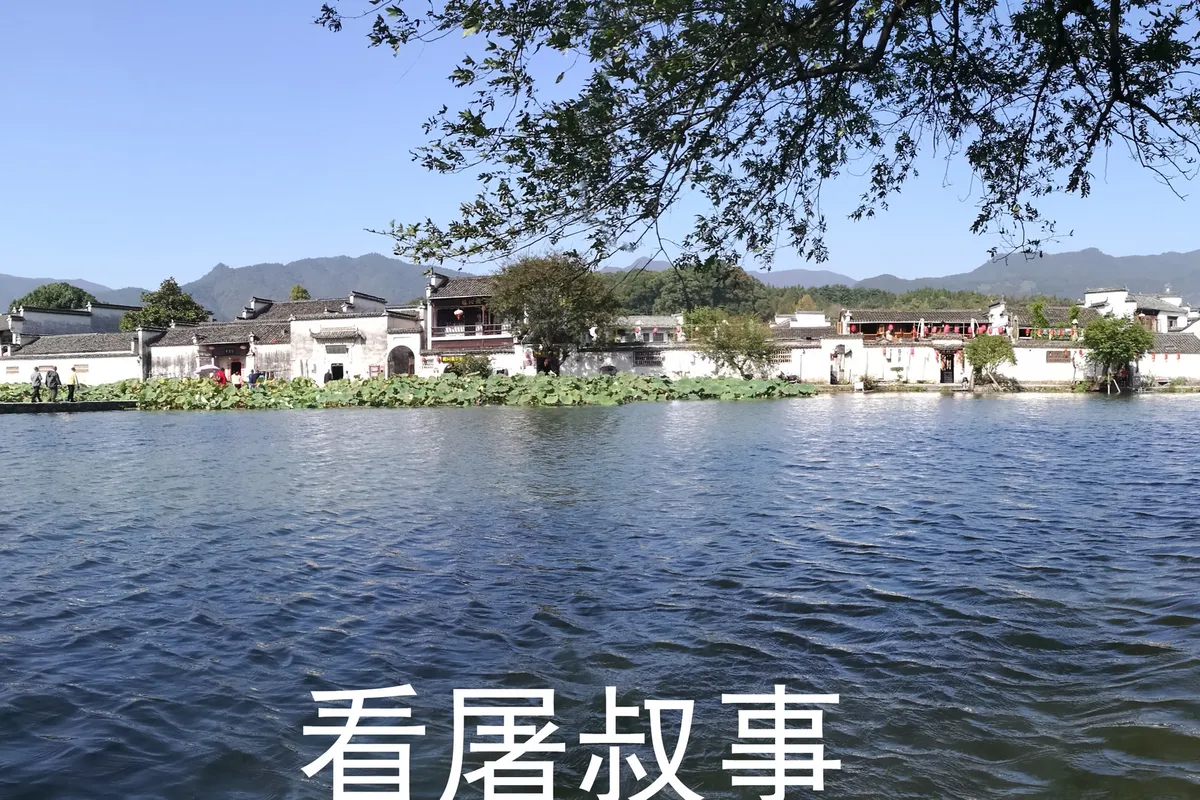
Entering Hongcun, known as "the village in Chinese paintings," the first thing that catches your eye is the famous South Lake. The sun was at our backs; green lotus leaves swayed on the lake, ducks played in the water, distant peaks and nearby houses reflected in the lake—a beautiful scene of lake and mountain. It attracted many cameras and easels.
Cross the Painting Bridge, and on the left is South Lake Academy.
Along the way, we visited Kuanhe Hall and the former residence of Wang Daxie.
At the center of Hongcun is Moon Marsh, excavated during the Yongle period of the Ming Dynasty. The surrounding Huizhou buildings are reflected in the water—a perfect photo spot.
On the north bank of Moon Marsh is the Lexu Hall, the ancestral hall. Most residents in Hongcun are surnamed Wang, so it's also called the Wang Ancestral Hall.
The so-called "big landlord's house" by the villagers is the most luxurious building in Hongcun—Chengzhi Hall, the residence of Wang Dinggui, a wealthy salt merchant from the late Qing Dynasty. It has a study, kitchen, stable, bodyguard room, and rooms for male and female servants, as well as exquisite Huizhou carvings.
Hongcun is not big, and the attractions are concentrated, so you don't need to plan deliberately—perfect for a leisurely stroll.
We turned back to the big tree at the village entrance and left the village around 1:30 PM, returning to the parking lot.
Drove 20 km to Xidi.
Xidi Village was inscribed as a World Cultural Heritage site in 2000, known as "the most beautiful village in the world" and "a treasure house of ancient folk houses."
Xidi's memorial archways are especially famous. The landmark is the three-arch, four-pillar, five-story Hu Wenguang Bluestone Archway at the village entrance.
All streets and alleys in the village are paved with Yixian bluestone. Two clear streams flow through the village, and 99 high-walled deep alleys make you feel like you're in a maze.
The village retains more than 300 ancient residences from the Ming and Qing dynasties. 124 of them are well-preserved, along with 3 ancestral halls, including Lingyun Pavilion, Cishi Archway, Ruiyu Court, Taoli Garden, East Garden, West Garden, Dafu Di, Jing'ai Hall, Lufu Hall, Qingyun Pavilion, and Yingfu Hall. These ancient residences are wooden structures with brick walls, unique in style and beautiful in shape. Their "layout, structure, decoration, and construction" are exemplary of Huizhou architecture. The three carvings of stone, brick, and wood are known as the three wonders of Xidi.
In summary, Hongcun is stunningly beautiful but more commercial. Xidi is better preserved and has a stronger cultural atmosphere.
We left Xidi after 4:00 PM, took the expressway back to the hotel, toll 21.85 yuan.
For dinner, we went to "Huangshan Mama" restaurant near the hotel. Good atmosphere; later in the evening, there was a wait outside. Since we two didn't have big appetites, we ordered a Yanduxian (stewed bamboo shoots with salted pork and tofu skin) for 59 yuan and two bowls of rice. Tasted great.
We chatted late with some Yunnan guests at breakfast. Checked out at 10:00 AM.
The cruise terminal for the Xin'an River Landscape Gallery is at Shendu Town, She County, Huangshan. After leaving the hotel, we took the expressway to She County, toll 15.20 yuan, then S324, about 56 km in total.
Arrived at Shendu Town pier at 11:15 AM. There was a parking lot by the pier, parking cost 10 yuan.
Only the 1:00 PM boat was available. Ticket price 80 yuan (free for 65+), boat fare 68 yuan.
We wandered around the pier and the town.
The cruise went down the Xin'an River, with green water and Huizhou villages on both sides forming the landscape gallery.
First stop: Jiusha Village, to see the Jiusha "sun-drying autumn" display. Red chili peppers, golden rice, black beans, green wax gourds, corn, pumpkins, sweet potatoes—these ordinary agricultural products were arranged into beautiful scenes, along with the Xin'an River and village houses, creating picturesque autumn drying tableaus.
Second stop: Zhangtan.
We went ashore to see the Huizhou Ten-mile Dowry Museum. It introduces Huizhou folk customs, with exhibits such as the "first bed under heaven" and the "first sedan chair under heaven."
The Han Zhangliang Marquis Temple was built to commemorate and worship Zhang Liang from the Han Dynasty.
The large camphor tree in front of the temple is over a thousand years old and is a famous tree in Anhui Province. Folk performances were held here for tourists.
Finally, we arrived at the Mian Tan riverbank to watch the "Nine Surnames Fishing Performance" and other shows.
The entire trip took about 3 hours round trip.
Returned to Shendu Town pier almost at 4:00 PM.
We picked up the car and drove 27 km to Huizhou Ancient City, arriving around 4:30 PM. There were no parking spaces in the front square, so we found a spot in a small lane nearby. The marked spaces there were free—nice.
Huizhou Ancient City is one of the four major ancient cities in China, well-preserved. It is a National Historical and Cultural City and a 5A scenic area. It is the birthplace of "Huizhou Studies," one of the three major Chinese schools of thought, and is known as "the land of culture and propriety in Southeast China."
Free admission for visitors over 65.
The ancient city consists of an inner city and an outer city, with four gates: east, west, south, and north. It also retains barbicans, city gates, ancient streets, and alleys.
Attractions within the city include Huizhou Garden, Yuliang Dam, Xuguo Stone Archway, Changqing Temple Pagoda, East Watchtower, South Watchtower, Doushan Street, Tao Xingzhi Memorial Hall, Xin'an Stele Garden, and Taibai Tower, among seven sites.
First, we climbed the city wall to overlook the area. Passing through the Huizhou Garden archway was Huizhou Garden, then Xuguo Stone Archway, Nine-Dragon Wall, Huizhou Prefecture Office (already closed at 5:00 PM), Yanghe Gate, Watchtower, the "Southeast Culture" Archway, Cao's Two Residences (Great Huizhou Opera Troupe) where Huizhou opera entered Beijing, and Huang Binhong Memorial Hall, among others. Of course, there are also over 300 ancient residences and ancestral halls forming neighborhoods.
It started to get dark.
We found a restaurant, had dinner, and left the ancient city.
Tomorrow we would go up Huangshan, so we went to a supermarket to buy some food and fruit.
Drove 50 km on the expressway (toll 13.04 yuan) to Tangkou.
Tangkou: a major tourist town at the foot of Huangshan, serving as the southern gate of Huangshan and the必经之路 for visiting the Huangshan Scenic Area.
Checked into Kaiyuan Manju Hotel (Huangshan Scenic Area branch) after 8:00 PM.
The room was spacious with complete facilities. Service was very attentive.
The manager told us that for tomorrow's trip up Huangshan, we could leave our main luggage in the car and only bring essentials; the car could be parked for free at the hotel parking lot. The hotel gave each guest a hiking stick, and a free shuttle took us to the Zhaixi Transfer Center (only 700 meters from the hotel).
October 25 had good weather; the temperature on the mountain was 9–18°C. That day was the ninth day of the ninth lunar month, the Double Ninth Festival.
Huangshan is a National 5A Scenic Area, a World Cultural Heritage site, and a World Natural Heritage site.
You must reserve tickets and a time slot to go up Huangshan. Our reservation was for 10:00 AM. After breakfast, at 9:20 AM, the hotel's minibus took us to the Zhaixi Transfer Center.
At the entrance, we scanned our IDs for verification and had our temperature taken (ticket 230 yuan, free for over 65 but still requires reservation). Then we took the scenic area bus (19 yuan/person). The bus ride to the rear mountain Yungu Cable Car Station took about 20 minutes, then we took the cable car up (80 yuan/person). The cable car ride lasted about 8 minutes.
We got off at Bai'e Ridge Station.
When touring Huangshan, the route from the front mountain to the rear mountain mainly involves uphill sections, with Aoyu Peak having a long continuous uphill. The section from Bright Summit down to Beihai and then to Yungu Temple is also mostly uphill.
In contrast, the route from the rear mountain to the front mountain is mostly downhill, with the uphill concentrated between Beihai and Bright Summit (if you visit West Sea Grand Canyon, you can take the cable car to avoid this uphill section).
Therefore, ascending from the rear mountain is less strenuous, and most tour groups choose the rear mountain cable car route.
For travelers with ample time and average physical strength, or those with special needs, ascending from the rear mountain is recommended.
We walked downhill to Shisun Ridge, one of Huangshan's best viewpoints, though the morning light was against us.
We saw Harp Pine, Guanyin Peak, Woyun Peak, Shixin Peak, Black Tiger Pine (with views of Brush Holder Peak and Dream Pen Producing Flowers). (Those with good stamina could go to Qingliang Terrace, Monkey Gazing at the Sea, Lion Peak, and then return.) Then we saw Tuanjie Pine and checked into Xihai Hotel.
Xihai Hotel had excellent facilities and service.
First, we went to Paiyun Pavilion to experience the West Sea Grand Canyon.
There was a "stone-splitting pine" listed in the World Heritage Site. Its roots were deeply embedded in a rock, splitting it into three pieces. This is an ideal spot to enjoy the sea of clouds, sunset glow, and fantastic peaks and valleys, with views of "Immortal Drying Boots," "Fairy Playing Zither," "Immortal Walking on Stilts," "Wu Song Fighting Tiger," "Immortal Pointing the Way," "Smooth Sailing," and more—truly beautiful.
We took a detour, passing in front of Danxia Station, and headed to Danxia Peak to watch the sunset.
The sunset time that day was 5:26 PM. Although Danxia Peak was not spacious, it had already gathered more than twenty people.
The sunlight was good, so we waited and waited. But the clouds below never dispersed. Sunset glow appeared in the west, but the sun still refused to show its face. The sunset time had passed, so apparently we wouldn't see it.
We returned to the hotel restaurant for dinner. Things on the mountain were expensive, but the chef's skill was good.
We wondered if we could see the sunrise tomorrow morning.
In the morning, the clouds were still thick, so no sunrise.
The breakfast at Xihai Hotel was quite good. Remember, everything on the mountain was carried up by porters. We asked them yesterday: they are paid 0.48 yuan per jin (0.5 kg).
Going down the West Sea Grand Canyon is said to be very tough, but the essence of Huangshan lies in the West Sea Grand Canyon. Not going down it is like not having come to Huangshan at all. The typical route to visit the West Sea Grand Canyon is to descend from the north entrance of Paiyun Pavilion, which is less strenuous as you go downhill, though it puts more strain on the knees. We took it slow.
It was 2 km to the bottom. We walked and looked around; the canyon was full of grotesque rocks, deep caves, and paths built along cliffs.
The valley was filled with peaks, forests, pines, rocks, and flowers—scenic spots everywhere. Famous peaks include Shuangsun Peak, Jiulong Peak, Shichuang Peak, Shizhu Peak, Bodao Peak, Paifang Peak, and Songlin Peak.
On the first loop, we took the left path for better scenery. On the second loop, the left path was quite steep, so we took the right. All the steps were man-made; there was only one toilet in the entire West Sea Grand Canyon, after exiting the second loop.
The scenery along the way was indeed beautiful.
After walking for 3 hours, we finally reached the bottom at Paixi Station. We took the West Sea Grand Canyon sightseeing cable car (100 yuan/person, saving about 2 hours) to Tianhai Station.
If you go up the front mountain and take the funicular down to the West Sea Grand Canyon, you reach the bottom and then have to go uphill all the way to Paiyun Pavilion, which takes about 2 hours—elderly or less fit people might need 3 hours, too tiring.
From Tianhai Station, walk about 500 meters to Tianhai Square, where there are some shops and toilets.
Next to it is Baiyun Hotel.
We stayed at Baiyun Hotel that night.
The facilities were a bit outdated, but the service was decent. Especially the buffet dinner—so many varieties, you just need the appetite.
There were many Cantonese tour groups dining with us. Since they didn't have enough time, they didn't go down the West Sea Grand Canyon, but some group members spent 200 yuan to take the funicular down to the bottom and then come right back up—pointless.
The front mountain refers to the area from Ciguang Pavilion to Bright Summit, including Hot Spring, Yuping Pavilion, and Tianhai Scenic Area. Main attractions include Welcome Pine, Banshan Temple, Tiandu Peak, Yuping Pavilion, Lotus Peak, Yixian Tian (A Stretch of Sky), and Aoyu Peak.
Sunrise that day was at 6:18 AM.
From Baiyun Hotel, climb about 500 meters to reach Bright Summit, the second highest peak of Huangshan at 1860 meters. Its landmark is the large white ball of the weather station.
In the early morning, wearing the free down jackets provided by the hotel, we set off.
It was still dark, but the summit was already crowded. All the good spots were taken.
It wasn't cold, and the wind was light.
Gradually, the glow of dawn appeared, causing a stir. Unfortunately, the sun was still blocked by clouds. Time passed minute by minute—it seemed we were not fated to see the sunrise at Huangshan.
We had a panoramic view of the peaks, then returned to Baiyun Hotel via the same path.
The hotel breakfast was still generous.
We checked out at 10:00 AM.
Bright Summit under the blue sky was truly beautiful.
Huangshan's front mountain is majestic, while the rear mountain is elegant.
Not far ahead was Aoyu Peak.
Aoyu Peak is an excellent viewpoint in Huangshan, offering views of Bright Summit, Lotus Peak, West Sea, and many other peaks.
We descended from Aoyu Peak, bypassing Yixian Tian (to avoid the crowds coming up from the front mountain) and went through Aoyu Cave to Baibu Cloud Ladder.
We encountered many tourists coming up from the front mountain; some were already sitting on sedan chairs before climbing Yixian Tian. How much? 780 yuan. Because coming up from the front mountain is all uphill—indeed tiring.
We again bypassed Baibu Cloud Ladder and took the left path toward Welcome Pine. Although a bit longer, it was easier.
This path could also lead to Lotus Peak (about 2 hours), but we didn't have time, so we went around.
We had a distant view of Tiandu Peak (Lotus Peak and Tiandu Peak open alternately; this year Lotus Peak was open).
First, we saw the Farewell Pine.
Next to Yuping Pavilion Hotel was the famous Welcome Pine.
The Welcome Pine in the sunlight was indeed beautiful. Tourists lined up to take photos with it.
We did the same and took our photo with it home.
Saying goodbye to the Welcome Pine, we arrived at the Yuping Cable Car Station. The tour of the front mountain took 3 hours.
We took the cable car down (90 yuan/person). Then we took the scenic area bus (19 yuan/person) back to Zhaixi Transfer Center, arriving at 2:00 PM, ending our Huangshan trip.
We called the hotel to send their car to pick us up. After a short rest, we retrieved our car and drove to Taiping Lake at around 4:00 PM.
Taiping Lake lies between Huangshan and Jiuhua Mountain, a large artificial reservoir on the upper reaches of the Qingyi River.
From Tangkou to Crowne Plaza Huangshan Taiping Lake Resort, 51 km, toll 22.80 yuan.
The five-star hotel was right on the edge of Taiping Lake, with a great location, nice facilities, and good service.
The room was spacious and clean. Although it was cloudy, from the balcony we could see the hazy lake and mountains, with islands of various sizes and heights dotting the lake, like a fairyland.
We found a local restaurant not far from the hotel called "Zhuyuan Mountain." A crucian carp and radish soup was delicious, and a stir-fried vegetable was fresh and tasty. The prices were reasonable—very good.
October 28 was still cloudy.
The hotel breakfast was quite rich.
After breakfast, we drove along S103 and S322 provincial roads around Taiping Lake. This is a scenic road with beautiful lake and mountain views. There were many parking spots, viewing platforms, and ferry terminals along the way.
We went to the Taiping Lake cruise terminal 7 km away. Parking was 10 yuan. You can take a cruise on the 4A Taiping Lake Scenic Area; the ticket is 60 yuan (free for 65+), and the boat ticket is 32 yuan.
Since it was cloudy, we didn't go boating.
We strolled along the wooden boardwalk built on a floating bridge by the lakeside. The lake water was clear and blue, the mountains undulating—no wonder it's called "Huangshan's Lover."
We returned to the hotel and checked out at noon.
We continued along Taiping Lake, taking county roads with many curves and some mountain roads. It took over an hour to cover 51 km. Arrived at Taohuatan Scenic Area at 1:20 PM.
Famous because Li Bai wrote here: "The peach blossom pool is a thousand feet deep, but not as deep as Wang Lun's feeling for me when we parted."
Parking 10 yuan, ticket plus ferry ticket 65 yuan, but for those over 65, only the ferry ticket costs 10 yuan.
Taohuatan is actually a section of the Qingyi River. The Zhai Village on the east bank and the Wan Village on the west bank face each other across the pool, two ancient Huizhou villages from the Ming and Qing dynasties.
At the parking lot is Chen (Zhai) Village, originally called Shuidong, ancient name Nanyang Town. We first visited the Wenchang Pavilion, built in the 32nd year of Qianlong (1767). It is a three-story octagonal building with double eaves and flying corners.
When we came out, we met a village electric tricycle driver; we took his car for 10 yuan.
We went to the Zhai Ancestral Hall, which has a plaque "Zhongxiao Tang" (Loyalty and Filial Piety Hall) bestowed by the emperor. It has three halls, covering a thousand mu, built with nanmu wood and white marble. It is praised as "the first ancestral hall in China" by Mr. Luo Zhewen, an ancient architecture expert from the National Cultural Heritage Administration.
The ancient Nanyang Old Street is paved with irregular cobblestones, with mottled walls on both sides.
Passing through the narrow old street, the ancient two-story pavilion is the Tago Ange Pavilion. On the horizontal plaque under the eaves are the four characters "Tago Ancient Bank" inscribed by a villager named Zhai Rong. The ground floor is a passage, with solid brick walls on both sides and a stone foundation, with stone steps leading down to the river.
The ground floor of the pavilion is open to the old street, with a semi-circular arch facing the pool. You can go upstairs via a small side door; there are windows and railings facing the pool, from which you can overlook Taohuatan and other sights.
Through the arch is the Tago Ancient Bank East Garden Ferry, where Wang Lun sang farewell to Li Bai.
On the east bank, Chen Village faces Wan Village on the west bank across the Qingyi River. We took the ferry across. There is an islet in the river; the dark-colored water there is the Peach Blossom Pool.
After landing, we saw the west bank gate tower, and entering it was Wan Village Old Street, where there are many old Ming and Qing buildings, but all very dilapidated.
The splayed Yi Gate was first built in the fifth year of Zhenguan of Tang Dynasty (631 AD) and rebuilt during Qianlong of Qing Dynasty. It is two stories, with the ground floor as a passage in a concave shape. The marble door frame bears the characters "Yi Men" (Righteous Gate). The lower part of the side walls is made of stone blocks, the upper part of brick, with polished patterned brick veneer. Exquisite workmanship, unique features. The main structure remains.
The Rainbow Bridge looked quite ordinary.
Wan Village Academy seemed newly built.
A short distance ahead was Wang Lun's tomb; passing Wang Lun Temple, we came to Huaixian Pavilion standing by the river.
From here, you can overlook the islet in the Qingyi River and Chen Village on the opposite bank.
Unfortunately, despite being a 4A scenic area, there was no public toilet on the west bank. Tourists in need had to take the ferry back to the opposite bank, where there was a public toilet near the Tago Ange Pavilion.
We returned to the parking lot after 5:00 PM.
It was 41.9 km to Jing County. There were many large trucks on the road; we drove slowly to the county town. Checked into the Green City Hotel (Jing County Boutique Third Branch).
Breakfast at Green City Hotel was simple—congee, soy milk, fried dough sticks, steamed buns, zongzi, etc.—but for a hotel costing only 173 yuan per night, it was acceptable.
At 9:35, we left the hotel and took G205 toward the Southern Anhui Sichuan-Tibet Line.
The so-called Southern Anhui Sichuan-Tibet Line starts from Jing County town, follows X074, X076, and X061 county roads, and finally reaches Ningguo City, about 120 km in total. It passes through Tingxi Township, Suhong Village, Taolingtou, Banqiao Village, Fangtang Township, and Qinglong Township, traversing the largest primeval forest in southern Anhui, and multiple peaks over 1000 meters like Taolingtou and Laohuping, as well as rivers and reservoirs like Shuimo Tingxi and Qinglong Bay. It boasts both the essence of southern Anhui scenery and the steepness of the Sichuan-Tibet Highway, attracting self-driving and cycling enthusiasts from all over.
It was said there is no gas station in the mountains, so we first looked for one on the national road. We passed two gas stations but neither had 95-octane gasoline; we had to drive an extra 7 km to fill up. Actually, now the local government in Suhong Village has built visitor service centers, gas stations, parking lots, and public toilets for the convenience of self-driving tourists.
We didn't go to Shuimo Tingxi; we headed straight for Suhong Village.
The starting point of the Taoling Highway in Suhong Village is the highlight section of the Southern Anhui Sichuan-Tibet Line. The Taoling Liudao Wan (six bends) winding mountain road snakes upward, resembling the 72 bends on the Sichuan-Tibet Highway, hence the name Southern Anhui Sichuan-Tibet Line.