5-Day Spring Festival Trip to Thousand Island Lake and Huangshan in 2021 (with Super Detailed Huangshan Route)
2020 was a year when everyone stayed at home. At the beginning of the year, during the Spring Festival, I went back to Chengdu to visit relatives and travel along the way, but due to the sudden outbreak of the epidemic, I only played half the trip, and the return journey was basically like fleeing. The virus that swept the world also made everyone understand life and living more, respecting nature and living in harmony. Living in the moment became my biggest gain in 2020.
After the summer of 2020, the situation in China was fully under control, which sparked my desire to travel to Tibet during the Spring Festival. Winter tour of Tibet has always been a route I longed for. So after the National Day, I began planning the trip to Tibet: setting the route, looking at hotels, renting a car, checking train tickets (later switched to flights), and applying for the border pass. Everything was ready, just waiting to depart...
But as the deep winter approached, small-scale outbreaks in multiple places made long-distance travel a luxury. During the Spring Festival travel rush, prevention policies changed three times a day. For long-distance travel, uncertainties and risks were too great. After careful consideration, I had to cancel the Tibet trip and leave it for later. After a year of hard work, the precious Spring Festival holiday was worth going out to adjust my body and mind. Since I couldn't go far, I decided to drive to nearby low-risk areas. The trip became a five-day tour of Thousand Island Lake and Huangshan.
D1: Nanjing - Thousand Island Lake
D2: Around Thousand Island Lake - Qianfen Line
D3: Thousand Island Lake - Huangshan
D5: Huangshan - Hongcun - Nanjing
At 8 a.m. on February 8, I set off from Nanjing. Near the Spring Festival, there were many cars in the city, but once on the highway, there were very few cars. This time I chose self-driving around Thousand Island Lake instead of taking a boat to the islands. Driving along the lake allows you to appreciate the lake from both far and near. The whole journey was smooth except for the West Ring Road of Hangzhou, which was congested due to many cars leaving the city. At 1 p.m., I arrived at the Thousand Island Lake Kaiyuan Resort. The hotel is built by the lake, with good facilities and a children's playground, perfect for taking kids. The lake view room cost 380 per night including breakfast for two, great value for money.
After parking in the underground parking lot of Kaiyuan, I was about to check in when I suddenly realized I had forgotten my backpack. All my documents were in the bag. After driving for five hours to the destination, I was devastated. I had to go to the front desk to ask if I could check in without an ID card. Fortunately, I could check in with an electronic ID card. Without the card, I just needed to enter my ID number and do facial recognition. After checking in and sending my luggage to the room, I planned to go to the town for lunch and also visit the police station to see if I could get a temporary ID card, so as not to affect the subsequent Huangshan trip.
Lunch was a set meal from Shao Ji Fish Wharf, which ranks high online. The taste was just average, neither surprising nor disappointing. I guess the Thousand Island Lake fish head soup is similar everywhere. The whole town is full of shops selling fish head soup, so you just have to take your chances. After lunch, I went to the police station to ask about a temporary ID card, but they no longer issue temporary IDs. I could only take things one step at a time. Back at the hotel around 4 p.m., the child went to play at the children's playground while we took a walk by the lake. It started raining in the evening, so we returned to the room to rest, skipping dinner. I called the Huangshan scenic area in the afternoon and was told that I could pick up tickets with an electronic ID card and my ID number. I was finally relieved.
The hotel bedding was good, and I slept very well. Breakfast was a buffet with a rich variety and good taste, very satisfying. The weather was good today, no sun but no rain, and the temperature was suitable. I planned to take the Qianfen Line: Thousand Island Lake Kaiyuan Resort - Thousand Island Lake Bridge - Wenxin Island - Meiling Observation Deck - Xiaojinshan Observation Deck - Zhuli Village Observation Deck - back to the hotel.
The first stop was Wenxin Island. I originally planned to book the Zhiya Art Hotel on the island, but a few days before departure, I found no rooms available, so I switched to Kaiyuan. There are two hotels on Wenxin Island: Zhiya and Dielai. You need to park your car in the lot, and the hotel provides an electric car to pick up guests across a floating bridge to check in. Since we didn't book a hotel on the island, we wanted to have a look. During the special period, the security guard at the parking lot said we couldn't go to the island if we weren't staying there. After chatting with him for a while, I tricked him by saying we were staying at Kaiyuan and wanted to see if the island hotel was better, so we might switch. He checked our health codes and travel history codes and let us on the island. It turned out that there were too few guests; Zhiya Hotel was not open, but Dielai was operating normally. Wenxin Island is not big; we finished strolling in half an hour. The scenery was not better than Kaiyuan on Qilin Peninsula, and the facilities were not as good.
Meiling Observation Deck is halfway up the hill with a good view. This season, the water level of Thousand Island Lake is low, revealing dark red rocks on the islands, creating a great visual effect.
Zhuli Village Observation Deck is not as high as Meiling, but the view is comparable. There is a parking lot, restroom, and fruit sellers nearby, so you can park and rest while enjoying the view.
After visiting Zhuli Village, we turned back. On the way, we stopped at Xiaojinshan Bridge Observation Deck but found no big surprise. We also passed Maple Leaf Gorge, which was small and exquisite.
Back in town, we had a simple lunch at a noodle shop. For dinner, we planned to have a hot pot buffet at the hotel. I have to complain about the traffic in town: narrow roads, many cars, and many sharp turns and steep slopes, comparable to Chongqing. In the afternoon, I took a nice nap while the child's father accompanied the child at the children's playground. In the evening, we went to the restaurant and learned that the hot pot buffet was only available on weekends, so only the Chinese restaurant was open. We ordered a three-person set meal. The fish head soup was much better than what we had at Shao Ji the day before. The dishes were exquisite, and the dessert, snow lady, was delicious—the child ate it all. The price was not much higher than in town, but the food quality was much better. I recommend dining at the hotel. We went to bed early that night, ready to depart for Huangshan the next morning.
Due to promotional activities a few days earlier, many people from the province brought their children to stay. The previous morning, after we finished breakfast, many people came to the restaurant, and we had to wait for seats during peak hours. So this morning, we went to eat at 7 a.m., trying different varieties from yesterday. The taste was great! After breakfast, we packed up, checked out, and headed to Huangshan. The straight-line distance from Thousand Island Lake to the South Gate of Huangshan Scenic Area is less than 100 km, but the driving distance is 200 km, taking about 3 hours. We drove along the Chunkai Line by Thousand Island Lake until Majin in Quzhou, then got on the Jingtai Expressway, about 90 km to the highway. The road had no traffic and good conditions, but the speed couldn't go fast. After 110 km on the expressway, we arrived at Tangkou Town, the South Gate of Huangshan, around 11:30 a.m. We found a highly rated restaurant, Old Xie Huizhou Cuisine, for lunch. Then we parked at Jiahua Parking Lot and told them we were staying at a hot spring hotel; the parking fee was 30 yuan per time, unlimited time.
Regarding the hotel on Huangshan summit, it was also full of twists. I originally booked Xihai Hotel, and a few days earlier, I confirmed the epidemic prevention requirements with them. But on February 9, while at Thousand Island Lake, I received a call from Xihai Hotel saying that due to prevention requirements and too few visitors, Xihai Hotel would close from February 10. Only one hotel each on the front and back mountains would remain open: Shilin Hotel on the back mountain and Yupinglou Hotel on the front mountain. They suggested I change to Yupinglou, but my planned route was to go up from the back mountain (Yungu Cable Car), visit the back mountain (Beihai, Xihai areas), stay at Xihai, then on the second day visit the front mountain (Tianhai, Bright Summit, Welcome Pine), and take the Yuping Cable Car down, staying at the hot spring hotel. Changing to Yupinglou would make the first day too tight and the second day too loose, and since I was traveling with elderly and children, it was not suitable. Finally, I changed to Shilin Hotel in the Beihai area, which was quite a hassle.
After parking, we brought our luggage. Since we would stay one night on the summit and one night at the mountainside, we packed food, drinks, and supplies. My husband and I each carried a hiking backpack. With the family, we walked to the South Gate Passenger Transport Center, about 300 meters away. A few days earlier, I had booked tickets (entrance + cable car + bus) on the China Huangshan WeChat public account. We verified with the order confirmation SMS and my ID number (since I forgot my ID card). Upon entering, we found that there were only 330 visitors to Huangshan on February 10. That was too few... The tourist bus to Yungu Temple only had our family of four—a private bus. After about 20 minutes, we arrived at Yungu Temple. We split up: I took the elderly and child up the Yungu Cable Car to White Goose Ridge, while my husband hiked up on foot, saying he wanted to exercise. The cable car was fast, about 10 minutes to White Goose Ridge. This was my sixth time on Huangshan, so I knew the route well. We walked slowly, enjoying the scenery. The itinerary for today was relaxed: White Goose Ridge - Stone Bamboo Shoot Vat - Mushroom Pavilion - Beginning-to-Believe Peak - Harp Pine - Black Tiger Pine - Beihai Hotel - Shilin Hotel. It took less than 2 hours to reach Shilin, our accommodation for the night. We checked in and sent the elderly and child to the room to rest. About an hour later, my husband arrived at Shilin. He was fast! We took a short break, then he and I went to Cool Terrace - Monkey Gazing at the Sea - Lion Peak for a stroll, while the elderly and child rested in the room. Tomorrow would be a longer walk with more climbing.
The weather on the summit today was overcast with some sea of clouds, and the temperature was low. There was no chance of sunset. According to the forecast, it would rain tomorrow, so sunrise and sea of clouds were unlikely. After visiting Lion Peak, we returned to the hotel and ate the food we had brought up for dinner. Shilin had been renovated a couple of years ago, so the facilities were decent. The room had no air conditioning but had an oil heater. The rooms on the summit are not big, but the oil heater kept it warm enough for showering and sleeping. There were very few guests, only about 10 rooms occupied. We went to bed early, planning to get up at 6 a.m. the next day to try our luck for sunrise.
I specifically compared Xihai Hotel and Shilin Hotel since I had stayed at both. In terms of room decoration and facilities, Xihai was better, and the rooms were larger. But regarding location, Shilin was more convenient. The sunrise/sunset spot for Xihai was Danxia Peak, about a 20-minute walk away with steep uphill sections, difficult for the elderly. Danxia Peak was good for sunset but blocked for sunrise. Shilin's sunrise/sunset spot was Cool Terrace - Monkey Gazing at the Sea, only 5-6 minutes from the hotel on easy paths, very close and convenient.
I slept well, warm and comfortable. At 6 a.m., I put on the hotel's down jacket and went out to try my luck. As soon as I stepped out, I saw it was raining heavily with thick fog. I couldn't see anything, so I went back to the room and lied down. At 7:30, I called the elderly and child from the next room to go to breakfast. The hotel included breakfast: simple porridge, steamed buns, eggs, bread, milk, etc. It was light but filling. Probably because there were so few guests, the breakfast couldn't be elaborate. It was a far cry from Xihai Hotel's breakfast buffet, which was rich and comparable to Kaiyuan (though expensive; I recall the child's breakfast there was 158 yuan).
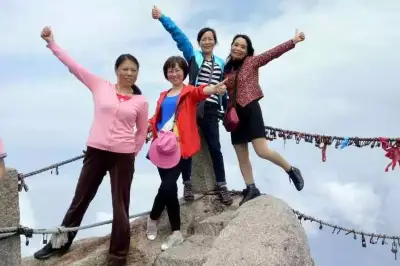
After breakfast, seeing the rain easing, we quickly packed up, checked out, and headed to Bright Summit. The route: Shilin - Beihai Hotel - Guan Shi Ting - Bright Summit. Passing Beihai Hotel, we noticed it was under full renovation. Once finished, I might try staying there next time. It drizzled all the way, with heavy fog and very low visibility. We could barely see anything. After nearly an hour, as we approached Bright Summit, it started to snow. The temperature dropped sharply, and the wind was fierce. It was freezing. I took a photo in the snow and quickly descended. After Bright Summit, we headed to Haixin Pavilion, where it was more sheltered. Haixin Pavilion - Aoyu Cave - Hundred-Step Ladder - Lotus Pavilion - Welcome Pine. This is the traditional Tianhai route, taking about 1.5 hours, normally the most crowded section. But coming just before the Spring Festival, we encountered almost no one. Taking a photo in front of Welcome Pine without queuing—this was the first time in my six visits. I felt emotional, even a bit mixed, sincerely hoping that things would recover soon so people could freely go outdoors and enjoy nature.
The mountain was windy and cold. After seeing Welcome Pine, we went into Yupinglou Hotel's restaurant and ordered a hot cocoa and a hot coffee to warm up. The prices were reasonable—around 30 yuan for a freshly ground coffee. Everything is carried up the mountain, so the price is fair. It was New Year's Eve, and the restaurant was festively decorated. Though there were few visitors, the atmosphere was strong. Yupinglou Hotel had been upgraded a couple of years ago, with good facilities and service. Behind the hotel is a large viewing platform, only accessible to guests staying there. In the future, I might try staying at Yupinglou on the front mountain for the views, provided the weather cooperates. Over the years, hotels on Huangshan summit have been undergoing renovation in rotation: Yunye & Paiyun Type Hotel (formerly Paiyunlou Hotel, at the entrance of Xihai Grand Canyon), Baiyun Hotel, Shilin Hotel, Yupinglou Hotel, Xihai Hotel, and also the boutique mountain lodge Huangshan Yun Ji (renovated recently). Beihai Hotel is currently closed for renovation, likely to be finished in a year or two. So apart from Bright Summit Villa (which is basic, like a hostel), the other operating hotels are all good, with decent service and similar prices. The Huangshan tourism is very mature.
After coffee and a rest, we walked to Yuping Cable Car, a 15-minute walk, and took the cable car down directly to the transfer center. The Yuping Cable Car has been upgraded too. I remember the old terminal was at Ciguang Pavilion, and you had to walk from there to the transfer center. Now it extends all the way to the transfer center, which is very convenient. Since we were staying at the Hot Spring Hotel that night, we didn't take the scenic bus (which would cost 8 yuan per person for a 5-minute ride to the hot spring stop). Instead, we walked from the transfer center along the road for about 20 minutes to the Hot Spring Hotel. There is also a shortcut down the steps, about 10-15 minutes, but it was a bit slippery from the rain and there were no people. We took the road with the elderly and child. On the way, we saw a group of monkeys on the steps rummaging through trash cans. They seemed unafraid of people; even as we passed, they continued calmly. I quickly distanced myself, as I had a psychological shadow from being scratched by monkeys at Emei Mountain years ago.
Previously, I had booked a package at Huangshan Hot Spring Resort: two nights in Yongquan South Building (one night) with double breakfast, dinner, hot spring, and Hongcun tickets. Great value. When we arrived, because there were too few guests, Yongquan South Building was closed, and they upgraded us to Xuanyuan Building, which has better rooms and larger space—the best in the resort. Xuanyuan Building is halfway up the mountain. We waited at the roadside near Yongquan Building (there's a security booth; they call the hotel front desk to send a car to pick up guests; the security guard was very enthusiastic and chatted with us while we waited). The car took us to Xuanyuan Building's front desk. We checked in, took our luggage to the room, and it was already 1:30 p.m. The restaurant was still open for ordering. We ordered a simple lunch: a serving of Huizhou fried rice and a serving of handmade dumplings. The portions were large, and the chef was excellent—simple dishes made colorful and fragrant. The dumplings were freshly made. Three adults and one child were stuffed. The bill was only 70 yuan, incredibly good value for a scenic area.
At check-in, the front desk told us that the hot spring opened at 3 p.m. and suggested we go then, as it would be just-refilled water, clean. They said a car would pick us up from the lobby at 2:55 p.m. The shuttle times from Xuanyuan Building to the hot spring were 3 p.m., 5 p.m., and 7 p.m. If we missed the free car, we could walk (20 minutes) or drive (5 minutes). Unsurprisingly, our family had the car to ourselves. At the hot spring, we exchanged our names and ID numbers for wristbands, changed, and went to the pools. Since there were almost no people, only three pools were open. The attendant said more would be opened as guests increased. It was a nice feeling having the hot spring to ourselves. Huangshan Hot Spring is one of the Four Wonders of Huangshan (the others being pines, rocks, and sea of clouds). My child loves it; this was her third time at Huangshan, and each time we stayed at the hot spring hotel. We soaked until after 6 p.m. During that time, no more than 20 people came, and eventually, five pools were opened. It was very relaxing. At 6:30 p.m., a car took us back to Xuanyuan Building. We hung our clothes to dry and went to the restaurant for the New Year's Eve dinner. The hotel package included dinner (a set meal for two: three dishes and a soup). I added a lamb hotpot and poured some plum wine I brought from home. The New Year's Eve dinner on the trip was quite presentable. I praise the hotel chef again—the home-style cooking was excellent, much better than the highly rated Old Xie Huizhou Cuisine in Tangkou. Probably the chef at Xuanyuan Building is better. During my 2018 post-snow trip, I stayed at Yongquan Building, and the chef there was far inferior. After dinner, we returned to the room to watch the Spring Festival Gala, called our parents to wish them a happy New Year, and planned to sleep in the next day before heading to Hongcun.
Last night, I watched the lively gala until 10:30 p.m. and couldn't stay awake. Thinking back to childhood, I used to stay up for the New Year, setting off firecrackers with my dad at midnight, going to sleep only after receiving red envelopes from my parents, then waking up early, putting on new clothes, and visiting neighbors to exchange New Year's greetings, my pockets full of melon seeds, peanuts, and candies. Times have changed. The old lively Spring Festival memories remain only in my mind.
At 9 a.m., we went for breakfast. The buffet was quite rich, with many local specialties. I appreciate the service at Huangshan's hotels. The hotel had free shuttle to the Xin Guo Line transfer center at Tangkou at 8 a.m. and 12 p.m., but those times were inconvenient for us (8 a.m. too early since our Hongcun ticket was for 1 p.m., 12 p.m. too late). The hotel offered a charter service: a minibus for 80 yuan to Jiahua Parking Lot, anytime. I asked the front desk in the morning and called a car at 10 a.m. to take us to the lot. 15 minutes later, we got our car and headed to Hongcun. Hongcun was not originally in my plan; I had been there many years ago. The ancient villages in southern Anhui are similar, but Hongcun is more famous. Since we got free tickets and the elderly and child had never been, we decided to stop by.
From Tangkou to Hongcun, it's a 30-km winding mountain road, about 45 minutes. The whole route follows Y102, with great scenery and good road conditions, but many bends, especially sharp ones, so drive slowly. This is a famous tourist route in Anhui, connecting two World Cultural Heritage sites. During peak season, it might be congested. The mountain roads are narrow.
Hongcun is a representative of Huizhou-style ancient villages, known as a "village in Chinese paintings." The main attractions are the water system (South Lake, Moon Pond) and the three carvings on buildings: brick, stone, and wood carvings, as delicate as paper cuts. I visited in 2006, when it was less commercialized, and many art students were sketching there, which was a unique sight. Now, almost every household has turned into a guesthouse. There are countless homestays in the village. Excessive commercialization has made Hongcun no different from other ancient towns in China, except for the Huizhou architecture. The ticket price of 104 yuan is very low value for money. I wouldn't come if I had to buy a ticket, and even with a free ticket, I wouldn't waste time here again. The over-commercialized Hongcun and Xidi seem to have no future. After spending 1.5 hours in Hongcun, we had lunch at a random snack bar and started the journey home. 314 km and 4 hours later, we arrived back in Nanjing. This 5-day trip to Thousand Island Lake and Huangshan ended satisfactorily. Although the weather left regrets about Huangshan's scenery, regrets are reasons to come again. The beautiful Huangshan Mountain is worth visiting again and again, with different scenery each season.
March 6, 2021 (End)
I. Route Overview
There are currently three entrances to Huangshan Scenic Area:
1. South Gate at Tangkou Town: 90% of visitors enter through the South Gate. This route has two cable cars: back mountain Yungu Cable Car and front mountain Yuping Cable Car. 90% of South Gate visitors take Yungu Cable Car up, visit Welcome Pine, and take Yuping Cable Car down. This is the most mature, least strenuous, and most convenient route. The downside is crowds; during peak season, queuing for cable cars can take over 3 hours. Some suggest the reverse: Yuping up and Yungu down to reduce queue time, but I don't recommend it because going up from the front mountain involves mostly uphill hiking, which is very strenuous. Going up from the back mountain and down to Welcome Pine is mostly downhill, with only the Hundred-Step Ladder being tough.
2. North Gate at Gengcheng Town: Very few visitors enter from here. There is Taiping Cable Car, with the upper station near Danxia Peak. The North Gate's Songgu Nunnery has inconvenient transportation; it's nearly 60 km from the South Gate, at least an hour by car, and there is only one daily bus from the South Gate to the North Gate (at 4 p.m.); otherwise, you need to charter. The advantage is that the upper station is very close to Xihai Grand Canyon, making it the most convenient for visiting Xihai. In recent years, tour groups have increasingly used this route because Taiping Cable Car has no queue, saving time. Tour buses drop visitors at the North Gate's Fuling Ridge transfer center, then drive to the South Gate to pick them up after they descend. This is less convenient for self-drive or independent travelers.
3. West Gate at Jiaocun Town: This is a hiking route for outdoor enthusiasts. There is no cable car. The advantage is that you rarely meet anyone; 99.9% of people don't enter from the West Gate. The disadvantage is the long distance, very physically demanding. If you are not a regular hiker, it's best not to attempt. The West Gate also has inconvenient transportation, and it's closed in winter. There are very few accommodations there.
1. About Tickets: Winter season (Dec 20 to Jan 20): full price 150 yuan. Normal/peak season (Jan 21 to Dec 19): 190 yuan. Children (6-18) and seniors (60-65) half price. Children under 6 and seniors over 65 free.
2. About Cable Car Tickets: Winter season: Yungu/Taiping one-way 65 yuan, Yuping one-way 75 yuan, Xihai Grand Canyon sightseeing cable car one-way 80 yuan (closed in winter depending on weather). Normal/peak season: Yungu/Taiping one-way 80 yuan, Yuping one-way 90 yuan, Xihai Grand Canyon sightseeing cable car one-way 100 yuan. Children under 1.2m are free, 1.2-1.5m half price. No senior discount for cable cars.
3. About Lotus Peak and Tiandu Peak: These two peaks (Carp's Back is on Tiandu Peak) open alternately, every 5 years. They are closed in winter (early Dec to March). Lotus Peak is the highest, Tiandu Peak is the steepest. If you want to climb both, you have to go during the transition year's summer and autumn, i.e., once every 5 years. Climbing Lotus Peak does not affect taking Yuping Cable Car down. Tiandu Peak is very steep, with separate up and down paths. Going to Tiandu Peak essentially means giving up the Yuping Cable Car; descending from Tiandu Peak top to Ciguang Pavilion is very tiring, your legs will be useless. People with average fitness or fear of heights should not attempt.
4. About Accommodation: There are several hotels on the summit with similar prices—standard rooms start at 1000 yuan. Due to the epidemic, the multi-bed dormitory rooms have been suspended, and it's unknown when they will reopen.
Criticism: The winter season for Huangshan used to be from November 15 to March 15 of the next year. Now it's only one month, which is basically robbery. The Huangshan ticket is 190 yuan; Xihai Grand Canyon is worth 150 yuan, and the rest combined is worth 40 yuan.
II. Route Recommendations
(A) One-Day Routes (depending on physical fitness):
1. Back Mountain Up (Yungu Temple), Front Mountain Down (Yuping Cable Car)
(1) This is the classic one-day route (90% of one-day visitors choose it): Yungu Temple - Mushroom Pavilion (new Yungu cable car) - Harp Pine - Beginning-to-Believe Peak - Black Tiger Pine - Guan Shi Ting - Bright Summit - Haixin Pavilion - Aoyu Peak - Hundred-Step Ladder - Lotus Pavilion (if Lotus Peak open, can go up from here) - Welcome Pine (Yuping Tower) - Yuping Cable Car down.
(2) * This route is crowded; queues on holidays. If you want to take only one cable car, it's recommended to walk from Yungu Temple to White Goose Peak (2.5 hours, fit people under 2 hours). It is said that on holidays (I haven't crowded Huangshan on holidays), Yungu cable car queue exceeds 2 hours. Taking Yuping cable car down: first, descending hurts knees; second, walking from Yuping Tower to Ciguang Pavilion is far (about 3 hours).
* If going to Tiandu Peak, strongly recommended to take Yungu cable car up. To climb Tiandu Peak, continue past Welcome Pine. After that, you cannot take Yuping cable car down (if approaching from Welcome Pine side). Walking from Tiandu Peak top to Ciguang Pavilion takes at least 4 hours, with high and steep steps. Not recommended for those with fear of heights. For a one-day trip, time is tight; you must start early.
* The biggest regret of this route is missing Xihai area.
(2) Taiping Cable Car Up (Songgu Nunnery), Front Mountain Down (Yuping Cable Car)
This is a relatively new route to avoid crowds and queues:
Taiping Cable Car (Songgu Nunnery) - Danxia Peak - Xihai Grand Canyon entrance - First Ring - Second Ring - Bottom - Xihai funicular up - Baiyun Hotel - Haixin Pavilion - Aoyu Peak - Hundred-Step Ladder - Lotus Pavilion - Welcome Pine (Yuping Tower) - Yuping Cable Car down.
* This route covers the most scenic spots, maximizing ticket value. It's long and tight on time; visiting Lotus Peak is very rushed, and Tiandu Peak is impossible in one day.
* This route has inconvenient transportation, especially for self-drive tourists. Songgu Nunnery is in Gengcheng Town (North Gate), Yuping Tower is in Tangkou Town (South Gate), 60 km apart. If you park in Tangkou, you need a charter to Gengcheng. If you park in Gengcheng, after descending you need to charter back to Gengcheng.
* This route is the most expensive: Huangshan ticket 190 + round-trip scenic bus 19*2 + Taiping cable car up 80 + Xihai funicular 100 + Yuping cable car down 90 = 498 yuan. Too expensive.
* This route misses the Beihai area, and it's best not to go in winter when Xihai Grand Canyon is closed.
(3) West Gate Up (Diaoqiao Nunnery), North Gate Down (Songgu Nunnery) via Taiping Cable Car
This route is only for hiking (no cable car), suitable for very fit people who don't care about seeing Welcome Pine. You only see the Xihai Grand Canyon scenery, with few people. Perfectly avoid crowds and enjoy Huangshan's beauty alone.
Diaoqiao Nunnery - Sanxi Bridge - Xihai Bottom (about 4-5 hours) - Second Ring - First Ring - Xihai Grand Canyon entrance - Paiyun Pavilion (about 3 hours) - Danxia Peak - Songgu Nunnery (Taiping Cable Car down).
* The West Gate to North Gate is about 30 km. This route is only for independent travelers; no tour groups. You need a charter between North and West Gates.
* This route can also be reversed: North Gate up by cable car, then hike down to West Gate. But two drawbacks: 1) West Gate has few accommodations (only homestays), inconvenient for meals and lodging; it's hard to find a car after descending; you must arrange a pick-up in advance. 2) If you go up from North Gate to Danxia Peak and then to Xihai in the morning, you'll encounter tour groups coming from Taiping, causing crowding on the steep paths. In the afternoon, the crowd thins out. Going from West Gate up, you reach this section in the afternoon, avoiding crowds.
* For a one-day trip, this route forces you to miss the Beihai, Tianhai areas (Lotus Peak, Tiandu Peak, Welcome Pine).
(B) Two-Day Routes (depending on physical fitness):
For a two-day trip, you can stay on the summit, or exit the mountain on the first day and re-enter on the second day (tickets are valid for 3 days, allowing two entries, but scenic buses and cable cars are single-use; you must repurchase). Staying on the summit is recommended because it saves energy and allows you to see sunset and sunrise. The only downside is cost.
1. Back Mountain Up (Yungu Temple), Front Mountain Down (Yuping Cable Car)
Day 1: Yungu Temple - Mushroom Pavilion (new Yungu cable car) - Harp Pine - Beginning-to-Believe Peak - Black Tiger Pine - Beihai Hotel - Cool Terrace - Monkey Gazing at the Sea - Xihai Hotel - Paiyun Pavilion - Xihai Grand Canyon entrance - First Ring - Second Ring - Xihai funicular - Baiyun Hotel (accommodation, also possible at Bright Summit Villa).
Day 2: Bright Summit - Haixin Pavilion - Aoyu Peak - Hundred-Step Ladder - Lotus Pavilion (if Lotus Peak open, can go up from here) - Welcome Pine (Yuping Tower) - Yuping Cable Car down (or go to Tiandu Peak and hike down).
* This is the classic two-day route, covering all main attractions. The effort is balanced over two days. The disadvantage is crowds and queuing along the same path as 90% of visitors. If staying at Shilin, Beihai (currently closed for renovation), Xihai, or Paiyun Type Hotel, the first day is easy, the second is tight. If you want to go to Tiandu Peak, you must stay at Baiyun or Bright Summit Villa.
* Staying at Shilin Hotel: sunrise/sunset at Cool Terrace and Monkey Gazing at the Sea, very close (5 min).
Staying at Xihai Hotel or Paiyunlou: sunrise/sunset at Danxia Peak, at least 15 min walk. Danxia Peak offers beautiful sunset and sea of clouds, but sunrise is mostly blocked.
Staying at Baiyun Hotel or Bright Summit Villa: sunrise/sunset at Bright Summit, which is excellent for both, but very crowded; you must go early to secure a spot. Photographers should claim positions early.
2. Taiping Cable Car Up (Songgu Nunnery), then descend from any of three directions:
(1) Taiping Cable Car Down (Songgu Nunnery)
Day 1: Taiping Cable Car (Songgu Nunnery) - Danxia Peak - Xihai Grand Canyon entrance - First Ring - Second Ring - Bottom - Xihai funicular up - Baiyun Hotel - Bright Summit (accommodation)
Day 2: Bright Summit - Guan Shi Ting - White Goose Ridge - Beginning-to-Believe Peak - Black Tiger Pine - Cool Terrace (there's a stone path to hike down to Songgu Nunnery, about 3.5 hours) - Monkey Gazing at the Sea - Shilin Hotel - Xihai Hotel - Paiyun Pavilion - Danxia Station (Taiping Cable Car down)
* For this route, if hiking down to North Gate Songgu Nunnery, you must go with companions. You'll hardly meet anyone, and there are wild monkeys.
* This route misses the Tianhai area (Aoyu Peak, Hundred-Step Ladder, Lotus Peak, Welcome Pine, Tiandu Peak).
(2) Yuping Cable Car Down (Ciguang Pavilion)
Day 1: same as above
Day 2: Bright Summit - Haixin Pavilion - Aoyu Peak - Hundred-Step Ladder - Lotus Pavilion (if Lotus Peak open, can go up) - Welcome Pine (Yuping Tower) - Yuping Cable Car down
* From Welcome Pine, you can descend to Tiandu Peak (if open) then hike down to Ciguang Pavilion—basically your legs will be destroyed.
* This route goes up at North Gate (Gengcheng) and down at South Gate (Tangkou); independent travelers need to plan ahead.
* This route misses the Beihai area (Beginning-to-Believe Peak, Cool Terrace, Monkey Gazing at the Sea, etc.)
(3) Yungu Cable Car Down (Yungu Temple)
Day 1: same as above
Day 2: Bright Summit - Flying Stone - Echo Wall - Paiyun Building - Xihai Hotel - Shilin - Cool Terrace - Monkey Gazing at the Sea - Beihai Hotel - Black Tiger Pine - Beginning-to-Believe Peak - Mushroom Pavilion - Yungu Cable Car down
* This route goes up at North Gate (Gengcheng) and down at South Gate (Tangkou); independent travelers need to plan ahead.
* This route misses the Tianhai area (Aoyu Peak, Hundred-Step Ladder, Lotus Peak, Welcome Pine, Tiandu Peak).
Travelogue Table of Contents:
1. Foreword
2. Day1 (Feb 8) Nanjing - Thousand Island Lake
3. Day2 (Feb 9) Around Thousand Island Lake
4. Day3 (Feb 10) Thousand Island Lake - Huangshan
5. Day4 (Feb 11) Huangshan
6. Day5 (Feb 12) Huangshan - Hongcun - Nanjing
7. Appendix: Compiled Huangshan Route Recommendations (from 20 years of personal experience visiting Huangshan 6 times)
[The rest appears to be a website footer or navigation links, which seem out of place. I will include them as given but note they seem like boilerplate. However, the instruction says to preserve meaning and details, so I'll include them.]
Travel Information Hotel Index Strategy Index Ticket Index Website Navigation Travel Index Cruise Index Corporate Travel Index Franchise Cooperation Distribution Alliance Friendly Links Corporate Gift Card Purchase Insurance Agent Agency Cooperation Hotel Joining Destination and Scenic Area Cooperation More Franchise Cooperation About Ctrip About Ctrip Hot Spots Contact Us Join Us User Agreement Privacy Policy Business License Security Center Ctrip Content Center Intellectual Property Trip.com Group Algorithm Publicity