Wandering Through the Ancient Huizhou Region of Huangshan During the 2021 Qingming Festival
"To know the wealth and splendor, one must travel between Huangshan and Qiyun; a lifelong obsession, yet never dreaming of arriving in Huizhou." What does this place, which the great Ming dynasty playwright Tang Xianzu both loved and hated and never wished to visit even in his dreams, actually look like? During the Qingming Festival short holiday in 2021, after long anticipation, I finally set foot on this land.
The ancient Huizhou region consisted of one prefecture and six counties: She (pronounced 'she' with the fourth tone) County, Yi (pronounced 'yi' with the first tone) County, Xiuning, Qimen, Jixi, and Wuyuan. The first four counties now belong to Huangshan City, Anhui Province; Jixi County belongs to present-day Xuancheng County, Anhui; and Wuyuan belongs to Shangrao City, Jiangxi Province. In 1987, the State Council renamed Huizhou Prefecture as Huangshan City.
Huizhou was once a cultural and ideological hub, home to the largest number of ancient academies in the country and the birthplace of the deeply influential Cheng-Zhu school of Neo-Confucianism. The Huizhou studies, integrating cultural and artistic forms such as the Huizhou merchants, Huizhou cuisine, Huizhou architecture, and the Xin'an painting school, together with Dunhuang studies and Tibetan studies, constitute China's three major regional schools of thought that have gone global.
Map showing the location of the ancient Huizhou prefecture and its six counties.
Schematic diagram of the flow directions of the Xin'an River, Fuchun River, and Qiantang River.
The people of Huizhou, living in the southern part of Anhui, are more interested in Hangzhou than in their own provincial capital, Hefei. This is, of course, due to the close geographical connection between the two areas. The Xin'an River is the mother river of the ancient Huizhou region. It originates in present-day Xiuning County, Huangshan City, and ends in Jiande, Hangzhou City. When the Xin'an River reaches Jiande's Xin'anjiang Town, it meets the Xin'anjiang Hydroelectric Station—the first large-scale hydroelectric power station built independently by China after the founding of the country. The artificial lake formed by this power station is Qiandao Lake, located in Chun'an County, Hangzhou City. Qiandao Lake Scenic Area is one of China's first batch of 5A-level scenic spots, known for its beautiful scenery.
The section of the Xin'an River that flows through Jiande City to Xiaoshan District, Hangzhou City, is called the Fuchun River, passing through Tonglu and Fuyang counties, with a total length of 110 kilometers. On both sides, the mountains are lush green, and the river water is clear enough to see the bottom. The famous painting 'Dwelling in the Fuchun Mountains' by the Yuan dynasty great painter Huang Gongwang was inspired by the Fuchun River. The smaller front section, known as 'Remnant Mountain,' is now housed in the Zhejiang Provincial Museum as its treasure, while the larger back section, 'Master Yongwu,' is kept in the Taipei National Palace Museum.
The section from Xiaoshan District, Hangzhou City, to the sea is called the Qiantang River, most famous for the Qiantang River tidal bore.
Thus, the Xin'an River flows downstream via the Fuchun River and Qiantang River straight to the East China Sea, naturally forming a bloodline connection with Hangzhou. Historically, the rise of Huizhou merchants relied on this ancient Huihang waterway to transport local specialties such as timber and tea from Huizhou to Hangzhou and Shanghai, and then to other parts of the country. Today, the popular Huihang Wuyue Ancient Trail is a symbol of the close historical exchanges between the people of the two regions.
Day 1: Arrived at Huangshan City and checked into a budget hotel by the Xin'an River. Huangshan City boasts natural scenery represented by Mount Huangshan and the Xin'an River, as well as the humanistic charm of ancient Huizhou villages such as Xidi and Hongcun and Shexian Ancient City. Tourism is the city's most important industry. The Xin'an River flows through the city. The old town area, Tunxi, with Tunxi Old Street, is adjacent to the Xin'an River. Strolling along the riverside promenade, I felt the slow-paced life of a small town in southern Anhui—everything was so leisurely and comfortable. At night, Tunxi Old Street was bustling with tourists, noisy and crowded, lacking the tranquility and beauty of the riverside. The narrow bluestone-paved street was lined with shops, selling mostly local specialties and items common to any old street. After a quick glance, I returned to the hotel.
Day 2: Took a bus from the tourist distribution center to Xidi and Hongcun. This is a dedicated tourist line, with buses running about every hour, very convenient. If you are on a day trip and not staying overnight in the ancient villages, it is recommended to visit Xidi first, then Hongcun, because Hongcun is larger and has more bus connections, making it easier to return to Huangshan city center or the Mount Huangshan Scenic Area in the evening. After more than an hour of winding mountain roads, there were almost no farmlands on either side, only tea gardens and bamboo forests. As the saying goes, '70% mountains, 10% water, 20% farmland'—the lush greenery covered the mountains.
Xidi and Hongcun are both typical clusters of ancient Huizhou-style village buildings. Xidi Village was first built in the Northern Song dynasty. At the village entrance, you first see the Ming dynasty Hu Wenguang Archway. Walking through the village following the signs, you can appreciate the ink-wash painting-like Huizhou architecture. Focus on visiting a few larger ancestral halls and residential houses. The villagers are simple and honest; most residents are still original inhabitants, and the commercial atmosphere is not too strong. It is perfect for aimless wandering and relaxation. If you are interested in ancient architecture, this is definitely the right choice. It takes about three hours to walk around. Then, go to the distribution point at the village entrance and buy a ticket for the bus to Hongcun.
Huizhou architecture is characterized by black and white colors. The white horse-head walls are the most distinctive and well-known feature. The horse-head wall tops are higher than the roofs, with stepped outlines. The walls are whitewashed with lime, and the tops are covered with blue tile eaves, creating a clear and elegant look. Brick carving, wood carving, and stone carving are the three unique architectural crafts of the ancient Huizhou region. The building structures are mostly three- or five-courtyard layouts, symmetrically arranged along a central axis. The front is three bays wide, with a central hall and side rooms. In front of the hall is a rectangular courtyard for light, ventilation, and drainage, symbolizing the auspicious 'four waters returning to the hall.' The courtyard is associated with wealth and fortune; Huizhou merchants valued gathering wealth, hence the courtyard, which collects water, wealth, and blessings.
Hongcun was first built in the Southern Song dynasty. The village is larger than Xidi, with a stronger commercial atmosphere. Many of the houses in the village have been rented out for business. Besides typical Huizhou ancestral halls and residential houses, the most beautiful attractions in Hongcun are South Lake and Moon Pond. South Lake surrounds the village, while Moon Pond is at the village center. They are connected by channels, forming a very scientific water supply and drainage system.
Around 4 p.m., I left Hongcun and took a bus from the village entrance distribution center to the Mount Huangshan Scenic Area. Tonight I stayed in Tangkou Town, convenient for tomorrow's climb.
Mount Huangshan, originally named 'Yi Mountain' because of its blue-black peaks and rocks, was renamed in the sixth year of the Tianbao era of the Tang dynasty (747 AD) due to the legend that the Yellow Emperor once made elixirs here and became immortal. The Ming dynasty great traveler Xu Xiake, after climbing Mount Huangshan, exclaimed: 'Among all the mountains on land and sea, none surpass Huangshan in Huizhou. After climbing Huangshan, no other mountain is worth seeing; the view is ultimate.' This was later paraphrased as 'After seeing the Five Sacred Mountains, no other mountain is worth seeing; after seeing Huangshan, no other mountain is worth seeing even among the Five.'
Mount Huangshan has a unique peak forest structure. With numerous peaks, it is known for 'thirty-six major peaks and thirty-six minor peaks.' The majestic Lotus Peak (1864.8m), the broad Bright Summit (1860m), and the steep Heavenly Capital Peak (1810m) are the three main peaks, dominating the center of the scenic area. This landscape is best viewed from the Yuping Tower viewing platform! Ascend Yuping Tower, with Heavenly Capital Peak on the left and Lotus Peak on the right. The layered green peaks form a breathtaking three-dimensional picture. In front of Yuping Tower Scenic Area is a large stone platform, on the left side of which is the famous Welcoming Pine! Mount Huangshan is the only scenic area in China that holds all three world titles: World Cultural Heritage, World Natural Heritage, and World Geopark. Mount Huangshan is famous for its odd-shaped pines, grotesque rocks, sea of clouds, and hot springs.
With high expectations, I got up at 6 a.m. to catch the first group into the mountain. I deliberately chose the last day of the holiday to avoid the peak crowds. Indeed, there were very few people. Later I learned that only a few thousand visitors came that day! So for the entire trip, I didn't have to queue for any cable cars or the West Sea mini-train—I had a whole cable car cabin to myself!
After researching many climbing routes, I finally decided on the southern gate: take the Cloud Valley cable car up, explore the North Sea scenic area, then head to the West Sea scenic area, descend via the First and Second Rings to the valley bottom—this section is the steepest and most dangerous part of the route. From the valley bottom, take the mini-train up to Tianhai Station, then walk to the Welcoming Pine Scenic Area at Yuping Tower platform. From there, take the Yuping Cable Car down.
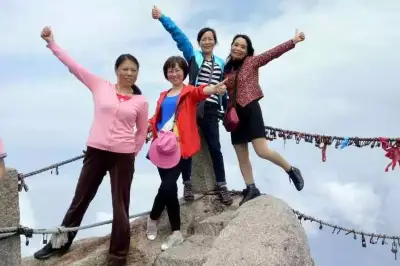
I wandered along the way, measuring the majesty and beauty of Huangshan with my footsteps. Combined with the extremely low visitor flow, the viewing experience was truly delightful. No wonder artists of all ages have been fascinated by Huangshan! The ancients said, 'Mountains high, admire them; paths broad, follow them.' Facing the remarkable craftsmanship of nature, we insignificant beings should suddenly feel enlightened! All worries and troubles are thrown to the winds! In front of such spectacular and beautiful nature, how can a tiny speck of dust like me not strive, not improve, not be optimistic? Life is worth it! The future is promising!
Around 4 p.m., I descended the mountain and took a bus back to Huangshan city center. Near the hotel I stayed at was a large Xinhua Bookstore, brightly lit, offering a wide variety of books, coffee, and creative products.
The bookstore provided many reading seats, either by the floor-to-ceiling windows overlooking the river or on the stairs where you could sit directly. I stayed quietly inside, waiting for the sunset afterglow and the endings of the books. I browsed several books I liked and picked up a collection of essays by Feng Zikai, titled 'Simplicity is Good,' which soothes the soul. I read about 'the third of the bright moonlit nights under heaven, the rogue being Yangzhou,' and about Tangqi Ancient Town where people row black awning boats. What can books bring us? It is that moment of peace, emotion, and joy in the heart...
Day 4: In every city, aside from must-visit attractions, what I enjoy most is experiencing the local customs and daily life of ordinary people. In the early morning, the vegetable market was full of lively atmosphere. Vendors and aunties were busy bargaining. Pretending to be a local, I walked around the market several times, buying fresh bamboo shoots, cured meat, and preserved mustard greens. I saw the famous Huizhou cuisine stinky mandarin fish and hairy tofu... Well, this is much better than the souvenirs at Tunxi Old Street.
Took the midday flight back. Goodbye, Huangshan; goodbye, Huizhou...
TIPS: Recommended local specialties of the ancient Huizhou region:
1. Tea: It was Qingming season, and pre-Qingming green teas were on the market. Huangshan Maojian and Taiping Houkui are famous green teas. Qimen Hongcha (Keemun black tea) is one of China's four major black teas. In Tunxi Old Street and the ancient villages of Xidi and Hongcun, there are many small shops stir-frying tea leaves on site, where you can also taste freshly brewed tea. However, it's hard to tell the genuine from the fake. I didn't buy any, so I can't recommend. I checked Taobao and found many Huangshan shops selling seasonal new tea; you could try that, though it might feel different from buying locally. Alternatively, you can buy from large supermarkets or tea stores in the city, which should be more reliable than at the scenic spots.
2. She inkstone and Huizhou ink stick: Excellent representatives of China's four famous inkstones, with inkstones being the foremost among the four treasures of the study. The main production area is now in She County. In a remote small house in Xidi Ancient Village, I saw a She inkstone with the simplest design. When touched, it felt as smooth and warm as baby's skin, with a uniform and deep color. On the side of the inkstone, there was a small golden dot of mineral matter. When I got back, I searched online but wasn't sure if it was a 'gold-star inkstone.' If you want to give a gift to a friend who is a scholar or artist, a set of She inkstone and Huizhou ink stick is an excellent choice. Alternatively, you can go to the She inkstone street in She County town for more options.
The picture below is one I took from the internet; I don't know how to maintain it, still learning...
3. Other local specialties: Huizhou cuisine is one of China's eight major cuisines. Its fame is related to the travels of Huizhou merchants and the difficulty of transporting food. Typical representatives include Huizhou hairy tofu and stinky mandarin fish. I visited a relatively large farmers' market in Huangshan City, but the items there were not convenient to carry. You can buy vacuum-packed dried tofu and mandarin fish at supermarkets or specialty stores. Additionally, the dried goods section in the market had a high quality and variety of dried bamboo shoots, making them a good choice for local specialties.