A High-Speed Rail Trip for Two (Part 2): Huangshan
Winter has passed and spring has arrived. City dwellers accustomed to urban clamor, it's time to escape the city to embrace nature and enjoy the breath of spring. If you missed Yangzhou in March and the peach blossoms at Daling Temple in April, Huangshan in May is a good choice. As the saying goes, 'After visiting the Five Sacred Mountains, you don't need to see other mountains; after visiting Huangshan, you don't need to see the Five Sacred Mountains.' Huangshan has been one of China's most famous mountains since ancient times, with its unique pines, strange rocks, sea of clouds, and hot springs known as the 'Four Wonders.' In Huangshan City, She County and Yi County are ancient towns with thousands of years of history. Among them, Xidi and Hongcun are representative of Hui-style architecture and folk customs.
To avoid the peak travel season, we scheduled our trip for the day after the May Day holiday (May 6-9, 4 days total). It is said that climbing Huangshan is very tiring and takes a few days to recover, so this time we only chose two representative scenic spots: Xidi, Hongcun, and Huangshan. We still chose high-speed rail as our means of travel.
Day 1: Guangzhou - Huangshan North - Hongcun
There is only one high-speed train from Guangzhou to Huangshan each day, arriving at Huangshan North around 3 p.m. Fortunately, there are shuttle buses to various scenic spots on the right side of the Huangshan North station, and we just caught the last bus to Hongcun. The fare is 30 yuan per person, and it takes about an hour to reach the west gate of Hongcun. Of course, taking a taxi is also a good option; the official guide price is about 200 yuan. Whether to take the bus or taxi is up to you, depending on your budget. To slowly experience the scenery of Hongcun, we chose to stay overnight inside the scenic area. According to online introductions, Hongcun scenic area is contracted by a private company, and ticket checks are very strict. Also due to the pandemic, for safety we made reservations and purchased tickets early on the Huangshan tourism platform. Most accommodations in the scenic area are guesthouses. The one we booked was converted from a century-old house, simple and quiet, weathered and gentle. The only drawback was poor sound insulation.
After checking in, the sky gradually darkened, and the red lanterns in the village lit up one by one, shining like stars in the misty rain. The white-walled, black-tiled farmhouses contrasted beautifully with the surrounding mountains, reflected in the lake like a landscape painting, intoxicating.
Day 2: Hongcun, Xidi
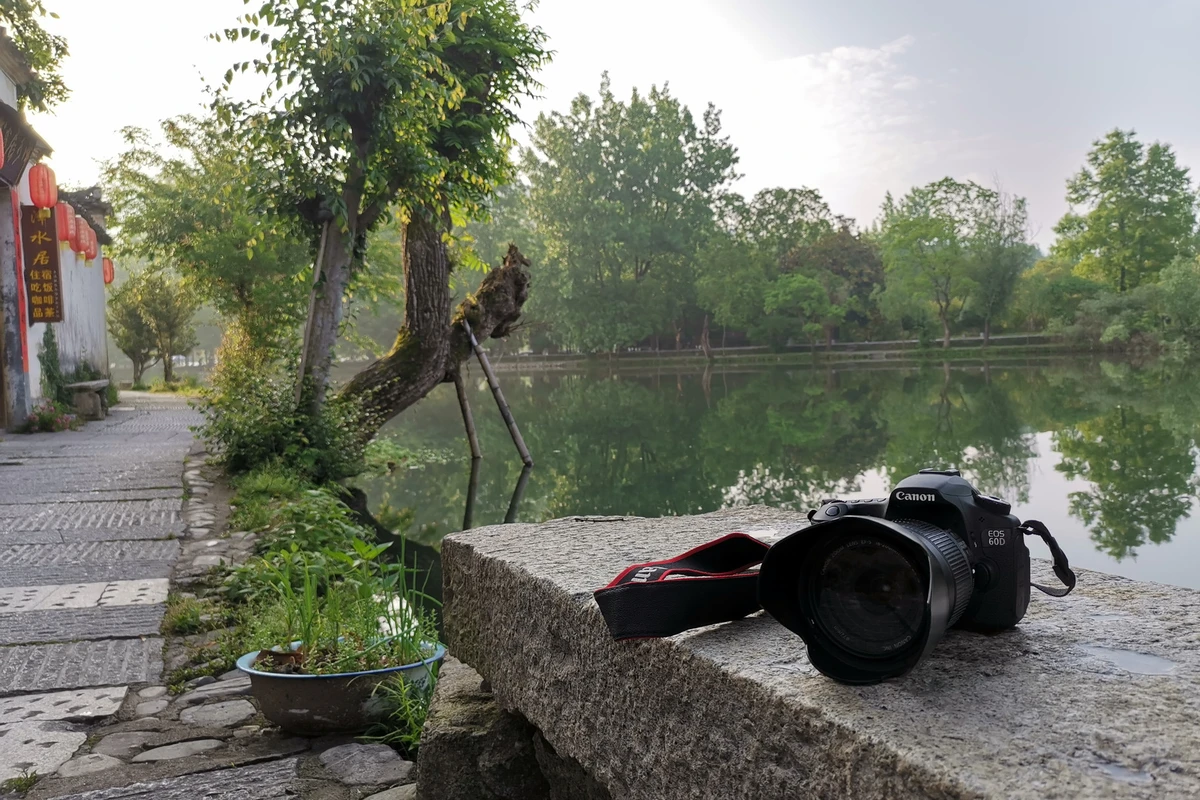
Hongcun: In the early morning, the mist had not yet dissipated, and the ancient town was shrouded in haziness, as if covered with a thin veil, looming. From a distance, it looked like a round island surrounded by the emerald South Lake. In the center of the lake, there was a small stone bridge, narrow enough for only two people to pass. On both sides of the small river were bluestone-paved paths, shiny and smooth. Willow trees, Hui-style residences, and mountains in the distant white mist were clearly reflected on the lake's surface. Occasionally, a breeze passed, causing ripples on the water.
Entering Hongcun along the Painting Bridge, there is a large circular pond in the center. This is the famous Moon Marsh Lake, also the 'ox stomach' of the ox-shaped village, shaped like a half moon, so locals call it Moon Lake, built during the Yongle period of the Ming Dynasty.
A different view of Hongcun.
Xidi: All streets and alleys in Xidi are paved with Yi County bluestone. Most are residences of wealthy families, with simple and elegant architectural tones, stronger architectural features. Compared to Hongcun, it is more grand and refined, but also somewhat bleak. Personally, I prefer Hongcun.
Day 3 & 4: Huangshan Scenic Area
Tangkou Town is located within the Huangshan Scenic Area. You need to take a special bus from the transfer center to the foot of the mountain, then take a cable car up. Huangshan has two cable cars: Cloud Valley Cable Car and Jade Screen Cable Car, which go up from different points at the south gate. Cloud Valley Cable Car goes up from Cloud Valley Temple in the back mountain, while Jade Screen Cable Car goes up from the front mountain. The scenic spots visited are the same, just in different order. Jade Screen Cable Car ticket is 90 yuan, Cloud Valley is 80 yuan. If you go up by Jade Screen, you come down by Cloud Valley, and vice versa. Personally, I suggest going up the back mountain and down the front mountain, which is more comfortable. Below is our route.
To watch the sunrise and sunset, we chose to stay overnight on the mountain. Honestly, this time's sunrise and sunset didn't impress us too much, but compared to the rainy days before, it was still worth it. The official website provides approximate times for sunrise and sunset (quite accurate), while the sea of clouds is more likely to be seen in July and August.
Personal tips to avoid pitfalls:
1. No need to bring a tripod for sunrise/sunset photography because there is no suitable place to set it up on the mountain; it's just a burden.
2. The First Ring, Second Ring, valley bottom, and the internet-famous little train are not worth it. The First and Second Rings just go down to the valley bottom with no scenery along the way. Going to the valley bottom only to spend 100 yuan on the so-called internet-famous little train to return to Bright Summit takes less than 10 minutes. According to the picture I posted, you can instead go from Paiyun Pavilion to Flying Stone, Qunfeng Peak, and finally reach Bright Summit.
3. It is recommended to go up the back mountain and down the front mountain. If you don't go to Lotus Peak, it takes about two hours to walk from Bright Summit to Welcome Pine, not too strenuous. Suggest going down early before the tour groups arrive, so you can take photos of the beautiful scenery without crowds, and take the cable car down without squeezing in line.
4. When going up, be sure to stretch and relax during breaks. If conditions allow, you can get a foot massage at the top.
This trip was only 4 days, so we selected Hongcun and Huangshan. We didn't have time to visit Muzhu Bamboo Sea, Tangyue Memorial Archways, Tachuan, etc. But that's okay; we plan to come again for an autumn trip to Huizhou, slowly experiencing the warm and quiet sunshine, gentle breeze, the blue sky and white clouds, the stone alleys, the moss-speckled black tiles and white walls, and quietly listening to the joys and sorrows of the years.