Casual Notes on Huangshan
Taking a bus is an inseparable process of connection in modern society. It allows us to experience the process of farewells and welcomes. The scenery outside the window moves forward like a traveling song, scene after scene without end; as a new scene appears, what passes through the heart is regret for what has gone and anticipation for what is new.
The journey from Wuhan to Huangshan takes nearly six hours by train, but about three hours of it are spent making detours. The bullet train passes through most of Jiangxi Province. After leaving Wuhan, looking out, the first thing you see is the plains, vast and boundless, with rice paddies stretching out. As a native of northern China, growing up in the countryside where the crops were all northern—wheat, corn, and so on—I had a magical understanding of rice paddies back then. I thought rice was something very precious, that only a very, very few people in China could eat it. I even believed that being able to have a meal of rice was something you could boast about for a long time. During my time at university in Wuhan, though I had seen rice paddies a few times, I still couldn't help looking out the window until the paddies faded away, and only then did I reluctantly withdraw my gaze. This might be a sacred ritual, like the carp streamers for Japanese boys or the dolls for girls—a ritual for growth, a beautiful memory of childhood perceptions.
The train was to pass by Poyang Lake. As three "homebodies" who rarely went out, even before reaching Poyang Lake we started staring at the map where the lake would be, opened our phone cameras early, checked every few seconds on the train to see if we had arrived, and excitedly told the other two, "Almost there, almost there." Actually, we were still a quarter of an hour away from the lake by train. The section where the train crosses Poyang Lake is over water. The train feels like a solitary boat drifting on the water—without Yueyang Tower's "floating light, leaping gold, still shadows, sunken jade," nor Erhai's "wind, flowers, snow, and moon." To describe it in one phrase: "In all directions, vast emptiness; a lone boat as if in the sky." Yet it had a special charm, indescribable, inexplicable.
When passing through Jingdezhen, the train direction was to be adjusted, and our seats also needed to be turned around. In an instant, many thoughts came to mind. I prefer to sit facing the direction the train is moving. The scenery that passes by never returns; farewells and welcomes happen in a split second. There is joy and sorrow, parting and reunion. What comes toward you will eventually pass; at the moment of contact, it is suddenly lost—there is decisiveness and also unflinching resolve. In that instant, it tempers our determination, sparing us from lingering emotional torment. Conversely, I really dislike sitting with my back to the direction of travel. This is an extremely sorrowful way of saying goodbye and welcoming. New scenes come into view from behind me, slowly reaching my eyes; from the start they carry the fate of loss, gradually moving away from me, irretrievable. This focuses all my attention on the mournful ritual of farewell.
Tangkou Town is a transit hub that gradually emerged around Huangshan tourism. It is also the necessary stop for entering Huangshan from the South Gate. The locals live off the mountain, so the entire town is mainly restaurants and hotels. Our visit to Huangshan coincided with the tail end of the Lu'an outbreak, so there were relatively few tourists. With no visitors, the whole town felt like a ghost town. What frightened us even more was the excessive enthusiasm of the hotel owners. As soon as we got off the car, a crowd of local hotel owners surrounded us. The three of us had a bunch of people standing in front of us. At first we thought it was the mafia, and were thinking about how to escape, when the owners asked if we wanted to stay. Under their warm invitation, we checked into one of their hotels. We thought that would be the end of it, but what really scared us came later: the owner would follow us asking, "Hungry? Have you eaten? Why not order some food here?" and similar things. The three of us all ordered noodles. Maybe it was a matter of taste, or maybe because we had been in Wuhan too long and our palates had become heavier—the food was too bland. One of my companions had to add two big spoonfuls of chili paste to get it down. Because Tangkou Town is a city built on tourism, everyone in the town has a kind of restless feeling. Whether it's hotel owners and staff or street vendors, what they showed me was a false sincerity. As night fell, the city grew quiet. Without the hustle and bustle of tourists, Tangkou gave me a sense of stillness. That extra stillness added a layer of mystery to Huangshan.
Huangshan, one of China's ten most famous mountains and the most extraordinary mountain under heaven, is located in Huangshan City in the south of Anhui Province. It has 72 peaks. The main peak, Lotus Peak, is 1,864 meters above sea level. Together with Bright Summit Peak and Heavenly Capital Peak, it is one of the three major peaks of Huangshan, and one of the 36 major peaks. Huangshan was originally called "Yishan" because of its blackish-green peaks and rocks, and its distant dark blue appearance. Later, it was renamed "Huangshan" due to the legend that the Yellow Emperor (Xuanyuan) once made elixirs here. Huangshan's representative landscapes include the "Five Wonders and Three Waterfalls": the Five Wonders are strange pines, grotesque rocks, sea of clouds, hot springs, and winter snow; the Three Waterfalls are the Renzi Waterfall, Baizhang Spring, and Jiulong Waterfall. When the Ming dynasty traveler Xu Xiake climbed Huangshan, he exclaimed, "After climbing Huangshan, there are no other mountains under heaven; the view is complete!"
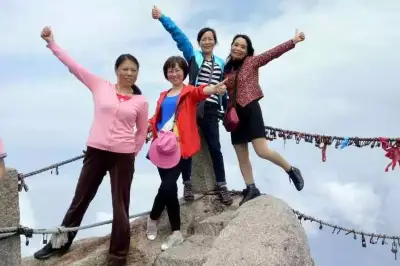
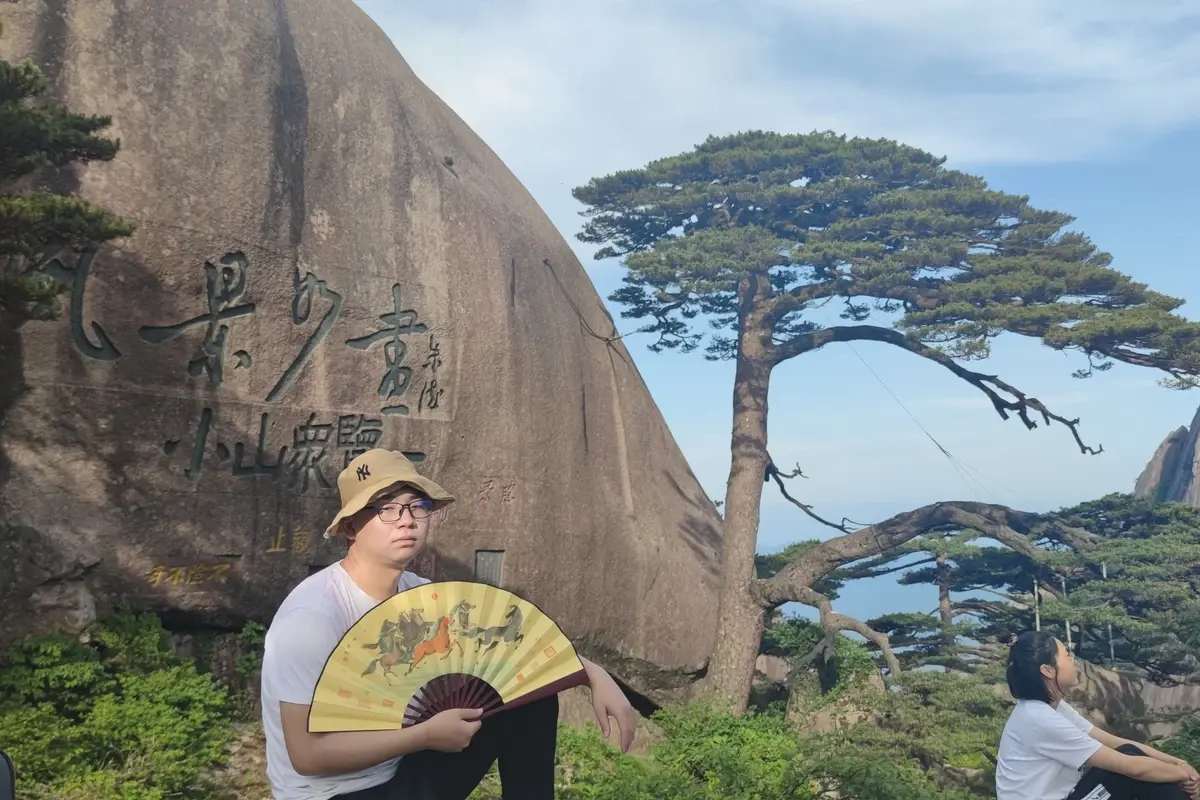
We climbed Huangshan the day after arriving in Tangkou. Originally we planned to cover all the scenic spots in two to three days, but due to epidemic prevention requirements, camping was not allowed, so we missed the sunrise. When we set out, the hotel owner recommended we take walking sticks. Being three young men, we politely declined, not realizing how much we would regret that decision. But that's a story for later. From Tangkou Town to Huangshan, everyone has to take a special tourist bus. This leg of the journey was the most affordable of all our expenses on Huangshan. Compared to average scenic spots, Huangshan tickets are on the expensive side, but once you enter the scenic area, you find they are worth the price. The main mode of transportation within Huangshan is the cable car. From the scenic area entrance to the core attractions, it takes about three hours on foot, but only about fifteen minutes by cable car (I strongly recommend the cable car—you can see scenery that you cannot on foot, and the core area is huge, so saving energy lets you see more beautiful sights; the views are as shown in the photos). Entering from the South Gate, taking the cable car, first arriving at Shixin Peak: the first stop is breathtaking (as shown in the photos)—strange pines, grotesque rocks, sheer cliffs everywhere. It makes you marvel at the uncanny work of nature. As a layperson, I couldn't help snapping pictures non-stop! Because it was my first time at Huangshan and I lacked experience, we chose a day when the sun was beating down on puddles of water, so we missed many views. For instance, the famous "Monkey Gazing at the Sea"—without clouds, a lone stone monkey stared blankly at the mountains, desolate. Lotus Peak, Flying Over Peak, Heavenly Capital Peak, etc. Hard to believe we climbed six mountains in one day, including a big canyon. At the very end, our final stop was the Welcoming Pine Tree. One companion, too tired, didn't go to see it. I think that was a huge regret, but he can keep a good memory of the Welcoming Pine in his heart. After I saw the Welcoming Pine, I felt a sense of regret. It didn't have the majestic feeling I had as a child; instead, it felt small and delicate. Still, it fulfilled a childhood wish.
All in all, Huangshan's scenery is magnificent. Although I didn't see everything this time, "seeing all the flowers of Chang'an in one day" is nice, but one should always leave something behind as an excuse to come again.
I love tea. Every time I visit a place, I go check out the local tea shops to see if there's any good tea to drink. I sit in the tea shop and soak in the rich fragrance of tea. Drinking tea is about its lingering charm—from bitter to sweet. As a child, all I tasted in tea was bitterness, so I didn't like it much. The habit of drinking tea started in Kathmandu. During my stay in Kathmandu, besides studying Nepali, I had a lot of free time. So I enjoyed talking with the locals—first, to improve my Nepali, and second, to learn about Nepali culture and customs. In those conversations, I got to know a tea seller, and he was the reason I started drinking tea. When we first met, every time we went to his shop, he would brew a pot of golden tea for us. As we interacted more, it became a habit. After Nepali class every afternoon, I would sit in his shop for a while, drink tea, and chat. Gradually, I developed the habit of drinking tea. Later, wherever I went, I would first ask locals if there was a tea house or any good tea.
Huangshan tea includes Huangshan Maofeng, Taiping Houkui, and Qimen Hongcha (Keemun black tea). Of course, there are also some wild teas, but the first three are the most famous. Huangshan tea has formed a complete industry chain, including tea planting, roasting, and selling. Huangshan Maofeng and Taiping Houkui are green teas; Qimen Hongcha is a black tea. Since I personally prefer black tea, I drink more Qimen Hongcha. Compared to other teas I've tasted, Qimen Hongcha has a certain smoothness—perhaps the softness of the Jiangnan water towns.
The thing that left the deepest impression on me during the Huangshan trip was this baked cake! I have eaten countless baked cakes, but only this Huangshan one was unforgettable—heart-wrenching, tears and sobs, tears streaming, excruciating pain, piercing heartache, stamping and beating my chest, crying to heaven and earth, deep hatred, mournful to the extreme, sorrow of losing a spouse, grief-stricken, pain as if skin peeled off, deep wounds still aching, forehead furrowed and heart pained, gnashing teeth in grief, gnashing teeth in hatred, deep loathing, deep disgust—pain upon pain, pain piercing the heart and spine, pain entering the heart and spleen, heart and brain agony, heartbroken to the point of wanting to cry but having no tears, so painful I wished I were dead, overwhelmed with worry, pain upon reflection, bitter hatred, so painful I wished for death, no attachment to life, and lingering words of attachment. Maybe I bought it in the wrong place, but I never want to eat it again. Later I bought from another place and brought it back. My roommate finished all the cakes that same day. Maybe I'm not meant to eat Huangshan meat cakes!
Huizhou-style architecture with an extra river.
Travelogue Contents: 1. Riding the Bus 2. Tangkou 3. Huangshan 4. Tea 5. Baked Cake 6. Hongcun 7. End!!!
Travel Information | Hotel Index | Attractions Index | Flight Index | Website Navigation | Travel Index | Cruise Index | Corporate Travel Index | Franchise Cooperation | Distribution Alliance | Friendly Links | Corporate Gift Card Purchases | Insurance Agency | Agency Cooperation | Hotel Franchise | Destination and Scenic Area Cooperation | More Franchise Cooperation | About Trip.com | About Trip.com | Trip.com Highlights | Contact Us | Careers | User Agreement | Privacy Policy | Business License | Security Center | Trip.com Content Center | Intellectual Property | Trip.com Group Algorithm Disclosure