Wuyuan and Huangshan Self-Driving Tour
In the summer of 2021, most places in Jiangnan were exceptionally hot and long; in early July, after a brief visit under the scorching sun to Weizhou Island, I began a long period of staying at home, which eventually saw off the intense heat and ushered in the cool autumn. Golden autumn is an excellent time for travel; if I didn't take some concrete action, I would feel I was letting the season down. So I picked a nearby destination I wanted to visit—Wuyuan and Huangshan—made some preparations, and set off by car.
The first stop was Likeng Village in Wuyuan, Jiangxi. The village has a history of nearly a thousand years, surrounded by mountains, with well-preserved Hui-style ancient architecture well worth a visit.
Visitors to the village can stay either inside or outside the scenic area. Considering we were driving and had a lot of luggage, we chose to stay inside the scenic area where we could drive in. Just after the long holiday and with rainy weather, there weren't many tourists inside.
The next day, we first went to Huangling, a famous spot for sun-drying autumn crops. Huangling Village, a national AAAA-level tourist attraction, was built in the mid-Ming Dynasty with a history of over 500 years. It is a typical mountain village with houses arranged in a fan-shaped terraced pattern around the water outlet, giving a strong sense of layers. The rain continued to fall, but there were still quite a few visitors; those taking the cable car had to queue for about 20 minutes. Despite the rain, the unique scenery seemed to keep our spirits high.
Persimmon trees laden with fruit.
What craftsmanship!
A little bird "stealing" a persimmon.
Then we drove to Tunxi Old Street in Huangshan. Also known as Song Street, it is the best-preserved ancient street in China with architectural styles from the Southern Song, Ming, and Qing dynasties. It is the only "National Historical Preservation Block" and was chosen as one of the "China Historical and Cultural Streets" together with Beijing's Guozijian Street and Suzhou's Pingjiang Road. The old street is 1,272 meters long and consists of over 300 Hui-style buildings built in different periods. Because it is located at the confluence of the Hengjiang, Shuaishui, and Xin'an rivers, it is also called a flowing "Along the River During the Qingming Festival".
Afterwards, we drove to Tangkou Town at the foot of Huangshan and checked into the Dexin Cultural Boutique Hotel, which is right next to the South Gate. The hotel's front door is modest, but its "content" is rich—it has dozens of rooms, a large restaurant, and a sizable supermarket, all very convenient. As we had learned beforehand, the hotel owner was warm, attentive, and professional. He used colored pens and text to draw a detailed one-day tour route for us on a Huangshan map, which was very practical guidance. He also analyzed that the weather would likely clear up after rain the next day with good visibility, and encouraged us to give it a try.
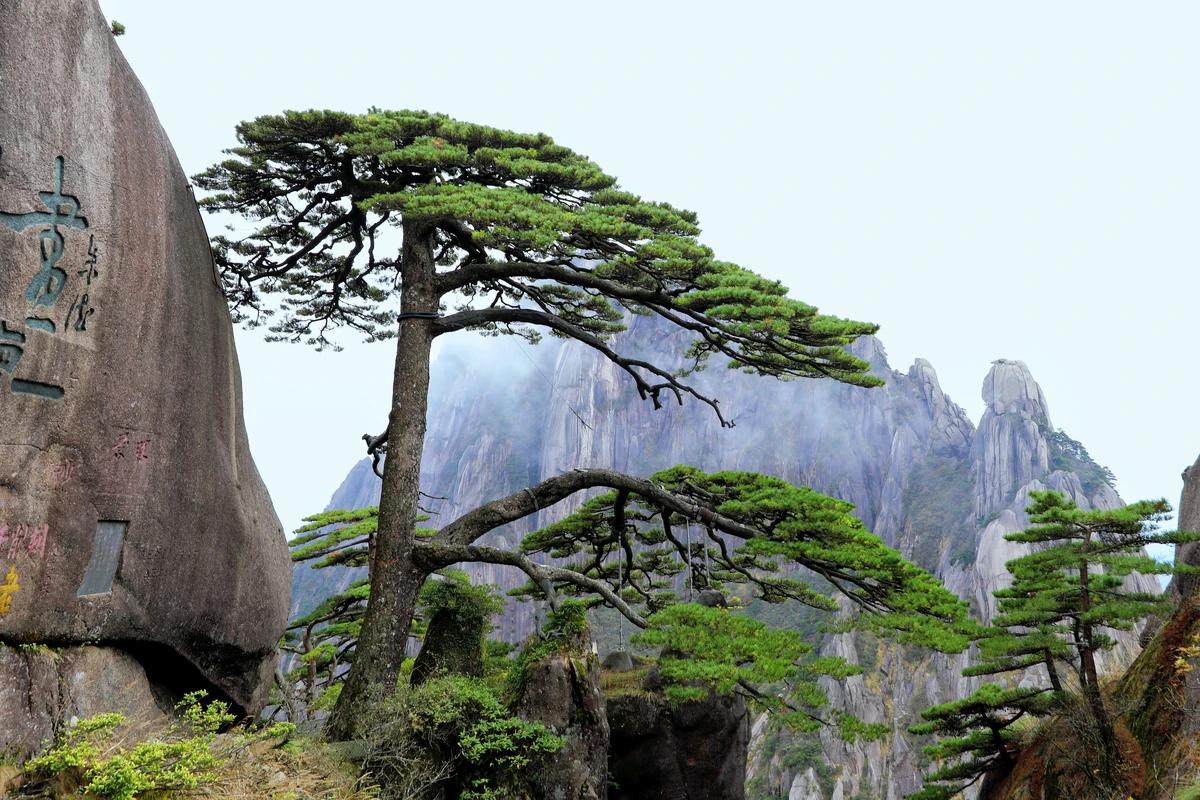
At 7:30 a.m., we walked 200 meters to the South Gate to buy tickets, then took the shuttle bus at the main transfer center to Yungu Temple, where we transferred to the cable car to get near Mushroom Pavilion. From there we hiked to Shixin Peak, Black Tiger Pine, Monkey Gazing at the Sea, Lion Peak Summit, Big King Pine, Bright Summit, Aoyu Peak, Hundred-Step Ladder, and Welcoming Guest Pine. Then we took the cable car at Yuping Pavilion and transferred to a bus to descend, returning to the South Gate transfer station. The entire trip took about 9 hours. The scenery of Huangshan is truly incomparable—very pleasing to the eyes but also very taxing on the legs. After going around, not only I but many other tourists were walking with a "twisted" posture. Although there were sedan chair services on the mountain, very few people used them. I saw some people wearing knee pads while climbing, which probably helped—it's something worth considering for the future.
Aoyu Carrying Golden Turtle.
Huangshan's most famous Welcoming Guest Pine.
On the way back, we went to the porcelain capital Jingdezhen to buy some ceramics. We also visited the "Big Bowl" Plaza in the Changnanli Cultural Scenic Area to experience the Jingdezhen International Ceramics Expo Food Festival. Then we stopped by Nanchang to see the "Sunac Mao" blue-and-white porcelain building complex, which is unique and probably "unmatched in the world".
Throughout this trip, at every stop, we only needed to show our itinerary code to prove our "clean record" to pass.