Going to Huangshan Without Waiting for the Return from the Five Sacred Mountains
I just wanted to match the 'Welcome Pine' to its name, stamp this Chinese calling card with my own mark and leave traces of the mountains and rivers. Only after arriving did I realize how small my mind was. The perfect match of beauty and danger made Huangshan never perfunctory. Standing right before it and being immersed in it, I couldn't help but push my physical limits and gain a bit more courage. At the age of 60, we climbed the highest peak and counterattacked the grand canyon. The challenge of the hiking route was beyond what I could ever imagine achieving.
Departing from Beijing on September 1st, high-speed rail round trip in three days: Day 1 took the earliest train and arrived at Huangshan North Station at noon, then headed straight to the scenic area to climb Huangshan, staying overnight at the top at Baiyun Hotel; Day 2 descended the mountain before sunset and returned to Huangshan City to stay at Huazhu She · Huangshan Yujian Old Street No. 8 Courtyard; Day 3 lingered for a while and returned at noon.
No stories, no travel. That day we took the earliest train (6:34) — actually it was a mistake. I thought I had misremembered the time; originally I thought it was the 6:54 train, but when I bought the outbound ticket, I had already set the stage for the error. It wasn't until the conductor checked the ticket that I found out this train only went to Lu'an in Anhui, so we had to get off in Hefei and transfer.
One mistake led to another. We stopped in Hefei for lunch. When we entered the station, we saw a notice that the train we needed to take was delayed by two and a half hours — we were instantly stunned. At that rate, by the time we arrived at the scenic area, the shuttle buses and cable cars would have stopped running. There was a long queue for ticket changes. We quickly operated on our phones to find a nearby train, but there were no seats, so we chose the next one. Just as we finished, the staff announced that even without a seat, you could board the nearby train, but if you had already changed your ticket, it wouldn't work. Regaining our senses, we realized that all our pre-purchased tickets (admission, shuttle bus, cable car, the hotel on the summit, the reservation after descending, and the return train tickets) were at risk.
We decided to adapt and re-plan. The urgent task was to cancel a series of bookings to minimize losses, because with the usage time approaching, they were essentially non-refundable. We didn't stop for a minute while waiting; our phones never left our hands. We used the most sincere words to touch people's hearts, uploaded various order screenshots and even photos of the station notice. Except for the return train tickets which incurred a cancellation fee, we managed to get everything else sorted. So we adjusted: the first night we stayed in Huangshan City, the next day we went up the mountain and still stayed at the summit, and the third day at noon we descended and returned. Then we rebooked everything all over again. And then it turned out that this actually suited our desired outcome better, and then we imagined traveling to Huangshan...
Nowadays, Huangshan City was once Tunxi County and later Tunxi City, about 60 km from the Huangshan Scenic Area. 'Huangshan North Station' (high-speed rail station) is in the suburbs, closer to the scenic area. There is a one-stop direct bus costing 20 yuan per person, with departures at different times — more frequent in the afternoon than in the morning. You can also share a private car, usually 7-seater with 6 passengers, at 40 yuan per person. You can search online in advance to contact the car owner. Taking a taxi (chartered car) basically costs between 170 and 200 yuan. From the city center to the scenic area, only a taxi (chartered car) is available.
Huangshan City features three main sights: two old streets (Tunxi Old Street and Liyang Old Street) and one river (Xin'an River). The city is not large and quite clean, with persistently high temperatures hovering around 34°C. At night it dropped a bit, after all it was autumn. We stayed at a highly-rated guesthouse on Tunxi Old Street (we had never tried this type before). At the end of a narrow alley, pushing open the courtyard gate revealed a hidden paradise.
Home away from home, very warm. The veranda and small courtyard were exquisitely designed, the guest rooms comfortable. Many old objects were preserved, evoking a sense of familiarity. The qin, chess, calligraphy, painting, tea ceremony rooms were all perfectly arranged. If you stayed a few idle days, it would be both nourishing and pleasing to the eye. The exquisite century-old courtyard brought a dialogue across time and space, truly enjoyable.
Under the evening glow, the Tunxi Old Street was sparsely populated. The pandemic had not yet truly eased, and tourist cities were hit hard. The night scenery was serene, the Hui-style architecture graceful, with a rare quietness. We found a famous old restaurant for stinky mandarin fish. When in Anhui, you must have this delicacy. The place was bustling, the taste authentic, and the price reasonable. I highly recommend Tunxi's 'Laoganma Local Food Restaurant'. In Beijing, you can't find such an affordable experience.
After dinner, we strolled along the Xin'an River. The colorful lights on both banks beautified the small town at night. The two old streets faced each other across the river. The original old bridge connecting them had collapsed in a flood and was being rebuilt, so now to go from Tunxi Old Street to Liyang Old Street you had to go around via the new bridge. While viewing Liyang Old Street from across the river, a tuk-tuk driver asked if we wanted a ride. After a day of battles, we were a bit tired and agreed immediately.
Liyang Old Street had more modern elements than Tunxi Old Street. There were old-style buildings and shops alongside trendy wine bars and restaurants. The blend of ancient and modern appealed to people, and locals also liked to come here. There were still not many people, but it was better than Tunxi. On the way back, the tuk-tuk driver (a woman) said that before, you could only see heads and no feet here, with bustling crowds and tremendous liveliness.
The next day, we arranged for the car to pick us up at 8:00. The guesthouse owner said that with fewer tourists these days, we didn't need to leave too early. The driver had chatted with us amicably the day before when we took a taxi from the high-speed rail station to the old street. We settled on a fixed price of 150 yuan, and also agreed that he would pick us up after descending and take us to the high-speed rail station. Leaving the city and getting on the expressway, we arrived at Tangkou Town in 45 minutes, then arrived at the scenic area shuttle bus transfer station. It was not just few people; it was almost empty. At one time, people would line up as early as 6:00 AM when the gates opened. The shuttle buses were idle in a row, and the cable cars also ran with many empty cabins.
Reminder: Tickets must be purchased one day in advance on the Huangshan Tourism Official Platform (mini-program). Adult ticket 190 yuan/person, students and seniors aged 60 and above half price, those over 65 free. No tickets sold at the scenic area entrance. Visitors usually enter through the South Gate (there are also West Gate and North Gate). At the transfer center, take the bus into the scenic area for 19 yuan/person (about 15 minutes). Be sure to distinguish the direction: front mountain (Yuping Cable Car) and back mountain (Yungu Cable Car).
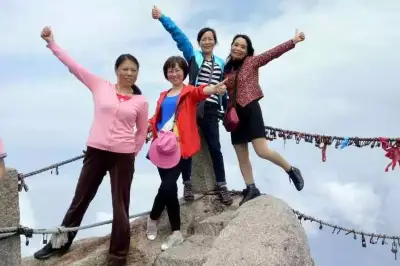
We went up from the front mountain, took the Yuping Cable Car (about 15 minutes) — Welcome Pine — Lotus Peak — Hundred-Step Cloud Ladder — Aoyu Peak — Baiyun Hotel. It was still over thirty degrees at the foot of the mountain, but as soon as we stepped out of the cable car cabin on the mountain, a cool breeze hit us. Huangshan is scenic everywhere, immediately capturing the heart. The 'Welcome Pine' was not far from the cable car station. Meeting it gave a ceremonial start to the tour. Although every pine on Huangshan is extraordinary, the fame is engraved on this one. The few tourists were a blessing; we could cuddle with the Welcome Pine freely, then climb to the adjacent huge rock to show some thrilling pose. Opposite was a cliff in the mist, and looking down into the bottomless depth felt like hanging in the air. When I stood up, my legs couldn't stop trembling. The price of taking photos was enduring it.
I must add that on the way from Yuping Cable Car to Welcome Pine, there is also a 'Farewell Pine'. Although there is a sign, it receives little attention. Since there is coming and going, remember it too! With high spirits, we continued towards Lotus Peak.
Huangshan's three main peaks, in order of height: Lotus Peak, Bright Summit, and Celestial Capital Peak. Lotus Peak and Celestial Capital Peak open alternately every five years. The temptation of climbing dangerous peaks lies in the boundless scenery. Before setting off, I watched a few videos and hesitated. When I climbed Baishi Mountain at 55, my right leg started having problems. Over the years, it's fine on flat roads, but when going uphill and consuming certain energy, pain appears when going downhill. From then on, I truly understood that going up is easier than going down.
Family encouragement gave me the greatest courage. I adjusted my backpack and summited. This mountain climb was basically 'crawling' up and down. There were many others doing the same, including young guys. The appearance might be poor, but it's important to balance energy and achieve the goal. The path was steep, dangerous, and narrow in places less than one meter. Those afraid of heights dared not look sideways. It took us one hour to finally stand on the summit at 1864.8 meters.
The summit area was not large. Without the few people, you could imagine a different arrangement. The mountain body resembled a lotus with several caves connecting through. Reminder: when descending, be sure to follow the direction of the stone carving 'Tuwu Chengqing Qiong' (suddenly supporting the blue sky). Many people made mistakes, including us. When tired, every extra step felt difficult. Later, every time I looked at Lotus Peak from afar, I felt immense pride. Look, that's the peak we climbed! Especially standing on Aoyu Peak (second only to the three main peaks in height), facing Celestial Capital Peak and Lotus Peak, I was deeply moved.
With the achievement of summiting Lotus Peak, my ambition to climb Aoyu Peak was reignited. Even though my legs were already struggling, as long as I didn't slack off, there was hope. After the base of the peak, I continued head down without stopping and climbed a stone ladder backwards. Standing up, I sighed whether this was a bit self-torturing. My husband told me that what we had just passed was actually the 'Hundred-Step Cloud Ladder'. Fortunately, his legs were very supportive and gave me a lot of support along the way. During those two days, I wanted to shout from the bottom of my heart: 'You are my legs.'
'Yixiantian' (One-Line Sky) was temporarily closed, so we took a detour to Aoyu Peak, which actually suited my current condition. Standing on Aoyu's back, I looked back at the steep stone ladder on the ridge, frozen before my eyes. Aoyu's mouth faced Lotus Peak and Celestial Capital Peak, all three peaks in the same frame. 'Baiyun Hotel' (white building) and 'Bright Summit' (round ball landmark) were in sight, victory near.
Around 3 PM, we entered the lobby of Baiyun Hotel (Area A). They also adjusted our reservation from Area B to Area A and upgraded the room (the two areas are 100 meters apart). Thank you so much! Every small kindness to reduce steps matters. I collapsed on the bed for a quick rest. We were at the summit and wanted to watch the sunset, but it started raining and didn't stop until dark. We were glad we didn't get caught in the rain, but regretted missing the sunset. We even thought about tomorrow's sunrise. The hotel lobby screen showed a 55% probability. Sunrise time was 5:44.
At 5 AM, we got up, put on the down jackets provided by the hotel, grabbed flashlights, and headed to Bright Summit. The sky was still dark, a deep blue with bright stars — a good sign. We climbed 700 steps to reach Bright Summit. If we had stayed at Bright Summit Villa, it would have been 50 meters away. The wind was strong, but still few people allowed us to stand at the best spot. When the sky turned fish-belly white, the sea of clouds below was magnificent. Unfortunately, clouds drifted over. The sun only squeezed a sliver of a face from the red and dazzling light, then was instantly covered. That was the 55% probability, and we were content.
We descended 700 steps (walking backwards) back to the hotel. On the way, I unexpectedly captured a full view of the turtle riding on Aoyu's back — yesterday I had searched for it for a long time from above. My husband applied ointment and massaged my legs for a while, relieving some pain. After a short rest and breakfast, we started a new day. Perhaps due to few tourists, the dinner buffet was not available (usually 160-180 yuan/person), only set meals or à la carte. The room included breakfast, which was a buffet and quite rich.
Regardless of age and physical condition, staying overnight at the summit is very worthwhile. Although the room rates and dining are rigidly unaffordable, considering that at an altitude of 1800 meters, everything is carried up by human porters, you can understand. Since we encountered such a breathtaking beauty, if we could accept the cost, to travel leisurely and see to our heart's content is an outcome we didn't want to miss.
We descended via the back mountain: West Sea Grand Canyon — Cloud-Dispelling Pavilion — Unity Pine — Black Tiger Pine — Dream Pen Flowering — Yungu Cable Car. On this day, the mountain tour began with the challenge of 'West Sea Grand Canyon'. The canyon has a drop of about 430 meters. Most visitors enter from Cloud-Dispelling Pavilion, go all the way down to the bottom, and take the internet-famous rail trolley up. We did the opposite: first took the rail trolley down to the bottom, then reverse-climbed over 2200 steps up to Cloud-Dispelling Pavilion. As the rail station staff said, only 'tough guys' do this. Indeed, we didn't see a single tourist going in our direction. This was also because my legs made descending more difficult — otherwise I would have had to give up the grand canyon. Being conquered by beauty again witnessed our perseverance.
The scenery was everywhere. The amazing thing was the visual enjoyment of constant change — too beautiful! Step by step, surrounded by cliffs, walking on clouds like aerial photography. I had already forgotten my legs. Three hours completely overturned the relationship between photos and reality. No matter how you shoot, you can't capture the colors and three-dimensionality of the eyes. And the occasional appearance of clever squirrels — intoxicating to the point of bleeding. No regrets left.
We had a coffee at Cloud-Dispelling Hotel and rested a bit. Facing the 'Flying Stone' in the direction of Bright Summit, it no longer felt strange. There are too many flying stones, truly amazing the craftsmanship of nature — if someone had deliberately designed and placed them, it couldn't be so coincidental. We continued walking down to the Yungu Cable Car lower station (Bai'e Ling Station), passing Xihai Hotel and Beihai Hotel. The famous pines of the back mountain appeared one by one. We paid a courtesy glance at 'Shixin Peak' and 'Monkey Gazing at the Sea' but didn't go further. Then we passed the symbolically named 'Unity Pine', 'Umbrella Pine', and 'Black Tiger Pine'. Actually, all the pines on the whole mountain are extraordinary, no exaggeration.
White mist shrouded 'Dream Pen Flowering' as if falling into a fairyland. You were also in the clouds and mist, not knowing where. Still sighing, facing the natural creation, you couldn't capture that effect with a camera. Lend me a pair of keen eyes! The majestic grandeur of the front mountain and the delicate softness of the back mountain were perfectly embodied here.
The Yungu Cable Car lived up to its name, especially the upper half. If not for the glass of the cable car cabin, it seemed you could reach out and touch the drifting clouds and mist. Huangshan's seamless beauty gently carried us down to the mountain. The hiking pole with red 'Sizhao' fruit witnessed our tough memory: that when we are too old to go anywhere, we can still hold each other as treasures in the palm of our hands.
Recommended itinerary: Day 1: large transportation to Huangshan City, preferably by high-speed rail. After exiting the station, there are multiple transportation options to the scenic area. Stay overnight in Tangkou Town at the foot of Huangshan. Day 2: climb the mountain, best to arrange one and a half days. Enter the mountain in the morning, stay overnight at the summit. Day 3: descend after noon and return.
Back mountain ascent: Huangshan South Gate — shuttle bus (Yungu Cable Car direction) — Yungu Temple station take cable car (one-way 80 yuan/person, about 10 minutes) — Harp Pine — Shixin Peak — Black Tiger Pine — Monkey Gazing at the Sea — Dream Pen Flowering — West Sea Grand Canyon (Cloud-Dispelling Pavilion entrance, descend to the bottom) — take the rail trolley (one-way 100 yuan/person, note it closes at 17:00) — stay at the summit.
Front mountain descent: early morning Bright Summit to watch sunrise — Aoyu Peak — One-Line Sky — Hundred-Step Cloud Ladder — Lotus Peak — Welcome Pine — Yuping Tower station take cable car (one-way 90 yuan/person, about 15 minutes) — shuttle bus — return to Huangshan South Gate.