Yellow Mountain: A New Beginning (Travel Notes + Guide)
Yellow Mountain: A New Beginning (Travel Notes + Guide)
At the beginning of the year, I wrote in my plans: go to Yellow Mountain, go to Nanjing, go to Xi'an.
Nanjing had a COVID outbreak, so that was put on hold; Yellow Mountain was too far, and there was always rain in the scenic area, so I waited.
The cost, risk, travel guides, accommodation, and location choices—every aspect of traveling was enough to intimidate me. Because I was traveling alone, I had to take care of every detail. I scoured websites on my phone, looked for guides until my head spun, spent 4 days on research, browsed Ctrip for 3 days, asked around among friends and family, and jotted down all the key points in my notes.
One morning at a little past 4 a.m., I dragged a suitcase full of lone courage onto a bus. Getting on the bus meant the victory trumpet had sounded—once you're on the road, the destination is close.
Every time I persuaded my parents to let me go out, it felt like I was persuading myself. It's easy to talk about going anywhere, but taking real action requires a lot of courage.
Just before setting off, I thought about backing out and lying flat in bed. My mind was saying: What am I doing? Wasting money and tiring myself out—I might as well buy a suit. Stop, don't go! But my body started nimbly putting on shoes, washing up, pulling the suitcase, going downstairs, and opening the door.
On the way, someone asked: "Young lady, traveling alone?"
"Yeah, I always travel alone, it's very convenient," I replied, pretending to be calm and experienced.
I really had done so much research that I took the bus directly to the Yellow Mountain Scenic Area, avoiding several transfers and saving a few dozen yuan.
After arriving at the scenic area, I took a taxi to Tangkou Town at the foot of the South Gate of Yellow Mountain and checked into a local youth hostel. The manager was beautiful and smiled very friendly; after processing the check-in, she helped me with my luggage and led me to my room.
The hostel had a great atmosphere. At 8 p.m., they gave a unified hiking briefing in the lobby, helped pair up hiking partners, and provided free trekking poles. The shop sold raincoats, gloves, and other travel supplies.
This hostel had many books and was carefully decorated. There was a common area where a group of strangers, mostly young people, could chat and form hiking teams.
After a quick wash, I called the driver who had taken me to the hostel. He said he would drive me to any scenic spot I wanted for just 50 yuan for the afternoon. Naively, I thought I had met an incredibly kind person. I bought a drink from the supermarket that I wouldn't normally buy for myself—a pricey one—and gave it to the driver.
On the way to the "Jadeite Lake" that the driver strongly recommended, I realized I was a plump, tender leek waiting to be harvested. In fact, we only went to Jadeite Lake, and it was ridiculously close. I wanted to go to the Mukan Bamboo Sea, but he insisted it wasn't nice—though netizens had good reviews and the ticket wasn't expensive.
When I checked the map, I saw the scenic spots were far apart. I understood why he stopped me. Afraid of conflict, I didn't say much more. I even bought the tickets he forcefully recommended.
On the way back, he said that with the ticket to Jadeite Lake, I could drink free tea and listen to the history of Yellow Mountain. I wondered why I hadn't seen this in my research, but when I asked the driver, he didn't answer.
I again felt I was being petty and misjudging this incredibly kind person.
When I sat down in the empty tea room, a nearly bald auntie poured me tea and started talking about how this tea was good for the skin and that tea was suitable for elders. I began to realize there's no free tea on Yellow Mountain.
After barely finishing two sips, I quickly escaped. The auntie chased after me and asked if I wanted to buy local specialties. With a straight face, I got into the car and told him I wanted to go back.
In the driver's car, I said to the official tourism company's customer service: "Wow, I met a driver."
The customer service immediately replied: "Don't buy tea, don't buy tea, don't buy tea."
I almost laughed and jumped out of the car. I said, "How did you know?" He said, "As soon as you said 'driver,' I knew."
Then he explained some local tourism scams on how they rip off tourists. When I was looking for guides on WeChat, I had found the official public account and added the Yellow Mountain travel group, as well as customer service. It's an official channel that doesn't push sales, only answers questions—highly recommended.
Let me talk about my experience at the Jadeite Lake scenic area. I deeply regretted it, my intestines greener than the lake water. The best spot in the whole scenic area is shown in the picture.
After finishing the scenic area, I could feel how hard the copywriters had tried.
There was a five-star attraction named "Love Character Stone." I thought it must be a spectacular view, at least a heart-shaped stone at worst. As I got closer, I began to suspect that the Love Character Stone might be just an ordinary rock with the character "爱" (love) written on it.
When I excitedly rushed to the blocked-off undeveloped area, the staff told me that was the end; the last scenic spot on the ticket was not open.
I asked, "Where is the Love Character Stone?"
He casually pointed to the ground behind me. I saw a flat, large rock with a big red painted character "爱" on it.
I was at a loss... I felt the wind stop, the trees wither, the water freeze, the leaves turn yellow, birds fall, and shrimp stare blankly. I marveled at how accurate my sixth sense was.
A little suggestion: When you go to Yellow Mountain, just climb Yellow Mountain. Scenic spots like Nine Dragon Waterfall are not recommended. If you want to go home after climbing, there's luggage storage at the foot of the mountain. If you have enough time, energy, and money, you can visit Hongcun or Xidi. The entrance fee is 90 yuan, which I think is unnecessary.
Below is the guide section.
Recommended essential and precautionary items. Essentials: ID card, sun-protective clothing, trekking pole, power bank, charging cable, mask, hat, thermos, bread, tissues. Preparations: cucumber, orange, chocolate, fruit knife, socks, raincoat, gloves, one bottle of water. (There is drinking water on Yellow Mountain.)
Stretch before going up the mountain and after coming down. I personally tested it—my legs really didn't ache.
Yellow Mountain is really winding. Seeing the official website guide for the first time can be dizzying. I first looked at a simple route map, then a complex one; it took a long time to fully understand.
If you go to Yellow Mountain, know that it has several parts:
- Yellow Mountain city area (with Tunxi Old Street)
- Yellow Mountain North Station (high-speed rail station)
- Tangkou Town (a small town at the foot of Yellow Mountain with plenty of accommodation, a 10-minute drive from the scenic area entrance)
The scenic area has parking spaces, but the day we parked, it cost 44 yuan. If a local farmer invites you to park in front of their house, it might be 10 yuan. Communicate with them; if you're unsure, you can record it. (My temporary hiking team drove from our accommodation to the scenic area entrance.)
Route 1: Home → nearby high-speed rail station → Yellow Mountain North Station → bus to Yellow Mountain Scenic Area → accommodation → foot of Yellow Mountain Scenic Area → bus to the starting point of the climb.
Route 2: Home → bus station → Yellow Mountain city → bus to Yellow Mountain Scenic Area → accommodation → foot of Yellow Mountain Scenic Area → bus to the starting point of the climb.
Route 2: Home → bus station → Yellow Mountain Scenic Area bus → accommodation → foot of Yellow Mountain Scenic Area → bus to the starting point of the climb. (I took Route 3.)
1. From the transfer center, take the scenic area bus to Cloud Valley Temple—buy a 19-yuan ticket—then take the cable car up the mountain or hike up—start sightseeing. (This is the back mountain route, which is gentle.) Back mountain cable car: 80 yuan.
2. From the transfer center, take the scenic area bus to Ciguang Pavilion—buy a 19-yuan ticket—then take the cable car up the mountain—start sightseeing. (This is the front mountain route, which is steep.) Front mountain cable car: 90 yuan.
Check the opening times for going up and down before you go. They differ between spring/summer and holidays/weekdays.
The entrance facilities of Yellow Mountain Scenic Area are the longest, most complex I have ever seen. First go to the scenic area parking lot, then buy a bus ticket to the foot of the mountain, then multiple ticket checks.
When looking for guides, many place names seem reachable. If it's confusing, I suggest looking at a simple map.
Once you're on Yellow Mountain itself, it's divided into three main parts: front mountain, back mountain, and West Sea. You can go up and down via the front or back mountain. Almost no one can hike both up and down without taking a cable car in one day. When I teamed up with a friend from Hunan at the hostel, he knew nothing about Yellow Mountain. When we reached Black Tiger Pine, a group of tourists started coming down from where we came up. He asked, "Is this it? There's nothing much to climb!" Just then, a scenic area worker, an old man, snorted from his nose and coldly said, "Dreaming! You haven't even started climbing yet!" The nearby tourists laughed and walked away.
If you want to tour the scenic area in one day and take only one cable car, I recommend arriving at the foot of the mountain at the earliest opening time. Don't take too many photos while climbing; just take a few. Keep a tight pace.
I didn't take the small train in the West Sea Grand Canyon—100 yuan for 3 minutes, I felt it wasn't worth it. Also, the West Sea area is newly developed; I suggest not going.
Previously, customer service told me not to go, saying that if I planned to climb in one day with one cable car, I wouldn't have enough time or energy. I didn't believe it. After climbing the West Sea and heading to Bright Summit, I almost collapsed on the steps.
Once on the mountain, you can look at the map and follow tour groups. The back mountain is quiet and relaxing; the front mountain is steep and breathtaking. I went for the steep steps of Yellow Mountain—there's a sense of adventure. I came up from the back mountain, and by the time I reached the front mountain, I was very tired and pressed for time, so I just skimmed through. I forgot to go to Lotus Peak—a bit regrettable.
It may seem like it's always raining on the Yellow Mountain scenic area app. Don't worry too much about the weather—as long as it's not dangerous, it's fine. Yellow Mountain weather is changeable. I checked the forecast in the morning—thunderstorms. When I set out, it was overcast. On the mountain, the sun came out. At noon, there was fog. In the afternoon, it was cold and overcast. In the evening, it rained. After descending, it cleared up.
Be sure to bring food up the mountain!!! It's part of the hiking ritual. But don't carry too much! Just ham, bread, melon, and some tasty snacks. On one section where I was too tired, I ate while climbing, and the pain was halved.
This shop was the only sincere recommendation from the driver who drove me. The prices were reasonable. I bought a backpack full of food for about 50 yuan. The noodle restaurant next door was good, and the stir-fried dishes weren't cheap but tasted good.
After being outside, I appreciated home even more. After returning to Hefei, I found the prices in the small alleys there were very friendly.
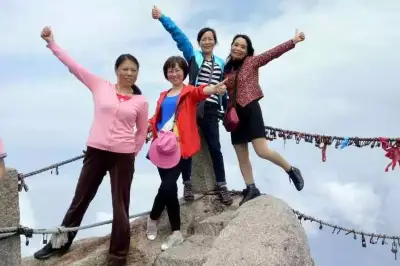
Finally, let me share some interesting encounters with people during the climb. I teamed up with two others from the hostel to climb together. I had detailed notes, so the other two, who had no guide, were happy to follow me.
The happiest part of the journey was meeting all kinds of interesting tourists: elderly couples from Guangdong and Guangxi, a live-streaming tour guide, a young lady in high heels, and a 3-year-old child. They'd appear in your view, then disappear, then show up in a corner of your photo album. We met at Cloud Valley Temple, parted at Beginning-to-Believe Peak, met again at Cloud-Pai Pavilion, brushed past at Turtle Cave, shared a frame at Bright Summit, separated on the descent, and took selfies in front of Greeting Pine.
Experienced hikers would go down backwards, saying it was easier on the knees, and enthusiastically recommended the method.
A common consensus among Chinese tourists: queue to check in at famous spots. The row of stones in front of Greeting Pine had been worn into little butt-shaped indentations by countless sitters.
When I was taking photos for my companions in front of Greeting Pine, some tourists noticed my patience and asked me to take photos for them. After I shot for a middle-aged couple, they carefully looked at the pictures, smiled, and thanked me! I felt a sense of duty as an Anhui local.
As for whether Yellow Mountain itself is beautiful, I can't really judge, because it was the first mountain I had ever seen. So I can't fully grasp the saying: "After seeing the Five Sacred Mountains, no other mountain is worth seeing; after seeing Yellow Mountain, no other mountain is worth seeing." So if I have another chance to climb, I will compare and savor more. I will challenge those steep, narrow stone steps again.
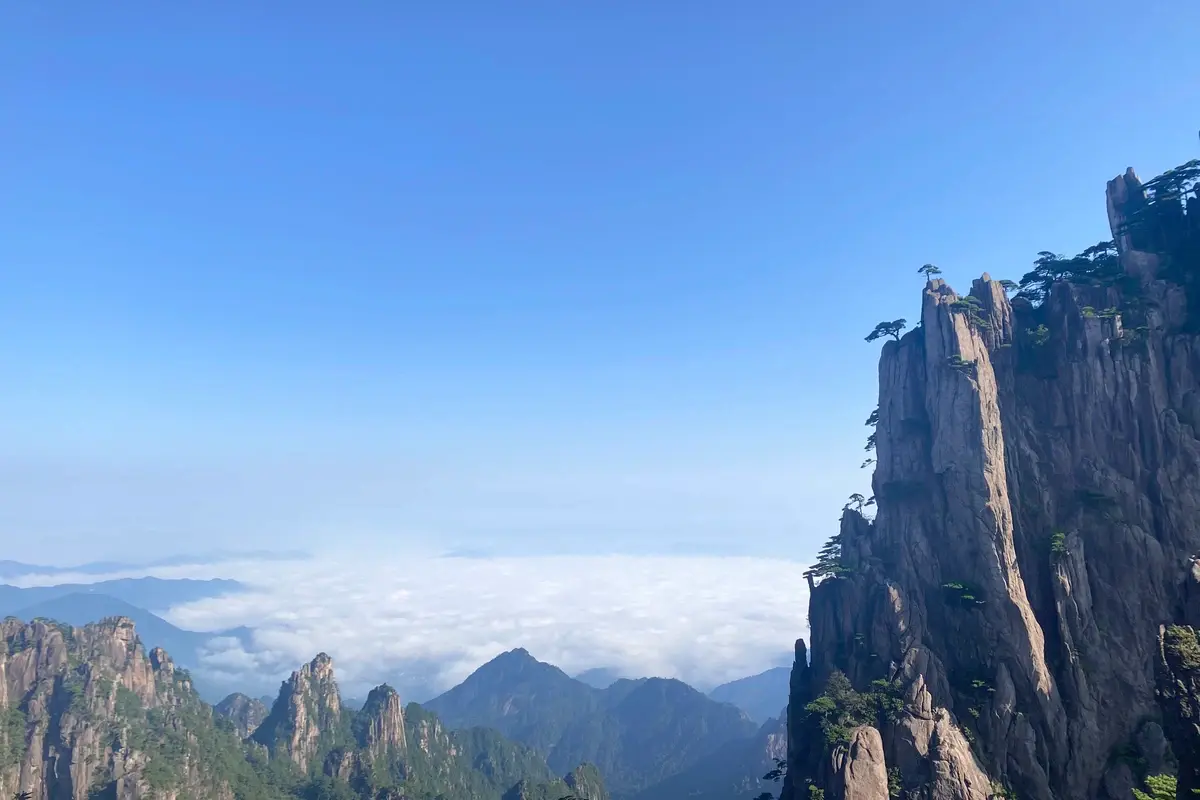
But I witnessed how fog could swallow a mountaintop in three minutes.
I remember a particularly funny scene: we reached "Monkey Gazing at the Sea" and clearly saw a monkey-shaped rock sitting on a peak, staring at a smaller hill opposite.
It looked more like "Monkey Gazing at a Hill" rather than at the sea.
Again, the Hunan teammate asked, puzzled: "Is this what Monkey Gazing at the Sea is? Isn't the monkey always there? It's not that rare?"
"Someone in the group yesterday said they sat for an hour and didn't see it!" I started to wonder too.
So we sat down and had some snacks. Within less than three minutes, fog suddenly rolled in, engulfing the small hill opposite the monkey rock, and sure enough, it became "Monkey Gazing at the Sea." Then the monkey rock itself was also swallowed. So Monkey Gazing at the Sea really can disappear. I thought maybe a demon wind came and Wukong went to catch monsters.
Soon other tourists arrived and said disappointedly: "Oh, we can't see Monkey Gazing at the Sea." Only then did the three of us realize how lucky we were—we had seen a rare wonder of Yellow Mountain in just a few minutes.
On the return trip, I took my hiking friend's suggestion and bought a high-speed rail ticket, thinking to experience a different route. Other than being an hour faster, there wasn't much difference. There were also a few small surprises along the way, but as long as I got home safely, the trip was a success. For a girl like me, going out requires even more courage about safety.
My biggest gain from this Yellow Mountain trip was not the scenery, nor the travel companions, but courage. The courage to go alone to more places in the future. The confidence not to fear making travel guides or road bumps ahead. The unlocking of new possibilities—turns out I could do it, I could do it alone.
When I was doing research, I also discovered many possibilities and methods. The scenery of travel itself may not be that captivating, but the bits and pieces before setting out are enough to make you grow. I cut off a shackle in my mindset. When exploring happiness and broader horizons, I can be lighter and less worried.
In the drama "The Imperial Coroner," Xiao Jinyu said: People say he's strategic, steady, and resourceful. It's not because he's divine, but because he has more information and comprehensive understanding, so his judgments are closer to the truth. Confidence is not arrogance; it's data from analysis and evaluation. The so-called sense of security comes from what you can predict and control. When you are well-prepared, you can choose, judge, doubt, and believe.