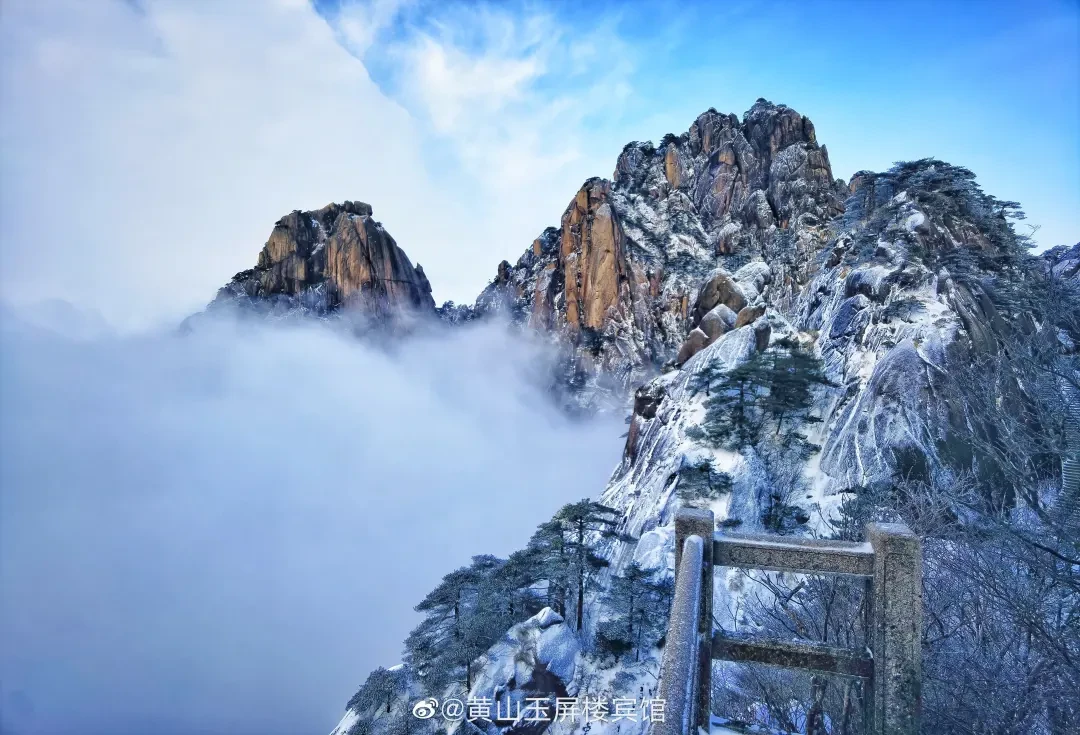
Climbed Huangshan to See the Rime-Covered Trees
I haven't been to Huangshan (city) for a long time.
This season is the local off-peak travel period, but driving on the streets, I found it too desolate. On the way to climb Huangshan, I hardly saw any people or cars. When we arrived at the scenic area, only my friend and I went through layers of security checks, preparing to take the shuttle bus to the scenic spot. For a major tourist destination like Huangshan, only about 600 people were climbing the mountain that day.
"Sigh, when will the pandemic ever end?" I silently sighed to myself while boarding the cable car to begin today's climbing journey.
In today's post, you'll learn: winter Huangshan climbing guide, price levels, accommodation tips, and some sincere advice.
Winter Huangshan Climbing Guide
Climbing Huangshan is a childhood dream from long ago. Although I can't remember the elementary school textbook about Huangshan, the scenic beauty left an impression on everyone from a young age. But actually climbing it is a different story.
At first glance, Huangshan seems unremarkable—neither steep nor very high, and without thrilling features like the "Turn of the Goshawk." Yet many say climbing Huangshan is exhausting. Why? Because there are many peaks! Huangshan is a circular mountain with over 200 attractions. If you rely entirely on walking up and down to cover most spots, it takes at least 2–3 days. No wonder people say "after Huangshan, no other mountains are worth seeing"—maybe it's because you're too tired! 😂
What to See When Climbing Huangshan?
The famous Huangshan has five wonders: strange pines, bizarre rocks, hot springs, sea of clouds, and winter snow. The first three are easy to see or experience—strange pines and bizarre rocks are scattered along paths and peaks; you don't need to seek them out—you'll see some as you pass. The latter two depend on the season and luck.
Many think that as long as the mountain is tall, there will be a sea of clouds. Actually, cloud formation has its reasons and patterns. Huangshan has high peaks and low valleys, lush forests, short sunshine hours, and slow evaporation, leading to high humidity and moisture, making rain and fog common. That's why many visitors often see nothing but clouds and mist.
Huangshan's sea of clouds is mainly formed by low clouds and ground fog. The best time to view it is from November to May, especially after rain or snow, just before sunrise or after sunset, when it's most spectacular.
There are five spots to view the sea of clouds: Yuping Tower for the South Sea, Qingliang Terrace for the North Sea, Paiyun Pavilion for the West Sea, Bai'e Ridge for the East Sea, and Guangming Summit for the Heavenly Sea.
Cloud sea photo taken by the roadside.
In winter, snow scenes are a must. From December to February, it's the heavy snow period, making it easy to see ice falls and rime. Best viewing spots: Yuping Tower, Beihai, Songgu, and Hot Springs.
When I went, it had snowed a few days earlier, and we saw crystal-clear rime everywhere. The sun occasionally appeared on the mountain road, and a stranger ahead called me to look back at the sparkling rime in the sunlight—only to have a shower of rain fall on me.
Recommended Route
Huangshan has a front mountain and a back mountain. Online debates rage about whether to start from the front or back. Based on personal experience, for an easier climb, start from the back and descend from the front. The front mountain has beautiful scenery, including the Welcoming Pine, so it's crowded with tour groups in the morning; starting from the back avoids them. Going up the back first, then to the front, you won't feel a big drop in scenery and will always be surprised.
Main reason: the front mountain is steep, the back is gentle. When I descended from the front, the path looked like this (see photo). I couldn't imagine climbing up that—I'd be exhausted. If you're afraid of heights, take the front mountain up and back mountain down.
There are three cable cars: the back mountain Cloud Valley Cable Car, the front mountain Yuping Cable Car, and the North Gate Taiping Cable Car. Tickets are marked accordingly. Also, there's the West Sea Sightseeing Train for the West Sea Grand Canyon.
Here's a one-day route recommended by many netizens based on experience:
Cloud Valley Cable Car up → Shixin Peak (home to famous pines like the Welcoming Pine, Black Tiger Pine, Linked Love Pine, Dragon Claw Pine, Sleeping Dragon Pine, and Sea-Exploring Pine, plus strange rocks like Stone Bamboo Shoots and Eighteen Arhats Facing South Sea) → Paiyun Pavilion (for cloud sea views) → Guangming Summit (view Flying Rock and Heavenly Sea) → West Sea Grand Canyon (take the popular train; suggest buying a round-trip ticket to save time) → Lotus Peak or Tiandu Peak (alternate opening) → Welcoming Pine → Yuping Cable Car down.
In winter, the West Sea Grand Canyon and Lotus Peak are under maintenance until March 31, so these areas and the West Sea Sightseeing Train are closed—don't go for nothing! Also, Cloud Valley Cable Car has been under maintenance for half a month, so we took a detour via the North Gate Taiping Cable Car. Actual hiking time: 4.5 hours. The steep front mountain was mostly downhill for us, relatively easy. Next time, I'll climb again via Cloud Valley Cable Car and stay two nights.
We entered the mountain at 11 a.m. and skipped many spots to catch the last cable car. If you're going soon, you can follow our route:
Taiping Cable Car up → Paiyun Pavilion → Flying Rock → Qunfeng Summit → Guangming Summit → One-Line Sky → Aoyu Peak → Hundred-Step Ladder → Welcoming Pine → Yuping Cable Car down.
Accommodation Guide & Price Tips
To watch sunrise or sunset, stay on the mountain. The cable car stops at 4:30 p.m., and walking down after sunset takes 3–4 hours in the dark—dangerous.
Famous sunrise viewing spots: Shixin Peak (Mushroom Pavilion), Gongyang Peak (Bai'e Villa), Lion Peak (including Qingliang Terrace and Shuguang Pavilion), Danxia Peak, Guangming Summit (including Danlian Peak), Aoyu Peak, Yuping Peak.
Sunset spots: West Sea Paiyun Pavilion, Danxia Peak, Flying Rock, Guangming Summit, Bu Xian Bridge, Lotus Peak. Paiyun Pavilion and Bu Xian Bridge are most famous for West Sea sunset glow.
In short, for convenience, stay near Guangming Summit. The terrain is open, and you can see both sunrise and sunset here.
For a weekend trip, most people rest at Tangkou Town at the foot of Huangshan and climb the next day. Friendly reminder: Huangshan is actually quite far from Huangshan city (Tunxi District). If we had known, we wouldn't have compressed our mountain time.
There are many accommodation options on the summit. Top-rated ones (surveyed) include:
- Yuping Tower Hotel: Near Yuping Cable Car, easy for luggage. Renovated 2015. Watch sunrise at Guangming Summit (30 min walk). From 1140 RMB.
- Guangming Summit Villa: On Guangming Summit, renovated 2015, great views, close to sunrise, sunset, and cloud sea. From 1260 RMB.
- Baiyun Hotel: Good location near Aoyu Peak, Guangming Summit, and West Sea train. Renovated 2008, slightly better conditions than Guangming Summit Villa. 20 min to Guangming Summit and Aoyu Peak. From 1020 RMB.
- Paiyunxinglv (highly recommended): Renovated 2021, newest facilities. 15 min walk from North Gate Taiping Cable Car, near West Sea Grand Canyon entrance, Danxia Peak for sunrise/sunset. Has star-gazing rooms, camping tents, café, game room, popular with young people. Free laundry and Costa coffee. From 1188 RMB, great value.
Rooms on the mountain are generally small and expensive—understandable, given the premium location. Book a month in advance during peak season.
Hotels on the mountainside: Huangshan Xiangyuan Yungu Hot Spring Resort. Located by Cloud Valley Cable Car on the mountainside. Stay one night, then climb the next day.
This hotel was once Huangshan State Guesthouse, later acquired by Xiangyuan Holdings and redesigned by Hong Kong CCD. The renovated hotel is lightly luxurious, elegant, and Zen-like, with 62 rooms, some with private hot springs. The public area has 6 hot spring pools—soothing after a climb.
Climbing may sound tough, but it's quite friendly for "pay-to-win" players. I took a photo at the snack shop on Guangming Summit (see below). Drinks and snacks cost 3–5 times more than at the foot, but grilled sausages are cheap: 4 RMB each, 10 RMB for three!
If staying on the mountain, you can check luggage; fees depend on size and distance. Photo for reference.
I met many porters carrying luggage, used linens, hotel supplies, and trash. They'd rest often, and we'd alternate leading, but I eventually left them behind.
I expressed sympathy for their hard work. When I learned they earn only 100 RMB per trip, I said I'd bring my own trash bag and not litter. He quickly said, "This job isn't for the very young or very old. Miss, leave the trash here—otherwise they won't make money." I didn't know what to say, feeling a bit sad.
Climbing is a classic delayed gratification. Most of the time, you're just stepping up and down, with no choice but to move forward. After each climb, I swear I'll never do it again, but "the most beautiful scenery is often in the most dangerous places"—without climbing, how could you see it?
Some tips:
- Take high-speed rail to Huangshan North Station. Very convenient.
- Hours vary by season: March–Sept: 6:20–17:30; Oct: 6:00/6:20–17:30; Nov–Mar 1: 7:20–16:30. To see sunrise/sunset, stay on the mountain.
- Tickets: Entrance 150 RMB, cable car 65–75 RMB one way. Buy round-trip.
- Bring ID. Without it, you can report ID number, but it's cumbersome. Yuping Cable Car has poor signal; need to cancel online ticket and buy offline.
- OTA offers "Huangshan Climbing Three Treasures" (10 RMB): walking stick, map, raincoat.
- Bring your own food. In winter, watch for slippery ground. Bring a thermos; water refills are available on the mountain.
- This season: wear comfortable, waterproof, warm clothing. Huangshan isn't a short cable car ride—you'll walk a lot. Wear sneakers. It's cold and windy on top, protect your head.
- Many signs on the mountain; you can use Baidu Maps—tested and effective.
About COVID policies:
- Huangshan's policy is relatively humane. When I went, Shanghai had asymptomatic cases, and my itinerary code wasn't starred, so I didn't check local rules. But staff said Shanghai arrivals must have 48-hour nucleic acid test and another test upon arrival.
- After negotiation, I showed my Taobao shipping address and signed a statement promising I hadn't been to Yangpu, Baoshan, etc., to enter. Policies change quickly—check local rules before traveling, get tested, and comply.