Winter Tour of Huangshan
I visited Huangshan about ten years ago on a company trip, going with a tour group and a huge crowd, so I only had a faint memory of being there. At that time, I missed the West Sea area and had always wanted to go again. Just then, during the Double Eleven promotion, I booked a hotel at the summit. Starting from the end of November, I kept checking the weather on Huangshan, planning to go when it snowed. On December 15th and 16th, moderate snow was forecast, and a major temperature drop began. The 17th and 18th were clear. Coincidentally, the pandemic restrictions were just lifted. I called a hotel in Tangkou, and they didn't even require nucleic acid tests anymore! How great was that? I immediately asked for leave and prepared to go to Huangshan.
I set off on the afternoon of the 16th, driving four and a half hours to Tangkou Town. The hotel was less than 500 meters from the transfer center. The front desk lady said it was heavily snowing on the mountain—perfect timing! The next morning, I got up early, had breakfast, and headed to the transfer center.
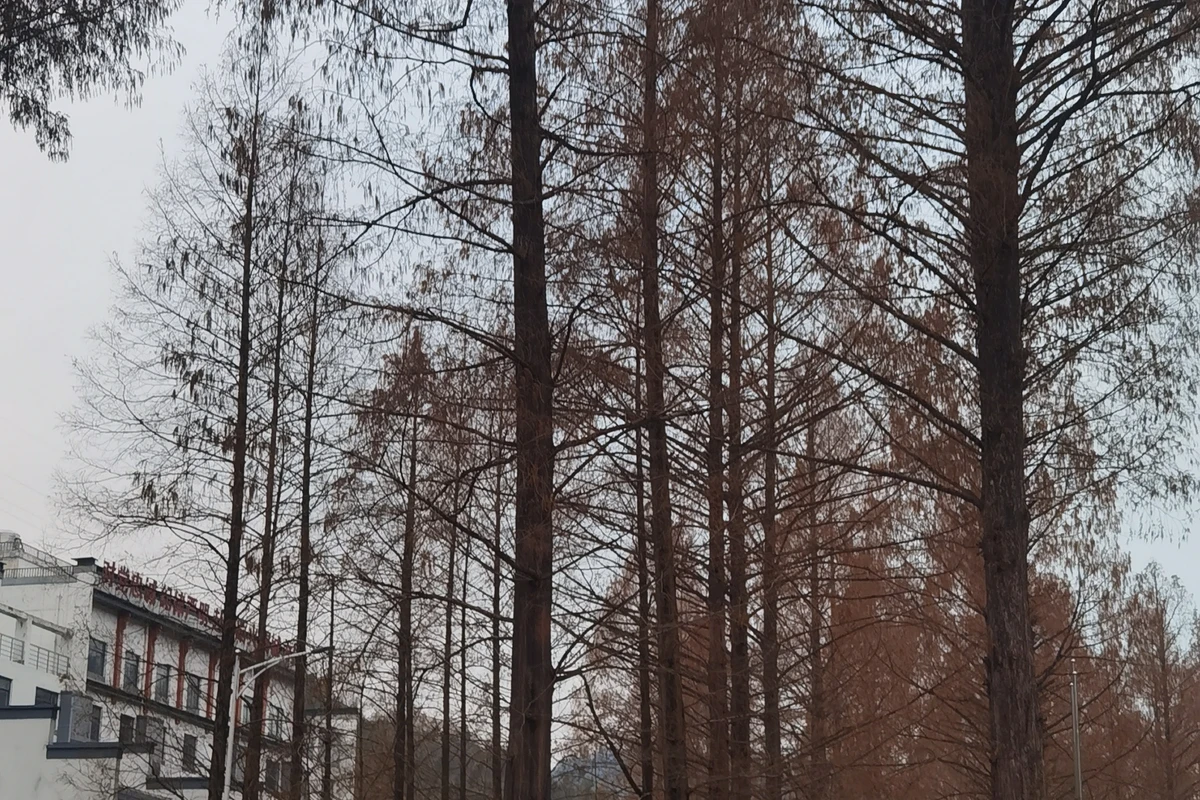
Along the roadside were tall trees, with a thick layer of fine yellow leaves covering the ground.
This is the entrance to the transfer center. I arrived just before 7:20 AM. When it opened at 7:40, there were already two to three hundred people. If you plan to visit Huangshan in one day or are in a hurry, pay attention to the cable car and transfer bus schedules. Also, tickets and cable car tickets are easy to buy on the platform, but transfer bus tickets are not. You can scan the QR code below.
All pre-booked tickets (entrance, cable car, and transfer bus) only require scanning your ID card—very convenient. Huangshan did a great job with this. Also, when boarding the bus, make sure you are going to Ciguang Pavilion or Cloud Valley Temple; don't get on the wrong one.
I originally planned to hike from Ciguang Pavilion to the Greeting Pine, but when I arrived and saw the snowy scenery on the mountain, I decided against it and took the cable car instead.
Looking down from the cable car, the snowscape became more beautiful as we ascended. I put on my gloves, hat, scarf, and crampons. At 8:20 AM, I arrived at the Yuping Cable Car Station and began climbing.
Twenty minutes later, I reached the Greeting Pine, next to the Yupinglou Hotel.
The weather was clearing up, and strange wisps of mist rose from the sunlit side of the mountains.
Although the sun came out, the wind was strong and it was very cold. There was snow on the rocks, but not much on the trees—probably blown off by the wind. There was no scenery with snow clinging to branches.
At 9:20 AM, I reached the Hundred-step Cloud Ladder and started descending a bit. When I got near Sea Heart Pavilion, it was a small valley.
Suddenly the scenery improved immensely—trees covered in silver blossoms, giving the real feel of hiking in snow.
In the distance, I could see the ball on Bright Summit. Finally, at 10:20 AM, I reached Bright Summit.
Looking far away, the scenery on the back mountain was much more beautiful than on the front mountain—I mean the snowscape. The wind on the back mountain was significantly weaker. The mountains and trees were fully covered in snow, dressed in silver. The building in the valley should be the West Sea Hotel, where I planned to stay tonight. The peak directly opposite should be Danxia Peak.
Around 11:00 AM, I arrived at King Pine, and ten minutes later, I finally reached the West Sea Hotel. The lobby had ginger tea, and it felt great to drink. For lunch, I wanted to order something, but it was extremely expensive. Fortunately, there was a buffet—140 yuan for lunch and 180 yuan for dinner. Many people were staying there. I had originally wanted to book a king bed room, but it was unavailable. Only a standard room was left—very small, but the facilities were decent. The room also had an oil heater. I took a nap after lunch and set out at 3:50 PM to go to Danxia Peak to watch the sunset. I climbed to the top of Danxia Peak around 4:30 PM.
This area had the best snow scenery—almost no wind, blue sky, and the twilight gave a feeling of rime ice! Very beautiful!
From the top, I could look back at Bright Summit, with the West Sea Hotel below.
It was still early, so I continued a bit toward the Danxia Cable Car Station. When I returned to the top of Danxia Peak around 4:50 PM, it was packed with people, and almost all the good spots were taken. Truly, I had risen early but arrived late. Eventually, I stood on a fairly steep rock and watched the sunset with difficulty.
At 5:02 PM, sunset began; 15 minutes later, it was quiet. The weather was good—perhaps too good—with no remarkable twilight or colorful clouds. A red sun set against the snowy landscape. Suddenly, a strong gust of wind blew snow off the trees, as if watching the sunset in a heavy snowfall—an incredibly beautiful scene.
After sunset, darkness fell quickly. A section of the path was very steep, and it was getting dark. The people ahead walked slowly, causing a backlog behind. Not far down the main road was Paiyunlou Hotel. Going this direction, I reached Paiyun Pavilion, where I could faintly see the West Sea Grand Canyon, but it was too dark to see much. Although the weather was clear with no clouds, there were almost no stars in the sky. I returned to the hotel and went to bed early.
Sunrise was forecast for 6:58 AM. I got up at 5:00 AM and set out around 5:25 AM, taking the same path as before—passing Unity Pine and King Pine toward Bright Summit. The lowest temperature that day was -14°C. The hotel's wardrobe had large cotton jackets that could be worn over my clothes, but they were heavy for hiking. There was almost no wind, so it didn't feel too cold. Stars dotted the sky, but unfortunately, many places along the way had streetlights. I arrived at Bright Summit around 6:25 AM. By the time I reached the platform in front of Baiyun Hotel, it was already packed with people. In front of the platform was a small peak, with a narrow path leading to an iron gate that wasn't locked. I followed others inside, where three or four rows of people were already standing. Many people were also on higher ground. Fortunately, it was a slope, so I found a spot that didn't block the view. People kept coming in; after 6:40 AM, there was basically no space left.
As soon as I stood, the far edge of the sky was already shining with boundless light.
Around 6:51 or 6:52, the crowd suddenly stirred, followed by exclamations. The sun didn't appear from the farthest horizon but suddenly leaped out from behind a distant mountain! Within just two or three minutes, it had completely emerged. Taking advantage of the crowd's reluctance to leave, I immediately retraced my steps. The small slope was already filled with two to three hundred people. When I reached the platform in front of Baiyun Hotel, there were an estimated three to four hundred more. The easternmost windows of Baiyun Hotel were all occupied by people—what a perfect spot to watch the sunrise from a hotel room without any obstruction to the view. Those rooms must have been expensive.
I returned via the Flying Rock path, arriving at Flying Rock at 7:20 AM. It was completely empty—just the two of us. The distant peaks had a golden glow like sunlight on gold mountains.
This path offered beautiful views, with a distant look at the West Sea Grand Canyon.
After breakfast, I checked out and set off again around 9:00 AM. By 10:00 AM, I climbed up to Cooling Terrace and Monkey Gazing at the Sea. Note that the path is very narrow here, forming a small loop—one way up and one way down. Don't go the wrong way, or it will cause congestion. Lion Peak was closed to climbing. Near the bottom was Shilin Hotel, and a bit further was Beihai Hotel, but Beihai was under renovation and likely unavailable for a long time. I saw people carrying renovation materials slowly up the stairs, step by step—truly not easy.
Passing Dreaming Pen Blossoms, Umbrella Pine, and Black Tiger Pine, I encountered many named pines along the way. There were new tour groups, with guides telling various stories and jokes.
At 10:50 AM, I climbed up to Starting-to-Believe Peak. Only after going up did I believe it! The snowscape was beautiful. Around 11:30 AM, I arrived at White Goose New Station, took the cable car down, and returned to the transfer center by 12:30 PM.
I found a restaurant near the transfer center and tried stinky mandarin fish. My original plan was to visit nearby ancient villages, but I felt unwell and hurried home.
1. Winter is not a good time to climb Huangshan. First, it's cold, and hiking with many layers is inconvenient. Second, Lotus Peak and Heavenly Capital Peak alternate opening every five years, but both are closed in winter. The West Sea Grand Canyon is also closed. Some dangerous spots, like Lion Peak, are off-limits. Additionally, the three main cable cars undergo maintenance in rotation, so you need to plan your route in advance to avoid backtracking. Of course, Huangshan's snowscape is very beautiful, and the sunrise and sunset after snow have a unique charm. So if you come to see the snow, pay attention to the weather forecast for the Huangshan Scenic Area—not Huangshan City. And it's best to go within one or two days after snowfall; if it doesn't keep snowing, the snowscape quickly disappears with the wind. We descended the day after the snow. From Starting-to-Believe Peak to White Goose New Station, the snow on the pine trees was almost gone. So I think choosing the right time is crucial for a winter hike on Huangshan. Of course, if you simply want to hike, it doesn't matter.
2. Regarding accommodation: For those entering and exiting via the South Gate, stay in Tangkou Town. Choose a hotel close to the main transfer station. Don't pick a hotel near the South Gate unless you plan to hike all the way from the South Gate. When searching for hotels, directly search for the transfer station and find hotels based on the distance. Tangkou Town is basically a long, narrow town centered around the transfer station, with two main roads extending westward and northeastward along the mountain slopes, lined with hotels and restaurants. A distance of 200 to 500-600 meters is ideal. Being too close isn't good due to traffic noise. It's best if the hotel offers parking and is within walking distance. Most hotels allow free two-day parking if you book with them. Parking at the transfer station or South Gate public parking lot can be expensive. Additionally, the transfer station has buses to other Huangshan scenic areas and the high-speed rail station. Accommodation on the mountain is certainly not cheap and cannot compare to the foot of the mountain. Many platforms now have promotions; pay attention to what is included, such as tickets, breakfast, buffet meals, etc. Also, the West Sea Hotel has A and B sections.
Referring to an online map of Huangshan, a major reason for staying on the mountain is to see sunrise and sunset. Yupinglou Hotel allows you to watch sunrise and sunset next to the Greeting Pine, but because Heavenly Capital Peak, Lotus Peak, and the West Sea Grand Canyon are closed in winter, unless you ascend from Ciguang Pavilion very late in the afternoon, you'll have to return the same way. Baiyun Hotel and Guangming Villa are in the best location—directly at Bright Summit for viewing—but reportedly the accommodation conditions are a bit worse. However, the location is truly excellent, especially the rooms on the east side of Baiyun Hotel, which offer a direct view of sunrise from the window. West Sea Hotel and Paiyunlou Hotel allow you to watch sunset at Danxia Peak; for sunrise, you need to go to Starting-to-Believe Peak or Bright Summit. I recommend Bright Summit, because Shilin Hotel is closer to Starting-to-Believe Peak. Beihai Hotel is under renovation, otherwise Starting-to-Believe Peak would have more people, and the space on Starting-to-Believe Peak is limited, making it easy to lose a good spot. From West Sea Hotel and Paiyunlou Hotel, you can take a small loop to Bright Summit: ascend via Unity Pine and King Pine, and descend via Flying Rock, so you don't backtrack. The Flying Rock side offers a distant view of the West Sea Grand Canyon with excellent scenery—best to see it during daylight. Considering the snowscape, West Sea Hotel and Paiyunlou Hotel are located in a valley with less wind and beautiful snow; Baiyun Hotel and Guangming Villa are at higher elevations with beautiful distant views.
3. After checking in, you can add the hotel manager's WeChat or follow the Huangshan Tourism public account. They will send times and probabilities for sunrise, sunset, and even sea of clouds. But these are only probabilities, and times are for reference; there may be deviations. Wherever you go to watch sunset or sunrise, it's best to arrive at least 20 minutes early, otherwise it's easy to lose a good spot. So for sunrise, get up early and allow enough time. Since you'll be waiting in an open area for 20-30 minutes, dress warmly. Most hotels have large cotton jackets that can be worn over your clothes.
4. In winter, because cable cars undergo maintenance in rotation, planning your route up and down by cable car becomes tricky, and you may easily end up backtracking. The area to explore on Huangshan is vast, even though many places are closed in winter. So plan your route well and don't bring too much luggage up the mountain. Leave what you don't need at the foot. If you enter via the South Gate and exit via the North Gate, or vice versa, you'll have to carry all your luggage, making the trip tiring. I saw several people on the mountain with large suitcases; they eventually had to hire someone to carry them to the cable car station. If you have good stamina and hike without the cable car, especially in snow, the distance covered by cable car will take 30 to 60 minutes longer than usual, even for fit people. Descending is even more tiring, so plan your time well to avoid missing the last transfer bus; otherwise, you'll have to walk a long way.
5. For a winter tour, dress warmly. The wind on the mountain is strong; wear windproof clothing. Mid-length coats are best—short ones can't block the wind, and long ones hinder movement on steep sections. A hat that covers the ears is recommended; the hood on a coat is inconvenient and blocks peripheral vision. In snow, crampons are essential—much better than hiking poles. The road maintenance workers can't clear snow quickly, and low temperatures freeze the snow hard, making it very slippery. Slipping on steps is dangerous, especially when descending. Shoes should be warm and high-top, as you might be curious to step into the snow on the roadside—it can be deep, and if snow gets into your shoes, it's terrible. If you wear glasses, consider switching to photochromic lenses; if not, bring sunglasses. On clear days, the snowy landscape is dazzling and can hurt your eyes. Don't bring too many snacks; you probably won't eat much on the trail due to the cold and wind. There aren't good places to rest temporarily on the trail. Bathrooms are not convenient for eating. You can rest in the lobby of hotels you pass, but you'll have to take off crampons, and putting them back on is troublesome. So make sure to eat well for meals. If you don't eat at the hotel, bring enough proper food. However, hotel buffets are decent with many options and not extremely expensive (considering everything is carried by hand from the cable car to the hotel). Similarly, don't bring too much water. The best is a thermos; public restrooms along the way provide hot water. You won't drink much in cold weather, and hot drinks are comforting. Bottled water in winter is a bad idea—temperatures on the mountain are around minus 10°C, and bottled water will be freezing cold. Hotels usually provide ginger tea; you can fill a bottle from the hotel in the afternoon to take with you, but don't expect it in the morning for sunrise—hotels generally offer it after noon. One reminder: don't bring a drone up the mountain; reportedly, you need a permit to use one, and private applications are usually not approved. Also, the trail maps on the mountain are not great—there are few large maps, only small directional signs indicating the next major scenic spot. If you're not familiar with the area, you might easily go the wrong way. I encountered several people asking for directions. After watching sunrise at Bright Summit, on the way to Flying Rock, two girls followed us for a long time before suddenly asking if it was the direction to Yuping Station—they had realized they were lost. So have a general idea of the layout.
The snowy Huangshan is very beautiful, especially on a clear day after snow, with stunning sunsets and sunrises. But if not for the snow, I would choose another season—you can visit fewer places and route planning is more troublesome. However, in winter, there are usually promotions: tickets are discounted, and hotels have deals. It's well worth a visit when it snows!