In the Spring of March, Touring Mountains and Waters with the Elderly
In the third month of spring, with warm weather and blooming flowers, this year marks the initial easing after three years of the pandemic. After being confined for a long time, we, accompanied by the elderly, embarked on a delightful self-driving tour. Our destinations were places the elderly had long yearned for: Huangshan, one of China's landmarks, renowned since ancient times as 'after visiting Huangshan, no other mountain is worth seeing,' and Lushan, praised by Chairman Mao in his poem 'The infinite beauty is found on perilous peaks.' The trip lasted seven days, which was relatively tight.
Day 1: Shenzhen - Mabugang, 350 km, 3.5 hours. To avoid the fatigue of driving over 1,000 km directly from Shenzhen to Lushan, we first returned to our hometown in Mabugang after sending the kids back to school on Sunday, saving us from exhaustion on the long journey the next day. We arrived home near 11 p.m., quickly went to sleep, and prepared to set out early the next day.
Day 2: Mabugang - Lushan, 710 km, about 8.5 hours. Today's journey was long, so we had to start before dawn. Fortunately, it was the first day of the trip, and everyone was in high spirits and excited. Since we didn't have much time, we had to arrange it this way. Initially, I wanted to take the water road over Poyang Lake, but without rain at this time, the lake had dried into a desert, so we couldn't experience driving on water; thus, we gave up that idea.
After entering the Lushan scenic area through the main gate, we drove along the winding mountain road to Guling Town. We paused briefly on the roadside at Lulin Bridge on Lulin Lake, but fearing we might block traffic, we headed straight to our inn. It was already 5 p.m. by the time we settled in, so we couldn't visit Meilu Villa before it closed. Instead, we visited Villa No. 177 among the villa complex, which had its own charm. As the interior was under renovation, we strolled for a while and then slowly walked to Guling Town's main street to get a glimpse of Lushan's true face.
Day 3: Lushan - Jingdezhen, 180 km, 2.5 hours. Before starting our tour of Lushan, let's get a general understanding. Lushan is located within Lushan City, Jiujiang City, Jiangxi Province. It is a World Cultural Heritage site, a World Geopark, a National Key Scenic Area, a 5A-level tourist attraction, one of China's Top Ten Famous Mountains, one of China's Four Great Summer Resorts, and one of the first National Civilized Scenic Tourist Demonstration Zones. It rests on Poyang Lake to the south and borders the rolling Yangtze River to the north, with layered peaks, majestic beauty, towering trees, and rushing streams—this is Lushan's charm. The poems 'You cannot see the true face of Lushan because you are inside it,' 'Flying down three thousand feet, as if the Milky Way has fallen from the nine heavens,' and Chairman Mao's 'In the twilight, I see sturdy pines, amid chaotic clouds they remain calm; nature has created an immortal's cave, infinite beauty is on the perilous peaks' have accompanied our growth for generations, making Lushan an endless longing for everyone.
Since we were with the elderly, we mainly chose the western route attractions. Although not as grand as the eastern route's Hankou Slope, Five Old Men Peaks, and Three-Step Waterfall, we visited the world-renowned 'In the human world, the flowers are gone by April, but in the mountain temple, the peach blossoms just begin to bloom' — Flower Path Park, Bai Juyi's Thatched Cottage (beloved by Bai Juyi), and the ever-changing Ruqin Lake, Jinxiu Valley, Heavenly Bridge, Perilous Peaks, Former Negotiation Platform, Stone Pine, Wonder-Viewing Pavilion, Imperial Stele Pavilion, and Immortal Cave.
Early in the morning, after breakfast, we took a sightseeing bus from Guling Street to Jinxiu Valley. Before boarding, we asked clearly about the queue location. In the morning, eastern route visitors are more numerous, and the queue can be long. We bought tickets the night before, 70 yuan per person, with no discount for the elderly. First, we strolled around Ruqin Lake but didn't enter Flower Path, as Lushan wasn't yet in full bloom. We took some photos at the Flower Path gate, crossed the road toward Jinxiu Valley. About 200 meters into the entrance, we reached Lushan's famous 'Heavenly Bridge' — actually a suspended boulder jutting out, not over a deep chasm. It doesn't look perilous, but if you stand at the front end with the distant cliff as a backdrop and the photographer positioned low, you can use the visual difference to create a thrilling cliff-edge photo. Seeing the long queue, we gave up the idea and followed the crowd slowly toward Immortal Cave.
There were quite a few tourists today. We moved slowly with the crowd and after about 2 hours, we reached the exit of Immortal Cave. We took a bus to the Lushan Conference Site. Inside, my father-in-law seemed more interested in the history.
After leaving the Conference Site, it was nearly 2 p.m. We took another sightseeing bus directly to Hankou Slope, hoping to see the beautiful view of Poyang Lake from a high point. Although the sky was clear, there was still fog in the distance, so we couldn't get a clear view. After a while, we returned by bus to the hotel to pick up our car. Since the temperature on the mountain was around 5°C at night, and the elderly were afraid of the cold, we checked out and headed toward the warmer Jingdezhen. Driving along the winding mountain road for 34 km down to the foot, we recorded an ultra-low fuel consumption of 5.3 liters per 100 km. It seems my little Volvo is quite obedient.
Passing over Poyang Lake Bridge, a road sign indicated Shizhong Mountain Scenic Area ahead. Recently, we had been watching CCTV's documentary 'Home Far Away,' which introduced it — a stone mountain at the intersection of Poyang Lake and the Yangtze River. At its base, due to long-term erosion by the river, a cave-tongue had formed, and when hit by the river water, it emitted a sound like a bell. At the junction of lake and river water, there was also a clear dividing line. This immediately sparked our interest. We adjusted our route and left the highway. After about a 15-minute drive, we arrived at the Shizhong Mountain cruise terminal. Since it was nearly 5 p.m. and we still had to reach Jingdezhen, we didn't board a boat but played around on the shore for a while.
Continuing on to Jingdezhen, we stayed at a homestay tonight, which was quite nice. We ordered takeout delivered to the room. Everyone could wash up and wait for the food. We cooked a plate of wild vegetables picked by the Yangtze River — a very pleasant meal.
Day 4: Jingdezhen - Huangshan, 250 km, about 3.5 hours, 172 (note: number may be a typo, likely omitted context). After breakfast, we drove to the China Ceramics Museum in Jingdezhen. World ceramics look to China, and Chinese ceramics look to Jingdezhen, Jiangxi. The thousand-year porcelain capital, Jingdezhen, is renowned worldwide for its unique style: 'white as jade, bright as a mirror, thin as paper, and resonant as a chime.' Porcelain is the essence of traditional Chinese art and has been cherished as an artistic treasure from ancient times to the present. We love the Westerners' LV and Vacheron Constantin, while Westerners love our ceramics, silk, and tea. When Zheng He sailed to the Western Seas, he took ceramics, tea, and silk around the world. To appreciate the beauty of Chinese ceramics and feel the profound ceramic culture, you must visit the Jingdezhen China Ceramics Museum. Located at No. 1 Zijing North Road, Changjiang District, Jingdezhen City, Jiangxi, it is the first large-scale specialized ceramics museum in China and a national first-class museum. It houses over 50,000 pieces of ceramic treasures from the Neolithic period and various historical eras since the Han and Tang dynasties. The museum presents a complete history of Chinese ceramics, arranged by the sequence of ceramic production in Jingdezhen, through exhibits and panels. There are eight exhibition halls displaying ceramic treasures from different historical periods. The long and splendid ceramic culture and history attract countless visitors. The museum opens at 9 a.m., and free tickets can be reserved via the WeChat official account. The account also offers guided tours: 1. Free fixed-time guided tours: sessions at 10:30 a.m. and 2:30 p.m. (Note: only for individual visitors; please register at the service desk half an hour in advance, limited to 30 people per session). 2. Paid guided tours: 100 yuan per session for up to 10 people. 3. Audio guide: rent audio equipment for self-guided tours, 30 yuan per person per session, with a deposit of 200 yuan per person. If you want a thorough visit, it's best to book a guided tour in advance; 100 yuan allows a detailed tour, but I couldn't get one. After collecting tickets from the self-service machine, I slowly entered the museum, passed the screen, and entered the exhibition hall, feeling the profound historical atmosphere of thousand-year ceramic culture. Walking through the time tunnel of ceramic history, I savored the ancient ceramic treasures left from various dynasties, experiencing the evolution of ceramics from ancient to modern times.
After visiting the ceramics museum for over 2 hours, in a nearby village there is a privately built Porcelain Palace that has gained some fame in the tourism world. We continued driving to see what kind of building it is. The Thousand-Year Porcelain Palace is located beside Xinping Road, Xinping Village, Fuliang County, Jingdezhen City. From a distance, it looks like a colorful giant round 'cake,' with a structure resembling Hakka earthen buildings, both round and square. The distant square one was not yet open. The two open round buildings are covered inside and out with porcelain pieces and ceramics. The exterior walls are inlaid with the four famous Jingdezhen porcelains: blue-and-white, linglong (rice-pattern), famille rose, and color glaze. The top is covered with various small porcelain dishes. Half of the porcelain is embedded in the walls, with a unique design. Many of the decorative ceramics were made in wood-fired kilns in the 1980s, and some are said to be fine pieces. The entire building used over 60,000 pieces of porcelain and 80 tons of porcelain fragments — definitely worth a visit. Ticket: 25 yuan, free for those over 65, free parking.
After visiting the Porcelain Palace, I saw a fellow traveler at the parking lot with a RV that had freshly ground coffee. So I sat beside him to rest for a while, had a cup of coffee, and then continued toward Huangshan.
This video was posted twice — can any expert guide me on how to delete it?
Passing through the beautiful countryside of Wuyuan, the golden yellow rapeseed flowers contrasted with distant mountains, nearby waters, white walls, and black tiles, forming a harmonious picture. Here you can let go completely, allowing your soul to fly freely. Looking down from the highway, we saw terraced fields, winding lines, a small river in the valley basin, two or three villages gathered by the river, surrounded by green mountains — a very beautiful rural landscape of Wuyuan.
This trip didn't include Hongcun. On the road, my wife and I decided to detour to Hongcun to scout it out for a future autumn trip. There are cameras on the roads in Hongcun, so to avoid fines for illegal parking, we only made a brief stop at the Tachuan Autumn Color Observation Deck and then continued along the winding mountain road.
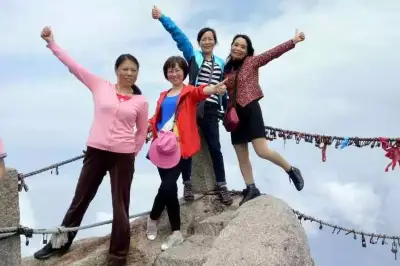
Day 5: Huangshan. Since the elderly were afraid of the cold, we didn't plan to watch the sunrise or sunset on the summit. We stayed at a hotel at the foot of the mountain, 300 meters from the transfer center.
To visit as many scenic spots of Huangshan as possible in one day, we had to get up early and take the early cable car up the mountain. Our planned route: Transfer Center - Jade Screen Cable Car - Greeting Pine - Hundred Steps Cloud Ladder - Aoyu Peak - Sky Sea - Bright Summit - Stone Bamboo Shoots Ridge - Cloud Valley Cable Car - Transfer Center. Such a day of climbing would probably be tiring for the elderly, so after descending, we rested well at the hotel.
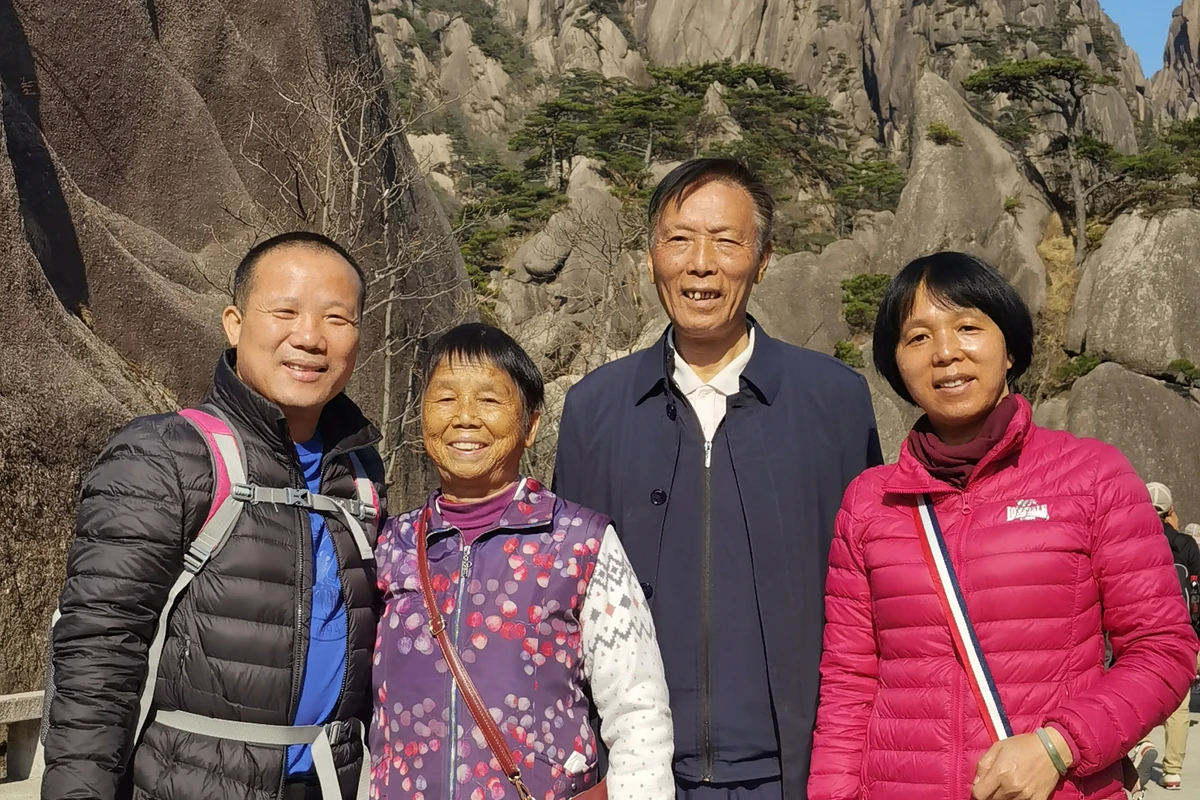
In the vast crowd, my sharp-eyed father-in-law immediately spotted a childhood friend from the same village coming toward us and called out to reunite.
There were many tourists today. The area in front of Greeting Pine was crowded, showing that after three years of the pandemic, people had a revengeful urge to travel.
At dinner, my father-in-law expressed great satisfaction with the trip arrangement and suggested that we have a drink together.
After dinner, we bought some souvenirs on Tangkou Street and prepared for the return trip the next day.
Day 6: Huangshan - Longyan, 800 km, about 8 hours. In the morning, it started to rain. We secretly felt lucky for our good fortune; otherwise, we would have disappointed the elderly, only able to gaze at Huangshan from afar and sigh over the Greeting Pine.
We drove through the wind and rain toward Longyan, Fujian, where awaiting family eagerly anticipated our arrival.
Day 7: Longyan - Longchuan - Shenzhen, 550 km, about 6 hours. After lunch with relatives, we filled the trunk with a full load of love and set off for our warm home — Shenzhen.
Recording this self-driving trip: total distance 2,750 km, fuel cost 1,600 yuan, average fuel consumption 0.58 yuan per km, tolls 1,214 yuan along the way. Meals cost 1,640 yuan, hotel cost 1,221 yuan, tickets and scenic area transportation 1,480 yuan (Lushan free tickets, Huangshan free for elderly), souvenir items 200 yuan, total cost 7,286 yuan.