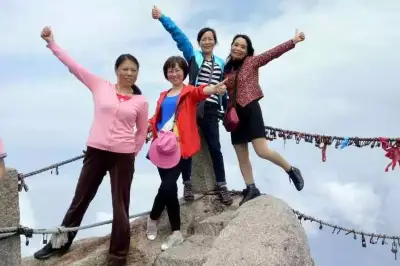
Origin of the Trip: A 5-Day Self-Drive Tour with My Bestie to Huangshan
I had always wanted to visit Huangshan to see the Welcoming Pine and Hongcun Village. After discussing with my bestie, we decided to take a spontaneous trip.
For this Huangshan trip, we rented a car in advance from a certain national chain rental platform, picking up and returning it at Huangshan North Station. Since the roads and car were unfamiliar, I personally recommend buying full insurance when renting. And be sure to choose a nationwide chain rental platform to avoid being cheated.
Day 1-2: Enjoy Huangshan Cuisine & Climb Huangshan
We arrived at Huangshan quite late that day. After picking up the car, we found a random restaurant for a meal. We had boiled fish – the fish was from the local river and tasted pretty good. We also ordered houttuynia cordata (zhe'ergen), which I tried for the first time. It indeed had a fishy smell.
After dinner, we went back to rest. We set off very early the next morning. Huangshan is huge, so a two-day trip is more appropriate. Of course, if you don’t mind the high accommodation cost on the mountain, a three-day trip is best.
We got up after nine, went for breakfast at ten. There was already a couple who had come down from Huangshan; they said they couldn’t see anything clearly in the rain, just took photos at the Welcoming Pine and came back via cable car. Fortunately, the handmade dumplings at this restaurant were tasty, so that was a good start.
After breakfast, we grabbed umbrellas, put on raincoats, and set off. Visibility was indeed poor in the rain. But along the way, there were many surprises. For example, when we took the Cloud Valley Cable Car from the back mountain and stepped out of the cable car, the misty clouds were actually quite beautiful.
First stop: Harp Pine. The Harp Pine is one of the ten famous pines in Huangshan, known for its shape. Its trunk is straight, the top is umbrella-shaped, resembling a harp, and also like the yamen gate of ancient government offices, hence also called “Yamen Pine.”
From Harp Pine to Shixin Peak is very close, at most fifteen minutes. But with fog, we couldn’t see the distant views. Originally, from Shixin Peak you can see many mountains in the distance, as the B&B owner told us, but now we could only take photos of ourselves.
Because of the heavy fog blocking the distant views, we didn’t go to Qingliangtai (Cool Terrace) or Monkey Gazing at the Sea. Instead, we headed towards Bright Summit Peak and Flying-Over Rock. In this way, we basically covered all the back mountain scenic spots today.
The back mountain is relatively easy. Since we came up via the back mountain cable car, walking to Paiyun Pavilion was mostly downhill. The pine trees below Bright Summit Peak were very beautiful.
Actually, the Bright Summit meteorological station is just upstairs of the Bright Summit Villa. Some fellow travelers wanted to go up, but were told that non-hotel guests are not allowed. Still, this counts as Bright Summit. Finally, I attached a photo of the sunrise we saw the next morning to end the first day.
So, even on a rainy day, climbing Huangshan is worthwhile – you can still enjoy beautiful scenery.
Day 3: Another Perspective of Huangshan
After watching the sunrise, we went back to the hotel to rest for a while and had breakfast there.
Then we went to Lotus Peak. The scenery along the way was also great. Before climbing Lotus Peak, there are two paths: one to the left is relatively gentle; the other to the right is the Hundred-Step Cloud Ladder, quite steep, with 210 steps. For me, it wasn’t difficult; I paused once and went up. But seeing others, it wasn’t easy for them.
After finishing the Hundred-Step Cloud Ladder, there were constant loudspeaker reminders: it takes 4-5 hours to queue for Lotus Peak, suggesting bypassing it on the right and heading directly to the Welcoming Pine.
I thought I could handle Lotus Peak easily. After waiting for over an hour, we reached the top. Actually, the summit of Lotus Peak is not large, with two staff members maintaining order.
It was already 5 p.m. when we finally visited the Welcoming Pine. The last cable car time was 17:15. Some said 5:30, but the staff said 17:15. So we hurried to take the cable car. When we left, Huangshan was once again shrouded in mist and clouds, looking ethereal.
After coming down, we found another small restaurant for dinner.
Day 4: The Grandeur of Hongcun
On this day, I finally arrived at the long-awaited Hongcun. Isn’t this exactly the ink-wash painting in my mind? Looking at the lake, the houses, and the distant green mountains – everything was breathtakingly beautiful.
The white walls and grey tiles are classic representatives of Huizhou architecture and a UNESCO World Heritage site. Famous spots include South Lake, Moon Pond, the village entrance, ancestral halls, several wealthy families' residences, as well as the continuous streams running through the entire village. In the past, the upstream was where the wealthy lived, using the water for washing and cooking; downstream was for the poor. But of course, that’s just the old saying; it’s no longer the case.
We entered the scenic area and stayed at a B&B on the back mountain. It was very clean – that’s my primary requirement for accommodation. We walked around Hongcun for a long time, through every alley and every street. We also saw many elderly men with big cameras taking photos. Compared to them, my equipment was too shabby.
After the long walk, we were exhausted and returned to the B&B to rest for a while. After a short break, we followed the village paths to the village entrance, looked at the two big trees guarding the villagers, watched the streams, tasted Mao tofu, and played with a guzheng at Jushan Hall. If I weren’t so stout, I would have worn Hanfu to fit the scene.
Hongcun at night is truly beautiful. The Moon Pond under neon lights was enchanting, the small bars slightly intoxicating, chatting with friends, reminiscing about bygone days, toasting to friendship.
Everyone has a different understanding of scenic spots. Some people, who are used to Wuzhen and Xitang, might think Hongcun is just so-so. But we still felt it was worth it!
Day 5: The Different Jiulong Waterfall
Early in the morning, the village was so quiet that we could hear birds chirping and roosters crowing. We wanted to take a closer look at Hongcun, so we entered the village committee, visited the home of Hongcun’s richest man, went to the school, learned about its history, and experienced the simple family traditions of the Hongcun people.
Then we drove away from Hongcun and headed to Jiulong Waterfall in the Huangshan Scenic Area. This place was also beautiful. There were several waterfalls; we couldn’t remember exactly if there were nine.
Anyway, there was a small lake with green water, and the waterfall splashed up mist, which was especially beautiful.
For accommodation, we chose a hot spring hotel next to the Cloud Valley Cable Car at the back mountain of Huangshan. It was nestled by the mountain and river, blending perfectly with nature. It combined modern design techniques while preserving the charm of Huizhou ancient architecture.
Strolling in the garden, breathing quietly, or soaking in the hot spring to dispel fatigue – it was truly leisurely. Watching the mountains and rivers at sunset, watching birds return home. In my heart, this is what a resort hotel should be like.