Experiencing the New Year Flavor at Huangshan: A Unique Six-Day Trip
This time our itinerary was quite packed. I originally planned to just climb Huangshan alone, but after thinking it over, I felt it would be too wasteful, so I decided to arrange a few more stops besides Huangshan. In the end, we turned it into a 6-day trip.
We took the high-speed rail directly to Huangshan, then picked up a car from a Mouhai store here. There were too many people traveling during the Spring Festival, so I booked the car several days in advance. Picking it up on site was more convenient. Besides, I imagine trying to rent a car on the spot during the Spring Festival would be impossible.
Xidi, Bishan, Hongcun, Zhanqi Village—the first three are in Yixian, and the last is in Shexian. After arriving at Huangshan and getting the car, we drove directly to Xidi. Feeling hungry, I ate at the Xidi Huizhou Cuisine Restaurant opposite the scenic area. Walking in, it was packed with people.
I ordered a Huizhou-style stir-fry, which included tofu skin, shredded pork, bamboo shoots, etc. It was a home-style taste, costing 45 yuan—a bit pricey, considering it's at the entrance of the scenic area. The rice was a bit undercooked, probably because they were too busy during the Spring Festival to cook it thoroughly. After eating, I went up to the fourth floor to take panoramic photos, but there were too many people and the scene was messy, so I didn't get good pictures.
The ticket was half price and allowed free entry and exit within three days—excellent. This time I didn't make a very detailed plan; since the scenic area isn't big, I just followed the crowd and moved forward. Xidi Town was formerly called Xixi or Xichuan, named after the three streams flowing from east to west. Later, because there was a post station (pudi) three li away on the ancient western post road of Huizhou Prefecture, it was renamed Xidi.
At the entrance, there were audio guides for rent—20 yuan for the device and 10 yuan for earphones, but not many people rented them. Considering that I mainly came to photograph the scenery, and I could look up history online and eavesdrop on tour guides, I didn't rent one. As soon as I entered, I saw the Hu Wenguang Cishi Archway.
After passing the Hu Wenguang Cishi Archway, I entered Xidi Village. The village is laid out with 'mountains at the back, water around, and a screen in front.' Surrounded by mountains on all sides, the village is shaped like a boat nestled in the hills. The scenery is simple and elegant, with two clear streams flowing through the village.
Red lanterns and couplets were everywhere, and every household was filled with the festive atmosphere of the New Year. There were also typical Huizhou-style buildings and streets. Many of the guesthouses and restaurants were converted from residents' own homes, with simple and honest folk customs. An elderly man was basking in the sun by the roadside, smiling at the passersby.
Following the guide, I learned about and observed many mansions of high officials and wealthy merchants. During that time, Xidi Village produced many high officials and rich merchants, accumulating great wealth. In feudal society, there were strict hierarchical regulations for building mansions and residences.
Huizhou merchants could only use high-quality stone and wood, focusing on exquisite carving to show off their wealth and status. Therefore, in Xidi, exquisite stone carvings, brick carvings, and wood carvings can be seen everywhere—on door covers, window lattices, and door panels.
There is a shop called 'Girlfriend's General Store,' which is very unique. It operates on an honor system with no shopkeeper, and it has many vintage items—a trip down memory lane for those born in the 80s and 90s.
I mailed two postcards from the Xidi Post Office, stamped with Xidi's special stamps. There were nearly 20 stamps; if you want to stamp them all, you can buy a creative notebook. There were also special zodiac stamps, refrigerator magnets, bookmarks, etc. The walls were covered with postcards, carrying good wishes from people over the years. Next to it was a slow mail box, where you can choose to send mail in a future year, with varying prices—quite meaningful.
Tonight, there were many folk performances in Yixian Xidi. I walked toward the observation deck. A large artificial moon was steadily hanging among the woods, and the waterwheel on the lake complemented it. The woods changed colors with the lighting, as if experiencing spring, summer, autumn, and winter overnight.
From time to time, brilliant fireworks burst over the water, under the colorful forest, showing the prosperity of the era. As music played, the musical fountain on Mingjing Lake began, sometimes gentle, sometimes passionate, swaying and rising with the rhythm, forming various dreamy shapes.
The Night Painting Archway - Hu Wenguang Archway Projection Show: the flashing lights were designed according to the archway's architectural structure, and the ever-changing patterns told the story of the archway's past and present. When the night projection narrated the ancient and modern legends on this ancient archway, it felt surreal, as if Xidi's thousand-year history immediately appeared before my eyes.
The next morning, I still wandered around Xidi. In the afternoon, I set off directly for Bishan. Arriving at the Bishan scenic area, it instantly became quiet. A traditional village, free of charge, not overly commercialized, with few tourists. At the entrance was written Li Bai's poem 'Reply in the Mountain': 'You ask me why I choose to dwell in the green mountains; I smile without answering, my heart at ease. Peach blossoms and flowing waters go away quietly; there is another world beyond the mortal realm.'
Today, the descendants of the Wang clan of Bishan still live a leisurely life, rising at dawn and resting at dusk. Farming, raising silkworms, picking tea, growing hemp, and handicrafts remain their traditional production methods. Sacrifices, market fairs, folk songs, and village operas are still their traditional customs.
Bishan Village still preserves the typical historical features of ancient Huizhou villages: white walls and black tiles of old dwellings, staggered horse-head walls, winding and deep alleys, and a pagoda standing tall at the village entrance—all deeply imprinted with the memory of time.
The Bishan Gongxiao She (Bishan Commune) focuses on the fusion of folk crafts and contemporary design, connecting the material and spiritual needs of cities and villages. The building and its furnishings resembled a small shop from the past.
I had a bowl of beef noodles at the building opposite, costing 38 yuan a bowl—a bit pricey. The beef was very tender, and the broth was fresh. The broth was really fresh; the boss said it was simmered from early morning. For that alone, it was worth it. The boss added an egg for free, but the egg was a bit salty.
Around 5 PM, I arrived at Hongcun. The scenic area was crowded. I saw South Lake at sunset; it was really beautiful. Trees, mountains, and houses were reflected on the lake, like a natural ink painting, stunningly beautiful. I watched quietly, completely merging with the scenery. In the distance, someone was paragliding against the mountain breeze.
After dropping off my luggage, I went out to explore Hongcun at night. Compared to Xidi, it was heavily commercialized, with huge crowds, making it hard to move. There were tremella soup and rice wine with the Hongcun label, an art gallery, cafes, etc.
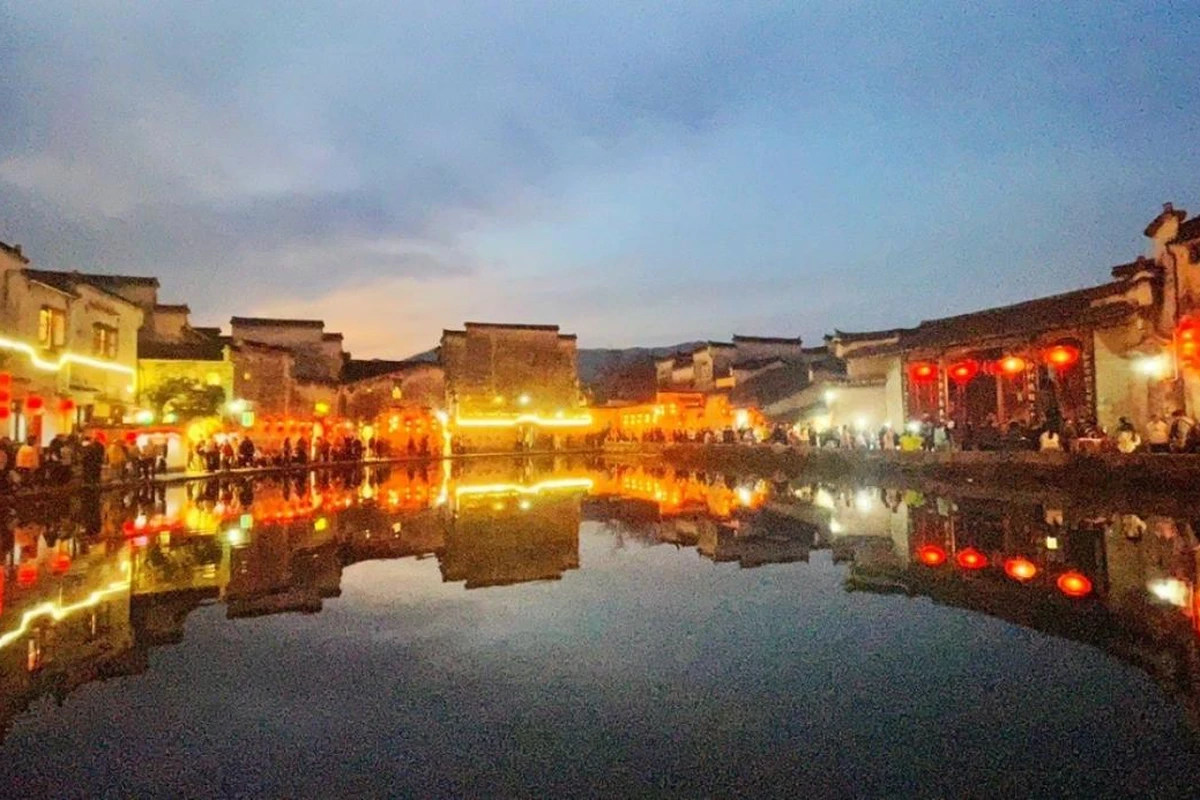
Later, I arrived at Yue Zhao under the night scene. During the Spring Festival, Yue Zhao was lively, with red lanterns hanging high. People either brushed past each other by the lake or sat by the lake watching the crowds and the water scenery. Under the gray-blue sky, Yue Zhao was festive, welcoming visitors from afar.
Feeling hungry, I bought a Hongcun roast duck roll. The old lady was unhurried, and tourists waited patiently. It felt like the shop was very busy and doing good business. The taste was average, just ordinary, enough to fill my stomach.
Along the way, people kept handing out free pastries; the freebies distributed on the street could fill you up.
I went to the Hongcun Post Office, mailed a postcard, bought a card stamped with Hongcun's characteristic scenic spots—a combination of several large stamps—and also bought a wooden refrigerator magnet.
Travel Log Contents:
1. Day 1: Yixian County Trip
Travel Information
Hotel Index
Strategy Index
Flight Index
Website Navigation
Travel Index
Cruise Index
Corporate Travel Index
Franchise Cooperation
Distribution Alliance
Friendship Links
Corporate Gift Card Procurement
Insurance Agent
Agent Cooperation
Hotel Franchise
Destination and Scenic Area Cooperation
More Franchise Cooperation
About Ctrip
About Ctrip
Ctrip Hotspots
Contact Us
Careers
User Agreement
Privacy Policy
Business License
Security Center
Ctrip Content Center
Intellectual Property
Trip.com Group
Algorithm Disclosure