Summer Six-Person Trip to Huangshan
People: Me, Coco (my gf), my colleague L, my colleague Y (L's gf), my colleague K, M (K's bf), total six.
Starting point: Shanghai
On the morning of July 10, around 6:30, I entered Shanghai Circus World Metro Station from Exit 3, and met Coco in the first carriage of the 6:40 train. We had one 30L backpack, one 20L backpack, and two waist bags, starting our journey.
Around 7:30, we arrived at Shanghai Meilong Metro Station, turned left, went up the overpass (a warm-up for carrying weight), and then went down to the South Railway Station to wait for L&Y and K&M.
Around 7:45, L&Y arrived; at 8:00, K arrived; at 8:01, M arrived.
We took the 8:18 train from Shanghai to Hangzhou, 25 yuan per person. Six people sat facing each other on two three-seat benches.
Around 10:00, we arrived in Hangzhou. At Hangzhou Railway Station, we bought tickets for the 13:10 bus from Hangzhou West Bus Station to Tunxi, 60 yuan per person.
There was a free shuttle to the West Bus Station 20 meters opposite the train station. We arrived at Hangzhou West Bus Station around 11:00, and on the second floor of the waiting hall, each bought a quick meal for 6-8 yuan: one meat and two vegetables or two meat and two vegetables. The taste was pretty good, especially recommended: pickled chicken leg. After eating, we sat a while, finished all the blackberries and plums we brought, and departed at 13:10.
The roadside scenery became more beautiful, with many continuous mountain ranges and short tunnels, as we entered Anhui province. It was originally planned as 2.5 hours, but we arrived at Tunxi Bus Station around 15:00.
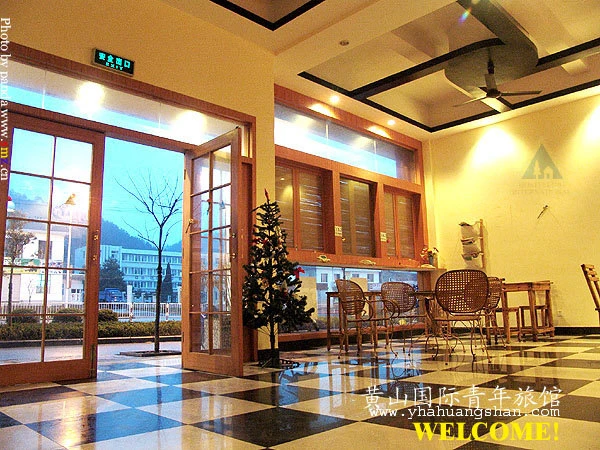
It took less than 5 minutes to walk from Tunxi Bus Station to the Huangshan International Youth Hostel. We were non-members, 35 yuan per person, booking a six-bed room - Room 306. Three bunk beds: all girls on top bunks, all guys on bottom bunks. There was a simple bathroom with a basin outside, dry-wet separation. It didn't feel like a hotel, more like a university dorm, but with pleasant color schemes (mainly green and orange), giving an IKEA feel; the girls thought it was cozy. But compared to standard star-rated hotels, there was no TV or phone in the room, no toiletries or slippers, so bring your own. (But I remember Shanghai's Old Captain Youth Hostel had toiletries.)
There was a 1-hp split air conditioner, aluminum louver blinds, simple but with some thoughtful details.
The youth hostel also offered extra services, like booking for Huangshan hotels, internet at 5 yuan/hour, and a large common room on the third floor with TV for chatting.
Most notably, the first floor.
The first floor had all-raw-wood tables and chairs, giving the feeling that a waiter might ask, "Sir, are you staying for a meal or just passing?" To the right of the entrance was a large whiteboard for graffiti from travelers around the world. I saw at least English, Korean, Japanese, and Russian messages. The six of us also drew on it and took photos.
On the upper right of the whiteboard hung a large dartboard. So from after organizing luggage until before dinner, we played darts.
We also went to the market near the hostel to buy a few cucumbers and tomatoes for the climb, and a large local Anhui watermelon.
Before coming, L had looked up online guides. At the Huangshan Youth Hostel, we had to try the cook's skill.
We ordered these dishes: braised stinky mandarin fish, fish-fragrant eggplant, small greens, local chicken pieces, stir-fried taro stems... all delicious with great color and aroma.
Also four bottles of local beer, which tasted great! Even the girls could try it because it had low alcohol content. Huangshan has good water, so the beer tasted good, and ice-cold in summer, it was a treat for travelers!
After dinner, two girls went back to rest, K&M went to withdraw money, so L, I, and others went out to buy water, slippers, food bags, etc.
An hour later, we returned to the hostel to eat watermelon, play darts, settle accounts, and then from 8:00 we took turns washing up in Room 306. Went to sleep around 9:00 to recharge for the next day's climb up Huangshan.
Notes:
1. There is a direct train from Shanghai to Tunxi, but it costs over 150 yuan. If time permits, following our route (Shanghai-Hangzhou-Tunxi) can save half the cost. To save time, take the overnight train, but that might sap energy for the next day's climb.
2. The cook at Tunxi Youth Hostel makes excellent food; a good dinner helps prevent fatigue for the next day's climb. Also, don't forget to pre-order breakfast for the next morning, and pack an egg fried rice for lunch on the first day. Fruits and water are expensive on the mountain, so buy some cucumbers and tomatoes (not too many, they're heavy) – 2 cucumbers + 2 tomatoes per person.
3. Don't buy water. Buying water was our mistake; it became a burden later. One 500ml bottle per person per day is enough; you can refill at the hostel, both on the mountain and at Tunxi International Youth Hostel.
4. No need to bring slippers; buy them at Lianhua/Hualian supermarket in Tunxi for 1.9 yuan a pair. Also buy two packs of large (50-piece) food bags, thin and light, more useful than plastic bags. They proved handy for protecting camera lenses, electronics, phones, walkie-talkies, sorting clean and dirty clothes, and carrying vegetables and fruit.
5. Try Huangshan local beer and Anhui watermelon – they taste fresher and more natural than in Shanghai.
6. Bring enough cash; don't withdraw from ATMs. K&M absent-mindedly forgot to take their card after withdrawing, but luckily a kind local chased them to return it. When traveling, such carelessness is the worst.
Before starting the second day's record, I'll summarize our photography gear.
Photography Gear:
Camera: Considering the strenuous climb, I brought a Contax G1 rangefinder film camera with three lenses: G21/F2.8, G45/2, G90/F2.8. Also an Olympus u115 point-and-shoot. Film: Fuji RVP100 (2 rolls), RDPIII (1 roll), Kodak 100G (1 roll), Kodak EB3 (1 roll). Negative film: Fujifilm Superia 100 (2 rolls). My gf brought her digital Sony DSC P7, small and convenient.
L brought his Fujifilm S602; M brought a Nikon F80D with a zoom lens (maybe 24-120, I always forget), EB3 (2 rolls), Superia 200 (2 rolls), Superia 400 (2 rolls); K brought her Canon Ixus.
L also brought a digital companion device, solving capacity issues for digital cameras.
1) In fact, I only needed the G21 lens on Huangshan; G45 and G90 were useless – just added weight. Even the G21 wide-angle was insufficient; I'd recommend a Voigtlander Bessa-T body and Heliar 15mm/F4.0, which together cost about the same as a G21, but rare on the second-hand market.
2) I brought a tripod but didn't use it. Traveling hard, the less the better. In the end, only M's tripod was carried; the other two stayed in the hotel.
3) Photography wasn't the only goal. Due to rain, I barely shot on the first day (July 11), except at the South Gate.
4) After returning, I realized I used the wrong film. Ideal setup: Contax G1+G21 with slide film for landscapes; the point-and-shoot with negative film for portraits; digital camera for flexibility.
5) I brought an X-ray-proof bag, which was useful. At the train station, it protected film from X-rays; on the mountain during heavy rain, it kept the camera dry. But it wasn't big enough; the G45 lens didn't fit and got some moisture. I dried it immediately upon returning to Shanghai.
6) Bring extra batteries for film cameras. I brought extras, but they got wet and were low on power... caused some trouble, details later.
Lesson learned for next time.
Oh, I forgot: around 4:00 pm on the first day, we also bought return bus tickets from Tunxi to Hangzhou for July 13, 60 yuan per person.
The next morning, we woke up excited. Around 5:00 am, we got up one by one, queuing to wash. Since Coco's thoughtful mother had told her to bring a rope to hang in the room, we dried the previous day's damp towels. We washed with hands, used dry towels to dry. Don't underestimate this detail: dry towels save weight and prevent mustiness in the bag. I even washed and dried my socks from the first day! [em31]
Details omitted; we went downstairs around 6:00 for breakfast: a bowl of congee, a steamed bun, an egg, pickled vegetables (I forget). After eating, the egg fried rice was ready, packed in lunch boxes. Each guy carried two lunch boxes. We also bought a Huangshan map (2 yuan each) and a raincoat per person (2 yuan each) from the hostel.
At 6:30, a car took us to the South Gate at Tangkou. The cost per person was maybe 6 or 12 yuan, settled with the hostel. The car went from the hostel to the train station, then along a main road in Tunxi (unknown name), picking up people along the way. It stopped 30 minutes at a hotel to pick up two people, which angered everyone.
The drive took over an hour; outside temperature seemed cooler, with a pleasant breeze at maybe 20°C. We arrived at the South Gate in Tangkou.
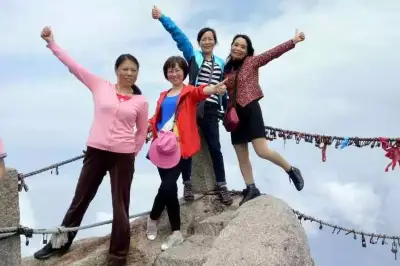
We were impressed by the South Gate's grandeur, so we took a group photo. Then we negotiated with taxi drivers outside, paying 30 yuan per car (10 yuan per person), two cars to Ziguang Pavilion. They were Zhonghua cars, fairly spacious.
At Zuguang Pavilion, vendors and porters swarmed us, offering to carry our bags for 8 yuan per jin, then 6 yuan. Annoyed, we ignored them, using silence as the best refusal.
Huangshan tickets: 200 yuan per person; half price for teachers/students. Coco is a teacher and brought her certificate, so she paid 100 yuan. M had returned to graduate school at Jiao Tong University after work, so he borrowed student IDs for us. The ticket seller didn't check carefully. But at the entrance, the staff checked IDs against tickets.
I went first, acting confidently, and passed. The others followed smoothly: Coco and M had real IDs. Y's student ID photo closely resembled her; K passed easily; L, however, was scrutinized for two minutes, asked if it was someone else's ID. L claimed, "I used to wear glasses, now contact lenses; why wouldn't it be me?" The confused staff let him in. A small episode that saved us money!
Starting the climb, everyone was excited. The girls ran ahead, light as swallows. We guys lagged behind, partly due to slightly heavier loads, and partly because we weighed more. I was the worst: after climbing about six floors' worth, I was panting, telling them to slow down to conserve energy. Eventually, I fell to the back, looking the most exhausted.
A persistent porter saw my fatigue and targeted me mentally. He kept offering to carry my bag. Despite being tired, I refused. After half an hour, L suggested I might give in, but I resisted, thinking of my running habits: I usually hit the wall early, but after overcoming it, I'd be fine. So I declined.
The front mountain path was steep and exhausting. Most tour groups take the rear cable car up and walk down the front. We did the opposite because the front offers better scenery when going up; descending would have the scenery behind you.
We passed Congrong Pavilion, Lima Bridge, and finally reached Banshan Temple. It felt like a long way. People coming down asked how far to Ciguang Pavilion; we asked how far to Tiandu Peak. Many shook their heads, saying we had only just begun. My spirit was crushed; I felt my strength was gone. Age catches up: after thirty, stamina and willpower seem worse.
With drizzle starting, L, our de facto leader, suggested we stop at Banshan Temple to rest and eat. I knew my face was pale; muscles above my knees were sore. Sitting down, I massaged my knees. K advised I was too tense; I should shake my legs. Coco said I never exercise and let everyone down. I felt embarrassed.
We brought out the egg fried rice. Though cold, it was fragrant, partly because it was good, partly because we were exhausted. Many envied our rice; we were curious where we got it. I finished a bottle of water to lighten my load. I bought a walking stick.
Rain got heavier and colder. I no longer cared about the matching red couple shirts Coco and I planned for the next day; I put yesterday's T-shirt over for warmth, and we wore raincoats.
After eating, we chose the path up Tiandu Peak.
Before climbing Tiandu, let me insert an online introduction:
Tiandu Peak: Located east of Huangshan, opposite Lotus Peak to the west, connected to Boyu Peak to the east. Elevation 1810m. Described as 'strong bones towering above the skyline'. Most magnificent among Huangshan peaks. Ancient people called it 'Dwelling of the Immortals'. Monk Daoyun in Tang Dynasty first reached the summit. In 1937, a trail with 1,564 steps, 194 stone railings, and 600m iron chains was built. The summit is flat, with a stone chamber. Outside is a stone like a drunken immortal (Immortal Holding the Cave Door), and a stone peach (Heavenly Immortal Peach). Engraved 'Reaching the Summit'. View: clouds and mountains. Poem: 'Even those impressed by Five Sacred Mountains find Tiandu extraordinary.' Folk saying: 'If you haven't climbed Tiandu, you've come in vain.' In 1983, a new path was opened from halfway.
Jiyu Back (Carp's Back): On Tiandu Peak. From the base, handrail, climb 1,564 steps to a stone ridge at 1770m. The ridge is over 10m long and only 1m wide, like a carp's back, with deep chasms on both sides.
After resting and eating, we set off. Wearing raincoats, we felt stuffy. With a bag in front and on my back, the raincoat stretched tight. K took a photo with her Ixus, showing me looking like a dinosaur. It became a joke.
Since the group was spreading out, we shared walkie-talkies in pairs, channel 7.7, commemorating the 68th anniversary of the Marco Polo Bridge Incident.
To be honest, after eating, I had no energy, just wanted to sit. It got colder, rain heavier. Though lighter after eating, my legs were still sore. I felt hopeless, unable to imagine returning to the hotel before dark.
About the hotel: L planned to stay at Tianhai Baiyun Hotel the first night, then Xihai the second. But Huangshan held a Miss Universe pageant, and the beauties stayed at Tianhai Baiyun on July 11, so we couldn't book it. The youth hostel suggested changing the route: walk more the first day to Xihai Shui Xie, then reverse to Tianhai the second day.
I hadn't studied the route beforehand, relying on L. He explained but I didn't look at the map carefully; confused about Tianhai, Xihai, Beihai. I just followed, always last.
We reached Jinji Jiao Tianmen (Golden Rooster Calls Heaven's Gate) when rain intensified. Many sheltered. We saw a stone tablet warning against climbing Tiandu in stormy weather. After discussion, we decided to continue, not wanting to regret it. But willpower couldn't overcome physical limits. My knees still hurt; I had to rest every 5 minutes. The porter had disappeared, giving up on our business.
The path steepened; Tiandu Peak appeared and disappeared in clouds. Stone steps narrowed, hard to place our feet; sometimes we had to walk sideways. Rain poured; one side was terrifying cliffs. The path zigzagged, sometimes with chains, sometimes without. Y stopped, serious, saying she preferred safety, didn't want to climb Tiandu. L, as her protector, decided to accompany her back to Banshan Temple, then take the path to Yuping and then to Tianhai/Xihai direction to the hotel. They left the decision to climb Tiandu to the remaining four. M and K had adventurous spirit and decided to continue; I wanted to climb but depended on my gf's choice; she chose to go up. The group split. I had no hope for good weather for photography, so I handed my heavy camera gear to L to take to Xihai Hotel.
The four of us (M&K, Me&Coco) continued upward – actually, we were crawling. L had read online that climbing Tiandu required using hands, so he brought work gloves from his company. We started using them before Jinji Jiao, but now we were like monkeys, climbing on all fours. The rain turned into a storm. Our gloves were soaked, but it felt exhilarating. My shoes were wet outside but socks dry inside; I boasted, but Coco and K said drying would be slow. Coco's canvas shoes were totally wet; K's mesh sneakers the same; M wore Gore-tex high boots, likely dry inside like mine.
We climbed and rested. Looking back, we were in a very dangerous position, with steep cliffs around, sparse ancient pines in welcoming poses. Thanks to birds eating pine cones and dropping seeds in their droppings, which took root over centuries, creating Huangshan's beauty. (My theory; don't judge me.)
The higher we went, the more dangerous and beautiful it became. Even in heavy rain, clouds drifted by. It felt like being in hell but heart in heaven. Water ran down the steps like a stream. M and I couldn't smile. Water seeped in through our shoe collars. Now our feet were soaked, but with no worries.
We met few descending people; soon it seemed we were alone in the valley. We shouted "Huangshan!" but no echo. Clouds hid the peaks, which was good because if we saw the deep chasms, we might have been scared.
Then we heard thunder. Coco got scared, suggested going back. I reasoned that if we heard thunder, it had already passed. But more thunder came, nearby. M and I turned off phones and walkie-talkies to avoid attracting lightning. We found a flat spot under a big rock to rest, waiting for the rain to ease. Rain didn't let up; thunderstorms continued. M decided to move forward. After a few seconds, he shouted, "Come quick! There's a cave to shelter!"
I saw a cleft, not a real cave, but a good shelter. M went in first, then K, then Coco at the entrance, calling me in.
I hurried in. We sat on steps, in order: M top, K, Coco, me.
Just a few seconds after I got in, suddenly a crack of thunder – seemed close yet far – I can't recall exactly. I just remember my finger touching the rock felt a tingle, then my hand bounced off – we were hit by lightning! It was close but not too close; it felt like static electricity. K and Coco said the same. M had it worse: his foot was in a puddle, and felt a shock from arm to foot.
The girls decisively decided to give up climbing Tiandu, no matter how close we were to the top or Jiyu Back. For safety, we had to go back down to Banshan Temple and follow L and Y's route.
I realized then that L and Y were rational, M and K were bold, and Coco and I were swing votes. After this close call, we had to decide carefully.
But I still hadn't fully grasped the severity, joking that maybe we were already spirits. The joke fell flat; their faces were serious. I looked behind: no bodies, we were still alive.
We headed down. The scenery was still beautiful, thunder less. But Coco was scrambling down fast, and I worried about her, calling her to slow down.
M and K stayed in line; we kept 4-5 steps between us to avoid falling. I was last – but also most exposed to another strike. But I'm a fatalist; if it's my time, so be it.
After about half an hour (or maybe 20 minutes), Coco excitedly called out that we had reached the spot where we parted with L and Y.
We arrived at the pavilion by Banshan Temple, where many sheltered. The staff nervously asked if anyone was still up. We said we didn't know.
About five minutes later, a man and woman came down, saying three more were behind. They said they also felt electric shocks.
I guessed the lightning struck the summit, and based on step voltage theory, they would have been more severely shocked. But I didn't want to dwell; better to forget.
We left the pavilion, heard the other three had come down. I didn't look back.
So ends our Tiandu life-and-death story. We then headed to Yuping, to catch up with L and Y. More to come later.
Subsequent Notes/Guide:
1) Later we learned that Tiandu and Lotus Peaks are rarely open simultaneously. This year both were open. Tiandu is known for lightning. In rainy weather, don't take risks like we did. There's a story of lightning killing a dozen people on Jiyu Back; afterwards the iron chains were replaced with ropes. I haven't verified, but locals say several people die on Tiandu each year. So only climb in good weather; heed the warning stone.
2) In thunderstorms, retreat immediately, turn off phones and walkie-talkies.
3) Bring work gloves for climbing Tiandu. After using, dispose of them in waste bins for environmental protection.
4) The point where we sheltered and got hit is called Tiandu Yixiantian, not far from the summit.
5) Most tour groups go up the back mountain and take the north path to Tiandu summit, descending via the south path. We did the opposite, which is tougher because the south path is steeper. But no superiority; scenery matters.
6) Tiandu scenery is beautiful but dangerous; "walk without looking at scenery; look without walking." Photographers should be careful. In bad weather, don't shoot; protect gear and yourself.
7) Travel in groups. Weather changes quickly; don't use umbrellas, use raincoats and rubber shoe covers (buy at base cheap).
8) Outdoor brands have value. We agreed quick-dry shoes and clothes are advisable.