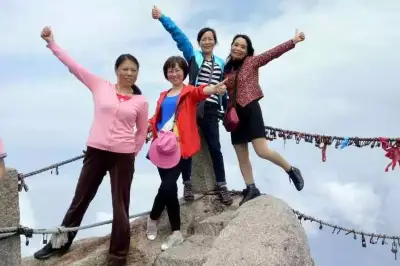
The Most Practical Huangshan Travel Notes (Text Version of a DV Video ^_^)
The Most Practical Huangshan Travel Notes
At 22:02 on April 13, 2006, the N518 train from Shanghai to Huangshan slowly and punctually started off, swaying with a train full of expectations, excitement, and a longing to embrace nature, relax body and mind, racing through the vast night.
In recent years, life has improved, more people travel, and all related costs have risen. For us young white-collar workers actively living in the fast-paced international metropolis of Shanghai, we deeply felt the meaning of the song: "I want to go to Guilin, I want to go to Guilin, but when I have time, I don't have money... when I have money, I don't have time." With both "money" and "time" limited for us, thanks to Hua Hua's successful planning and organization, Ah Hui's strong leadership as team leader, and the unity and cooperation of all members, this 3-day-2-night Huangshan independent trip was both happy and lucky. ^_^
Reviewing the preparation:
1) Determine the location, time, itinerary, transportation, approximate personnel, and budget of the independent trip. Confirm the person responsible for booking round-trip tickets and accommodation, and the assembly time and place before departure.
2) Elect a team leader, a manager for public expenses, and an accountant. (For common expenses like tickets, a fixed amount is collected and managed by one person, with another recording accounts. Settlement is done daily when checking into the hotel. This is more secure with everyone's attention.)
3) Prepare necessary items according to the destination, such as a double-shoulder hiking backpack, a waist pack (very practical), hiking gloves (anti-slip and waterproof, essential for climbing), sports shoes (anti-slip and waterproof), a warm jacket, disposable raincoats, etc. Also bring an appropriate amount of water, chocolate, biscuits, and some essential medicine (essential balm, cold medicine, Band-Aids, etc.). Don't forget your ID card and RMB! Camera, mobile phone, charger—Huangshan has excellent signal! All hotels can charge!
Departure on the evening of April 13, 2006
1) 2006-4-13 21:30pm: After a busy day's work, we gathered punctually at the agreed meeting point.
2) 2006-4-13 22:02pm: N518 train departed on time, arriving at Huangshan Railway Station at 8:48am the next day.
3) After the train ran smoothly, we collectively handed over our tickets, Huangshan entrance tickets (202.00RMB including 2 yuan insurance), and an estimated 500.00RMB for expenses on the 14th to team leader Ah Hui for payment of shared costs, with me responsible for keeping accounts.
4) 2006-4-13 23:20pm: The hard sleeper carriage lights went out, and everyone started to rest. (Upper bunk 164.00RMB, middle bunk 169.00RMB, lower bunk 175.00RMB, hard seat 94.00RMB; it is recommended to book early and take a sleeper for better rest, saving energy and good mood for hiking and enjoying the spring scenery on the way there, and sleeping well on the return trip to relieve fatigue. The hard seat simply does not allow proper rest, and the return trip is on N520, departing at 22:33pm and arriving in Shanghai at 9:48am the next day—if you have work that day, it's extremely tiring.) Health is the most important asset in life! ^_^ Take good care of yourself. ^_^
April 14, 2006: Best walking route up the front mountain of Huangshan (hehe ^_^ self-proclaimed)
Ciguang Pavilion → Banshan Temple → Tiandu Peak → Greeting Pine, Yuping Tower (Overnight at Yuping Tower Hotel)
2006-4-14 8:48am: Arrive at Huangshan Railway Station. (Huangshan maps at 2 yuan each and disposable raincoats at 1 yuan each are available outside the station—if you haven't prepared, buy them here at a reasonable price.)
→ 10:23am: Arrive at Tangkou (took a minibus from the station at 9:03am, 10 yuan/person, 1 hour 20 minutes to Tangkou Transfer Center at the foot of Huangshan; Tangkou is the gateway to Huangshan)
→ 10:53am: Arrive at Ciguang Pavilion (from the transfer center, take a new national line bus or taxi, 10 yuan/person, 30 minutes to Ciguang Pavilion; buy Huangshan entrance ticket 202.00RMB. This is the front mountain with beautiful scenery, suitable for walking up. Those with weak physical strength can take the cable car up directly to Greeting Pine/Yuping Tower)
→ 11:13am: Start hiking up → 12:37pm: Arrive at Banshan Temple (1 hour 24 minutes from Ciguang Pavilion to Banshan Temple)
→ 15:00pm: Arrive at Tiandu Peak (2 hours 20 minutes from Banshan Temple to Tiandu Peak)
It is said that on April 1, 2006, Tiandu Peak, one of Huangshan's three main peaks, ended its 3-month temporary closure and reopened to visitors.
Tiandu Peak is one of the three main peaks of Huangshan, with an altitude of 1810 meters. After a 5-year closed "rotation rest", it reopened in May 2005. However, the Huangshan Scenic Area decided to temporarily close Tiandu Peak from December 31 to March 31 each year. The scenic area's landscape department stated that this is to protect visitor safety and the vegetation on the peak. The pine trees that visitors must pass are wrapped with bamboo "coats" to prevent deliberate damage (such as carving on the trees—instead of such bad behavior, it's better to buy some She inkstone or Huizhou ink at Huangshan and practice calligraphy at home; you might even become a master calligrapher—just a friendly suggestion). This better protects Huangshan's pine trees.
Tiandu Peak is popular for its steepness and unique scenery. Because it is extremely steep and the steps are narrow and steep, the steps often freeze in winter, making it easy for accidents when climbing. Also, due to the dangerous terrain, fire prevention in winter is very serious. So it's best not to bring cigarettes or open flames up the mountain—thank you for your eco-friendly actions.
Tiandu Peak is located in the eastern part of Huangshan, facing Lotus Peak to the west and connecting to Boyu Peak to the east. It rises straight into the clouds and is the steepest of the three main peaks. In ancient times, it was called "the capital of the immortals," meaning the heavenly metropolis. Tiandu Peak is an angular peak formed by Quaternary glaciers. Its top is flat like a palm, with a stone carving saying "Ascend to the Peak." There is a natural stone chamber in the middle that can hold a hundred people. From the peak, you can see clouds and mountains connected, rivers like a line reaching the sea, and surrounded by thousands of peaks competing in beauty—a breathtaking view. Unfortunately, when we climbed, there was thick fog, so we couldn't see the full view of Huangshan's peaks and strange pines and rocks, but the misty fairy mountain scenery and magnificent sea of clouds were still a great treat. ^_^ Although Tiandu Peak is not as high as Lotus Peak (which was closed due to weather on our visit, so we couldn't climb it), its steepness is unmatched by Lotus Peak. The Hundred-Zhang Cloud Ladder is almost vertical, and we practically climbed with hands and feet. Tiandu Peak is the ideal place for a bird's-eye view of Huangshan's magnificent panorama, so people say, "If you don't climb Tiandu Peak, your trip is in vain." So our first challenge was the steepest Tiandu Peak. In ancient times, there was no path to Tiandu Peak, and very few could climb it. In 1937 (the 26th year of the Republic of China), a staircase was built, 3 li long, with 1564 steps, 194 stone railings, and 600 meters of iron chains to ensure safety for ascending to the top. In 1984, a new path was opened from the waist of the peak to the top. Standing on the peak, you can see clouds and mountains connected, rivers like a line, and thousands of peaks competing in splendor—a magnificent sight. An ancient poem praised: "Even those who have returned from the Five Sacred Mountains are amazed at the sight of Tiandu." In May 1965, Dong Biwu wrote: "The unique steepness of Tiandu, even a distant view is a fate; there is nothing comparable, nothing before it." Today, there is a folk saying: "If you don't reach Tiandu Peak, you've come in vain." It means that visiting Huangshan without climbing Tiandu is a wasted trip. The top of Tiandu Peak is flat like a palm, with a stone carving saying "Summit of Tiandu." Scenic spots within the peak include the Immortal Guarding the Cave, Carp's Back, Heavenly Bridge, Hundred-Zhang Cloud Ladder, Squirrel Jumping to Tiandu, Heavenly Jade Screen, Child Worshipping Guanyin, Golden Rooster Calling to Heaven's Gate, Two Monks Worshipping Buddha, etc. We really "climbed" the mountain, using hands and feet, especially when crossing Carp's Back and Heavenly Bridge. If you have acrophobia, it's better to choose a foggy day to cross, so you can't see the bottom of the valley and won't be too scared.
→15:25pm: Descend from "Summit of Tiandu." It had started drizzling, and the steep rock faces and ice-cold iron chains were covered with a thin layer of slippery ice. We all put on disposable raincoats (it's windy on the mountain, not suitable for an umbrella; for your safety, it's recommended to bring easy-to-carry disposable raincoats) and slowly descended using the concave footholds on the rock wall or the thick black iron chains (the rock wall is relatively less icy than the chains—just personal experience, hehe ^_^).
→16:00pm: Finally saw the Greeting Pine (35-minute walk from Tiandu Peak to Greeting Pine; this is also Yuping Tower, where the Greeting Pine grows on the left side of Yuping Tower, sprouting from a rock called Lion Rock. It is 10 meters tall, with a chest diameter of 0.64 meters, at least 800 years old. One of its branches extends outward like an arm welcoming guests from afar—graceful and elegant. It is the iconic landscape of Huangshan. It is a 15-minute walk from Yuping Tower Cable Car Station, which operates from 7:30am to 4:30pm; ticket price: adult 65 yuan/person, children 35 yuan/person.)
Episode 1: Decision to descend or stay overnight on Huangshan...
Since hotels on Huangshan require cash or deposit to book rooms, our group of five had not reserved accommodation in advance. But it was not peak season, so we decided to find lodging based on our itinerary after arriving. Initially, phone inquiries said all rooms were sold out. By 16:29, we were reluctant to give up but had no place to stay overnight, so we had to take the last cable car down before dark while the rain was light. Team leader Ah Hui had already put the money into the ticket window but wisely withdrew his hand. Then we asked the cable car station staff to help us find a place to stay on the mountain. We five waited alone at the ticket window of the soon-to-close cable car station for final news...
Cold, hungry, and tired, I saw a companion buy a hot tea egg from the Yuping Tower convenience store. Even though I thought 2 yuan for a tea egg on the mountain was expensive (only 0.5 yuan at the foot), at that moment something hot... expensive is expensive. The world is full of good people. ^_^ As soon as I put half the tea egg in my mouth, the salesperson asked if we were looking for accommodation (I nodded vigorously). He asked what standard we wanted. I said anything that can sleep, preferably one bed per person (floor bed is fine), with hot water for shower, or at least hot water to drink and wash feet. The cheaper the better. He immediately called Yuping Tower Hotel (where we had just come from) and confirmed that there was a multi-person room at 80 yuan per bed. Just mention the store's name when you go up.
I was so happy that I choked on the egg yolk and teared up, but I still shouted as loudly as possible to my companions. After confirming with the introducer, we happily returned to Yuping Tower. (Reminder: Remember the truth of "don't talk while eating," especially when eating egg yolk or chili—eat first, then talk. I learned it deeply... all is in silence.
Episode 2: "Check-in Storm."
Yuping Tower Hotel is a four-star hotel. With anticipation and uncertainty (along the way from Yuping Cable Car Station back to Yuping Tower Hotel, several men who seemed to be porters on the mountain told us there was no room at Yuping Tower and urged us to follow them to find good accommodation, only needing a 60 yuan introduction fee—friends, stick to your plan, don't waver), we quickened our pace and arrived at Yuping Tower Hotel.
Although the front desk manager raised the price from 80 yuan/person in the phone call 15 minutes ago to 150 yuan/person, we finally negotiated to 120 yuan/person after seeing the room. It was a meeting room with 7 single beds (about 18 sqm), very clean, dry, quiet, and warm. There were two washbasins, and each person had a disposable toothbrush kit and a pair of disposable slippers. The entire room was allocated to our group of five, no additional guests. Although we couldn't shower, there was hot water to soak our feet, which was very comfortable. We are content and happy. ^_^
Here, as guests of this hotel, we must mention a small issue: this front desk manager completely lacked basic service etiquette. His words and actions damaged the overall image and quality of a four-star hotel. He did not treat all guests equally; he spoke rudely to us staying in the "big room," using "you..." and "you people..." and even said, "If you think it's expensive, don't stay!" He kept us waiting from 16:50 until all other guests (mostly those staying in standard or luxury rooms costing thousands) left the front desk before processing our check-in (we finally checked in after 18:00). Throughout, this manager used honorifics like "you" (in a respectful sense) and flattered the luxury room guests, smiling like a blooming flower. Is this four-star service?!
Episode 3: "Shocking Dinner! and Room Change Storm."
Our team leader was so kind! He treated us four to a costly dinner at the Yuping Tower Hotel restaurant. (Again, on behalf of all members, thank you ^_^) There was also a funny incident: while we were enjoying our sumptuous dinner, a front desk receptionist came to ask us to switch rooms because a later-arriving tour group had a few people who couldn't fit. They said the conditions were the same, also single beds, but with more people, and the manager agreed to lower the price to 80 yuan/person. (In fact, the off-season room rate is 80 yuan/person, and peak season is 150 yuan/person. Since we were actually not in peak season, we should have paid 80. The manager knew we couldn't go down the mountain or change hotels, so he raised the price arbitrarily. So unfair, humph!) We refused and unanimously decided to stay put. Later, through reconnaissance by our members, the place they wanted us to move to was incomparable to our current room—crowded, noisy, dirty, and chaotic—definitely not "same conditions." Good thing we didn't "fall for it." Unity is victory!
Dinner time: 2006-4-14 18:46–19:09pm
1) Tea bamboo shoots with shredded pork: 55.00RMB
2) Fish-flavored shredded pork: 60.00RMB
3) Celery with dried tofu: 30.00RMB
4) Tomato scrambled eggs: 45.00RMB
5) Minced pork with vermicelli in a small clay pot: 45.00RMB
6) Milk soup crucian carp (2 fish) in a big bowl: 65.00RMB
7) White rice (one basin): 20.00RMB
Generally, vegetable dishes were around 30 yuan, meat dishes were over 50, and a small chicken was over 100. According to staff, mountain food is expensive because the cable car only carries people, not goods. Everything on the mountain is carried up by porters, so costs are high. Indeed, a 500ml bottle of water costs 5 yuan, cola etc. 10 yuan, a pack of 3+2 Master Kong biscuits 10 yuan (3 yuan at the foot), a mung bean popsicle 5 yuan, a red bean popsicle as high as 10 yuan, a tea egg 2-3 yuan, a cucumber 2-7 yuan... These items are sold at all rest platforms along the climb, prices very uniform and basically non-negotiable. ^_^
April 15, 2006: Best route to climb Guangmingding and hike down (self-felt)^_^
Yuping Tower → Baibu Cloud Ladder → Aoyu Peak → Tianhai → Baiyun Hotel → Buxian Bridge → Down to the valley bottom → Up to Menghuan (Fantastic) → Paiyun Pavilion → Feilai Stone → Guangmingding → Bai'e Ridge (cable car down) → Hike down → Passing Magpie on Plum Blossom → Immortal Turning Table → Peacock Pine → Yungu Temple → Hongcun Village (Yi County Hongcun, Xidi, Tunxi Old Street)
Spring is the best time of the year, and morning is the best time of the day. After a night's rest, everyone got up early, tidied up by 6:30am, ate some self-prepared breakfast (just biscuits with water or coffee ^_^; hotel breakfast is expensive—a small steamed bun, a small pastry, a small tea egg, and a bowl of thin rice porridge cost 20 yuan! Most people can't get full ^_^ so self-prepared breakfast is economical and practical ^_^), then settled the bill, checked out, and happily left the hotel to greet the clear morning on Huangshan.
Thinking about our luck ^_^, just when we arrived at Huangshan, on the way from the station to the mountain, people on the minibus loudly claimed we came at a bad time—heavy rain two days ago had closed Tiandu Peak, Lotus Peak, Guangmingding, and Menghuan (Fantastic) until the weather cleared. They said climbing now was not suitable, etc., in short, urging us to change plans and charter their car to the East Sea. Fortunately, we were united and firm in our conviction, not listening to rumors, and climbed Huangshan according to the original plan.
We were really lucky: while climbing the steepest Tiandu Peak, the weather was cool and foggy, and we climbed to the "Summit of Tiandu" in a fairyland-like misty mountain, enjoying a unique view of Tiandu without lingering fear. Every time we recall it, it's the beauty of the fairy mountain scenery. After descending Tiandu, it was drizzling and getting late. We thought we had to catch the last cable car or hike down in the rain, wasting our 200-yuan tickets. But persistence is victory—not only did we not end the trip disappointingly, but we also found a good place to stay and had a very peaceful night.
Although we didn't see the Huangshan sunrise (generally, you need clear autumn weather with little fog and low humidity for sunrise; according to locals, Huangshan has over 200 drizzly days a year), we enjoyed the misty beauty of Huangshan the day before, experienced the mountain in the rain, and greeted the clear sky and blue sea of clouds the next morning. The green mountains appeared and disappeared among pure white clouds; strange pines, strange rocks, green mountains, clouds... nature's masterpieces, and the spring sun strove to shine through the clouds, making one involuntarily intoxicated among the green mountains and clouds.
That bright blue sky cleared my heart instantly; the pure white clouds, innocent as a baby, washed my soul, making me feel in a holy temple, peaceful and serene. Smiles naturally overflowed on everyone's face.
2006-4-15 7:50am: Depart from Yuping Tower (at 10:09am, we encountered a Huangshan staff member in military uniform. All passersby had to register their name, number of people, contact info, and origin—Huangshan's safety measures are good, I think to prevent tourists from getting lost in the mountains.)
→10:47am: Arrive at Buxian Bridge, passing through Baibu Cloud Ladder → Aoyu Peak → Tianhai → Baiyun Hotel → Buxian Bridge. Along the way, we deeply appreciated the infinite charm of Huangshan's strange pines, strange rocks, and sea of clouds. (3-hour walk from Greeting Pine/Yuping Tower to Buxian Bridge.)
→12:02pm: Arrive at the valley bottom (1 hour 15 minutes from Buxian Bridge to the bottom), then ascend the Fantastic (Menghuan). At 12:53, at the signpost on the road from Buxian Bridge to Paiyun Pavilion, we met another registration officer in uniform. The same person who registered earlier registered again. 13:22pm: 0.5km from Paiyun Pavilion, rested 2 minutes, then continued climbing. Along the way, we often saw tenacious little orchids clinging to gaps in the hard rock, struggling to survive. The beautiful Huangshan magnolia flowers resembled Shanghai's city flower—white magnolia—holy and elegant like fairies in the mountains, playing among the strange pines and rocks, accompanied by lovely yellow bellflowers. The bellflowers hung like little golden bells on the branches, as if we could hear their happy and crisp songs—the good news of spring's arrival.
→13:52pm: Arrive at Paiyun Pavilion (1 hour 50 minutes from going through the valley bottom and Fantastic). From here, you can go to the West Sea Grand Canyon, or choose to go to Feilai Stone → Guangmingding → Bai'e Ridge (where there is a cable car down, but the station closes at 16:30pm) or hike down → passing Magpie on Plum Blossom → Immortal Turning Table → Peacock Pine → Yungu Temple (cable car station, from where you can take a minibus to leave Huangshan scenic area, go to Tangkou for accommodation, or go directly to ancient villages for next day's visit, or negotiate directly with the minibus driver to go to Hongcun, Xidi, or Old Street in Tunxi for the next planned destination.)
→15:05pm: Arrive at Feilai Stone (Flying Stone). This is a giant rock 12 meters high and weighing 600 tons, its bottom completely separated from the peak, as if flying from the sky—hence the name. The "magic stone" in the TV series "Dream of the Red Chamber" is this Feilai Stone. Legend has it that in ancient times, Nüwa refined stones to mend the sky, and one small leftover stone flew to the cliff of Huangshan. After thousands of years of absorbing the sun and moon's essence, it cultivated into a stone spirit and ascended, becoming the Ling Stone Boy. But on the way to the Queen Mother's birthday celebration, he smiled at a lovely little grass under his original body, Feilai Stone, and gave it a drop of life-saving dew. He was punished by heaven and banished to the mortal world as Jia Baoyu because he had started to think of worldly love and had to reincarnate and cultivate again. And the little grass that received the drop of dew turned into Lin Daiyu, repaying him with a lifetime of tears.
From Paiyun Pavilion (14:10pm) to Feilai Stone is a 55-minute walk.
→15:45pm: Arrive at Guangmingding (40-minute walk from Feilai Stone to Guangmingding). →16:17pm: Arrive at Bai'e Ridge. Since the 15th was Saturday, there were many tour groups, so the cable car line was very long. It was estimated that from buying tickets to getting down would take at least 3 hours. So our group of six (one joined at Paiyun Pavilion) decided to rest a bit and then hike down. Finally, at 18:24:58, all safely arrived at Yungu Temple. (1 hour 46 minutes from Bai'e Ridge to Yungu Temple.)
→2006-4-15 18:35pm: From Yungu Temple, we took a minibus directly to the next destination—Hongcun Village in Yi County. From Yungu Temple, passing the Huangshan gate (a symbolic photo spot like a memorial arch, usually not stopping unless you specifically ask the driver to stop for photos), we reached Tangkou in 25 minutes; from Tangkou to Hongcun it's a 50-minute drive. Generally, charter from Yungu Temple to Hongcun costs 160.00 to 200.00 yuan, depending on your negotiation. We chartered for 160 yuan, split among 6 people—26.66 yuan each.
We stayed at a place recommended by the driver: Linhu Restaurant in Jicun Village, Hongcun Town, Yi County. It was a relatively clean family-style inn, usually hosting students who come to paint here, and DIY tourists like us. The room was an 8-bed dormitory with four bunk beds, quite clean, with hot shower. The front hall served meals, where we wolfed down an affordable, authentic farm-style Huizhou cuisine.
Accommodation: Quoted 25 yuan per person, negotiated to 15 yuan/person, deal.
Dinner: 20 yuan per person share. Vegetable dishes 6-8 yuan, meat dishes 12-16 yuan. We had a freshly killed free-range chicken for 60 yuan. (Special recommendation: this chicken, though simply whole stewed, because it was free-range, the meat was firm, chewy, and delicious; the broth was pure and rich—one word: "unctuous"! The hot, clear broth warmed the whole body, feeling energy surging into every limb—so comfortable. ^_^
April 16, 2006: Touring Huangshan ancient villages—Hongcun Village in Yi County and Tunxi Old Street
Since we came directly to Hongcun the previous evening after descending the mountain and stayed at Linhu Restaurant, a 10-minute walk from the Hongcun scenic area, we had breakfast leisurely the next morning, bid farewell to the enthusiastic inn owner, and headed to Hongcun. (Friendly tip: if someone needs to return urgently, like one of our members who had to go back to Shanghai, you can take a long-distance bus from here—depart around noon, arrive Shanghai around 8-9pm; it's not only possible by the train at 10pm.)
Episode: Breakfast fun ^_^
We kids at the table were "starved" at Huangshan—our wolfing down dinner last night had deeply "moved" the landlady: almost every dish was cleared instantly. She must have thought, "My cooking is so good today..." So this morning, when we six asked for more steamed buns, saying how delicious they were, the landlady smiled and said as she brought more: "You can have all these in the pot..." Ha, the leftover goodness! So fragrant! So full!
Price: 2 yuan per person, all-you-can-eat steamed buns (actually supposed to be two per person, but we were cute so she gave us extra ^_^), unlimited hot rice porridge (the landlady had given up on us since last night—our bargaining was just too cute ^_^), one plate of pickled mustard, one plate of fried peanuts, one plate of radish strips, and one tea egg each. Quite a hearty breakfast! This price was more than 10 times cheaper than the hotel breakfast on Huangshan, and definitely filling.
I recommend that friends who need to buy souvenirs or gifts first scout the market in Hongcun, understand the prices of various specialties, and then buy accordingly to avoid regret.
Tea prices in Hongcun: For example, Jiaogulan (gynostemma) is known in medical circles as a substitute for ginseng, with anti-fatigue, anti-cancer, blood lipid-lowering effects. Premium health tea, very suitable for diabetes patients: 8 yuan per liang (in Old Street it's 37 yuan per liang). Qingshan Lvshui (wild small-leaf bitter tea) has fire-reducing, liver-clearing, and eye-brightening effects: in Hongcun 15 yuan/liang (Old Street 37 yuan/liang). There are many beauty flower teas like rose tea, jasmine tea, forget-me-not, carnation, all 2 yuan/liang. We bought various teas at "Fulü Tea House." The owner was a very hospitable young man, offering fair and reasonable prices. Other tea shops in Hongcun generally had higher prices than Fulü. However, I don't know much about tea; I just felt the taste was good after trying (the tea house owner was so kind—our group of five tried so many new teas we nearly got bloated, and he still smiled ^_^). If you friends know tea, feel free to find a good source yourself.
Hongcun has a small market concentrated area selling various Huangshan or Hongcun specialties, like She inkstone, Huizhou ink, stone and bamboo carvings, various bamboo crafts, utensils, small pendants—prices are much better than on the mountain, and you can bargain hard. I especially want to mention: the two bamboo cups given to me by a travel companion were made from fresh bamboo, polished and crafted, pure color, untouched by any chemicals. After coming back, I boiled them for 15 minutes to sterilize and now use them as daily water cups. The feeling is great. Every time I fill them with hot water, a faint fragrance lingers around my nose. Drinking from them saves tea leaves, haha ^_^ Again, my highest thanks to the friend who gave me those cups. I'll drink from them every day.
In Hongcun, there is a shop selling small baked cakes with dried plum vegetable and meat: 1 yuan for 3, very tasty.
Curiosity: Various prohibitions against students!
We saw many handwritten signs in Hongcun (ticket 80 yuan/person, with student or teacher ID you get a discount) like: "No dumping paint water into the toilet," "No entry without permission," etc., very strange and we felt sorry for the students. Why?! But seeing the many art students sketching everywhere in Hongcun, we sort of understood a little. But a sign saying "No entry without permission" at a restaurant seemed a bit much? If there is really a need to prohibit something, can't it be expressed in a gentler way? Aren't students consumers of the restaurant? Would the restaurant refuse their business? This sign involuntarily reminded me of the concession areas and many places in China during war times under invaders' rule, and some foreign places with signs like "Dogs and Chinese not allowed." This feeling of humiliation, sadness, and pain—I never expected to feel it during this Huangshan and Hongcun trip, stirring my Chinese heart.
Outside Hongcun, the stinky tofu at street-side stalls is also good: 1 yuan for 5 pieces, black, supposedly soaked in black sesame according to the owner. Dip in the homemade spicy sauce and sweet sauce—delicious! Spicy bliss! Iced red bean soup, green bean soup, and white fungus soup are cheap, delicious, and refreshing—1 yuan for a big cup.
At 3pm, take a minibus from Hongcun (2 yuan/person) to Yi County Bus Station (about 20 minutes), then transfer to a minibus to Tunxi Old Street (9 yuan/person, about 1 hour 15 minutes to Huangshan City Long-distance Bus Station). From there, transfer to a city bus (1 yuan/person) to Tunxi Old Street, about 5 minutes. The old street is just a few minutes' drive from the train station.
Visiting Tunxi Old Street is free. It's similar to Shanghai's Yu Garden or Qibao Old Street, with prices higher than in Hongcun, but negotiable—how much you can bargain depends on your skills.
At the entrance of the old street, there is a long-established Huizhou restaurant. The food is decent, reasonably priced. We had dinner at "Gourmet Home" (Meishi Renjia). The selection method is similar to the food court in Yu Garden: you choose by looking at the dishes, mark the number and price on the order slip, write your table number, give it to the waiter, and wait for the food to come.
Unforgettable episode: "Taxi chase after minibus!"
Our group of five finally arrived at Tunxi Old Street, the last stop of this Huangshan trip. The plan was to shop first, then eat, then go to the train station to return to Shanghai. At 17:38, as we were about to take a group photo in front of the stone archway at the old street entrance, we suddenly realized that one of our members had lost his digital camera and other valuables. Everyone became anxious for him.
In an emergency, our team leader calmly helped him analyze when and where the items might have been lost. We pooled our ideas and focused on the minibus from Yi County to Tunxi. Then we immediately took action: took a taxi and chased after it. First, we went to Tunxi Bus Station to see if the minibus had already left. It had been 40 minutes since we got off, and the minibus had already returned to Yi County.
We accelerated directly toward Yi County, dividing tasks: first report to police, then call the local traffic radio to find the owner via broadcast, and closely watch all suspicious minibuses and license plates, speeding toward Yi County.
Friendly tip for traveling friends: always get a ticket or note the license plate number just in case. We didn't have a ticket or the plate number, relying only on vague memories and blind luck, racing along winding mountain roads in a taxi chasing a minibus that might not be found.
Heaven bless! ^_^ Again proved the truth that persistence is victory, and there are still many good people. When we arrived at Yi County Bus Station, we immediately spotted minibus "Wan J 40030" driven by Master Wu. We were so excited we couldn't express it in words. When Master Wu returned the items to our companion and told us he had been waiting there all along, this historic moment at 18:41 will forever be unforgettable. Thank you, lovely Huangshan people! You once again showed the traditional virtue of returning lost items.
This heartwarming, lovely episode added a magical touch to our wonderful Huangshan self-guided tour, leaving a lingering aftertaste. We returned to Old Street at 19:37pm and even happier shared our final dinner of this Huangshan trip! (From Old Street to Yi County and back to Tunxi Old Street, the meter was 236 yuan, but we actually paid 150 yuan because we negotiated the price with the driver before getting in.)
After dinner, we strolled a bit on Old Street. There was wonderful unspoken cooperation: bargaining, paying, taking the goods, and moving on... Haha, in front of the priceless She inkstones, we each secretly touched the incredibly expensive giant inkstones while the owner wasn't looking—what a thrill! A stone so big and so expensive—who would use it?! Just touching it for fun, haha... just kidding, don't imitate it casually. ^_^
2006-4-16 22:33pm: As the N520 train slowly started, this wonderful Huangshan trip came to an end. Friends who are still too busy to breathe in daily life might consider following our example: gather a few travel companions, coordinate travel time, determine destination, budget, itinerary, elect a team leader, a cost manager, and an accountant, and set off on a relaxing, happy trip. ^_^
We are not just living; we want quality of life. In the midst of busy and intense study, work, and life, we should appropriately relax the tense string, give ourselves a break, even if it's just a trip to a nearby park or green space to get close to nature, slowly appreciate the breath of spring, and feel the vitality of spring.
Cherish everything you have, and you will realize how beautiful life is. ^_^
Huangshan Travel Notes—this is just my personal journal, travelogue, and reflections, providing perhaps some useful info for friends interested in visiting. It's simply a way to leave something for the beautiful memory of our group trip, a comfort for the once-stirring heart.
Written by Little Swallow
2006-4-29