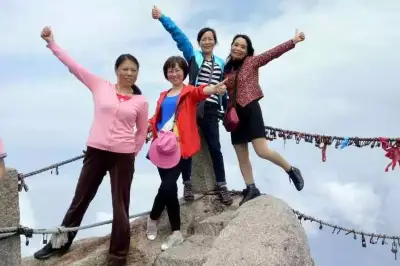
Yellow Mountain Trip
October 4th, Sunny
After much persistence, the dream of visiting Yellow Mountain that I've had since graduating high school finally came true, satisfying my "longing pain" for Yellow Mountain. The National Day holiday is not a good time for travel. At 7:00, while catching the bus at People's Square, I almost got lost in the crowd, breaking out in a sweat from anxiety. Once seated and the bus slowly started, my mood gradually relaxed. Outside the window was an exceptionally clear sky, with gentle sunlight streaming in. I really hoped the entire journey would be this fine and sunny.
The tour guide briefly explained the itinerary and precautions. My mother and I added two optional sightseeing spots: Yuliang Ancient Wharf and Monkey Valley. At 11:00, the bus arrived at Tianmu Mountain Hotel in Lin'an, Hangzhou. This so-called grand hotel was about the same as an ordinary restaurant in Shanghai—rough decoration, furnishings, and food—but when traveling, you can't be too picky. After the meal, following the crowd, I bought a bag of local Lin'an specialty fried snacks and munched them on the way. Around 3:00 p.m., we arrived at the outskirts of Huangshan City and visited China's first ancient dam, the Yuliang Dam, and the Xu Guo Memorial Archway in Huizhou. The former was like an ancient village with an entrance fee; many residents lived along the old dam, drinking wine or playing chess by the murmuring stream under the bright sun, completely undisturbed by us tourists, each content and carefree. The latter was more suitable for scholarly appreciation; after hearing the explanation, laymen like us yawned and quickly boarded the bus to wait. At 5:30, we arrived in the city. Thanks to the tour guide's special care, my mother and I, along with another mother-son pair, were arranged to stay at the New Nanguo Hotel (three-star). In the evening, we visited the famous Tunxi Old Street, which was disappointing—it paled in comparison to Shanghai's City God Temple. The guide had warned us in advance: half of the old street is flooded every year, and tea vendors mix dried old tea (soaked by floodwater) with new tea. So we stayed away from tea, bought disposable walking sticks and raincoats for the next day's climb, and returned to the hotel to rest.
October 5th, Sunny
Great, another fine day. After the so-called 15-yuan luxury buffet breakfast, I fully believed the guide's words: a three-star hotel in Huangshan is at most equivalent to a two-star in Shanghai, and a two-star here is like a Shanghai guesthouse. At 7:30, the bus headed to the first scenic spot: Yellow Mountain Monkey Valley. Located at the foot of Yellow Mountain, I no longer knew where I was—surrounded by lush greenery, crystal-clear streams, birdsong, and the sounds of nature. What a pity such a wonderful place is occupied by monkeys, while we humans, also with tails tucked between our legs, are crowded into noisy, congested concrete jungles to torment ourselves.
At 9:45, the bus headed to the Yellow Mountain scenic area, getting closer to my long-yearned destination. Yellow Mountain was anciently called Yishan. Legend has it that the Yellow Emperor, ancestor of the Chinese nation, brought his ministers Rong Chengzi and Fuqiu Gong here to refine elixirs and eventually ascended to heaven. In the sixth year of the Tianbao era of the Tang dynasty (747 AD), Emperor Xuanzong changed the name from Yishan to Huangshan (Yellow Mountain) based on this legend. It spans She County, Xiuning County, Yi County, Huangshan District, and Huizhou District within the city, covering an area of 1,200 square kilometers. The part now designated as the Yellow Mountain Scenic Area is 154 square kilometers, the essence of the so-called "five-hundred-li Yellow Mountain." The entrance to the scenic area is a symbolic archway inscribed with "Huangshan" by Marshal Chen Yi; tickets are not collected here. The bus wound up the mountain and was stopped at Lansheng Bridge. We took a scenic area minibus to Ciguang Pavilion (5 yuan per person). Our travel agency was quite capable; upon arrival at Ciguang Pavilion, we could sit down for lunch. Heaven knows how many people stood behind us, waiting for us to finish so they could take their seats! After lunch and a short rest, we took the Yuping Cable Car to Yuping Building, the first stop on Yellow Mountain. Despite the crowds, the view suddenly opened up—a beautiful boundless scroll spread before my eyes.
From Yuping Building, looking south at Tiandu Peak and north at Lotus Peak, it gathers almost all the wonders of Yellow Mountain, earning it the reputation as the finest spot on Yellow Mountain. The world-famous Welcoming Pine stands to the left of the building, with the Farewell Pine on the right. In front are the Accompanying Pine and Manjusri Terrace, and behind is Yuping Peak, where the famous "Yuping Reclining Buddha" lies on the summit—head on the left, feet on the right, remarkably lifelike. On a cliff rock is inscribed Mao Zedong's cursive calligraphy of "So many beautiful rivers and mountains." On the east cliff, there are inscriptions by Marshal Zhu De: "Beautiful as a painting" and Marshal Liu Bocheng's poem "Touring Yellow Mountain with Veteran Comrades of the Southern Anhui Anti-Japanese Resistance": "The anti-Japanese army went north in those days, longing for rain like a drought. Yellow Mountain has always had clouds like a sea, and henceforth the sky rains more." Along the way, the guide kept reminding us: "Walk, don't look at the scenery; look at the scenery, don't walk." Indeed, the perilous peaks of Yellow Mountain have claimed many lives, yet it's hard not to be captivated by the majestic, ingenious wonders. Reaching Yuping Building was just the beginning of the day's itinerary, but many in our group were already panting heavily. Only with the guide's repeated encouragement did we make it, reminding me of the 800-meter run in school. The real climb was about to begin.
First was the highest peak of Yellow Mountain, "Lotus Peak." Located north of Yuping Building, it stands at 1,864 meters above sea level—steep, towering, and majestic, resembling a newly blooming lotus flower, hence its name. From Lotus Ridge to the top of Lotus Peak is about 1.5 kilometers, a section called Lotus Stem, lined with famous Yellow Mountain pines such as Flying Dragon Pine and Hanging Pine, as well as Yellow Mountain azaleas. The summit of Lotus Peak is about ten square meters, with a Fragrant Sand Well in the center. Standing on top, looking around, thousands of peaks compete in beauty, and countless valleys emit mist. It is said that on a clear day, you can see Tianmu Mountain to the east, Lushan to the west, and Jiuhua Mountain and the Yangtze River to the north. After rain, the panoramic sea of clouds is even more spectacular. But when we actually started climbing, we truly understood what "Stem" meant: the towering peak, the increasingly narrow path, and the guide's warning that "once you go up, you can't turn back" sent shivers down our spines. Of course, there was another option: the "Lotus Lucky Path" for those who couldn't or didn't want to climb. I asked my mom, "Should we take the lucky path?" Her answer gave me a hundred times more energy: "Since we're here, not going up would be a waste of this trip." So, carrying our huge travel backpack, my mother and I chose the difficult Stem. Initially, the path was fairly flat with decent safety facilities, and the beautiful scenery kept our spirits light and relaxed. But the higher we went, the less we could afford to look at the scenery, because any misstep was unforgivable. The final section allowed only one person to pass, and we were truly climbing on all fours—the steps were so steep, with only a reassuring railing beside us, and a bottomless abyss below. Falling would mean certain death. During the climb, some people heeded the guide's advice and retreated, but they had to go down backwards. So that's what "no turning back" meant—looking down made my legs weak; even going forward, I couldn't guarantee I wouldn't tumble down. Just then, I saw a child, maybe five or six years old, crying in terror while retreating down the mountain. It took about an hour to reach the top (because of the National Day crowds, it was much better than the guide's earlier claim of 200 meters in half an hour on October 1st). Along the way, cheers and shouts of encouragement came from above and below; though our feet were shaky, our hearts were firm, and we made it to the summit of Lotus Peak in one go. By then, the summit was already crowded beyond capacity—this tiny patch of ground could hold at most a hundred people, yet it offered a panoramic view of all of Yellow Mountain's beauty. In all directions, the view was boundless, as if we were already in the clouds, unsure where we were. Looking out, the rolling mountain ranges stretched endlessly beneath us; above, the blazing sun seemed within reach. No wonder they say, "After seeing the Five Sacred Mountains, you don't need to see other mountains; after seeing Yellow Mountain, you don't need to see the Five Sacred Mountains." Even this single peak made me reluctant to leave and sigh in awe. Unfortunately, there was no time to sit quietly and gaze into the distance to see the far-off scenery clearly. The descent was much easier than the ascent, but we still passed the designated meeting time. We hurriedly called the guide, as we had agreed "no waiting after the time." The guide was quite good-natured. When we reached Lotus Pavilion, we learned that we were actually among the early ones to come down. After a short rest to lighten our backpacks, we passed the Turtle and Snake Rocks and the Hundred-Step Ladder to Cloud, arriving at the foot of Aoyu Peak. This peak is 1,780 meters high, named for its shape—like a giant whale raising its head, seemingly ready to devour the world. There were two ways to climb Aoyu Peak: "A Thread of Sky" and "Aoyu Cave." Having climbed with great enthusiasm, I clamored to take the "A Thread of Sky" path and let my mom go through "Aoyu Cave." But my mom chided me for underestimating her. So we took another peril of Yellow Mountain, "A Thread of Sky." But compared to Lotus Stem, I thought it was nothing. Soon we reached the summit of Aoyu Peak, took a photo with the fish head, and hurried to Tianshan, because we had misheard the guide and thought that after reaching Tianshan we would be arranged accommodation and the day's itinerary would end. At Tianshan Hotel, we waited leisurely for our group. A couple from the same group also arrived at Tianshan, and I confidently told them that we would gather here for accommodation. Seeing that there was still time, they went to Bright Summit Peak, which was nearby. We also couldn't resist; after waiting for half an hour and seeing no one, we went up to Bright Summit Peak. This Bright Summit Peak was nothing like the one in "The Heaven Sword and Dragon Saber"; it was completely modernized, with the famous Bright Summit Peak Meteorological Observatory. Only a stone slope remained well-preserved, a great spot for viewing the scenery. Bright Summit Peak is the second highest peak of Yellow Mountain, only 4 meters lower than Lotus Peak, at 1,860 meters. But because we had come from Tianshan, the actual climbing height was only 0.5 kilometers, so it wasn't strenuous. Fortunately, we met some other members of our group and learned that Tianshan had already been the gathering point, and the next destination was Xihai (West Sea), where we would stay. We were shocked; at least we hadn't waited foolishly at Tianshan, but we felt guilty for misleading the couple. It was already past 4:00 p.m., and Xishan (West Mountain) was still 3,500 meters away. Since we had fallen behind the main group, we had to see less scenery and hurry more. Along the way, Danxia Peak, Flying Stone, and Twin Bamboo Shoots Peak, bathed in the golden glow of the setting sun, looked enchanting and dreamlike. Especially at Echo Wall, where iron chains were covered with prayer locks, many young people shouted "Yellow Mountain, I love you." At that moment, it felt as if Yellow Mountain itself had life—a unique being, gathering the spirit of heaven and earth, the essence of nature. It made us feel the vast love and need of nature. So serene and majestic, even if we disturbed its tranquility, it embraced our audacity with its broad bosom. At that moment, did Yellow Mountain hear our words and smile? Urged on by the guide's phone calls, we finally reached our destination. I was utterly exhausted and could fall asleep as soon as my head hit the pillow. My mother had much more energy than I did—I had to admit defeat. Our mountain hotel was Xihai Hotel. Most hotels on Yellow Mountain are built against the mountain, so the terrain has to be utilized optimally. The lobby was on the second floor (first floor above ground), and the economy rooms were on the first floor (ground floor), with no windows because one side faced the mountain. We stayed in a ten-person economy room with bunk beds; the conditions were much better than imagined. Many travel groups' tourists had to share a single bed (including Spring Tour, which I had consulted earlier). The travel agency "Huangshan Fengqing" was chosen because it had enough local influence to guarantee one bed per person on the mountain, and indeed it proved to be the right choice. After a simple, expensive vegetarian meal (by my standards) and a quick wash, we went to sleep, as we had to get up at 5:10 a.m. to watch the sunrise. The mountain was very cold at night. My main luggage item—two down jackets (renting a coat on the mountain costs 50 yuan each)—came in very handy. When visiting Yellow Mountain in October, don't wear long underwear; your legs will only feel cold for a while because climbing warms them up quickly. Two layers of pants are cumbersome and can't be removed while climbing; moreover, your legs get hotter as you descend, so it's very unwise. Down jackets are needed because you can put them on when cold and take them off when hot—absolutely warm.
October 6th, Cloudy
Before dawn the next day, the group set off under dim streetlights and moonlight toward Beihai Lion Peak. We reached Lion Peak about ten minutes before the expected sunrise time. The 5+ hours of climbing on the first day had taken a toll on my usually sedentary body; my legs were already very sore. I couldn't compete for a good spot, so in a flash of inspiration, I climbed onto a rock, with one foot on the rock and the other on a nearby pine tree, finally gaining a foothold to quietly watch the sun's appearance. But it wasn't the best position; when cheers erupted from afar, there was still no sign of the sun on our side. I grew anxious. At that moment, even just a red line on the horizon made me snap away with my camera. Gradually, the first rays of dawn appeared, a cinnabar glow spread, and a red dot jumped out from the sea of clouds, forming an arc-shaped disc that rose into a semicircle. Suddenly, a red sun burst through the waves, soared upward, and ascended into the sky. The Qing dynasty poet Yu Hong described this scene: "Colorful clouds surge like morning sun, holding a red wheel to the sea gate. Now rising, now sinking, with dazzling light; the nine dragons mistakenly swallow a fire pearl." But just then, the camera battery ran out. After frantically changing the battery and snapping three hurried shots, when I looked up again, the sun had disappeared behind clouds, vanished without a trace. The sky turned from deep blue to light blue, a hazy dawn light revealing the misty mountains, pines, and rocks in the distance—dreamlike. This transformation took only about a minute. The veiled peaks and strange rocks gradually came into view; the entire mountain range was bathed in brilliant colors. The sky was filled with myriad rays of light, like a giant kaleidoscope, making one marvel at nature's wonders. Afterwards, we had breakfast at a temple in Beihai. The food was delicious—the best meal of my entire Yellow Mountain trip, especially the dried radish strips. Along the Beihai scenic area, we climbed to Shixin Peak. The most striking sight was the Lianli Pine (Twin Pines), a towering tree with a thick base that suddenly split into two trunks, as if two trees grew from the same root, inseparable and interdependent. This tree symbolizes the true love of Yang Guifei and Emperor Xuanzong: "In heaven, we wish to be like birds flying side by side; on earth, we wish to be like intertwined branches." Since we had to reach the foot of the mountain by noon for lunch, after arriving at White Goose Ridge at 9:00, we started the descent. We chose to walk down, thinking that descending was just like walking down stairs and wouldn't be too tiring. But, as they say, "Ascending is easier than descending." For two hours, we kept jumping on uneven stone steps—I can only describe it as jumping, because descending has a momentum; if you try to step cautiously, you'll exhaust most of your energy fighting that momentum. Only by going with the flow and hopping could I save energy. Despite that, after more than two hours of this mechanical movement, my legs no longer felt like mine; they trembled uncontrollably even when I stood straight. Descending the back mountain, we passed villagers carrying loads up the mountain on shoulder poles. Their loads included the water we drank, the oil we used, the food we ate, the bedding we slept on—everything we paid for was bought with the sweat of these laborers. Many climbers on the back mountain were panting heavily, while these villagers, relying only on a shoulder pole and a supporting stick, had to carry 80 to 100 jin (40-50 kg) up the mountain. Every few steps, they would use the stick to prop up the pole for a short rest, wearing thin cloth vests, sweating profusely, veins bulging. Many of them were elderly. On their shoulders, they carried not only physical weight but also the burden of life. The great mountain was just a part of real life, unfair to everyone, starkly highlighting the gap between rich and poor, revealing inequality. When I told people about this later, someone asked why they didn't use the cable car to transport goods. I was speechless. That is why, despite many good hospitals and doctors, poor people still die from minor illnesses. Certain things, stripped of their glamorous exterior and lofty ideals, only serve certain groups. Only after carrying those heavy loads can one become a recipient of service—and that road is so arduous and winding!
(At a glance)
(Sunrise in the east)
(In heaven we wish to be like birds flying side by side; on earth we wish to be like intertwined branches)
(A beauty in the twilight)