Complete Record of a Huangshan Trip in Golden October
I've longed to visit Huangshan for a long time, having researched various guides online for at least two or three months, but my friends are all lazybones, preferring the seaside to climbing mountains with me, which made me quite frustrated. Unexpectedly, I casually asked my mom if she was interested, and she agreed on the spot, even inviting my aunt and cousin to join. Haha, finally I could go to Huangshan.
On the last day of the long holiday, I went to buy train tickets for the N518 departing on October 13 and the N520 returning on October 16. It's my habit to buy return tickets whenever I travel by train, so I can feel at ease. However, as it turned out, buying tickets at Huangshan Station was quite convenient; I could have waited until I got there to buy return tickets—probably because the Golden Week had just ended.
Then I called Wangxiushan to reserve a room down the mountain, and also asked them to book a four-person room at Tianhai Mountain Villa on the mountain.
I borrowed two student IDs. At major scenic spots in Huangshan, using a student ID gets you a discount on tickets, and it worked quite well. My cousin and I managed to use them at several places, but a few other girls weren't so lucky—they couldn't get through at the main entrance of Huangshan and had to pay an extra 100 yuan each. The ticket checker said their student IDs weren't from accredited full-time universities, but the one I borrowed wasn't either—sweat. However, my student ID had registration stamps for every semester without fail, so I guess that's what the checker looked for.
October 13 (Friday):
22:02—boarded the train and set off. Having taken long-distance trains several times, I usually can't sleep even in a sleeper, so I bought a hard seat. There weren't many people; basically after passing the luxurious Nanjing Station, each person occupied a three-seat bench and lay down. But what was most unbearable was that the train attendant came every half hour to peddle things—from socks and pens to toys—annoying. On the way back, I slept in a sleeper, which was much quieter.
Train tickets (hard seat): 94×4 + 5×4 = ¥396
October 14 (Saturday):
Arrived at the station at 8:50 sharp. Got off and looked for someone to pick me up. There were many people waiting, but I couldn't find my name. After searching for a long time, I realized they had misspelled my name—dizzy! When everyone was together, the elderly lady in charge of pickups led us onto a minibus, ¥13 per person. The bus drove quite fast, the road was well-built, but the scenery along the way was ordinary since it hadn't rained for two months, and the small streams had almost no water. I saw orange fruits on big trees planted by the roadside at some houses. I said they were persimmons, but my mom said they were oranges. The driver said they were a local variety of apples, but not tasty. Unfortunately, I didn't see them later in Tangkou; otherwise, I would have gotten a few to look at. Even now, I don't believe they were apples. In just over an hour, we arrived at Tangkou Town. From a distance, I saw Huangshan out the window—it felt like looking at an ink wash painting. Huangshan is truly different from other mountains. The driver dropped each passenger off at the door of their hotel—quite thoughtful service.
I asked Wangxiushan to arrange a van, and together with four other girls, we chartered it to Hongcun, ¥25 per person. We found a restaurant near Hongcun for lunch. The food was okay; the stone ear fungus was good, and the five-leaf ginseng scrambled eggs were quite tasty. The prices were average and acceptable.
Hongcun—the ticket was actually ¥80, ¥40 with student ID. Isn't it just because Crouching Tiger, Hidden Dragon was filmed there, with Chow Yun-fat leading a horse across the village stone bridge and Zhang Ziyi skimming across the water in the small pond of Yuezhao? Whenever a place appears in a film or TV drama, the prices go up.
Hongcun is a typical Huizhou-style village, with careful attention to feng shui layout. Nowadays, Hongcun is more like an art classroom—students of painting and sketching are everywhere, at every spot that looks somewhat decent or characteristic, with easels lined up. After seeing many old houses, I felt little; the only things that intrigued me were the exquisite gold-inlaid wood carvings and the equally impressive ancient anti-theft systems in the old buildings, as well as the small holes in the embroidered tower for ancient ladies to peek through, and the secret room in the mahjong room for hiding a concubine—hehe, that was interesting. At the village head, two ancient trees—one red, one white—were lush and green. It is said that in ancient times, villagers would circle these two trees several times for weddings and funerals, but now they no longer follow that tradition. Alas, traditional customs are fading...
When we left the village, I saw even more students painting by the lake at the village entrance, densely seated... Such a village should be appreciated at dawn or dusk; during the day, too many people make it boring.
It was still early when we left Hongcun, so the group decided to have the driver take us directly to Nine-Dragon Waterfall, adding another ¥10 per person for the fare. There were fewer tourists at Nine-Dragon Waterfall, but since it hadn't rained for two months, the waterfall was pitifully small due to lack of water. However, because the water was low, we could climb onto the big rocks in the stream to pose. But the rocks were very slippery—I almost fell several times. The water, though scarce, was very clear.
Back at the hotel, I washed up and ate something, then listened to Boss Cheng explain the itinerary and precautions—very helpful. I heard that in August this year, someone fell from Tiandu Peak again—safety is really important! Thank you for the complimentary walking stick, map, and other items—they were very useful. I relied heavily on the walking stick during the climb. We had to set off at 5:30 the next day, so I went to bed after 8 PM. It had been a long time since I slept so early, but I fell asleep quickly.
Tunxi → Tangkou: 13×4 = ¥52
Wangxiushan rooms (two): 50×2 = ¥100
Charter to Hongcun and Nine-Dragon Waterfall: 35×4 = ¥140
Hongcun tickets: 80×2 + 40×2 = ¥240
Nine-Dragon Waterfall tickets: 32×2 + 18×2 = ¥100
Meals and shopping: ¥110
October 15 (Sunday):
Woke up at 5 AM, had breakfast, and set off at 5:30 sharp. It was still dark outside. Lucky for us—since there were exactly four of us, we were assigned a sedan car, while the others got a minibus. The mountain road was very dark, with many 360-degree switchbacks. The driver, familiar with the road, drove fast, and we were nervous but thrilled—it felt like riding a roller coaster. As dawn broke, a mountain peak faintly appeared; the driver said it was Xianglu Peak, and Yungu Temple was just ahead.
The car drove through the parking lot and dropped us right at the entrance. There were already people queuing at the gate and ticket office. They looked like the first batch; we were the second. When we got out, we saw a large tour group arriving behind us. The four of us quickly split into three groups: Mom and Aunt queued at the entrance, while my cousin and I queued separately for tickets and cable car tickets. Huangshan tickets and cable car tickets are sold at two different windows: the left sells cable car tickets, the right sells entrance tickets, each with two windows. Usually, the left window opens first for entrance tickets at 6:00, and cable car tickets start selling around 6:30, with the cable car beginning operation at 7:00. You absolutely must buy tickets before the tour groups, or you'll end up waiting—the cable car can only take 50 people at a time. Riding the cable car through the valley, looking up, we saw the colorful, beautiful mountain scenery and the morning sun; looking down, we saw porters carrying various goods up the mountain. There was a little incident: a tourist accidentally touched the speed control button, and the cable car suddenly sped up—everyone shouted in fun, saying they got both a cable car ride and a roller coaster ride, haha.
Exiting the cable car, we were surrounded by peaks. We naturally took photos for memories. In regular scenic areas of Huangshan, there are viewing platforms at good spots for people to stop and admire the scenery and take photos. Thus, the rule is basically: don't look at scenery while walking, don't walk while looking at scenery. The same tour group that came up with us was still there, so we followed them and eavesdropped on the guide. You run into tour groups everywhere on the mountain; when we heard the guide call for everyone to stop, we would shamelessly stop and listen too. The Black Tiger Pine was very imposing—dark, oily green, and shaped like the traditional Chinese character for 'tiger'. The Couple Pine seemed ordinary, surrounded by a circle of padlocks. Shixin Peak was closed, so we couldn't ascend it. What a pity! Nearby, we saw the Child Worshipping Guanyin, which was quite lifelike. Later, we saw it from several different peaks, just from different angles. When we reached Brush Tip Producing Flowers, there were so many people—nothing special to see. The original tree had died; the one we saw was a new replacement, still propped up with supports. From there, we arrived at Beihai Hotel, where the noise was tremendous. There was even a basketball court in the square—seems like the nationwide fitness campaign is going strong. At Beihai, go right to Cool Terrace, Stone Monkey Watching the Sea, and Lion Peak. We went for a stroll. Cool Terrace has many cliff inscriptions, and the view was very open. Stone Monkey Watching the Sea was very vivid.
Back at Beihai, go left toward Bright Summit. It's 2.5 km from Beihai to Bright Summit. We walked and looked along the way. There was no sun, but I still worked up a light sweat, and my legs were a bit sore. I sat down to drink some water and refuel. Continuing on, I saw two sedan bearers struggling to carry a man who easily weighed 180 jin (90 kg) up the steps. The bamboo poles serving as sedan shafts, as thick as a bowl's rim, bent severely. Seeing the bearers so strained, the passenger felt embarrassed, so he would sit for a while, then get off and walk a stretch, amusing all the tourists along the way. Perhaps because it was autumn, with fallen leaves rotting, the path smelled a bit unpleasant. I wondered—doesn't Huangshan grow sweet osmanthus trees? Not a single one. Instead, I saw many trees with labels reading 'stinky broom', which I suspect were the source of the odor. On the way, we met several elderly people in their sixties and seventies. From their way of speaking, with a lot of 'haha' and 'hehe', we knew they were from Taiwan. One old gentleman chatted with us along the way and said with emotion: 'Mainlanders are really fortunate! You can climb Huangshan at such a young age; we can only come to see Huangshan when we're this old.' Near the top of Bright Summit, to encourage himself, the old man shouted 'A-bian step down' as he ascended—haha, such a lovely old man.
Bright Summit is open and spacious. Mountain mist and clouds came and went, sometimes thick, sometimes thin. From afar, we could vaguely see figures on Yuyu Peak, and Lotus Peak appeared and disappeared. Looking around, we could take in all the surrounding peaks in their full splendor. I also checked the sunrise forecast: sunrise tomorrow at 06:09, probability 60%.
Leaving Bright Summit, we headed straight to our lodging, Tianhai Mountain Villa. It took about ten minutes to get there (I walked this stretch four times over two days, so I knew it very well). We started up the mountain at 7 AM, and with all the looking, listening, and stopping, we didn't feel like we walked fast, but we arrived at Tianhai before 10 AM. The room at Tianhai Mountain Villa looked quite new and clean. The four-person room was very good, with an electric kettle so we could boil water ourselves. We had brought our own dry food and instant noodles, so lunch was taken care of. After resting for a while, we set out lightly at 11 AM to tackle the West Sea.
We retraced our steps past Bright Summit toward the direction of Flying-Over Rock. Earlier, on the road from Beihai to Bright Summit, we had seen Flying-Over Rock from a distance—just a tiny speck. Up close, it turned out to be enormous, weighing over 500 tons. Huge! Absolutely large enough to carve the entire Dream of the Red Chamber. Come, come—touch it; they say it brings wealth. People had placed coins in the cracks of the rock, standing without falling. My cousin pointed at one and asked, 'Sis, what country is this coin from?' I took a look: 'Uh... a game token...' I nearly fainted.
Passing Echo Wall, I finally understood why we had been hearing people shouting all along—it was all its fault. I also stretched my neck and shouted a couple of times, but it seemed my female voice didn't have the same volume and echo as the males—too disappointing. Later, in the West Sea Grand Canyon, I let loose with a wild roar—this time, no one competed with me, and the acoustics were much better.
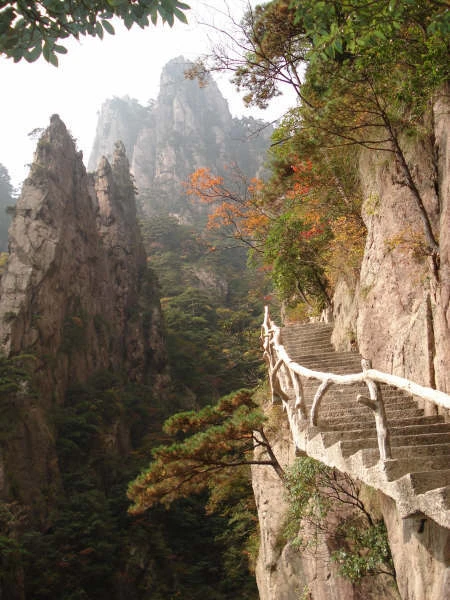
Finally, we reached the entrance to West Sea: Paiyun Pavilion. Standing on the terrace in front of the pavilion, we faced the West Sea peaks. Looking down, the canyon was deep, with thin mist swirling around, the mountain colors hazy. Entering the West Sea scenic area, the mountain path rose and fell steeply. Plank roads built along the cliffs wound up and down. At some places, the planks had gaps two fingers wide; looking through them made my heart pound. There were few people visiting West Sea. Glancing at the guard's register, I estimated maybe just around a hundred people per day. Inside the canyon, it was quiet and empty, with rugged rocks and winding plank roads. Every few steps, the mist would change, sometimes thick, sometimes thin, and the scenery would change accordingly. But after a while, my legs started protesting at every staircase—up and down. At first, I would walk a long stretch and then rest; later, I sat down at every stone bench; even later, I stopped every five steps or every ten steps and sat directly on the steps, not wanting to get up. Looking back at the path we had traveled, winding and spiraling down through peaks and summits—spectacular! Passing through a cave, I saw figures struggling to climb on the mountainside opposite. Hey, familiar—it was the same group that had been in front of us at the ticket queue this morning. They were fast! They waved and shouted to us; we waved our walking sticks in response. We cheered each other on, and the echoes of our cheers and laughter rose and fell through the valley... It looked close, just across, but it took us nearly an hour to reach that same mountainside. Along the way, we passed a construction site in the West Sea Grand Canyon; perhaps in the near future, there will be a hotel in West Sea too. Going up and down, winding through the peaks, we finally reached Immortal Walking Bridge, which spans two cliffs. The mountain breeze blew cool and refreshing. Once past Immortal Walking Bridge, we had covered more than half the distance. We met a few porters heading down toward Diaogiao Temple; I wondered how long it would take to descend from there. The remaining path was mostly flat, much better than the earlier constant ups and downs. Walking and resting, we finally saw Baiyun Hotel. Oh hey, we had completed this beautiful long march ZN (self-torture) mission! We finished at 16:15.
Back at Tianhai Mountain Villa, I collapsed onto the bed—so comfortable! Dinner, shower, so tired I fell asleep immediately, forgetting my dad's advice over the phone to soak my feet in hot water and apply hot towels to my legs. Oh well, the next day would be tough.
Breakfast: 5×4 = ¥20
Transport to Yungu Temple: 10×4 = ¥40
Huangshan entrance ticket: 202×2 + 102×2 = ¥608
Cable car: 65×4 = ¥260
Tianhai Mountain Villa four-person room: 105×4 = ¥420
October 16 (Monday):
Woke up in the morning with sore legs, and couldn't fall back asleep. I really regretted not applying hot compresses last night. I quickly got up to remedy the situation. After some fussing, the soreness slightly eased. I looked at the time—it was almost 5:30. I hurried out and headed toward Bright Summit.
Early morning, the air was cool but fresh. Looking up, the pitch-black sky was filled with stars, incredibly clear and bright—so close it seemed I could reach out and touch them. It was beautiful without any light pollution. The path to Bright Summit was crowded with people. When I reached the top, I saw a sea of black—probably at least 90% of the people who had come to Huangshan had gathered there (the other 10% were probably on the opposite peak—the view of the sunrise, with all those flashbulbs going off). The viewing platform was packed; there was no good spot left. Scanning around, I saw a small slope in front-right with pine trees and figures; it seemed there was still space. I climbed over a wall, only to find a hole in it—why climb high and low? Among the pine trees on the slope, I found a great spot. Some bold boys had climbed onto a big rock in front—superb view, completely unobstructed—but for safety, I didn't dare try it. At the top of the clouds, a straight band of red glow gradually rose, with a particularly vivid red section in the middle. I estimated the sun would appear at the deepest red. I waited patiently. The time passed 06:09, the scheduled sunrise time, but still no sun. I thought we wouldn't see it. Some people had started to leave. Suddenly, someone shouted, 'The sun is out!' I looked carefully—indeed, just below the densest red glow, an orange-red sliver like an eyebrow emerged, then gradually grew and widened, like a soap bubble rising slowly from water. It felt both long and fast. The crowd murmured in admiration, clicking their shutters incessantly, capturing every moment of the sunrise. In just two or three minutes, it was fully light. The whole sun floated up and hung in the sky, the orange-red egg yolk gradually becoming blinding. Although I was still not satisfied, my eyes couldn't take it anymore—retreat...
Back at Tianhai Mountain Villa, I rested a bit, had breakfast, and packed up. Checked out at 7 AM. With sore legs, I set off, beginning a day of pain and pleasure. Passing Haixin Pavilion, up Yuyu Peak, admiring the Tortoise Carrying a Golden Toad on its back, crossing a narrow crevice with a stone hanging overhead, seeing the vivid Pigsy, and then climbing the Hundred-Step Ladder—though they call it a hundred steps, a tour guide said it was 199. I was curious and counted—exactly 200. Did I miscount? The steps in West Sea yesterday were many more, but now with sore legs, climbing the Hundred-Step Ladder in one go started to hurt again. I sat down to rest. While listening to a tour guide talk about the nearby Lotus Peak, saying this rock looks like that, that rock looks like this, I munched on a crisp cucumber and enjoyed the scenery—very comfortable!
Lotus Peak was closed for conservation. We bypassed it, passed Yuping Station, and saw the famous Immortal Pointing the Way, but it looked more like an obscene middle finger gesture—tch, what kind of immortal, so uncivilized. Passing the Farewell Pine Version 2.0, a newly planted clone that was rather unsuccessful—small and lacking character. The Greeting Pine was much more beautiful. I had to queue up for a photo with it—nothing to do about it; it's the original, so it's cocky.
After a few twists and turns down Yuping Peak, we finally arrived at the long-admired Tiandu Peak. Xu Xiake said: 'After climbing Huangshan, there is no other mountain in the world to see; the spectacle is done!' How ridiculous that the arrogant Emperor Qianlong, a super narcissist, inscribed the two characters 'Guān Zhǐ' (The spectacle ends here) right across from Tiandu Peak! As a fervent fan of the Fourth Prince, I deeply resented this prodigal's ugly scrawl. Looking up at Tiandu, the axe-cut, sheer cliff stood proudly. The steep heavenly ladder rose straight up, disappearing into the summit. 'If you don't climb Tiandu Peak, your trip is in vain.' Despite my leg pain, I was determined to ascend. My cousin, seeing the steepness of Tiandu, trembled and backed out. So we split into two pairs of mother-daughter teams: my cousin and Aunt went around the base of Tiandu, while my mom and I bravely climbed up, agreeing to meet at Banshan Temple.
Looking up, the sky ladder seemed endless—deep and long. With sore legs, one hand on the walking stick, the other gripping the iron chain and rope, we climbed with many rests. The Sky Bridge and Carp's Back gradually got closer. Climbing on all fours up a section of cliff at least 85 degrees steep, we reached the 'Carp's Back', a narrow ridge with cliffs on both sides. It wasn't long, but very narrow—only enough for one person to pass. Luckily, there were ropes on both sides, but I didn't dare look down into the abyss below. We encountered an old man with a vigorous spirit and light steps. Upon asking, we were filled with respect—he was 90 years old! His extraordinary courage, perseverance, and physical strength were truly admirable. Many people took photos with him. Passing through several caves, we reached the summit. Standing on the absolute peak of Tiandu, we could see all the other mountains at a glance. The opposite Lotus Peak was especially clear and beautiful, like layers of lotus petals unfolding. Looking around, all peaks vied in beauty, thousand mountains rose, a splendid view. At the stone tablet inscribed 'Celestial Capital Absolute Peak, Elevation 1810m', we stopped for photos. Someone actually stepped outside the railing and hugged the tablet for a picture—very dangerous. A slip could be irreversible. Everyone held their breath for that person. Descending from the south side of Tiandu, though not as steep as the north side, the difficulty was no less. The path was winding and still steep, with several narrow crevices narrower and more dangerous than those on Yuyu Peak; we had to lower our heads to avoid hitting rocks. Along the way, we met several groups asking how far to the summit. Seeing them, I was glad we were descending—climbing up must be so painful. My mom and I encouraged each other, holding the ropes and using walking sticks, descending step by step. My mom was even faster than me—kudos.
Finally, we arrived at Banshan Temple, where we reunited with my cousin and aunt. They had been waiting for over an hour. It took more than 2 hours to climb Tiandu. We were exhausted and found the bread especially delicious. We finished our last rations and sat there, not wanting to move.
The descent was painful, but we had to continue. At 12:20, we finally reached Ciguang Pavilion. At that moment, I wanted to shout, 'We've come down the mountain!' but I had no energy...
Exiting the gate, we took a Xin'guo Line bus down the mountain. At the Huangshan main gate, we took a minibus back to the city. In the city, we toured around on rickshaws, then took a taxi to the Old Street to shop and have dinner. At 22:33, we boarded N520, bidding farewell to Huangshan and heading to our happy home...
Breakfast (purchased at the Tianhai hostel entrance, rice dumplings): 3×4 = ¥12
Xin'guo Line: 10×4 = ¥40
Huangshan main gate → Tunxi: 15×4 = ¥60
Old Street First Restaurant dinner: ¥151
Others: ¥29
Train tickets (return tickets already bought in Shanghai: two lower berths, two middle berths): (175+5)×2 + (169+5)×2 = ¥708
Total expenses for three days and four nights (excluding souvenirs): ¥3486. Per person: ¥871.5
Tips:
1. If possible, bring a student ID. As long as you're not too much older, it might work. Preferably a student ID from a full-time university.
2. Climbing Huangshan is tough; you may need to use hands and feet. Bring a walking stick and gloves—you'll rely on them.
3. The mountain hotels have electric kettles. Bring one bottle of water, then boil your own. At the town below the mountain, boxed Kangshifu noodles are ¥3 each; bring plenty of sausages, beef jerky, and chocolate. At Tianhai, food is relatively cheap.
4. After the first day of climbing, soak your feet in hot water and apply hot towels to relieve soreness. Better yet, bring some essential balm or bone-healing liquid.
5. For sunrise, you don't have to go to Bright Summit. Another peak to the southwest offers a great view with fewer people.
6. When descending, you can use a special posture: slightly squat with legs apart and slightly bent, then jump down with rhythm, like the running style of Jackie Chan in movies. Though it looks ugly, the staff on Huangshan say it's faster and won't hurt your joints.
7. Visit Hongcun at dawn or dusk; it's too crowded during the day.
(West Sea Autumn Charm)
(Plank Road Hidden)
(Sunrise at Huangshan)
(Viewing Peaks from Tiandu Peak)
(Carp's Back, and behind is that brave 90-year-old grandfather)