After Visiting Mount Huangshan, No Other Mountain Is Worth Seeing
After Visiting Mount Huangshan, No Other Mountain Is Worth Seeing
Summarizing the gains and losses of predecessors who traveled to the same place, I started preparing for this trip 10 days in advance, planning the route, booking accommodation, and reading various travel websites to determine the proper attitude and perspective for each scenic spot, which took quite some effort. But despite such meticulous planning, I still missed one thing: the weather on Huangshan. It wasn't until the day before departure that I remembered to check the weather conditions on a website. The forecast wasn't great: during our two days on Huangshan, it would be overcast and rainy, with a level 4 wind. People who have been to Huangshan all say it's beautiful but also very dangerous. I didn't mind the rain too much—it might even add some poetic charm—but the wind troubled me. I'm naturally timid and suffer from acrophobia. However, all the tickets and accommodations were already booked. It was like an arrow that had been drawn from a bow; once released, whether blown off course by the wind or knocked astray by raindrops, hitting the bullseye perfectly was unlikely. Yet I was no longer in control and couldn't turn back. With the heroic spirit of braving the elements, we set off.
April 18
At 9:00 a.m., we boarded the K45 train from Beijing to Fuzhou. This was my first time taking a train so far, my first time in a sleeper berth, and also my first time seeing the Yellow River. But I didn't act like an excited child; after all, I'm not that young anymore. The vitality of this little bug has been mostly drained, but since I'm not that old either, there's still enough energy left to keep it from dying. So I hardly stayed still on the berth, constantly jumping up and down to look at the scenery outside the window, watching the telephone poles race by, and checking the walls of farmhouses for any striking slogans.
Around 2:00 p.m., the train crossed the Yellow River Bridge. The wide riverbed was exposed with sand and gravel, and the water occupied only a narrow corner. The Yellow River seemed condensed, flowing quietly, slow and heavy, like a hunched old woman. Is this our mother river? It was hard to imagine the roaring, surging, muddy waves described in poems, songs, and textbooks. A faint sense of melancholy filled me.
April 19
The journey was uneventful. After nearly 21 hours, the train arrived at Huangshan Tunxi. Before coming to Huangshan, I had booked mountain accommodation and a pickup service through a website. I had also read many previous travelogues online that described the locals as honest and trustworthy. When we walked out of the station, we saw Ms. Hu holding a sign with our names, and my anxious heart immediately relaxed. Our ancestors invented the phrase "home away from home"—I truly understood that feeling now. Following their arrangements, we checked into the summit accommodation and planned our sightseeing route.
Route from the back mountain: Take the cable car or hike from Cloud Valley Temple (Yungu Si) to White Goose Ridge (Baie Ling), then to Beginning-to-Believe Peak (Shixin Feng), Brush Pen That Produces Flowers (Mengbi Shenghua), North Sea (Beihai), Lion Peak (Shizi Feng), Monkey Gazing at the Sea (Houzi Guanhai), Cool Terrace (Qingliang Tai), Dawn Pavilion (Shuguang Ting), Shilin Hotel, West Sea Hotel, Danxia Peak, Cloud Dispelling Pavilion (Paiyun Ting), West Sea Dreamlike Scenic Area (depending on time, enter now or the next day), stay overnight at West Sea Hotel or Baiyun Hotel, Flying-Over Rock (Feilaishi), Bright Summit (Guangming Ding), A Line of Sky (Yixian Tian), Hundred-Step Ladder (Baibu Yunti), Jade Screen Pavilion (Yuping Lou), Greeting-Pine (Yingke Song), Jade Screen Cable Car Station (depending on physical strength, either climb Celestial Capital Peak (Tiandu Feng) and hike down to Ciguang Pavilion, or take the cable car from Jade Screen Station down to Ciguang Pavilion), Ciguang Pavilion. Take the scenic transport (10 yuan) back to Tangkou, then transfer to a bus (10-13 yuan) to Huangshan City (Tunxi).
Now back to my travelogue: We hiked from Cloud Valley Temple to White Goose Ridge. Suddenly there were many more people, and the rain was noticeably heavier. The clouds and mist grew denser. I truly experienced the famous Huangshan clouds and mist—but not to enjoy the sea of clouds; rather, the clouds and mist prevented me from enjoying any scenery at all, like a jealous beauty: once you're in her embrace, you can have no other intentions.
Since I knew in advance that Beginning-to-Believe Peak was closed, we headed straight toward North Sea after passing White Goose Ridge. Along the way, Black Tiger Pine, Couple Pine, and King Pine were visible because they were right by the road, but everything beyond 20 meters was completely white. We passed a platform where a tour group was standing while the guide told everyone that from here they could see the famous Brush Pen That Produces Flowers in the distance, which drew a burst of laughter because all we could see was thick fog—not a trace of that magical pen. That pen must be skilled in freehand landscape painting, and today it was especially bold and heavy. Looking toward where the brush pen should be, my intention reached but the form could not.
By the time we got to West Sea Hotel, it was 1:30 p.m. Even though we wore raincoats, we were completely wet. A bone-chilling cold penetrated us. I quickly ran hot water in the bathtub to soak my feet, then went to the hotel restaurant for some hot food. I also ordered a bottle of Xiao'er (Erguotou) to ward off the cold. The food on the mountain was expensive, no doubt, but thinking of the porters we met along the way, carrying loads of over 100 jin (50 kg), swaying with each step—everything on the mountain is carried up on their shoulders. So the higher prices were understandable. After all, it's a 4-star hotel, and the food was passable. Wuxi spare ribs, mapo tofu, plus a bottle of Xiao'er cost 160 yuan. At least I warmed up and didn't have to worry about catching a cold or fever.
Outside, the clouds, mist, and rain showed no sign of stopping; instead, they grew thicker. The planned afternoon trip to the Dreamlike Scenic Area had to be abandoned. I turned on the TV and happened to catch Yao Ming's NBA playoff game. Watching the NBA on Huangshan was something I never planned for. It wasn't until after 5:00 p.m. that the rain let up a bit, but the clouds and mist remained thick...
We ate a late and filling lunch, so by dinner time we weren't hungry. I bought two cartons of milk and two packs of four-piece Miao Fu cakes at the West Sea supermarket. The prices were generally 3-4 times those on the plains, but acceptable compared to the effort of carrying them up the mountain. In the morning, I boiled water in the hotel kettle and warmed the milk by soaking it (still in its packaging) in the hot water—a decent breakfast that saved money, helping to offset the cost of accommodation.
I figured there would be no sunrise the next day, so I set my phone alarm for 6:00 a.m., planning to go to the Dreamlike Canyon early to make up for the disrupted plans.
April 20
After breakfast, we set off for Dreamlike Canyon at 6:30. To our delight, the sun was shining brightly. Even more heartening, the level 4 wind that the weather forecast had threatened never materialized yesterday or today, which made my mood equally bright.
Dreamlike Canyon is truly beautiful. It's said to be a new attraction developed only in recent years. Stone steps carved into the canyon walls plunge deep into the gorge, and some sections are plank roads built against the cliffs. The best part was that there were very few visitors. Tour groups generally don't come here, or if they do, they only take a peek at the entrance and then retreat. The morning sun cast rays of light through gaps in the peaks, revealing brown rocks and green forests everywhere, accompanied by birdsong in the empty mountains and the melody of mountain streams. It truly had a dreamlike, ethereal quality. As the winding path turned, the peaks of West Sea constantly presented new combinations of layered ranges, much like the shifting views in a Jiangnan garden. If sea clouds had been flowing, it could have rivaled a fairyland on earth. Many steps were extremely steep, comparable to the later Hundred-Step Ladder, and very tiring. I strongly do not recommend crossing the entire canyon, i.e., from Cloud Dispelling Pavilion to Immortal's Bridge, then through Tianhai, Bright Summit, Flying-Over Rock, and back to Cloud Dispelling Pavilion. This route takes at least five hours. In previous travelogues, several experienced hikers who crossed the entire canyon almost ended up fleeing in exhaustion. Moreover, I personally feel that the beauty of the canyon lies in the changing angles from the winding mountain path, offering layered views of the West Sea peaks, strange pines, and odd rocks. If you go all the way down to the bottom, you'll only see cliffs on all sides, and the scenery becomes more monotonous and diminished.
The entire canyon is 3.7 km long. We walked about a third of the way and encountered a restroom built into the mountainside, tucked under the road. It barely disturbed the scenery, was tiled inside, had flush toilets, and was very clean. The flushing water was probably mountain spring water, with stored potential energy converted into powerful kinetic energy that could wash everything away instantly. After taking care of business, we turned back.
We returned to the hotel around 10:40, rested a bit, and ate the remaining food to lighten our load. Around 11:30, we shouldered our backpacks and left West Sea Hotel, starting our descent down the front mountain. Before reaching Bright Summit, the path was relatively quiet with few tourists. We could leisurely enjoy the West Sea peaks, Flying-Over Rock, or take photos. I felt that the best scenery on Huangshan was indeed the West Sea area; by the time we reached Bright Summit, Turtle Peak (Aoyu Feng), and Lotus Peak, we hardly felt like taking any more photos. When we passed Flying-Over Rock, we only took distant photos from Xingzhi Pavilion and a small hill opposite. We didn't climb up to the rock to jostle for space and pose with the crowd. I never found the angle from which the opening scene of the TV series "Dream of the Red Chamber" was shot featuring this rock.
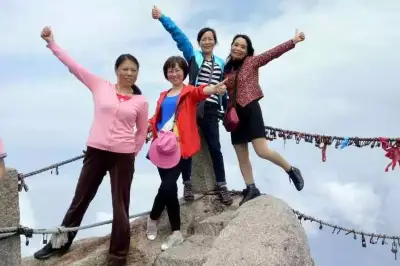
Almost every place with iron chains on Huangshan had locks hanging on them, some rusty, some shiny new. When we reached Bright Summit, the number of people suddenly increased, with noisy chaos. The sun beat down on the bare summit without any shade, adding to the heat. "Without reaching Bright Summit, you haven't seen Huangshan's scenery"—looking around from Bright Summit, I saw nothing worth remembering. The surrounding peaks—Lotus, Celestial Capital, Turtle, and Beginning-to-Believe—were all fully visible, too straightforward, lacking charm and spirit. I felt the saying should be: "At Bright Summit, you see Huangshan but not the scenery."
By the time we got to Tianhai, it was already crowded, with many tour groups converging from both directions. The atmosphere and mood for sightseeing were gone. Most people looked like refugees fleeing a disaster, lying around in disarray. Leaving Tianhai, we joined a senior tour group. Their pace suited us well, and we could also eavesdrop on their guide's explanations. After a few steps, we arrived at Sun-Drying Medicine Rock. The guide said it was where the Yellow Emperor dried his herbs, and the residual medicinal aura could cure all diseases. Standing there could cure athlete's foot, sitting could cure hemorrhoids. Instantly, the rock was covered with people standing, lying, or sitting—turning it into a "sun-drying people rock." But no one did a handstand to cure hydrocephalus or intellectual disability.
Another advantage of following the senior group was that the guide always chose the safest and easiest route. We descended Turtle Peak via the "Promotion and Wealth Path" (Turtle Cave). At the corner before the Hundred-Step Ladder, all tour groups stopped and asked tourists to turn around and look at several scenic spots on Turtle Peak: "Old Monk in Meditation," "Piggy Looking at Mirror," and "Mouse Stealing Oil." Climbing the Hundred-Step Ladder, I drank my last can of Red Bull (I had brought four cans from Beijing). Although the forecast was only around 10°C, with a 50-liter backpack and a professional-looking outfit, hiking up and down under the sun in a T-shirt and a single jacket was enough to make me sweat profusely. After entering the front mountain from Bright Summit, I don't know if it was because of the crowds or different perspectives, but aside from testing one's endurance, I saw nothing moving. It was just one isolated, towering rock after another, with bare, brown peaks and man-made (fabricated, not created) attractions like "Peacock Playing with Lotus" and "Tortoise and Hare Race" that could be named anything depending on what you think they look like. This area is a must-visit for all tour groups, and under the scorching sun, the crowds and various loudspeakers held by guides made you feel restless—completely unlike the lush, layered peaks and serene, dynamic atmosphere of West Sea.
On the descent, there was nothing but exhaustion. By the end, my legs and feet barely obeyed me. I changed walking styles: walking, hopping, forward, backward. By the time I reached Ciyun Pavilion, I was reduced to pure, stiff mechanical movements.
Around 5:00 p.m., I arrived at Ciyun Pavilion. Together with two others, I took a Santana taxi (10 yuan per person) to Tangkou's bus station, then boarded a minibus from Tangkou to Tunxi. During this time, many tea-selling peasant women were very persistent, but we firmly adhered to our resolve never to buy anything at scenic spots, no matter how cheap, and ultimately overcame their relentless, repetitive, and nagging sales pitches without spending a cent. The route between Tangkou and Tunxi has regular minibus services with a dispatcher at the station; management is relatively standardized, so you can ride with confidence.
It was already 7:00 p.m. We first went to "The First Floor" restaurant at the entrance of the Old Street for dinner. Huizhou cuisine is one of the eight major culinary traditions, but I knew nothing about it and lacked preparation. I ordered a "Mao Tofu" (fermented tofu)—it tasted good. The waiter recommended a Huangshan specialty called "Huangshan Double Stones": stone ear (a type of fungus that grows on rocks, as opposed to wood ear) and stone chicken (a type of frog that lives in rock crevices, as opposed to field frogs) steamed together. I've always considered frogs as friends of humanity and thus refuse to eat them, and I stuck to that principle regardless of whether they come from plains or mountains. In the end, I chose a dish of stone ear steamed with several vegetables, called "Huangshan Five Vegetarian Delights." The stone ear was thin, smooth, and tender—very tasty and worth trying. The soup I ordered was also decent; I drank over ten bowls (though the bowls were small). The chef at this restaurant was indeed skilled, but "The First Floor"...
We strolled briefly through the Old Street. Most shops displayed Huizhou inkstones, brushes, Huangshan Maofeng tea, and other local specialties. I didn't feel like buying anything. We took a taxi to the train station. Tunxi at night was brightly lit, with street-side专卖店, hair salons, and foot massage parlors lining the streets. The municipal construction surprised me—a foreigner—with its unexpected prosperity and modernity. Huangshan must have brought immense wealth to this place. At 10:38 p.m., we boarded the N520 train from Huangshan to Shanghai, heading to my next destination.