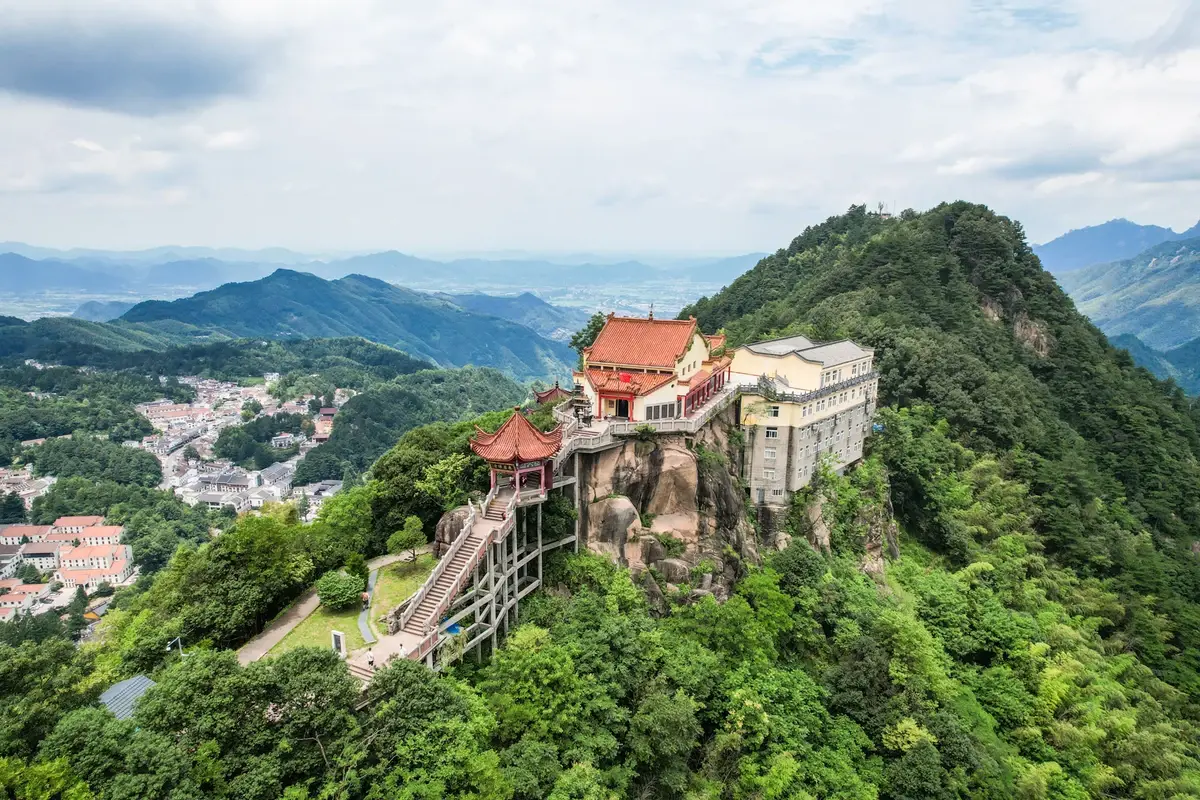
Departing for Jiuhua Mountain to Pray, Wherever You Go, Your Heart Finds Peace
At the beginning of the summer vacation, we set off for Jiuhua Mountain, one of the four great Buddhist sacred sites, to embark on a spiritual journey blending ancient charm and Zen meditation.
Located in Chizhou City, Anhui Province, Jiuhua Mountain is a UNESCO Global Geopark and a national scenic area renowned for its Buddhist culture and natural and cultural attractions. It is one of China's four famous Buddhist mountains. Jiuhua Mountain is a wondrous creation of nature, pure and elegant, earning the nickname 'Land of the Lotus Buddha.' It gets its name because the nine main peaks resemble nine lotus flowers, and the connected peaks form a natural reclining Buddha. The mountain is adorned with beautiful waters, flying waterfalls, and flowing springs, creating fresh and natural landscape paintings. With favorable weather, visitors can witness natural wonders such as sea of clouds, sunrise, rime, and Buddha's light, which vary with the seasons and are breathtakingly beautiful.
Huacheng Temple - Tiantai Scenic Area - Ancient Worship Platform - Tiantai Zen Temple - Shiwang Peak - Chuxin Sanshe · Dayin Xisheng Guesthouse
Baisui Palace - Five Hundred Arhats Hall - Dongya Zen Temple - Jiuhua Old Street - Taibai Study
In the morning, we arrived at Jiuhua Mountain Scenic Area and first visited Huacheng Temple at its foot. Surrounded by dense trees, this ancient temple exudes a profound tranquility. Built in the Tang Dynasty, it has witnessed over a thousand years of history, telling the story of Jiuhua Mountain's changes.
Entering the temple felt like stepping into a peaceful world. The temple houses many precious architectural relics and historical sites, each revealing ancient solemnity and wisdom.
The majestic Buddha statue, surrounded by incense and candles, attracted worshippers praying fervently, feeling the wisdom and compassion of Buddhism. The ancient buildings and sculptures convey Jiuhua Mountain's religious culture and human society to the world.
By noon, we left Huacheng Temple and decided to have lunch and rest before continuing our climb. We tried local specialty dishes.
Fried Polygonatum offered a unique taste and aroma. Initially, we didn't know what polygonatum was—it looked somewhat like ginger. The restaurant owner explained that polygonatum is a local treasure, a specialty mountain product of Jiuhua Mountain. It is a Chinese medicinal herb that nourishes qi and yin, strengthens the spleen, moistens the lungs, and benefits the kidneys. It is one of Jiuhua Mountain's unique dishes, and most visitors order a plate to taste.
Stone Ear Scrambled Eggs is one of the most common farmhouse dishes on Jiuhua Mountain. Stone ear, a mountain delicacy, is rich in amino acids and nutrients, with a subtle fragrance. When stir-fried with golden local eggs, it becomes very delicious. Stone ear helps reduce blood lipids, lower blood pressure, and alleviate various diseases, making it popular. When harvested, locals and monks treasure it, often saving it for special occasions. It is one of the famous 'Three Stones of Jiuhua Mountain' and belongs to the unique vegetarian cuisine of Jiuhua.
Bracken fern, a wild vegetable on Jiuhua Mountain, is a must-try. It is smooth, tender, yet slightly crunchy, nutritious, and leaves a deep impression with its unique flavor.
This meal not only satisfied our taste buds but also let us enjoy Jiuhua Mountain's unique charm.
In the afternoon, we went to the famous Tiantai Scenic Area. We took the Tiantai cable car, slowly ascending along the cliffs, admiring Jiuhua Mountain's beauty, looking down at the winding mountains and lush forests, feeling its grandeur and majesty.
After about ten minutes on the cable car, we reached Tiantai at an altitude of over 1,000 meters. Along the way, we saw many strange rock formations, such as the distant Ancient Worship Platform, the Giant Peng Listening to Sutras Rock, and the Golden Turtle Facing the North Star. The Ancient Worship Platform is the first stop in the Tiantai Scenic Area. It sits on a rare platform amidst towering mountains. The Mahavira Hall of the Worship Platform was built in the Tang Dynasty. Legend has it that Ksitigarbha (Jin Dizang) once recited the Avatamsaka Sutra here, and monks built this temple in his honor, naming it 'Dayuan Nunnery' (Ksitigarbha is called 'Great Vow Bodhisattva' in Buddhism). Because 'Worship Platform' is easier to remember, it is commonly called 'Ancient Worship Platform.'
Below the cliff ahead is the Worship Platform, and behind it is the lifelike Giant Peng Listening to Sutras Rock.
Giant Peng Listening to Sutras Rock is located west of Tiantai Peak. It is a 60-meter-high cliff rock adhering to the cliff, shaped like a giant peng with distinct beak and wings. Legend says that when Ksitigarbha Bodhisattva preached here, a giant peng flew over to listen and turned into stone, hence the name.
Looking down from the Worship Platform at the bell pavilion below the Mahavira Hall, the layered green mountains in the distance create a serene and beautiful scene, evoking solemnity and tranquility.
Now the real challenge began. We would climb more than 800 steps, taking about half an hour, to reach Tiantai Peak and visit Jiuhua Mountain's highest temple—Tiantai Zen Temple.
As we stepped through the temple gate, we were enveloped by its solemn atmosphere. The towering pagoda and majestic halls stood on the peak, seemingly merging with the sky. Slowly ascending the steps, we admired the temple's architectural beauty while feeling inner peace.
The incense was thriving, and the sound of chanting echoed softly. Finding a quiet corner, I closed my eyes and meditated. At that moment, I felt deep inner calm and peace.
As dusk fell, we arrived at Shiwang Peak. Standing on the summit, we overlooked the undulating mountains. The distant clouds shrouded the peaks, giving a mysterious and majestic feeling. I felt awe at the grandeur and beauty of nature.
Behind Jiuhua Mountain's highest peak, along a winding mountain road, the environment was quiet and serene, surrounded by lush trees and flowers. Where two streams met, a spacious area revealed an unusual building—Chuxin Sanshe · Dayin Xisheng Guesthouse.
As soon as I entered, I was drawn to its modern and minimalist design, blending with Jiuhua Mountain's natural environment. Every corner exuded warmth and comfort, making me feel at home.
The entire building was embraced by lush ancient trees. In the courtyard, a 400-year-old osmanthus tree stood out, three stories high, its fragrance refreshing the mind. In front was a blue shallow swimming pool with clear water, giving a sense of tranquility and relaxation. Cartoon floats were placed in the water, where children could swim and enjoy the coolness and freedom.
Beside the house was a small stream with clear and cool water. We played water fights, forgot our worries, and recalled childhood joys.
The children's play area in the courtyard was also creatively designed with various facilities. Children had great fun there, their innocence and energy reminding me of childhood happiness.
At the guesthouse's ancient tree coffee bar, I drank a cup of coffee or a pot of sweet tea, listening to birdsong, as if entering a secluded paradise. All worries vanished at that moment. Enjoying music and natural beauty, I immersed myself in a warm and peaceful atmosphere, feeling completely relaxed.
Each room was unique and poetic, with a simple yet elegant design, offering a homely and comfortable vibe. The spacious and bright rooms were simply and warmly decorated. The comfortable bed and soft bedding provided a restful environment. I couldn't wait to put down my luggage, lie on the bed, and enjoy Jiuhua Mountain's fresh air and peaceful atmosphere. The large bathtub in the viewing room allowed me to soak while enjoying the stunning scenery—especially healing! I slept well all night.
At dinner, we tasted more Jiuhua Mountain specialties different from lunch.
Jiuhua Polygonatum and Stone Ear Stewed Chicken: tender local chicken with polygonatum and stone ear, rich and flavorful, nutritious.
Lingyang Yipin Pot satisfied our hearty cravings. Dried green beans, dried bamboo shoots, daylily, and sweet potato starch were layered at the bottom, topped with pork belly and meatballs. The flavors melded together as it simmered, making it mouthwatering and perfect with rice.
Pan-fried Braised Hairy Tofu, golden on both sides, drizzled with Huizhou soy sauce made from soybeans, chili sauce, green onions, ginger, and garlic. It was savory, delicious, and crispy.
Stinky Mandarin Fish, a representative of southern Anhui Huizhou cuisine, smelled pungent but had tender white meat with a salty and fresh taste, offering a unique flavor.
After a day of exploration and culinary delights, I lay on the comfortable bed, recalling Jiuhua Mountain's scenery and food, feeling full of satisfaction and gratitude. The morning sun shone through the window, filling the room. Breathing the fresh air, we went to the dining room for a traditional Jiuhua Mountain breakfast. Crispy potstickers with savory and juicy fillings were irresistible, one after another.
The topping noodles were also delicious: bamboo shoots, dried tofu, and shredded pork stir-fried and placed on top, the sauce blending with the broth—quite tasty.
Big meat noodles with tender meat chunks and chewy noodles satisfied our taste buds and stomachs.
These delicious breakfasts, rich in texture, allowed us to happily start a new day of exploration.
Next, we visited Baisui Palace on Jiuhua Mountain's Mokong Ridge. It is the second flesh-body hall of Jiuhua Mountain, housing the remains of Master Wuxia. Wuxia passed away in the third year of the Tianqi reign (1623) at the age of 110, known as 'Grandpa Baisui' (Centenarian). Wansui Temple was built in his memory, also called Baisui Palace or Wannian Zen Temple.
Baisui Palace is a Qing Dynasty building that takes advantage of the south-to-north downward slope, creating a five-story multi-purpose structure integrating the mountain gate, main hall, flesh-body hall, and storage. The floors rise gradually, forming a labyrinthine, magnificent, and varied maze, resembling an ancient castle from afar. From the front below, the main hall appears as a single story, but from the back, the east wall is 55 meters high, five stories. The main hall uses natural rock (Dragon Head Rock) as its base beam, ingeniously combining architecture with rock formations.
Climbing the ancient stone steps, you discover hidden murals and carving art on the walls. Every step lets you enjoy Baisui Palace's unique charm.
With its white walls, gray tiles, and Hui-style architecture built along the mountain, Baisui Palace looks like an ancient castle from afar. A local saying goes: 'If you don't visit Baisui Palace, your trip is in vain; if you visit Baisui Palace, everything will succeed.'
Then we went to the Five Hundred Arhats Hall, a palace-style structure harmonizing with Baisui Palace to form a castle-like complex on a cliff. Covering over 1,000 square meters, this solemn temple houses five hundred arhat statues. Each statue is lifelike and unique.
From Baisui Palace, we took another path along winding stone steps, enjoying natural scenery, and headed to Dongya Zen Temple.
Legend says that when Ksitigarbha Bodhisattva first came to Jiuhua Mountain, he lived in a cave on East Cliff. From here, you can view the Yangtze River, look down on Jiuhua Town, look up at Tiantai Peak, and see all of Jiuhua's scenic spots—a panoramic view of the Buddha's land.
Feeling hungry during our tour, we again chose to taste local food. Stir-fried lotus root stems were sweet and refreshing, with tender texture and vegetable freshness complementing each other. River shrimp were tender and delicious, paired with spicy sauce, bringing endless satisfaction to my taste buds.
After the meal, we strolled along Jiuhua Old Street, enjoying its antique charm. Every brick, tile, gate tower, and exquisite carving carried the prosperous history of Jiuhua Mountain city.
The shops on both sides were dazzling with glazed tiles, vendors, handicraft stores, etc. The street was bustling with people, full of vitality.
As we walked, we were drawn to Taibai Study beside the old street. Legend says that this study was the residence of Tang poet Li Bai when he lived in seclusion on Jiuhua Mountain. Built in memory of Li Bai's two visits to Jiuhua, it is a site honoring his poetic talent and cultural contributions.
The interior of the study is simply decorated with Li Bai's poems, paintings, and calligraphy, immersing visitors in his literary world. It also displays historical artifacts and precious collections related to Li Bai's life and works, offering deeper insight into this literary giant.
The backyard of the study has been transformed into Taibai Tea House. Sitting there to cool off and sip tea, we imagined the immortal poet's life here, feeling quite pleasant.
The two-day, one-night trip to Jiuhua Mountain was an unforgettable experience. We enjoyed its natural scenery, rich cultural heritage, and local specialties. Our hearts were delighted and fulfilled—a unique cultural and natural experience.
Travel Notes: 1. Day 1 2. Day 2
Tourism Information: Hotel Index, Strategy Index, Ticket Index, Website Navigation, Tourism Index, Cruise Index, Corporate Travel Index, Franchise Cooperation, Distribution Alliance, Friendly Links, Corporate Gift Card Procurement, Insurance Agency, Agency Cooperation, Hotel Franchise, Destination and Scenic Area Cooperation, More Franchise Cooperation
About Ctrip: About Ctrip, Ctrip Hot Topics, Contact Us, Careers, User Agreement, Privacy Policy, Business License, Security Center, Ctrip Content Center, Intellectual Property, Trip.com Group Algorithm Disclosure


