Mount Jiuhua Travelogue: Scenic Spots – Transportation, Food, and Accommodation
Since ancient times, famous mountains have housed temples, leaning against old trees while drinking from clear springs, morning bells and evening drums chanted verses, a subtle smile and spontaneous fate.
I have long yearned for Mount Jiuhua, firstly for its beauty of mountains and waters, and secondly because Jiuhua is one of the four great Buddhist mountains—the sacred site of the Great Vow Kṣitigarbha Bodhisattva, with numerous historical sites and legends. To visit the actual place, to observe, recite, listen, and reflect—what a joy.
--- Transportation ---
Highways need no elaboration; nearby larger cities' long-distance bus stations have direct coaches to Jiuhua Service Center. In Qingyang County, Chizhou, there is also Bus 20 to Mount Jiuhua, fare 5 yuan.
From the airport to Jiuhua Service Center, a bus departs 20 minutes after flight arrival, taking about 40 minutes. For the return trip, a single bus leaves at 8:00 am from the Transfer Center, arriving at the airport with ample time for check-in; only one trip per day.
For high-speed rail, in addition to the previous Chizhou Station, a new Jiuhua High-Speed Rail Station has opened. Previously, after disembarking at Chizhou Station, you could purchase a 50-yuan internal transport ticket for Mount Jiuhua at the Jiuhua High-Speed Service Center in the station area, taking about 50 minutes to reach Jiuhua Service Center. Note that this 50-yuan ticket is actually a round-trip ticket from Jiuhua Service Center to various stops within the scenic area, and each route can only be used once. Geographically, Jiuhua High-Speed Rail Station is closest to Mount Jiuhua. When we went in June, there were promotions that the free bus from the new station to Jiuhua Service Center was to celebrate its opening. We planned to take it, arrive early at the foot of Mount Jiuhua (Kecun), check in, and then decide whether to visit the Grand Vow Culture Park downstairs or buy a transport ticket to the back mountain. But it turned out they started charging that day—the very first day—and as someone who rarely wins the lottery, I managed to hit that. Fare: 8 yuan.
--- Food and Accommodation ---
Mount Jiuhua tourism is well-established, forming two main accommodation areas. One is the Jiuhua New Street at the foot of the mountain, just across the road from Jiuhua Service Center. It's a 20-minute walk to the Grand Vow Culture Park, and convenient for transportation. Hotels and restaurants are plentiful across various price ranges, so it is relatively cheaper than the other main accommodation area—Jiuhua Street—inside the scenic area. Most major temples on Jiuhua are on Jiuhua Street; if you stay there, you can visit them right at your doorstep, saving time waiting and traveling. Between the two, each has its merits.
Jiuhua New Street is entirely a zone of inns, restaurants, and supermarkets catering to tourists. Accommodation options include brand chains, express hotels, hostels, etc. Most restaurants serve Huizhou cuisine, represented by stinky mandarin fish. On two evenings we visited two top-rated places on Meituan. Apart from the famous stinky fish, we ordered Jiuhua's special secret-prepared Polygonatum, stone ear scrambled eggs, kudzu flour balls, wild tofu, and stir-fried winter bamboo shoots with pork. Overall, the taste was decent; compared to Huizhou cuisine in Hefei, it was slightly saltier. Perhaps due to competition and years of management at this sacred site, service was warm and attentive. One restaurant offered free ice cream, another gave a detailed explanation of their health tea, and the boss kept asking if the food was to our liking. In discussions with the boss about Huizhou cuisine culture, we reached a consensus: Huizhou food is inherently salty, with heavy color, heavy oil, and rich sauces. Hefei, being a large city with a floating population, has a wider tolerance for flavors, so saltiness there is milder than in the Chizhou area. However, the saucy saltiness goes well with rice.
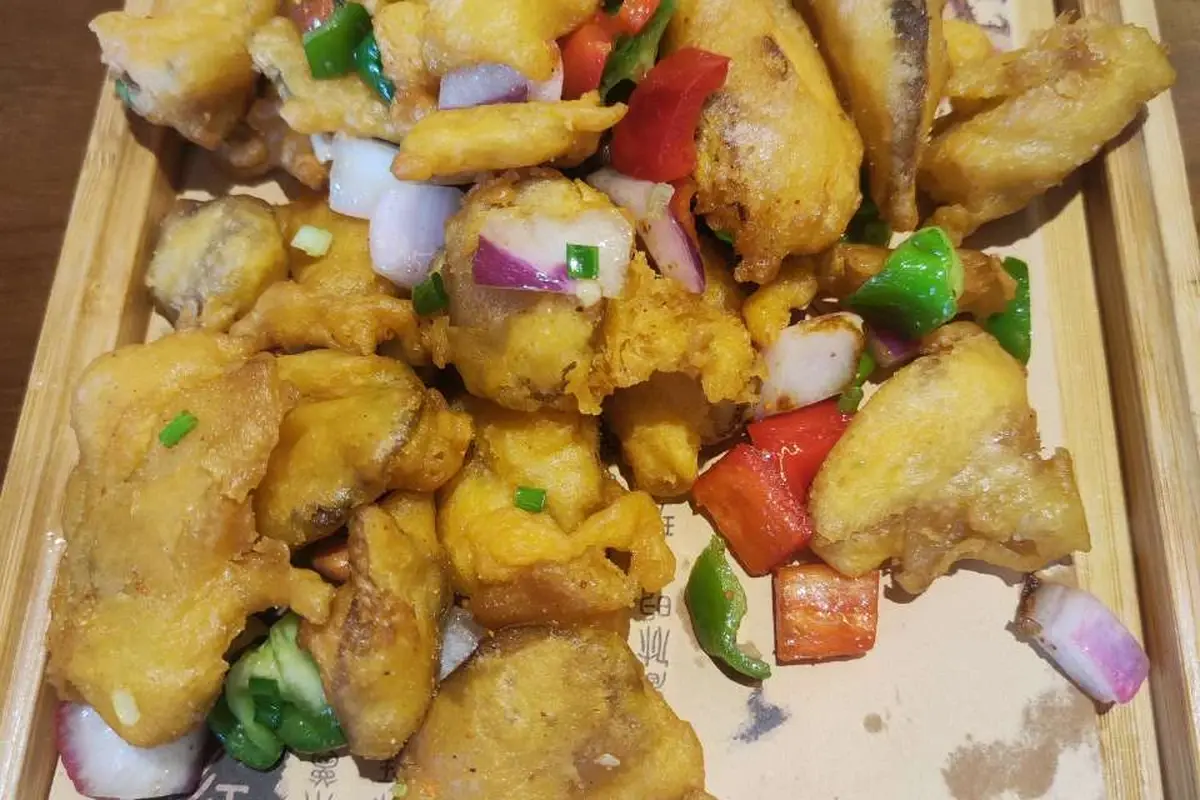
Secret-prepared Polygonatum: The Polygonatum is coated in batter, deep-fried, then stir-fried with onion, green and red peppers. The texture is crispy outside and soft-sweet inside. I suggested adding sesame salt or cumin would make it better. The boss looked a bit helpless and said they tried that before, but some people didn't like it and complained, so now it has to stay this way.
Kudzu flour balls: These are interesting. Minced pork, mushrooms, and lotus root cubes are stir-fried until about 80% done, then coated with kudzu flour and steamed. Starch-based foods are common in northern China—vermicelli, jelly noodles, liangpi, etc. Their common trait is that they become gel-like after shaping or cooking; kudzu flour does the same after steaming. Due to the granular filling, the surface is bumpy. When you break the ball open, the aroma of pork and mushrooms fills the air. Kudzu is sweet by nature, so the filling carries a slight sweetness. Both kudzu and Polygonatum are medicinal herbs; food and medicine share the same origin, and effects vary by person. Regular consumption is good for health, which is also a unique selling point of Jiuhua dining.
Stir-fried winter bamboo shoots with pork: Southern bamboo shoots, tender shoots with savory pork, slightly salty, a great dish for rice.
Wild tofu: I didn't catch exactly what it's made of due to the server's dialect. Chopped scallions, red peppers, and tofu cubes stir-fried with lots of oil. The texture is similar to northern stir-fried liangpi.
Stone ear scrambled eggs: Stone ear is not wood ear, though they look alike. I had tried this dish in Hefei; its essence is the clean texture and chewiness of stone ear. It grows on damp rock crevices of cliffs and is said to have effects of nourishing yin, moistening lungs, lowering blood pressure, strengthening the spleen, and harmonizing the stomach—hence its high price.


