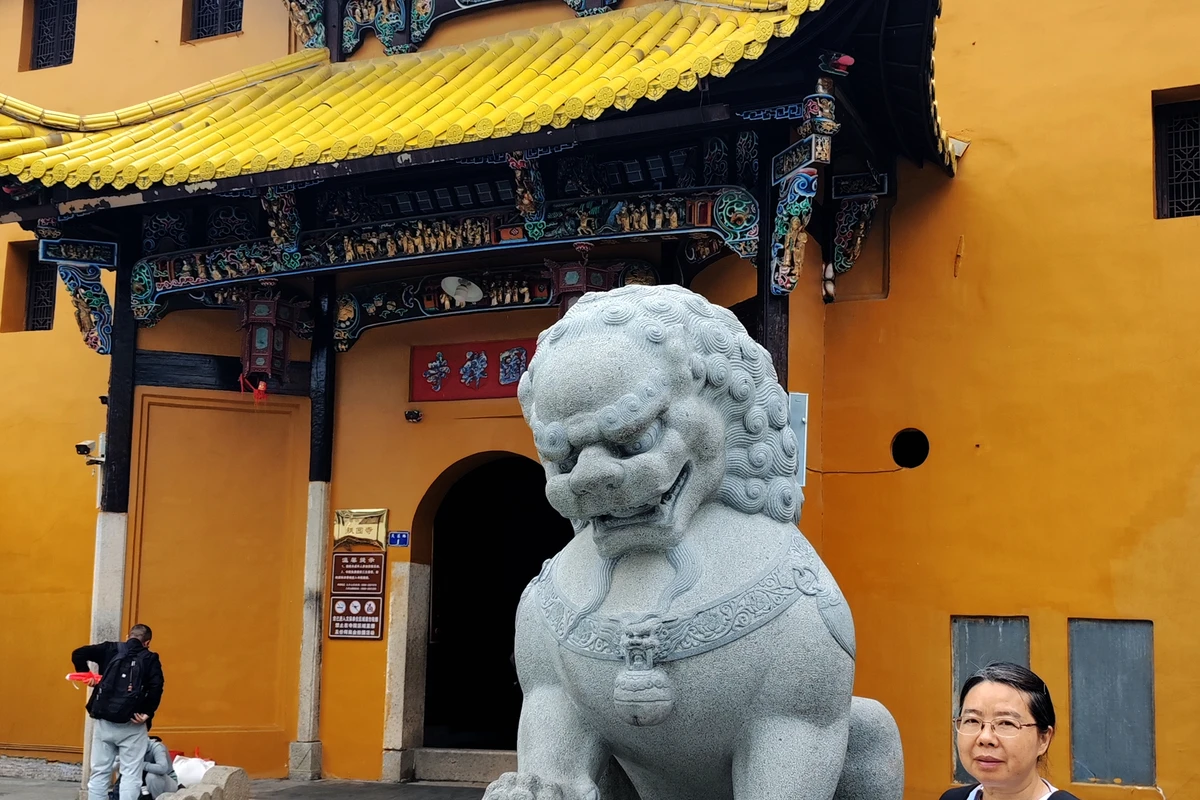
A Three-Day Pilgrimage to Mount Jiuhua
Day 1: At 9:18 a.m., we took train D5601 from Nanjing, arriving at Chizhou at 10:43. We then transferred to a free shuttle bus to the Mount Jiuhua Visitor Center, took the scenic area bus to Yingxian Bridge on Jiuhua Street, checked into Jiuhua Mountain Xingyun Villa, and visited Qiyuan Temple and Baisui Palace.
Day 2: From Huxingshan Station, we took the scenic bus to Fenghuang Song Station, then took the cable car to Tiantai Scenic Area. We hiked down, visiting Huiju Temple, Xiaotiantai, Roushen Baodian (Flesh Body Hall), Shangchan Hall, Zhantan Chanlin, and Huacheng Temple.
Day 3: We visited Dizang Chan Temple and Tonghui Chanlin, took the scenic bus down to Dayuan Cultural Park. At 14:19, we took high-speed rail G7146 and returned to Nanjing at 15:40.
Mount Jiuhua in Anhui, as the bodhimanda of Kṣitigarbha (Earth Treasury) Bodhisattva, one of the four great Buddhist bodhisattvas, attracts countless devout pilgrims every year, with almost no off-season throughout the year. It is said that Kṣitigarbha Bodhisattva made the great vow: "Only when all beings are saved will I attain enlightenment; if hell is not empty, I will never become a Buddha." One of his main duties is to rescue beings in hell. Buddhism considers hell a place of extreme suffering where beings receive retribution for evil deeds. Kṣitigarbha, unable to bear their suffering, enters hell and uses various skillful means to liberate suffering souls, guiding them toward liberation.
Mount Jiuhua became the bodhimanda of Kṣitigarbha related to the Silla (now Korea) monk Kim Gyo-gak. Kim Gyo-gak, whose Dharma name was Dizang, crossed the sea to China in the late Kaiyuan era of the Tang Dynasty and chose Mount Jiuhua for cultivation. He widely accepted disciples and propagated Buddhism, gradually increasing the Buddhist influence of Mount Jiuhua. Legend says that when Kim Gyo-gak passed away at age 99, many auspicious signs appeared, matching the descriptions of the Bodhisattva in the sutras, so local monks and laypeople deified him as the incarnation of Kṣitigarbha. Because of this, 99 became an auspicious number for Mount Jiuhua. There are 99 peaks, 99 temples, the 99-meter bronze statue of Kṣitigarbha at Dayuan Cultural Park, and 99 steps from Dizang Temple to Roushen Baodian.
The name "Jiuhua" originated from the Tang poet Li Bai. Before the Tang Dynasty, it was called "Jiuzi Mountain." During the Tianbao era, Li Bai traveled to southern Anhui twice. Invited by friends to gather at the foot of Jiuzi Mountain, he was captivated by its extraordinary peaks and wrote poems titled "Changing Jiuzi Mountain to Jiuhua Mountain in a Joint Verse" and "Gazing at Jiuhua Mountain Presented to Wei Zhongkan of Qingyang." Famous lines include "Wondrous existence divided two qi; the sacred mountain blooms with nine lotuses" and "The Tianhe (Milky Way) hangs green water, nine hibiscus emerge beautifully." In the preface of the joint verse, he wrote: "I thus change its old name and add the title 'Nine Lotuses' (Jiuhua)," because he thought the name Jiuzi was vulgar, and the nine peaks were as beautiful as lotus flowers, so he renamed it Jiuhua.
It is precisely the profound cultural heritage and unique charm of Mount Jiuhua that attracted us to embark on this three-day pilgrimage.
After arriving at Chizhou High-Speed Rail Station at 10:43 on April 24, we hurried to the exit to catch the 11:00 bus to Jiuhua. The Jiuhua scenic area offers a promotion: if you buy a 50-yuan scenic area bus ticket, you can ride the round-trip shuttle between Chizhou Station and Jiuhua for free. However, you need to confirm the departure time in advance. Currently, there are 7 time slots: 9:00, 10:15, 11:00, 13:00, 14:00, 15:00, and 17:20. For the return trip from Jiuhua to Chizhou Station, you don't need to confirm the time in advance; you can choose any of the 5 time slots: 7:15, 10:00, 12:30, 14:00, and 16:20.
After about a 50-minute ride, we arrived at the Mount Jiuhua Visitor Center, then took the scenic bus to Jiuhua Street. Around 12:25, we arrived at Yingxian Bridge. After ticket inspection and entering the scenic area, we called the owner of Xingyun Villa, who drove us to the guesthouse. After dropping off our luggage and resting a bit, we went to Qiyuan Temple.
Qiyuan Temple on Mount Jiuhua, originally named Qishu Nunnery and also known as Qiyuan Chan Temple, is the foremost of the four great monasteries on Mount Jiuhua. It was first built during the Jiajing period of the Ming Dynasty and is the largest temple combining palatial and residential styles. The temple is built on the mountainside, consisting of front hall, middle hall, and back hall. The axis of the front hall and the axes of the middle and back halls form a 45-degree angle, an asymmetrical layout that is quite rare.
The temple's name comes from a Buddhist story: "Jetavana Garden of the Benefactor of the Orphans and the Solitary." Sudatta, a minister of the Kosala kingdom who was extremely wealthy and charitable, was called "Anathapindika" (Benefactor of Orphans and the Solitary). He went to Magadha to propose marriage for his youngest son, heard about the Buddha, met him, and listened to the Dharma, becoming overjoyed. To let his relatives and friends in Kosala also hear the Dharma, he knelt and invited the Buddha to teach there. The Buddha said that monastics and laypeople have different lifestyles and that there was no monastery in that kingdom, so the conditions were not met. So Anathapindika resolved to build a monastery. Returning to Savatthi, he chose Prince Jeta's garden. The prince initially refused to sell but later said he would only sell if the garden was covered with gold coins. Anathapindika transported gold to cover the ground. When it was almost covered, a small patch remained. The prince thought he had changed his mind, but Anathapindika explained he was looking for more gold. The prince was moved by his sincerity and decided to sell the garden. He also contributed the trees, and they jointly built the monastery. After completion, the Buddha named it "Jetavana Garden of the Benefactor of the Orphans and the Solitary," commemorating both their merits. The Buddha resided there for about twenty-five years, expounding many scriptures, making it one of the two earliest Buddhist monasteries and an important Dharma propagation site.
Qiyuan Temple consists of ten single buildings, including the Lingguan Hall and Maitreya Hall. The front hall is Lingguan Hall, where a statue of the Celestial King Lingguan stands inside a niche. He wears golden armor, has a red face and red beard, and a small eye on his forehead. His right hand raises a steel whip, left hand clenched, in a vigilant pose. The reason why Lingguan is enshrined here instead of Skanda is associated with a story. It is said that after Kim Gyo-gak attained enlightenment, an unbelieving scholar-official used an iron needle to pierce the right leg of Kim's remains to test if they were real. When Skanda, the guardian deity of Kim, returned from patrolling the mountain, he insisted on killing the scholar. Kim told Skanda that he had once accidentally stepped on a louse, saying the scholar was the reincarnation of that louse, and told Skanda not to pursue. But Skanda disobeyed, chased after the scholar across Five Streams Bridge, and killed him. Kim became angry, expelled Skanda, and invited the Daoist guardian deity Wang Lingguan instead.
All temples on Mount Jiuhua provide three sticks of incense for free, representing the Three Jewels: Buddha, Dharma, and Sangha. Bringing large or tall incense is prohibited. When lighting incense, use the left hand to hold and light it (left-handed use right hand), gently fan the flame with the right hand to extinguish it, avoid blowing with mouth. Hold the incense at eyebrow height, hands flat in a "pagoda-holding" gesture, left hand on top, thumb pressing the incense base. The first stick is inserted in the middle as an offering to the Buddha, the second on the right to the Dharma, the third on the left to the Sangha. The three sticks must be straight and vertical.
After leaving Qiyuan Temple, we took the left hiking trail to Baisui Palace, not taking the cable car, and reached the top after about 30 minutes of walking.
Baisui Palace is located at the top of Chaxiao Peak on Mount Jiuhua, at an altitude of 871 meters. It was first built in the Ming Dynasty, originally named Zhaixing Nunnery, later renamed Wannian Chan Temple. It is one of the four great monasteries on Mount Jiuhua, along with Qiyuan Temple, Dongya Chan Temple, and Ganlu Temple.
During the Wanli period, the Wutai Mountain monk Haiyu, with the style name Wuxia, wandered here. Seeing that Lion Mountain had a formation like a turtle and snake guarding and offering, he practiced here, eating wild fruits, and used tongue blood mixed with gold powder to copy the Avatamsaka Sutra (81 volumes) over more than 20 years. Chan Master Wuxia passed away at 124, and his body did not decay for three years. His disciples gilded the body and enshrined it. In the sixth year of Tianqi (1626), Emperor Zhu Youjian of Ming granted Wuxia the title "Incarnation Bodhisattva." He is still enshrined in Baisui Palace. To commemorate the 100-year-old Master Wuxia, the nunnery was renamed "Baisui Palace" (Hundred-Year Palace).
In 1917, President Li Yuanhong of the Beiyang government donated a plaque reading "Protect the Nation, Eternal Chan Temple" and a vertical plaque "Imperially Bestowed Baisui Palace for Protecting the Nation."
Another famous attraction at Baisui Palace is the Five Hundred Arhats Hall, a palace-style structure harmonious with Baisui Palace, forming a castle-like building complex on the cliff, enshrining 500 arhats in various poses, grand and magnificent.
From the observation deck near the upper station of the Baisui Palace cable car, you can see the Natural Sleeping Buddha. The Natural Sleeping Buddha of Mount Jiuhua was discovered in September 1999, reportedly first spotted by the then-president of the Mount Jiuhua Buddhist Association, Ren De. From the observation deck in front, the contours of the Huatai scenic area peaks resemble a peacefully sleeping giant. The sleeping Buddha generally runs north-south, composed of rocks and peaks of various sizes and heights. When the head faces south, it rests on the peaks of Tiantai, with Dahuatai and Xiaohuatai forming the body, looking up to the sky, with a prominent "nose bridge," protruding "Adam's apple," and visible "eyelashes," resembling a kind old man lying down.
Even more miraculous, when viewed from north to south, it also appears as a Buddha, with the head facing north, resting on Dahuatai, wearing a Guanyin hood, closely resembling the legendary Kim Gyo-gak. The "chin" when facing south becomes the "nose" when facing north.
Mount Jiuhua is the bodhimanda of Kṣitigarbha Bodhisattva. The appearance of the Natural Sleeping Buddha is seen as a miraculous Buddhist symbol, adding to the mystery and religious atmosphere of Mount Jiuhua.
Baisui Palace carries the legend of Chan Master Wuxia. Walking along the ridge, we arrived at Dongya Chan Temple, which also has deep ties with Kim Gyo-gak. It is said that when Kim first came to Jiuhua, he lived in a cave on East Cliff. During the Zhengde period of Ming, Monk Zhoujing built a thatched hut here, later constructing "Yanzuo Hall" to worship Kim. During the Wanli period, Monk Putong changed the name to "Dongya Chan Temple," which became one of the four great monasteries. The main hall enshrines the Buddhas of the Three Times: Bhaisajyaguru of the Eastern Pure Land, Shakyamuni of the Saha world, and Amitabha of the Western Pure Land.
From Dongya Temple, we continued to Huixiang Pavilion.
Huixiang Pavilion was first built in the Ming Dynasty, originally named Huayan Nunnery, later changed to "Huayan Chan Temple." It is one of the earliest documented temples on Mount Jiuhua to promote the Huayan school. The main hall is a two-story wood-structured palace with double eaves and carved beams, enshrining the Huayan Triad: Vairocana Buddha, Manjushri Bodhisattva, and Samantabhadra Bodhisattva, as well as statues of the Twenty-Four Devas.
The name "Huixiang" (return incense) relates to pilgrims' customs. It is located on Huayan Ridge at the southern end of East Rock, the only route from Jiuhua Street climbing stone steps to Tiantai. In the past, pilgrims returning from Tiantai would burn incense here as a final ritual, hence the name.
On the slope beside Huixiang Pavilion stands the only single pagoda-style building on Mount Jiuhua: the Ten Thousand Buddhas Pagoda, also called Huayan Pagoda, donated by glass tycoon Cao Dewang. The seven-story pagoda is 33 meters tall, the first all-copper Buddhist pagoda in China.
The unique name origin of Huixiang Pavilion adds a strong humanistic atmosphere to Mount Jiuhua. With this insight into Jiuhua culture, we returned to Jiuhua Street and went to Qiyuan Temple to taste the vegetarian meal, experiencing the simplicity and tranquility of monastic life.
We arrived at Qiyuan Temple around 16:30. The vegetarian meal was 10 yuan per person, a buffet with several vegetable dishes and soup. Since we came a bit late, by the time we finished one bowl and wanted more, the food was gone.
After the meal, we opened our umbrellas and walked back to Xingyun Villa in the drizzle to rest.
The next morning at 6:20, we went to Huxingshan Station, queued for the bus to Fenghuang Song Station, then paid 85 yuan for the cable car to Tiantai Scenic Area. There is a saying: "If you haven't been to Tiantai, you haven't really been here," showing the importance of Tiantai.
Soon after leaving the cable car, the view was enchanting. Distant mountains in dark blue, white clouds swirling around. As an extension of the Huangshan range, Jiuhua is quite reminiscent of Huangshan.
Passing by the Ancient Baijing Terrace (Ancient Sutra Worshiping Terrace), built in the Qing Dynasty, it is said that Kim Gyo-gak once worshiped and recited the Avatamsaka Sutra here. Monks built a temple in memory, named "Dayuan Nunnery." Because "Baijing" (worshiping scriptures) is easy to remember, it is commonly called "Ancient Baijing Terrace." We walked around but couldn't find the footprints left by Dizang Bodhisattva while worshiping—perhaps not our fate.
Before heading to Tiantai Temple, we first went to the right to the highest peak of Jiuhua: Shiwang Peak (1,344.4 m). The steps are steep, with dangerous cliffs and bizarre rocks on both sides. Climbing to the top, we looked far into the distance; all peaks lay at our feet, giving a feeling of "looking down on all mountains."
Tiantai Temple is on Tiantai Peak (1,308 m), the second highest peak on Jiuhua. Also known as "Dizang Temple," it is named for being at the top of Tiantai Peak, a must-visit site for pilgrims worshiping Kṣitigarbha's holy traces. It is said that Kim Gyo-gak once lived here, leaving a relic called "Golden Immortal Cave." The temple consists of three residential-style halls, with a frame structure, double eaves, iron tile roof, and upturned eaves.
From Tiantai Temple, a path leads to Huatai Scenic Area, taking about 2 hours, saving 160 yuan for the Huatai cable car, but you might need to buy a scenic bus ticket to return to Jiuhua Street. According to online tips, Huatai's scenery is mediocre and has no temples, so we walked a short distance towards Huatai. At the fork between Luohan Dun and Dabei Yuan, we didn't continue but turned toward Dabei Yuan and returned to Fenghuang Song.
Dabei Yuan is a smaller temple. The nuns there, seeing us standing outside, brought out canvas stools and a thermos for us to sit and rest.
The road back to the main road at Tianqiao Temple was very secluded, with almost no tourists. When we finally reached Tianqiao Temple, my wife's anxious heart calmed down.
We reached Huiju Temple near 11 a.m. While resting on stone benches at the entrance, we heard the striking of a cloud board inside the temple, signaling that the vegetarian meal was to be served. The cloud board is a bronze piece shaped like a cloud, usually hung in temple corridors. When calling monks for meals, it is struck in a certain rhythm; monks hearing it head to the dining hall.
We went into the Wuguan Hall (Five Contemplations Hall) and asked a monk if we could eat. Receiving an affirmative answer, we found empty seats, took bowls, and served ourselves. The meal was quite abundant: six dishes and one soup per table, pre-arranged. About five or six tables were set; monks and visitors could sit at any table. After eating, we washed our own bowls and chopsticks, then continued downhill.
Around 11:30, we reached Fenghuang Song (Phoenix Pine) at the foot of the mountain. The Phoenix Pine of Jiuhua is known as the "First Pine Under Heaven." The pine is 7.68 meters tall, with a diameter of 1 meter, uniquely shaped like a phoenix spreading its wings. The main trunk is flat with the tip raised like a phoenix crown; two branches one high and one low like a phoenix tail; green grass around the roots; a large circular stone under the tail called the "phoenix egg." Historical records show it existed in the Northern and Southern Dynasties, over 1,400 years ago, planted by the divine monk Beidu. In October 1995, China issued a set of stamps titled "Scenic Spots of Jiuhua," with the sixth stamp featuring the Phoenix Pine. It is also listed as one of Anhui's four famous ornamental trees, along with the Welcoming Pine on Huangshan, the Love Tree in Tongling, and the Tree-in-Tree at Yu King Temple in Tushan.
We took the scenic bus to Xiaotiantai stop, then climbed nearly 300 steps at an incline of nearly 70 degrees to reach Xiaotiantai Temple. Xiaotiantai has a unique geographical location, offering a panoramic view of Jiuhua's magnificent scenery. Hence the saying: "If you haven't been to Xiaotiantai, it's a wasted trip to Jiuhua."
Following mountain paths, we continued to Roushen Baodian (Flesh Body Hall). This is one of the core attractions of Jiuhua and a sacred site for Buddhist believers. First built during the Zhenyuan period of Tang, in the tenth year of Zhenyuan (794), Kim Gyo-gak passed away at 99. His flesh body remained in a casket for three years, still "colored like alive, hands soft, joints making sounds like shaking golden locks." Buddhists recognized him as the manifestation of Kṣitigarbha, so they built a stone pagoda to enshrine the flesh body, revered as Kim Dizang, and later built a hall around it, called Roushen Hall (Flesh Body Hall) or Dizang Tomb.
In the twelfth year of Guangxu (1886), the Flesh Body Pagoda underwent a major renovation, moving the hall entrance to face south, with a plaque "Southeast's First Mountain" above. 81 steps were built steeply to the south, symbolizing the 81 tribulations of life. From 1992 to 1999, the abbot Shengfu conducted a major renovation according to the principle of "repairing the old as old," moving the main entrance to face north, and setting the steps at 99, corresponding to Kim's age at death.
The main body of Roushen Baodian is square, 16 meters each in length, width, and height. The floor inside is paved with white marble. In the center is a 1.8-meter-high white marble pedestal, on which stands a seven-story octagonal wooden pagoda. Inside the pagoda is a three-tier stone pagoda containing Dizang's flesh body. Many pilgrims walk clockwise around the hall three times; each circumambulation is considered to eliminate one's own karma and accumulate blessings, helping practitioners move toward liberation and enlightenment.
To the left of the main entrance of Roushen Baodian is the Yin-Yang Well. It is said that through the reflection in the well water, those with affinity can see their past lives or even deceased relatives. Thus, this well attracts many tourists queuing to look.
From Roushen Baodian, we went to Shangchan Hall. In the Guanyin Pavilion at the back courtyard, there is the only Water-Dripping Guanyin statue on Jiuhua. A long queue formed in front of it; people took turns wetting their foreheads and eyes with water flowing from the Pure Vase, symbolizing peace, smoothness, and fulfillment of wishes.
At the foot of the Water-Dripping Guanyin statue is a spring called Jinsha Quan (Gold Sand Spring). Despite notices prohibiting coin throwing, the spring water is covered with coins. Legend says it was where Li Bai washed his inkstone. The three characters "Jinsha Quan" on the rock beside the spring are said to be written by Li Bai.
Next is Zhantan Chanlin (Sandalwood Chan Forest), a key national temple, built during the Kangxi period of Qing. Its main gate faces Huacheng Temple, the founding temple. Two mountain gates are horizontally aligned on both sides. The main buildings are three grand halls: Huayan Baodian, Dabei Baodian, and Dayuan Baodian, arranged in a "pin" (品) character. Huayan Baodian is in the middle, enshrining the Huayan Triad: Vairocana Buddha in the center (the Dharmakaya of Shakyamuni), with Manjushri and Samantabhadra on the sides. Dabei Baodian, originally called Dabei Lou, is the earliest built of the three. Many locals still call Zhantanlin "Dabei Lou." Inside, a 9.19-meter-high golden statue of the Thousand-Armed, Thousand-Eyed Guanyin (Avalokitesvara) is enshrined.
Dayuan Baodian is similar in style to Huayan Baodian. In front are eight green stone dragon pillars with deep relief carvings: each pillar has two dragons facing each other, soaring upward, with a treasure pearl in the middle. The pillars are paired, each with distinct shapes, beautifully vivid. Inside, a 9.9-meter-high four-sided statue of Kṣitigarbha Bodhisattva is enshrined.
At the entrance door sits Dizang's mount: the Divine Beast Dixi (Hearken), transformed from a small dog that Kim Gyo-gak raised. When Kim Gyo-gak practiced diligently on Jiuhua in the late Kaiyuan period of Tang, he brought a white dog named "Dixi." During their joint ascetic life, Dixi helped Kim turn danger into safety. When Kim passed away, the white dog also died beside him. Since Kim was recognized as the incarnation of Kṣitigarbha, the dog became known as a divine dog, being a token, beloved pet, and protector.
The earliest written record of Dixi comes from the Buddhist story "Daoming Returns to Life" unearthed from Dunhuang's Library Cave. In Wu Cheng'en's Ming novel Journey to the West, Dixi is a divine beast crouching under the seat of Kṣitigarbha, skilled at discerning truth from falsehood and good from evil. Its image comprises a tiger head, unicorn horn, dog ears, dragon body, lion tail, and qilin hooves, resembling but not identical to dragon, tiger, lion, qilin, or dog. It is believed to understand Buddha's teachings, human nature, and ward off evil, symbolizing auspiciousness.
From Zhantan Chanlin, we used mobile navigation to head to Huacheng Temple. As the founding temple of Jiuhua, its history dates back to the fifth year of Long'an in the Eastern Jin Dynasty (401 AD). In the second year of Zhide in Tang (757 AD), a local named Zhuge Jie and others built a temple here and invited the Silla monk Kim Gyo-gak to reside. After Kim's passing, monks believed him to be the incarnation of Kṣitigarbha, and Huacheng Temple became the holy site of Kṣitigarbha.
Huacheng Temple faces south, with a strict symmetrical layout rising from south to north. It backs onto Baiyun Mountain, faces Furongling, with East Cliff on the east and Shenguangling on the west, and Huxing peaks surrounding the north, as if four mountains form a natural city. As the founding temple and the bodhimanda of Kṣitigarbha, it holds supreme status in Buddhism, serving as an important site for pilgrims to worship and pray.
Especially noteworthy is the Release Pond (Fangsheng Chi), where Dizang once released captured animals. The pond is surrounded by stone railings, with calm, clear water reflecting the sky, clouds and ancient temple, creating a peaceful scene.
After several vegetarian meals in a row, in the evening we went to Dongjia Xiaochu Huizhou Restaurant (Roushen Baodian branch). We ordered stinky mandarin fish, hairy tofu, Jiuhua Three Delicacies, water celery with dried tofu shreds, and vegetarian spare ribs—a small treat.
The next morning, we went again to Roushen Baodian, eager to see the Yin-Yang Well that we missed the previous day due to the crowd.
We hadn't visited Dizang Chan Temple yesterday, so we took the opportunity today. In the main hall of Dizang Chan Temple, a golden Dizang Bodhisattva statue is enshrined in the center, flanked by Min Gong and Daoming. Kṣitigarbha sits in lotus posture, wearing a five-Buddha crown and a solemn robe, holding a mani pearl, dignified. On the left is the attendant Daoming, a monk in robe holding a staff; on the right is Min Gong, layman with long white beard.
Walking to the front square, passing by Mituo Hall and Dizang Chan Temple, we climbed 99 steps and finally reached the Yin-Yang Well.
Today there were not many people at the well. I leaned down over the well opening and looked carefully. The bottom was covered with coins, but I saw nothing else special.
On the way back, we passed by Jingjie Jingshe (Pure Clean Pure House) and enjoyed a vegetarian meal buffet for 15 yuan per person. After eating, we returned to the guesthouse, packed our luggage, checked out, then walked to Yingxian Bridge to take the scenic bus to Dayuan Cultural Park.
Around 9:30 a.m., we entered Dayuan Cultural Park. Inside, the 99-meter-high outdoor bronze statue of Kṣitigarbha is the tallest of its kind in the world. Including the base, the total height reaches 139 meters. During the spring and autumn equinoxes, a unique "Buddha light" phenomenon appears here.
Dayuan Cultural Park is free to visit, but the Hongyuan Hall inside requires an additional ticket; we didn't enter. We bypassed it and went straight to the Buddha Light Pool (Foguang Chi). The pool is 99 meters in diameter, only 9 centimeters deep, with the bottom paved with golden mosaic tiles. Standing by the pool, the reflection of Kṣitigarbha's holy statue is clear on the water, shining with golden light under the sun, magnificent and magical.
Next came the Pure Land Lotus (Jingtu Lianhua), the world's largest white marble lotus throne. It is a three-tier structure with a main diameter of 46.9 meters and height of 12.9 meters, composed of four layers totaling 136 lotus petals.
The cultural park holds a fountain show at 10:30 a.m. and 3:00 p.m. daily. Today, the show started early at 10:05.
After enjoying the show, we continued towards the Dizang statue. Passing by the Divine Beast Dixi, due to the folk saying "Touch Dixi's tail, smooth wind and smooth water," there was a long queue, so we gave up.
The 99-meter bronze statue of Kṣitigarbha is in the form of a standing monk, right hand holding a staff, left hand holding a mani pearl, serene in expression and solemn in countenance, facing northwest. The statue is assembled from 3,000 bronze panels made of imitation 18K corrosion-resistant sub-gold copper alloy. Inside, three elevators go up to the head. According to information, the design uses over 1,100 tons of copper; the face alone used 35 kg of gold for sprinkling. The number 99 echoes Jiuhua's 99 peaks and Kim's age of 99, symbolizing the return to the origin and attainment of enlightenment.
In Kṣitigarbha's right hand, the staff symbolizes opening the gates of hell to save suffering beings; in the left hand, the mani pearl symbolizes illuminating darkness and bestowing wisdom and blessings.
To satisfy people's wish of "temporarily clutching the Buddha's feet" (a Chinese idiom for seeking help at the last moment), the statue was designed with a passage to the feet, allowing visitors to worship the feet of the 99-meter Kṣitigarbha. I also joined in, went up and held the Buddha's feet. I heard that the huangjing (golden grass) crispy rice sold in the park's souvenir shop was fragrant. After tasting, I found it delicious and spent 100 yuan to buy 8 packs.
Leaving Dayuan Cultural Park, we went straight to the Jiuhua Visitor Center to take the bus back to Chizhou Station. Upon reaching the bus departure area, we got on, and within less than 5 minutes the bus started. I looked at the time: 12:05. It seems the schedule is not entirely accurate.
On the bus back to Chizhou Station, we changed our train tickets, then took the 14:19 train home, arriving in Nanjing smoothly at 15:40, successfully concluding this three-day trip to Mount Jiuhua.


