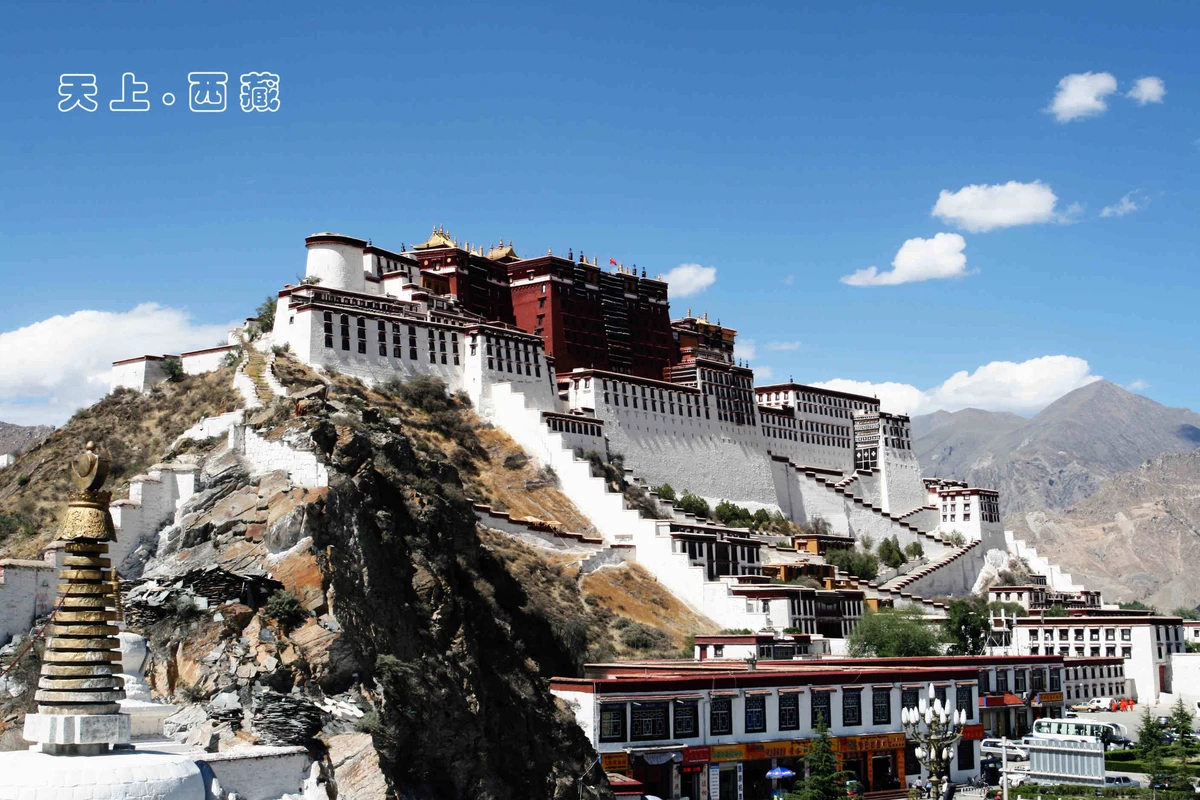
Heavenly ● Tibet
A lucky Tibet journey began on the plane, peering through the window at the endless snowy mountains beneath white clouds, my heart had already landed. Speaking of how lucky this trip was, it all started with a random Weibo repost that won me a free flight and hotel from Shanghai to Lhasa, courtesy of Ctrip. And so, a dream destination that had always been in my plans but I never thought I'd visit so suddenly appeared before me. I hastily packed my bags, didn't even have time to plan an itinerary, and embarked on this Tibet adventure!
We had to book one day in advance, and photography was not allowed in the main hall. Although only a small area is open to the public, the opulence and splendor inside will definitely make you feel it's worth it.
Since tickets for the Potala Palace require advance reservation, after landing we headed straight from Gonggar Airport to the ticket office at the west gate of the Potala Palace. After successfully booking tickets for the next day, we went to the White Pagoda Viewing Platform at the southwest corner of the Potala Palace (tickets 2 yuan per person) and took some standard photos of the Potala Palace.
Having such a close encounter with the Potala Palace so soon, and fueled by the excitement of just arriving in Lhasa, we casually walked into a local sweet tea house to experience the daily life of the locals. The milk tea, 5 yuan a thermos, tasted really good. While sipping our tea, we looked around curiously at the Tibetan patrons. Little did we realize we had become the center of their attention... Indeed, we were the only two Han people in the tea house! As for the taste of the sweet tea, it reminded me of the malted milk drink I had as a child.
The first night I suffered from severe altitude sickness, waking up every 1 to 2 hours. Finally, when morning came, I found both eyes swollen like puffy beans. The plan for this morning was to visit the Potala Palace. The mysterious Potala Palace—here I come!
This is the building that leads into the White Palace area of the Potala Palace (where successive Dalai Lamas held major religious and political ceremonies like the enthronement ceremony). Once you enter, cameras are forbidden. The internal glory and splendor can only be experienced with your eyes and remembered with your heart; words alone are completely inadequate to describe it.
Sera Monastery is one of the six great monasteries of the Gelug sect of Tibetan Buddhism. Located in the northern suburbs of Lhasa, it is one of the three great monasteries of Lhasa, along with Drepung Monastery and Ganden Monastery. The most distinctive feature of this monastery is the debating sessions. Be sure to go at a fixed time in the afternoon to watch.
We chose to visit Sera Monastery, famous for its debating sessions, for the afternoon. Sera Monastery is one of the six great monasteries of the Gelug sect, located at the foot of Sera Utse Mountain, 3 kilometers north of Lhasa. Together with Drepung Monastery and Ganden Monastery, they form the three great monasteries of Lhasa.
The main assembly hall, Tsokchen Hall
Debating is a form of Buddhist knowledge discussion, or you could say a method of study for the monks. Every day, the monks at Sera Monastery hold a debating session. It usually starts at 3:00 pm and ends at 5:00 pm, and you are free to watch.
The debate is a challenging discourse, where both sides engage in a war of words, using intense language. Debaters often employ various hand gestures to emphasize their points: they might clap to urge the opponent to answer quickly, or move their prayer beads to invoke the Buddha's power to defeat the other. The lively atmosphere on the debating ground deeply affects onlookers.
There are usually three travel routes around Lhasa: the Nyingchi route, the Shigatse route, and the Namtso Lake route. The Namtso Lake route, a day trip there and back, is the choice of most travelers.
On the way from Damxung to Namtso, we met a herdsman. He had 50 yaks and 200 sheep; a yak could sell for 5000 yuan, a sheep for 200 yuan. You could say the local herdsmen are small millionaires. Tibetan friends outside the scenic spots are all very simple and friendly!
This sacred yak has been spared from the slaughter!
Billed as the deepest, longest, and highest-altitude river valley on Earth. It's a must-pass on the way to Namtso.
On the Damxung grassland west of the Qinghai-Tibet Highway, there is a viewing platform for the main peak cluster of Nyenchen Tanglha Mountain by the roadside. The platform is surrounded by colorful prayer flags that connect heaven and earth, showing reverence for the sacred mountain.
Beautiful grassland pasture scenery on the way to Namtso Lake
The highest-altitude lake in the world, and the second-largest saltwater lake in China. In Tibetan, Namtso means "Heavenly Lake," "Spiritual Lake," or "Sacred Lake." It is a famous holy site in Tibetan Buddhism, revered as one of the four great fierce lakes. The scenery is extremely beautiful, with the lake surrounded by snow-capped mountains, full of mystery.
There is a legend among devotees that in the Year of the Sheep, all Buddhas, Bodhisattvas, and protective deities gather at Namtso to set up a great ritual. If a person goes on pilgrimage and circumambulates the lake once, it surpasses circumambulating the lake and reciting prayers ten thousand times at other times, accumulating immeasurable merit. So every Tibetan Year of the Sheep, monks and laypeople travel long distances to circumambulate the lake.
Sacred yaks by the holy lake and divine gulls on the water
For dinner, we went to the most famous Makye Ame in Lhasa, and to our surprise we got the best corner seat on the third floor. Though it was late at night, the Barkhor Street below was filled with prostrating worshippers, leaving not a single gap on the street.
Barkhor Street, also known as the octagonal street, is located in the old city of Lhasa. It is the famous circumambulation path and commercial center. Barkhor Street encircles the Jokhang Temple and is lined with many shops, eateries, and countless stalls. You can see many worshippers performing full-body prostrations on the street.
On the fourth day we set off for Shigatse. On the way we would pass Yamdrok Lake, Karola Glacier, Gyantse Dzong Fortress, and Palcho Monastery.
Billed as the deepest, longest, and highest-altitude river valley on Earth.
A water burial platform on the Yarlung Tsangpo River. Do you see the hammers and knives on the platform? You can imagine what they're used for.
On the road we encountered countless cyclists heading to Lhasa. As we approached Yamdrok Lake, we met one such traveler. This handsome cyclist had started from Hangzhou and spent a full 63 days to reach here. He still had about a dozen more days to go to reach his final destination—Kathmandu. Quitting a job to go on a long-distance cycling trip is something many people dream of but dare not do!
Yamdrok Lake at an altitude of 4441 meters, with the 6000-meter-high Gyalga Kangsar Snow Mountain in the distance
Also called Yamdrok Lake, it is one of the three sacred lakes of Tibet, along with Namtso and Manasarovar. It is the largest inland lake on the northern slope of the Himalayas. The lake has many branches and is very beautiful.
According to folklore, Yamdrok Lake was formed when a fairy maiden descended from heaven.
On the way from Lhasa to Palcho Monastery, you will pass Simila Pass. At an altitude of 4330 meters, this is the best spot to photograph Manla Lake.
After leaving Yamdrok Lake and crossing the 4330-meter-high Simila Pass, you arrive at the tongue of the Karola Glacier.
Famous as one of the filming locations for the movies "The Knot" and "Red River Valley," Karola Glacier is located on the border of Langkazi County and Gyantse County in Lhoka Prefecture of Tibet. It is one of the three major continental glaciers in Tibet. The enormous glacier stretches from the misty mountain peaks all the way down to just a few hundred meters from the road. This year, the glacier is continuously shrinking.
It looks like a castle but was actually a former county government seat. Located in Gyantse County, Tibet, it is called Gyantse Dzong Fortress, named after the rocky hill (Dzong) on which it stands.
I always thought it was a Han Chinese temple, but it is actually a purely Tibetan Buddhist monastery. Located in Gyantse County, Tibet, it was first built in the early 15th century. It is a monastery where the Sakya, Kadam, and Gelug sects of Tibetan Buddhism coexist.
Located within Palcho Monastery, it is known as the "100,000 Buddha Pagoda." The pagoda has nine stories, stands over 32 meters tall, has 108 doors, and 77 halls, shrines, and scripture chambers. It is a unique treasure in the history of Chinese architecture.
Shigatse, meaning "fertile estate" in Tibetan, is an ancient city with a history of over 600 years. We arrived in Shigatse in the evening; after dropping off our luggage, we went to the Saint Immortal Tibet-Nepal Restaurant next to our hotel for dinner.
It is the largest monastery in the Shigatse area of Tibet, the traditional seat of the Panchen Lamas from the Fourth onwards. It is located on the slope of Niseri Mountain west of Shigatse City. The monastery, built against the mountain and by the water, with golden roofs and turquoise tiles, is majestic and solemn. The interior halls are covered with murals of various styles, each with its own characteristics.
Returning from Shigatse to Lhasa, passing through the beautiful Lhoka region of Tibet.
Approaching the Lhasa area, you can see many such white ladders painted on the cliffs. These are heavenly ladders painted by Tibetans for their deceased loved ones, wishing them a swift arrival in heaven.
Back in Lhasa, of course we didn't miss seeing the beautiful night view of the Potala Palace.
Barkhor Street in the old city of Lhasa. There is a saying among Tibetans: "First there was the Jokhang Temple, then there was Lhasa city." In the main hall, there is a gilded bronze statue of the 12-year-old Sakyamuni, brought by Princess Wencheng from Chang'an. Side halls house statues of Songtsen Gampo, Princess Wencheng, and Princess Bhrikuti of Nepal.
Saying goodbye to Lhasa, I didn't seem too reluctant to leave, because I firmly believe that in the near future, I will come again! This six-day trip to Tibet merely lifted a corner of its mysterious veil; there are many more secrets awaiting my exploration. Everest, Ngari, Nyingchi... Heavenly Tibet, until we meet again next time!


