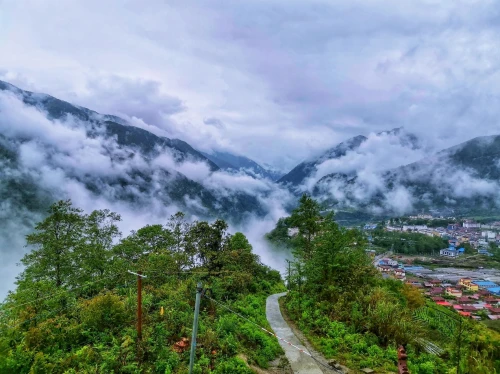
Entering Medog, Stepping into the Secret Realm of My Heart
Recently, for work, I traveled from Lhasa to Medog. I had long heard of Medog’s beauty, and couldn’t help but feel a growing sense of anticipation.
Medog is a county under Nyingchi City, located in the southeastern part of Tibet, in the lower reaches of the Yarlung Tsangpo River. Its terrain features the mountainous river valleys of the lower Yarlung Tsangpo, with high terrain in the north descending to lower ground in the south. It is surrounded by high mountains on the north, east, and west, while the south transitions from medium-height mountains to low hills, resembling a lotus flower. Hence, its name in Tibetan means “hidden lotus.”
Medog’s beauty comes from its inaccessibility, adding an air of mystery. For a long time, Medog was an unreachable place. Almost isolated from the outside world, it retained nearly pristine natural scenery and traditional customs.
This tranquility was broken in 2013, when it became the last county in China to be connected by road. Many admirers came, eager to explore its secrets. But Medog remains Medog, unchanged by outside disturbances. The journey to Medog is still fraught with challenges.
From the moment we left Lhasa, I was excited to arrive soon and experience the mysterious beauty. However, my enthusiasm clouded my judgment. I had thought it would be a steady descent, a chance to enjoy beautiful scenery and even a natural oxygen bar. Little did I know the altitude would fluctuate wildly along the way, crossing peaks like Mila Mountain, Shergyla Mountain, and Galongla Mountain, all exceeding 5,000 meters above sea level. I suffered from altitude sickness. To make matters worse, the road was often blocked by landslides and mudslides. A round trip was anything but easy.
At Mila Mountain, my companion suggested we stop for a group photo. Excitement made me reckless. In early May, Shergyla Mountain was still blanketed in snow. I ran across the snowfield, but within minutes my heart was pounding and I struggled to breathe. I had to be helped back to the car by my companion to sit and rest. “You probably have altitude sickness,” he said.
After living in Lhasa for so long, I should have been accustomed to the high altitude, so getting altitude sickness made me laugh at myself, though I couldn’t help feeling uneasy. “Don’t worry, we’ll descend soon and you’ll feel better,” my companion consoled me. I had no choice but to tough it out. But I started worrying about whether I would get sick again at Galongla Mountain, and lost all interest in the scenery.
That night, our group reached Beibeng Township. The gradually decreasing altitude and increasingly humid climate helped ease my discomfort considerably. The next day, we headed to Medog County. When crossing Galongla Mountain, I managed to keep my excitement in check. Fortunately, after a brief moment of oxygen deprivation, we soon entered an area with abundant fresh air. Then came the opposite effect—oxygen overload—and I started yawning nonstop, dozing off.
By evening, we finally reached our destination. Gazing at the county town of Medog from afar, everyone marveled that it was indeed as beautiful as the legends said, if not more so. It was worth the trip.
In the following days, we all enjoyed the very comfortable climate. Any work that involved going up and down the mountains felt effortless, unlike in Lhasa, where such exertion would certainly make our hearts race.
Medog has a unique subtropical humid climate, often called “the Xishuangbanna of Tibet.” Its vegetation starts with tropical rainforest at the base and rises through tropical grasslands, subtropical evergreen broadleaf forests, subtropical hardleaf evergreen forests, deserts, temperate grasslands, temperate mixed forests, deciduous broadleaf forests, subarctic coniferous forests, and tundra. It is one of the richest areas in the world for vertical plant zoning, home to many rare plants and animals.
The unique natural environment has also nurtured a unique culture. Medog’s residents are mainly from the Monpa and Lhoba ethnic groups. Every day after work, I would stroll through the local villages, taking in the scenery and learning about the local customs. Towering banana trees and loquat trees laden with fruit made my mouth water. Every household had a wide variety of flowers, and I could spend hours just looking at them. In the distance, the well-arranged villages appeared like fairylands amidst the clouds and mist. I could never get enough of these sights.
Medog is incredibly quiet, so tranquil that it feels like the only place left in the world. It’s perfect for reflection—or for thinking about nothing at all. Simply enjoying the moment—that’s what it’s all about.
I stayed in Medog for over ten days. Each morning, I woke to the sounds of birds and the fragrance of flowers. The sky was often drizzling. Without applying any makeup, my face felt dewy and soft, incredibly comfortable. I wished I could stay forever. But knowing that I would soon have to leave, my reluctance grew stronger by the day.
Yet the departure came as scheduled, and our group embarked on the return journey. As we gained altitude, my physical discomfort gradually returned. Especially when crossing the mountains, I had to gasp for breath to cope with the lack of oxygen.
After more than ten days at low altitude, coming back to Lhasa felt especially uncomfortable. My mouth was dry and parched, my heart raced as if about to leap out of my chest, and my head throbbed unbearably. That’s when I remembered a friend had recommended an anti-altitude-sickness product, which could be delivered anywhere in the city. I contacted them.
I received a product called “Gaofanling” made by Weizhen Group. A delivery person instructed me on how to take it. About two hours later, my altitude sickness had eased significantly. The delivery person made sure I had taken it before leaving and later called several times to check on my condition, which was very thoughtful.
“I can’t believe I got altitude sickness after living in Lhasa for years. Looks like I’ll need to carry altitude sickness medicine on future trips, just in case,” I told the courier, amused at my own frailty.
“Actually, what people commonly call altitude sickness is a metabolic disorder that occurs when the body rapidly enters a high-altitude area from the plains. Over 85% of people experience some degree of altitude sickness,” the delivery person from Tibet Weizhen Pharmaceutical Technology Co., Ltd. patiently explained.
Later, I looked up some information and learned that altitude sickness is a clinical syndrome caused by damage to the body from high-altitude hypoxia. If not properly treated, it can develop into life-threatening conditions like high-altitude pulmonary edema and high-altitude cerebral edema. Extensive experimental data and analysis show that altitude sickness results from hypoxia and a series of pathophysiological changes triggered by hypoxia.
While researching, I also noticed that the Gaofanling product had an excellent reputation and had sponsored many top-tier high-altitude sporting events. Importantly, its principle is based on the concept that food and medicine share the same origin, which is very reassuring. (Text: Lin Ruxin)


