All the Way West
As a typical Libra woman, I usually need at least three months to decide, prepare, and plan before every journey. Yet this trip to Tibet turned out to be an impulse one.
September is a lovely time, perfect for getting out and about. Friends’ posts on social media stirred my restless heart. Under my daily coaxing, my 60-year-old mother finally agreed to join, and so our trio of mother and two daughters set off — all the way west.
Worried about the high altitude and tight schedule (only six days in total), we had to take a roundabout outward route: Shanghai to Lanzhou by air, then Lanzhou to Lhasa by train. The trek was unspeakably tough — train delays, swapping trains midway, headaches and dizziness from the altitude, one hiccup after another. Thankfully, the scenery along the way more than made up for it…
P.S. At Lanzhou Airport I ate a bowl of authentic Lanzhou beef noodles without the beef, and on the train I watched my very first sunrise…
The guesthouse we stayed at was recommended by a colleague — Guzang Fanshi Boutique Guesthouse (Lhasa Barkhor Ancient City Branch). It’s right on Barkhor Street, very close to Jokhang Temple, though you have to wind through a maze of lanes. But a good brew fears no dark alley, right? It’s a place full of local character… And luckily, I have a great sense of direction, ha ha… From the rooftop on the fifth floor you can see the Potala Palace. I was so keen that I dashed up to take photos the moment we put down our luggage.
For dinner we chose a local internet-famous spot — Makye Ame Western Food Bar. The location is wonderful, but the food was just so-so.
Night falls very late in Tibet; at past 8 p.m. you could still see the sun. Barkhor Street after dark carries a mysterious atmosphere. Devout locals walk in winding groups around the temple (Jokhang Temple), and you see people prostrating themselves step by step, hoping to brush the Buddha’s sacred robe.
The next day’s plan was to pay homage to the sacred site on the back of the 50 yuan note — the Potala Palace. The best photo spot is on Yaowang Hill, which is actually a low little knoll. Regrettably, though we got up early for sunrise, we were late to the show: heavy rain scrambled our schedule… Before even entering the Potala Palace, our shoes were so wet you could raise fish in them. Miraculously, as soon as we stepped inside, the rain began to stop, and not long after, the sun came out…
Before leaving, we had a bowl of local aged yogurt with honey — tart and sweet, quite appetizing.
Then we went to Zaki Monastery. The Potala Palace isn’t far from Zaki Monastery; you can take a taxi. But note that taxis here accept shared rides, and you need quick eyes and quicker feet. The three of us waited quite a while before we flagged down an empty cab. After that, I used DiDi to call cars, which was very convenient.
Zaki Monastery sits on Zaki Road in the northern outskirts of Lhasa and is the only temple to the God of Wealth in all Tibet. Small as it is, the incense offerings are tremendously prosperous.
This is the temple of Zaki Lhamo, a manifestation of Palden Lhamo. It draws many devotees, and accomplished monks here bestow blessings by anointing visitors’ foreheads and consecrating precious items. Worldly protective deities still have karmic bonds with sentient beings, so they often take human form to interact with people. The goddess Zaki is just this kind of deity and is especially responsive. Many Tibetans and Han Chinese come here every Wednesday to burn juniper incense and worship.
The deity mainly worshipped at Zaki Monastery is fond of alcohol, so pilgrims bring not only khata scarves and juniper branches but also white liquor or barley wine. Monday is for praying to the Wealth God, Wednesday for peace, and Friday for health.
Like the Potala Palace, Jokhang Temple has fixed visiting hours, and we received a text message in advance with the time. After visiting the local god of wealth, it was already past 1 p.m. With our 3 p.m. slot still a while away, we took a taxi back to the guesthouse, grabbed a casual lunch, and rested a little before heading to Jokhang Temple. Unfortunately, because of the large crowds, we missed the 12-year-old life-sized statue of Sakyamuni Buddha…
Two of us three are vegetarians, so we had booked a vegetarian hotpot place in advance. But walking there from Jokhang Temple proved rather far. My mother grumbled the whole way that this road didn’t look like there could possibly be a restaurant here. Yet once we tasted the delicious food, all complaints vanished~
Like DiDi, the food-delivery app Ele.me also works a treat here. Before bed (it was already 1 a.m.) we placed an order for breakfast the next morning. To our surprise, the delivery guy showed up twenty-some minutes later… We had to ask him to come back and deliver it in the morning, and he took it with zero complaint. Kudos to him.
As devout Buddhists, we came purely for pilgrimage, so we made a last-minute plan and hired a car. That day we visited the three largest monasteries in Lhasa: Ganden Monastery – Drepung Monastery – Sera Monastery.
Ganden Monastery is one of the three great monasteries of Lhasa and one of the six main Gelugpa monasteries. Inside are 24 exquisite thangkas, and during the Butter Lamp Festival it holds memorial ceremonies.
Ganden Monastery is located on Wangburi Mountain at 3,800 meters above sea level on the southern bank of the Lhasa River, in Dazi County, Lhasa. Its full name is “Ganden Namgyel Ling” and it is one of Lhasa’s three great monasteries. “Ganden” is a Tibetan transliteration meaning “Tushita Heaven”. Among the six major Gelugpa monasteries, Ganden holds a uniquely important place. It was personally founded in 1409 by Je Tsongkhapa, the founder of the Gelug school, and is the mother monastery of the Gelugpa order; successive holders of the Ganden throne, the heads of the school, have resided here. Ganden Monastery consists of over 50 buildings, mainly including the Assembly Hall (Tsogchen), the residence of Tsongkhapa, the Yangpachen Chapel, the reliquary hall of Tsongkhapa’s stupa, the Jangtse and Shartse colleges, plus 23 regional dormitories (Kangtsen) and 20 smaller hamlet communities (Mi-tsen). Among the 23 Kangtsen, each has its own prayer hall, mostly two-storey structures built along the mountain contours, tier upon tier. From a distance, they occupy the entire mid-mountain, vast and spectacular. The Assembly Hall (meaning Great Sutra Hall, i.e., the main shrine hall) was built in 1409 and has 108 great pillars, able to hold 3,300 monks chanting at once. The main icon enshrined is Maitreya Buddha (the future Buddha), and later gilded bronze statues of Tsongkhapa and others were added. In the hall sits a throne supported by five golden lions, called “Ganden Thri Si”, which is the throne established after Tsongkhapa founded the Yellow Hat school. To the rear left of the hall is a small chapel with a sculptural fresco of “Tushita Heaven” above its door, exquisitely detailed and lifelike. Inside are Tsongkhapa’s meditation seat and a complete set of the Kangyur and Tengyur — the Tibetan Buddhist canon — written in pure gold ink. One pillar in the main hall is especially curious, raised about a palm’s width above the floor.
The largest monastery in Tibetan Buddhism, its annual Shoton Festival Buddha display ceremony is the grandest exhibition of a giant thangka in the Tibetan region.
Drepung Monastery nestles in a mountain hollow on the western outskirts of Lhasa. Its complex is enormous, with white houses and red chapels spreading across the mountainside like scales on a slope. From afar it looks like a giant heap of rice, and photos taken against the mountain are stunning. It holds an extremely high position in the Gelug school of Tibetan Buddhism. Inside, the architecture is both imposing and splendid, filled with many beautiful treasures and offering the chance to watch monks’ debate rituals. To visit Drepung, you first arrive at its mountain gate, from where you can see the monastery cupped in the hollow, surrounded by mountains on three sides, facing the Lhasa River and the plain ahead. The buildings rise layer upon layer, majestic, like a white mountain city. Once inside, you can view the Tibetan-style buildings up close: white-walled houses and golden-roofed, red-trimmed halls interspersed, all in characteristic Tibetan style. Unlike Han Chinese Buddhist temples on the plains, Tibetan monasteries are not laid out symmetrically along a central axis; rather, the buildings scatter up the mountain. You can follow a clockwise route, one by one. The full circuit around Drepung is about two kilometres, not tiring to walk, and circumambulating the monastery clockwise is also a way to accumulate merit and good deeds. Inside the monastery’s various halls is awe-inspiring; the great assembly hall has 183 pillars, each finely carved. The temple contains numerous dignified and exquisite Buddha statues, as well as a wealth of rare and precious art — beautiful thangkas, appliqué embroideries, murals — all worth seeing. Drepung Monastery debate sessions: Drepung is thriving with incense and pilgrims, many Tibetans performing kora and prostrations here. Following the footsteps of the faithful, you can walk around and worship…
Sera Monastery’s full name is Sera Mahayana Monastery. It lies at the foot of Sera Utse Mountain on the northern outskirts of Lhasa and was built by Jamchen Chöjé, a disciple of Tsongkhapa, during the Yongle reign of the Ming dynasty. The monastery is vast, with numerous buildings clinging to the hillside; the tall golden roofs glitter under the sun. It is one of Lhasa’s three great monasteries and one of the six main Gelugpa (Yellow Hat) monasteries.
A delay meant that by the time we got to Sera Monastery, we could still see the monks’ debates, but the main hall was already locked. My mother pleaded and managed to find a monk to unlock the door so we could pay our respects. Unfortunately, he said there were three keys to the main door and he had only one; even if he opened his lock, we still couldn’t get in…
Back at the guesthouse, we ate a bowl of local cold starch jelly and then set off to watch a performance. The show was magnificent and grand, but we felt so cold…
Since we were in Tibet, of course we had to see the local sacred lake on the last day of our itinerary. We hired a car for a day trip to Nagen La Mountain Pass – Namtso Lake. The round-trip drive took at least ten hours, but it was absolutely worth it. If I have the chance in the future, I’ll definitely stay overnight there — they say the night view is stunning.
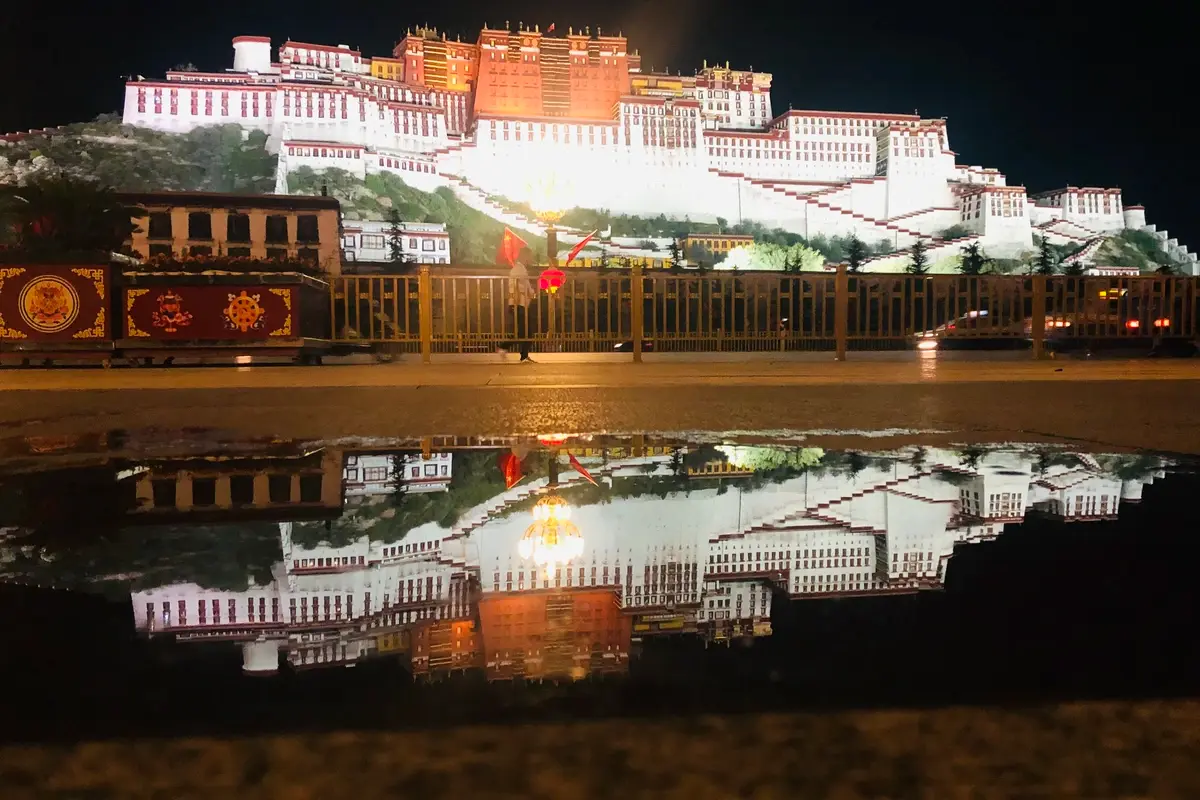
That evening we switched to an internet-famous hotel and spent the night in a much-hyped room, ha ha. We then took a taxi to eat the city’s top-ranked barbecued lamb skewers. I ate, while my brother watched. Very kindly, I ordered a few vegetable dishes for him and packed some for my mother, who had chosen to hole up in the hotel… After the feast, we took a taxi to Potala Palace Square, only to arrive late again and miss the musical fountain show. Watching a crowd of people snapping all sorts of photos of the Potala Palace, we also got quite excited and struck all kinds of kneeling and lying poses ourselves…
On the last day of the trip, we visited Ramoche Temple and a small temple next door. Here, we nearly missed the 8-year-old life-sized statue of Sakyamuni Buddha again — it’s located behind a glittering golden Sakyamuni, above head height, and you pass right beneath it…
After one final stroll along Barkhor Street, we had lunch, grabbed some takeaway internet-famous yogurt, and rushed to the airport to fly back to Shanghai… Alas, by the time the yogurt arrived in Shanghai, it had spectacularly leaked… At the airport we even debated whether to toss it as recyclable waste or wet waste…


