Returning to Tsang, Challenging Everest
How rare the Earth is in this universe, how fortunate we are! Looking across the world, the South and North Poles seem incredibly magnificent, inspiring awe and admiration. Yet, there is another Third Pole we can call our own — the Qinghai-Tibet Plateau. It still beckons, and behind its sacred, stunning beauty lies a harsh, overwhelmingly real truth. But even so, nothing could stop me from drawing near.
First, a brief itinerary:
D0 Shanghai Station — Z164 (hard seat) → Lhasa Station
D1 On the train
D2 → Lhasa Station
D3 Lhasa, Lhasa Station — Z8803 → Shigatse Station
D4 Shigatse → Everest Base Camp (Rongbuk Monastery)
D5 Bason Village → Shigatse Station — Z8804 → Lhasa Station
D6 Lhasa Station — Z166 (hard sleeper) → Shanghai
D7 On the train
D0 → Shanghai
This year I’m a high school freshman. Last year I got into my dream school through the high school entrance exam, but during my first year I’ve been near the bottom of my grade, constantly trying to catch up. In that time my health hasn’t been great, and right after the final exams of my second semester, I was hospitalized for a week with peritonitis following an appendectomy. The original plan for a hiking trip in Yunnan had to be cancelled, but I still wasn’t willing to give up on a summer adventure. So I decided to venture alone to the world’s Third Pole — Mount Everest!
Actually, last year I took my family on a trip to Nyingchi and Lhasa, so they all agreed to my request to go to Shigatse alone. Last year it was pretty much a leisurely style — typical sights, taxis everywhere, five-star hotels, fancy restaurants, soft sleepers on the train. It cost over 4,700 RMB per person! This year, I wanted something different — budget travel!
No need to describe the anticipation before departure.
D0 Shanghai Station — Z164 → Lhasa Station
I bought this ticket a week before leaving. All the sleepers on the outbound train were sold out, so I got a hard seat ticket. Unexpectedly, I snagged seat 009 by the window for only ¥402.5 — incredibly lucky!
17:15 at Shanghai Station, boarding.
After waiting almost two hours in the waiting room, they finally checked tickets. I was first in line. After boarding, I rushed excitedly to carriage 08.
Sure enough, I was the first one aboard. It had been almost half a year since I’d last taken a train, and everything felt a bit unfamiliar.
To my surprise, the guy sitting opposite me was the same one who had sat opposite me in the waiting room — what fate! He only rode for one stop though, getting off at Suzhou Station.
At 20:08 the train finally pulled out. I was so excited I almost went wild, feeling as if all my stress was released in that moment. Watching the moving platform and tracks, I felt a taste of paradise!
D1 On the train (enjoying the scenery of Gansu along the way)
Just after 5 a.m., after passing Zhengzhou Station, the train moved into an expanse of farmland, and suddenly, mist was swirling!
Wow, rural morning mist — it was so beautiful it made me want to cry. I thought of ‘The Peach Blossom Spring’ from our Chinese textbook and Bandari’s ‘The Foggy Dew.’ The noise and restlessness of the city truly got a cleansing in that moment!
I’d only slept a bit over 3 hours the night before, then slumped over and slept for a long time again.
I slept until past 10 a.m., nearing Xi’an. I started chatting with the girl in seat 8 beside me. She was in my grade, taking the train for the first time, and she was getting off at Nagqu Station and then spending 13 hours on a bus to Dêngqên County — that’s really tough! She was very kind and cute. She slept in the aisle seat, and when I tried to give her my window seat, she politely declined. A really good person.
Compared to her, maybe I’m much more fortunate. Some small things I really don’t need to complain about, because no one in this world has it easy!!
After 11 a.m., the train arrived at Xi’an Station. We passed the city wall. It was raining outside, and this was different from the Xi’an I remembered — the greenery was especially lush, maybe because I’d only visited Xi’an in winter before!
Once the train passed Xi’an Station, the carriage door did not open again all day. Due to heavy rain a few days earlier on the Longhai Line, all regular-speed railways had been restricted, and the train’s speed was about the same as in the 1970s.
The train passed through the Wei River valley. Sure enough, my geography teacher didn’t lie: in the Northern Hemisphere, fluids deflect to the right. Looking at the river, the right bank was eroded and the left bank was silted.
The mountains of the gorge were still beautiful.
The train finally crept past the core flood-affected zone. After passing Tianshui Station, we were nearly three hours behind schedule.
After passing Dingxi, we finally saw the sun. By then the train had made up half an hour. Go Z165!
At Lanzhou Station, the doors finally opened — they’d been shut tight for a full 10 hours. I took in a breath of air; it felt incredibly fresh!
The train arrived at Xining Station two hours late, where we switched to an oxygen-supplied carriage. The oxygen-supplied carriage felt much more luxurious than the domestic non-oxygen one from last night. The interior was decorated in Tibetan style.
After pulling out, the train ran much more smoothly than the night before. Before long, I fell asleep!
D2 → Lhasa Station (viewing the full panorama of the Qinghai-Tibet Plateau)
At 3 a.m., the train reached Delhi Station. The classmate sitting next to me really couldn’t sleep well, so under the pretext of looking at the scenery, I finally gave her the window seat.
I relaxed for a bit and wiped the condensation off the door glass with my hand. Suddenly, I saw an incredibly beautiful desert starry sky, like the eye of the universe — vast and boundless! Perhaps countless alien civilizations’ historical events are unfolding in those star systems every second! And the morning star shone as bright as a full moon, as if welcoming me to the Western Regions. I felt both awe and joy.
Back in the carriage, I saw her utterly exhausted, slumped over the table, fast asleep. I was so heartbroken I almost cried. I decided to let her sleep like that until daylight. I quietly sat down in seat 8, leaning back against the chair, and drifted off.
The train was still two hours late arriving at Golmud. After the locomotive was changed and we set off, the sky was fully bright. That was good — today I could enjoy the whole view of the Golmud–Lhasa section of the Qinghai-Tibet Railway.
At first, no snow mountains were visible, but I did see magnificent yardang landforms, and in the distance, vast grasslands and gullies — I couldn’t name them yet. (Note: yardang, not danxia.)
Nameless rivers and roads seen from above.
At 8 a.m., we finally saw our first snow mountain — Yuzhu Peak. Sunlight on the ice and snow reflected a hopeful light, reminding me of the saying: ‘Winter has come, can spring be far behind?’ It’s so true: when we go through icy suffering, if we persevere to the end, a spring-like victory will surely come!!
The train reached the foot of Yuzhu Peak, and seeing the ancient glaciers, my heart truly ached. Maybe the coronavirus was caused by humanity’s destruction of nature and melting glaciers. I hope humans will protect nature — drive one less trip, use one less watt of electricity. Then, maybe the Earth still has a chance to be saved.
The massive ice cliffs were awe-inspiring, humbling, terrifying!!
Villages we passed while crossing the Kunlun Mountains.
It made me think of the Nalati Grassland.
Crossing Kunlun Pass, the snowy grasslands looked so much like the landscapes of northern Norway. Apart from the thin oxygen, it was no different from the North Pole.
The sky was unusually blue.
The train reached Fenghuo Mountain. The rocks looked like the surface of Mars — the red ore is a special mineral formed by the chemical metamorphism of sedimentary rock!
Herds of cattle and sheep — an incomparably harmonious natural scene.
Fenghuoshan Tunnel — the world’s highest-altitude railway tunnel.
A little past 1 p.m., the train finally crossed Tanggula Pass. This year I saw those icy peaks again. They stood as solitary as ever, upon the high red soil, bringing water to life on Earth.
This is Tanggula Mountain photographed last year.
Cona Lake was still so beautiful. In the sunlight, it appeared half green, half blue. This is a national nature reserve, still undeveloped, so its beauty can only be seen from the train. I hope Cona Lake can forever keep its pristine ecology.
The vastness of the Northern Tibetan grasslands.
When the train arrived at Nagqu Station, I had to part with that classmate. There was indeed some reluctance in my heart, and I could only wish her happiness in life!
One more photo of the luxurious BSP Qinghai-Tibet Plateau YZ25T carriage.
Nyenchen Tanglha Mountain in Damxung County.
After leaving Nagqu, the train raced to make up time, running at about 130 km/h.
At 8:30 p.m., the train arrived at Lhasa Station, 55 minutes late. The moment the door opened and I stepped out, I was so exhausted I felt nothing, instead feeling lighter and lighter (they say that’s when sudden death is near). After the whole train had a temperature check and we exited normally, I took a bus to the youth hostel. The minute I got off the bus, I started vomiting uncontrollably and felt terrible. After going up and drinking some hot water, I collapsed into bed and slept like the dead.
D3 Lhasa city (half day), Lhasa Station — Z8803 → Shigatse Station
Just after 7 a.m., not even the alarm could wake me. It was my dorm roommate, Brother Fang, who woke me.
After breakfast, I took a bus to visit the Potala Palace. I hadn’t had time last year. Seeing the Potala Palace so close up, it looked utterly magnificent!
I’m terrible at history. I hardly understood what the guide said, but the halls inside were still stunning — all representing the crystallized wisdom of ancient working people. (No photos inside, so no pictures.)
After that, I caught a bus to Norbulingka. It truly is the natural oxygen bar of Lhasa, full of rare flowers, lush trees — absolutely the summer palace of Lhasa.
While touring the exhibition hall, I unexpectedly ran into my dorm roommate from last night, Brother Fang. Such fate — from then on we toured the place together.
It felt so much like a Suzhou classical garden.
After the visit, I parted with Brother Fang, then took the train to Shigatse Station, and then a bus to the youth hostel.
By sheer coincidence, the guy in the lower bunk, Brother Zou, was also heading to Everest, and like me, he was from Shanghai. He said he’d take me to the travel agency to confirm we were on the same tour. It turned out we really were, and the person in charge even assigned us the same vehicle. After that I handed over my ID for them to process the border defense permit.
The distinctive wall at Shigatse Tseyang Youth Hostel.
That evening we had Tibetan food. Brother Zou said the taste was just average, but I thought it was really good. The butter tea felt so much more authentic than what I’d had in Lhasa or Nyingchi — the milky flavor was especially fresh. The owner said the butter was made from pure yak milk.
D4 Shigatse — [15-seat minibus] → Everest Base Camp → Bason Village
At 10:50 a.m., we set off from the travel agency for Everest. No need to detail the long journey; the first stretch was barren with nothing in sight.
The further west we went, the worse the weather got. I started worrying whether Everest would be visible today.
After multiple ID and border permit checks, when the minibus crossed Gyatso La Pass, the sky was a blanket of clouds; we could see nothing. It seemed almost hopeless to see Everest today…
The wind at the pass was fierce, bitingly cold, making me shiver. My heart was just as icy. Disheartened, I climbed back into the vehicle.
When we crossed Gawu La Pass, the weather turned from overcast to heavy rain. Just as almost everyone in the car was despairing, I recalled my geography teacher saying: ‘On high plateaus and mountains, the weather changes a lot. Usually, the chance of clearing after a downpour is very high!’ The Himalayas have this high-altitude mountain climate, so I calmed down then, looking calm, though the disappointment inside was still strong.
Sure enough, at Gawu La Pass, it slowly started clearing to the northwest. Mount Everest was still hidden by clouds, but there was hope for seeing it today. Even though I’d prepared for the worst, that little hope slowly eased my dejection.
The 108 switchbacks of Gawu La Pass.
The minibus drove to the scenic area entrance, where we switched to the scenic shuttle bus. It cost 120 per person, already included in our no-shopping tour.
From the moment the shuttle set off, I pressed my palms together, shut my eyes tightly, and continuously recited an auspicious mantra. Normally, I, a science-loving person, wouldn’t chant it, but that day I was truly forced to.
The oxygen was so thin that I quickly got altitude sickness from chanting, yet I hadn’t even noticed…
The bus rounded a bend, and the whole vehicle burst into cheers: ‘Whoa! Everest!!’ I immediately opened my eyes and saw Everest revealing his face, so handsome! I got so excited I unbuckled my seatbelt and dashed to the front of the bus to snap pictures like crazy.
First distant view of Mount Everest.
When I returned to my seat, I suddenly lost consciousness for 0.5 seconds and nearly collapsed on the ground; luckily I grabbed a handrail. Only then did I realize I had ‘finally’ got altitude sickness! I opened my oxygen canister, took a few puffs, and felt much better after a while.
The bus arrived at the terminal, Rongbuk Monastery. The spot for viewing Everest from here was excellent. Step by breathless step, I slowly climbed a higher slope. Watching that handsome Everest appearing and disappearing through the clouds, he seemed very mysterious.
The wind was howling, and it was still freezing cold. Even though my hands were almost frozen stiff, I still didn’t feel cold. I took out my physics textbook and took a photo with Mount Everest and the Base Camp monument. Physics — my favorite subject. In the future I want to do scientific research in physics. I’m also the physics class rep. May I get an A+ in physics for the college entrance exam.
A+! A+! A+!
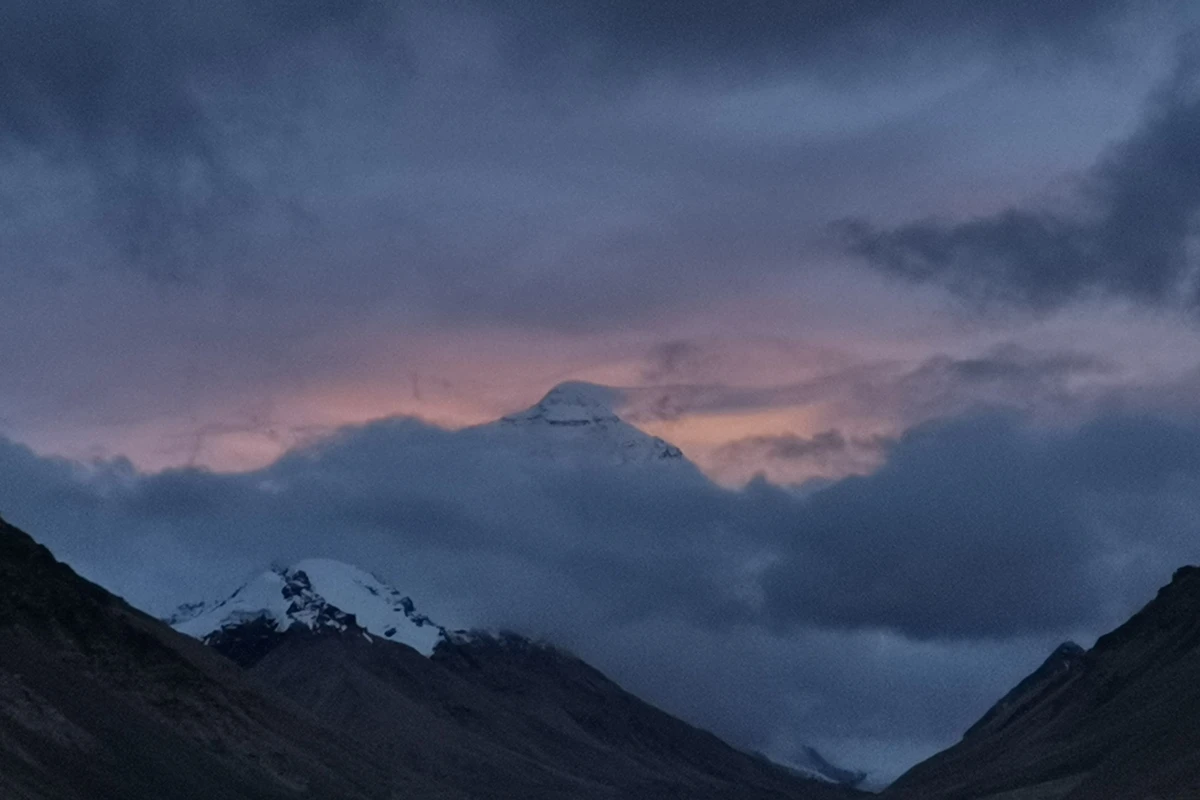
Watching Brother Everest’s shy face slowly emerge, I set up my camera for a time-lapse of the snowy peak at sunset. As the sky gradually darkened, he seemed to try to lift his white veil, revealing most of his figure.
I struck up a conversation with another tour mate, Brother Wang. He said he wanted to climb to the top of a nearby rocky hill. This guy really had incredible stamina. I asked if he wasn’t cold; he said it was fine. Frozen stiff as an icicle myself, I truly admired his guts. Every step made me shiver, barely able to move. He also said he wanted to summit Mount Everest one day — I almost idolized him. I wish him success in reaching the world’s highest point!
A while later, the peak gradually changed color. I thought this was the golden sunset on the mountain, so when it turned white I pressed the time-lapse stop button and prepared to turn away. After only a few steps, I glanced back and was instantly stunned:
This was the real golden sunset on the mountain. He wore a white cap of snow, and behind him the red afterglow told the stories of the Himalayas. Set against the flowing clouds, Brother Everest showed his gentle side, as if the threads of mist he breathed out were conveying feelings to me.
I was deeply moved by this scenery — it was earned by a 47-hour hard seat train ride, earned by reluctant goodbyes with friends along the way, and even more by the countless frustrations and blows during the 8-hour minibus trip! Perhaps my mantra even touched the spirit of the Himalayas.
Either way, this was the power of faith! Some deeply devout Tibetans work hard for half their lives, saving for three years, just to prostrate themselves all the way from Lhasa to Mount Kailash. Faith doesn’t need a clear scientific explanation — it belongs to the spiritual world. If consciousness survives after we die, then no money, fame, or fortune can be taken with us, but love and the soul can!
On the return bus ride, Brother Wang and I chatted happily. Arriving at Bason Village (the starting point of the scenic shuttle bus), I finally stayed in the worst hostel of my life! They had us three men sharing a 2-meter bed. The filthy environment and freezing bed were unbearable, so I took out my sleeping bag and crawled in; it felt much warmer!
D5 Bason Village (starry sky) → Shigatse Station — Z8804 → Lhasa Station
At 3:50 a.m., I woke up gasping for air. The room was almost maddening — completely unventilated. Worse, I was sleeping between two people, so the carbon dioxide concentration was high, meaning the oxygen level was even lower than outside. At an outdoor altitude of 4,900 meters already, this lack-of-oxygen-within-lack-of-oxygen environment was bound to wake me up!! My head ached violently, and I felt extremely nauseous. I put on clothes, went outside, and vomited, bringing up only yellow liquid.
Unexpectedly, once outside, I felt much better. The headache was gone. Looking up, I saw a sky full of stars and the Milky Way, incredibly spectacular! The Big Dipper seemed to guard the galaxy in the northern sky, Sirius twinkled affectionately, and the proud, bright Venus waited for something in the east. Although some clouds obscured it tonight, not as bright as what I saw in Delhi, this night sky still made my heart race!
After stargazing, I went back to sleep a bit. At 8 a.m. I immediately got up, packed my gear, had a sip of thin porridge, and got ready to go.
Today, while going through the 108 switchbacks of Gawu La Pass, I finally understood that the faster the speed or the tighter the curve, the greater the centrifugal force, directly proportional to the square of linear velocity (speed) and the reciprocal of the radius.
At Gawu La Pass, Mount Everest once again showed a sliver of his face. Though I felt ten thousand regrets in my heart, I had to say goodbye. The clouds were so thick that Lhotse, Makalu, and Cho Oyu were completely hidden. Only Mount Everest still bid us farewell. Perhaps this was our fate…
Goodbye, Mount Everest!
During a lunch stop in Lhatse Town, we were lucky enough to photograph a solar halo. It was a bit different from the one I’d snapped in Pingxiang — this one was blindingly intense; you couldn’t lift your head to look at it. Maybe the UV here is many times stronger than in Jiangxi!
In the afternoon, we passed rapeseed fields, very much in the style of Tsang.
This no-shopping tour was excellent. The itinerary said they wouldn’t drop us at the railway station, but because everyone on board was taking the train back to Lhasa, the driver was very kind and took us to Shigatse Railway Station. Really grateful to him!
The classmate heading to Dêngqên County had severe altitude sickness. After hearing that, I felt pretty worried, thinking of how awful it was to be woken by altitude sickness in the early morning — truly torturous.
Amitabha, may she be well!
At 18:40, the train departed on time. Strangely, maybe due to the environment, I felt a bout of depression. My heart was really heavy — perhaps I couldn’t bear to leave Tibet, perhaps I was grieving for this beautiful scenery. Looking up, the orange-yellow lights inside the carriage felt even more oppressively suffocating. I quietly slipped to the carriage connection and wiped away tears. But luckily, Brother Zou had booked a seat next to mine and sat beside me. After I told him, he kept comforting me. He was very understanding and could truly feel what I felt, not just saying ‘don’t overthink.’ Maybe it’s because we’re both earth signs. He even gave me a little hug in the end, which moved me deeply. It felt like fraternal love was a spiritual pillar, supporting my weightless, fragile heart.
Snow mountain scenery on the Lhasa–Shigatse Railway.
At 9:30 p.m., the train arrived at Lhasa Station, where it was pouring rain. The last bus had already left. Brother Zou and I had to share one umbrella. We waited under a tent for a Didi taxi. By the time we got in, we were both soaked. Finally we checked into Muye Youth Hostel.
D6 Lhasa Station — Z166 → Shanghai Station
In the morning I ordered a sweet tea at breakfast. The flavor was really nice — just the right amount of sugar, several hundred times better than bubble tea! After buying a few things, I went to the rooftop of the hostel and took some pictures of the distant Potala Palace and the old town of Barkhor.
Distant view of the Potala Palace.
Then I boarded bus No. 9, only to discover it’s a one-way loop. To get to the train station, it needs to go around almost the entire route. After getting on, I genuinely started getting anxious. Even more nerve-wracking, we hit literally every red light, and sometimes the light turned red the instant we got to it!!! I was almost in tears. The train ticket cost ¥793.5 — I had to catch it, because there’s only one a day and you can’t change it!
Under extreme mental torment, I arrived at the station 19 minutes before departure. I sprinted to the entrance, only to run to the wrong waiting room, then dashed back. By the time I got inside the carriage, there were only 5 minutes until boarding closed. I was so out of breath I could barely breathe and went to the restroom to throw up.
On the return journey, before crossing Tanggula Pass, I had altitude sickness the whole way. It kept raining heavily outside. I just lay in my upper berth inhaling oxygen, with no mind to enjoy the scenery at all.
D7 On the train
When I woke in the morning, I saw Qinghai Lake. It was overcast, and the lake wasn’t as blue as what I’d seen last year.
Qinghai Lake, photographed last year.
At 9 a.m., we transferred to a non-oxygen carriage. The luggage car is at the front of this train, so those of us in the last carriage got a 270-degree panoramic rail view.
The service on non-oxygen carriages was indeed much better than the oxygen-supplied ones. The dining car had 20% off everything, and 30% off for students. The oxygen-supplied car stuff was insanely priced, and the dining car didn’t even serve passengers.
The Gansu scenery we saw that afternoon was much more beautiful than on the way out. The Wei River valley, illuminated by sunlight, looked incredibly stunning.
Clouds lifting to reveal magnificent canyon mountains.
But the endless tunnels were terribly annoying.
After sunset, the train arrived at Xi’an Station. This ancient city was still as beautiful, full of old-world charm.
At night, I couldn’t fall asleep at first. I thought it was because I’d napped in the afternoon on the train, but then my stomach kept bothering me. I rushed to the restroom and vomited violently, my face scarlet, my eyes feeling like they’d pop out. Apparently I ate too much at the dining car that evening. I swear, I will never, ever eat in a train dining car again!!
D0 → Shanghai Station
In the morning, my school had two online exams. Taking exams on a phone on the train was really awkward, but luckily the train was in Jiangsu by then. If it had been yesterday in a signal-free mountainous area, I couldn’t have uploaded the digital papers — that would’ve been trouble.
After the exams, I rested for a bit. After Wuxi Station, there were only four passengers left in the carriage. I lay down on a lower berth and it felt so comfortable.
At 11:53 a.m., the train arrived at Shanghai Station. The weather was beautifully clear, and my ‘Everest Challenge’ journey ended perfectly.
Now, let me share some practical tips for Shigatse, Tibet (for Nyingchi and Lhasa tips, see last year’s travelogue ‘Endless Rails: Racing into Tibet’):
I) Everest Base Camp Guide:
1. Charter/Shared/Hitchhiking: You can take a morning train from Lhasa to Shigatse, then the 14:30 shuttle bus to Tingri County. After arriving in Tingri, stay one night, and the next morning charter/shared/hitchhike to Everest Base Camp. Chartering is easy but expensive, with a vehicle costing at least 800. Sharing or hitching is harder and depends on luck; you could wait a month. (Friendly tip: For the Lhasa–Shigatse train, you absolutely must buy a ticket for carriage 7 or 8. That way you exit super fast. Other carriages will make you wait until you cry.)
2. 2-Day No-Shopping Tour: Group tours to Base Camp that are 2 days are generally no-shopping and usually no guide. Never buy 3-day or longer tours — they’re full of shopping stops; the guide earns money from them. If it’s a 2-day, it’s best to depart from Shigatse. If departing from Lhasa, after arriving at Shigatse you might not leave until 2 p.m., so you could very easily miss the most beautiful evening glow of Everest. For a Shigatse departure, I suggest taking the Z8803 from Lhasa the afternoon before (or the Z8801 in the morning if you haven’t visited Tashilhunpo Monastery yet).
3. Weather: Plateau mountain climate — first, the weather changes dramatically; second, it’s very cold; third, Everest has little vegetation and severe oxygen deprivation. If you go in summer, definitely bring a raincoat. No matter the season, remember: two shell jackets! Two shell jackets! Two shell jackets! Important things must be said three times!! In winter you must add a down jacket. For oxygen, I suggest buying it in Shigatse or Tingri, priced at 25–40 RMB per canister, because oxygen canisters are not allowed on trains or shuttle buses (buy in Shigatse for group tours, in Tingri if independent).
4. Border Defense Permit: If not joining a tour, you must apply in your place of household registration/residence. Bring your household registration book/residence permit + ID card + 4 one-inch photos to the designated police station to fill out the border permit application. It’s processed very quickly. Doing it in Lhasa is extremely troublesome. If on a tour, you can hand it over to the travel agency, or if you want to do it yourself, follow the steps above.
5. About Altitude Sickness: I suggest not flying directly to Lhasa/Shigatse/Qamdo. You can fly to Nyingchi first to acclimatize, or take a train to Lhasa. If you don’t have severe reactions in Lhasa, then you can go to Everest with peace of mind. A few core tips: ① Drink a lot of water; water contains oxygen. ② Start taking Rhodiola rosea 8 days before departure. ③ When first arriving on the plateau, absolutely do not run. ④ The essence of altitude sickness is incomplete altitude acclimatization. By definition, as you gradually acclimate fully, the ‘sickness’ naturally disappears. So keep a normal mindset and you’ll surely be fine!
II) Lhasa City Guide:
① In the city center you can visit the Potala Palace (sightseeing/citadel), Chakpori Hill (sightseeing), Potala Palace Square/Fountain (sightseeing), Barkhor Street (old town), Jokhang Temple (temple), Ramoche Temple (temple), Norbulingka (garden). Apart from the Potala Palace, which requires booking tickets 24 hours in advance as soon as they’re released, you can buy on the spot for other attractions.
② In the secondary city center you can visit Drepung Monastery (temple), Sera Monastery (hiking/temple), and the Princess Wencheng show (drama). Sera Monastery requires a very high climb; make sure to use sun protection. For the nighttime show, book in advance.
③ Outskirts attractions: Guqiong Gangri Glacier and Namtso Lake. These two can be visited together on a group tour.
1° If you’re traveling alone, I strongly recommend booking a youth hostel, preferably a dorm of four or more for safety (recommended: Muye Chenge Youth Hostel, Lhasa).
2° For 2–4 people, I suggest the James Joyce Coffetel (Jokhang Temple branch).
3° For upscale or even luxury, you can choose the Intercontinental Lhasa Paradise, Shangri-La Hotel Lhasa, St. Regis Lhasa Resort, etc. (Lhasa St. Regis has even become a bus stop name.)
① Transportation within the city is very convenient. The most expensive Didi is not over 20+. A trishaw is only 10+. The bus is a uniform 1 RMB throughout the city, environmentally friendly, convenient, and cheap.
② From the train station to the city, you need to cross Lliuwu Bridge; it’s quite a distance. The last bus is at 21:45. If you miss it, you can only call a Didi. Remember, never take a metered taxi waiting at the station — their prices are a rip-off, 40 or even 50 RMB per person.
③ There are almost no shared bikes in Lhasa city. Some roads you simply have to walk. So it’s best not to stay out too late, or else no buses or trishaws — and if caught in rain, it’s awkward.
④ Airport buses all depart from the Aviation Hotel. The airport is particularly far from the city center, so taxi/transfer is not recommended.
This trip, I traveled a total of 9,975 kilometers, spending a total of ¥2,781.40. Over these long seven days, I experienced exhaustion, joy, sadness, frustration, surprise, anger, excitement, longing, and being moved — a mix of many emotions. I also felt the awe of nature and the insignificance of humanity!
The harsh plateau environment is extremely cruel, very much like life.
As the saying goes, ‘Nine out of ten things in life go wrong.’ So when we face brutal reality, we can fight alone, or we can seek help. But no matter what, as long as we bravely charge toward our setbacks and persevere to the end, we will surely see scenery as beautiful and moving as the plateau!


