Heavenly Tibet: Grand Beauty in the Journey
Heavenly Tibet: Grand Beauty in the Journey – Preface
In the early hours of December 16, 2019
The Spring and Autumn era buzzed with a hundred schools of thought;
The Warring States whistled with falling stars of generals.
The Li Sao opened a new age of odes and rhapsodies;
The Qin and Han shone through the Sima historians.
The Wei and Jin grace rested in the Orchid Pavilion;
Returning to the fields was Tao Yuanming.
Armor and spears once kept the beat with war drums;
Ancestors soared across rivers of ice on iron-clad steeds.
Cao Zijian exhausted eight bushels of talent alone;
The Poet Immortal and Poet Sage stirred poetry for ages.
Our divine land’s humanistic heritage rolls on;
I wish to ascend as an immortal and sweep up all romance.
Bathing together with the sun,
Sharing the pure light of the moon.
Subduing demons and saving the people, King Gesar towers through all time;
Rivers and glaciers carved a thousand frozen folds, mountains and gorges coiled in countless spirals;
Gazing up layered terraces of divine crags, thoughts reaching the summit with awe for the clouds;
The Potala Palace embraces eternal spring, snowflakes murmur like blossoming galsang flowers.
Majestic landscapes, timeworn history. Last year I toured Xi’an; now the long-awaited journey to the mystic holy land begins. Jotting these idle thoughts on the flight.
The magnificent Potala Palace
Heavenly Tibet: Grand Beauty in the Journey – Part 1
On the Chongqing–Lhasa flight
In the early hours of December 16, 2019, aboard the plane
The mountain city, the Fog Capital, lives up to its name. At 6:20 a.m. when we boarded, the entire airport was sealed in dense fog. At seven, the plane turned a circle on the ground and finally lifted off, roaring through the mist and clouds. Perhaps the morning flight had too heavy a task, towing the sluggish sun; during the climb we shuddered constantly, and the speakers kept murmuring soothing greetings, yet my heart still jolted along. By the time the plane steadied, the sun was about to climb onto the clouds. It spewed boundless lava-like light from behind, chasing the plane with heat and brilliance. Looking back, oh my, the sea of clouds was ablaze with rays of glory. Nearing eight o’clock, peering down from the cabin, mountain peaks pierced the cloud veil, gradually revealing their rugged forms, spreading ever more across the land. Soon I saw only mountains, no clouds – we must have entered the airspace of the Qinghai-Tibet Plateau. The land where the divine eagles soar was ready to welcome me.
The sun rose behind the plane
The terrain rose higher and higher, with hardly a cloud in between. Now and then a pair of misty wisps drifted by, looking exactly like pure snow lotuses before the sunlight touched them. As the elevation climbed, not a speck of green could be seen on the mountains, not even a hint of yellow. But then I spotted a deep gorge trailing a ribbon of green below the plane, fluttering away. Could that be the Yarlung Zangbo River? Gradually more snow appeared on the peaks, and the mountains showed only stark black and white, as if carved by axes and chisels, utterly sharp without any bluntness. They lay or stood like swords and blades, ready to stab the sky and pierce the firmament. Could this be the very force that gave birth to the Himalayas? A song goes, “Row upon row of mountains connected,” but that’s not true. They form clusters and groups, pulling and tugging each other, bowing in pilgrimage towards Mount Everest. When the sun lifted and shone down, the snowy summits glowed golden, as if strengthening the mountains’ thrust upward toward Everest.
By 8:30, the peaks below the plane were nearly all covered in snow, an endless vista of snowy wilderness. The altitude must have risen further. Around nine o’clock, perhaps because of the sunlight, clouds and mist rose from many snowy peaks and began to spread, surging and churning in the wind. A vast white ocean swirled, making it hard to tell cloud from snowy mountain. The mist grew ever thicker, trying to swallow the mountains, but the armored ridges held firm, proudly showing their grandeur.
Having stayed awake so long, I was bone-weary and could no longer keep my eyes open. I dozed off for a while.
At 9:45, the plane descended toward Gonggar Airport. Mysterious Tibet pulled my gaze outside the cabin once more. The peaks had less snow now, yet the ranges rolled on endlessly, majestic and grand. The mountains were like siblings, shoulder to shoulder, hand in hand. I did a little mental math: beneath the Himalayas there must be at least 1.4 billion siblings!
Endless snowy ranges stretching thousands of miles under the plane
Heavenly Tibet: Grand Beauty in the Journey – Part 2
Wandering downtown Lhasa
December 16, 2019
It was already midday when the shuttle bus from the airport entered downtown Lhasa.
The “City of Sunlight” had a clear blue sky, and under the sunshine it didn’t feel as cold as I’d imagined. Minus seven degrees Celsius, yet it felt about as warm as my hometown Yibin. Altitude sickness? None at all (reactions only crept in later).
Entering the city, the architectural style was utterly different from the hinterland. Glimpses of the Potala Palace appeared everywhere. I wanted to roam the city and looked for some wheels—but no shared bikes, no dockless bikes, and shared cars were out of the question. My driver’s license went unused. I’d be in trouble if I had to hike through the streets on my own two feet. Being a light traveler by nature, I hadn’t brought much luggage, so I decided to walk from the drop-off point all the way to the hotel. In the narrow streets, whole legs and chunks of beef were laid out on the roadside for customers to choose freely, weighed by the fistful—true boldness. Women on the street twirled prayer wheels while walking, chanting sutras. Both men and women mostly wore long skirts, flowing with devotion. But I wondered why the men wore hats and the women masks—skincare, maybe? Probably so, as many faces bore the flush of high-altitude sun. The handsome men and beautiful women of Lhasa had a look distinct from their inland counterparts, matching the harsh, chiseled austerity of the plateau peaks.
It was mealtime, yet the little roadside eatery had few customers. A glance at the menu showed prices were generally not cheap—twice those of the interior. I ordered a Tibetan-style covered rice dish; a bit pricey, but fragrant and tasty—thumbs up. Yet its lingering finish couldn’t match my hometown’s aftertaste. A Yibin covered rice seeps into the lungs and heart, so unforgettable. Now I was craving our grand Yibin Ranmian again. Floating clouds reflect the heart of a wanderer; the setting sun is an old friend’s sentiment. No sooner had I eaten than I felt homesick. Chatting with the owner, I learned that Lhasa once had shared bikes. Someone had pried off the locks and the bikes vanished without a trace, so the shared bikes disappeared. It was a surprise that even the holy city had its troublemakers. I remembered when I first got off the bus, a gang of tricycle drivers surrounded me quoting 25 yuan to take me to the inn, all in unison—no bargaining! I asked a taxi and found it was actually just two li away and only 10 yuan. A question saves the trap. It seemed, wherever and whenever, you can’t generalize about people. At the hotel, I mentioned my legs were a bit bad, and the handsome Khampa guy didn’t hesitate; he went out of his way to borrow a bicycle for me for free. How do you explain such kindness?
When I went shopping at a store near the hotel, I sat for over ten minutes and no assistant paid me any attention. That kind of doing business is again different from the interior. The goods just sat there, free of dust or grime, neither arising nor ceasing, neither increasing nor decreasing; you buy if you want, or not. Maybe the Lhasans have fully internalized the “Prajna Paramita” and put theory into practice. So I had to take the initiative and call a salesperson over. I bought some Tibetan medicine for my elderly father, hoping that remedies blessed by the local spirits would bring auspiciousness to the family. Out of the shop, sunlight poured down unobstructed. Shielding my eyes, I looked up at the sky, and had a glimmer of insight: perhaps people’s hearts here are also “a clear sky for ten thousand miles, totally limpid,” so there’s no haggling in business.
Boundless blue sky under the sun
Heavenly Tibet: Grand Beauty in the Journey – Part 3
Potala Palace, Barkhor Street
December 17, 2019
Last night I wolfed down dinner and collapsed on the bed without moving. I got up very early today, ready to visit the Potala Palace, the Jokhang and Ramoche Temples around Barkhor Street. I could spend the day in the city acclimatizing to the altitude.
The eastern sky was barely lit when I caught a ride to the Potala Palace. Stars still twinkled in the deep blue sky. Along the way, there were already many devoted pilgrims, murmuring incantations and making full prostrations every three steps, counting each bow. On the left of the Potala square stood a row of prayer wheels. Passers-by all gave them a spin. I too walked along, turning each wheel one by one. In the cold early morning breeze, the metal felt icy to my palm, but a warmth rose in my chest.
Rolling mountain ranges encircled Lhasa; the holy city lay tranquil in the basin. Tilting my camera upward captured nothing but blue in the sky; even a panoramic lens couldn’t catch a wisp of cloud. The sun rose while the moon still hung in the mid-heaven—truly the sun and moon sharing their glory. Approaching the Potala Palace and looking up, the White Palace spread grandly on the two flanks of the Red Palace. The whole edifice towered solemnly, giving you a real sense of “unalterable majesty.”
Photography is not allowed inside the Potala Palace, so I could only take pictures outside. After a few photos, I stepped into the palace.
The colors on the red walls of the Potala are arranged with magical artistry. Five hues—red, yellow, green, blue, and ochre—appear together on the massive walls, so vibrant yet able to ascend the halls of elegance with solemn and reverent dignity. Tibetan pilgrims walked with lowered eyes and gentle steps. Seeing such devotion, I could only follow in silence. The rented audio guide narrated the lives of the living Buddhas at each sacred alcove. The gilded halls and dazzling array of jewels were overwhelming, yet the narration went in one ear and out the other. All that swirled before my eyes were the pilgrims’ prostrations and murmured prayers.
When I exited the palace, the sun was already high. The morning chill seemed to have been baked away by the unobstructed blazing sun. Warm air filled my lungs, and my mind expanded, as limpid and open as the sky here. Wearing sunglasses, I faced the sunlight, trying to feel closer to the heavens. Bathed in sunshine, my stomach rumbled in meditation, so I heeded the primal call to refuel.
After eating, I strolled along Barkhor Street.
The landmark of Barkhor Street—boldly carved characters and simple stone slabs forming an organic whole.
Here it was truly a clash of ice and fire: springlike warmth in the sunlight, bone-chilling cold in the shadows of buildings.
As the sun performed its duty, clouds and mist rose and mingled, floating gently in the sky as if to set off the blueness—the utter clarity of the blue.
A beautiful woman with a thousand tresses pouring to the ground, dressed in ceremonial robes, walked slowly in worship.
The Jokhang Temple exuded a strong commercial air now, but the Tibetan Buddhist faithful still came here with the old and the young, prostrating just as before. A devout community, they performed the ritual: one bow, two knocks, three prostrations, then lying flat. Could this be an ancient form of sports here? Lingering in the Buddhist cultural heart of the holy city, I felt a certain message permeating the air, seeping into my skin and soul. The day moved westward; looking back at the Jokhang, I bade a silent farewell.
After dinner, I aimlessly rode the borrowed bicycle through the night streets. Traffic flowed, people walked in silence. The city showed no brashness. In the evening, Lhasa glittered with lights, and under the chill it became even more solemn.
Heavenly Tibet: Grand Beauty in the Journey – Part 4
Gonggar Zong ruins, Yamdrok Yumtso Lake, Naikincang Sang Peak, Karola Glacier
December 18, 2019
Mount Everest and the Potala Palace were the two main goals of this trip. Having soaked in the atmosphere of devotion, I next set out to complete the long-awaited ultimate geographical pilgrimage. The Everest journey began, with the first stop being Yamdrok Lake, arriving around noon. As soon as we hit the highway, vast desolate mountains bare of any life swept past. There was ice on the road, yet our young guide could still drive about 90 km/h.
The window seats were taken by two pretty girls, so I couldn’t take good photos—a pity. After nine o’clock the sun shone down, and the distant mountains interlaced light and shadow, with sharp yin and yang contrasts. Looking around, the entire landscape was a gray monotone, with the occasional snow peak poking out in the distance. Though the scenery was monochrome, thankfully the shifting mountains under the sunlight always brought some color changes that lifted the spirits.
Off the highway, several Tibetan-style houses by the road had wooden roofs and window eaves that flared upward, clearly echoing the Potala Palace. The air might not seem as vividly changing as the light, but by the time we reached the Yarlung Zangbo River, I felt a bit breathless. I took out a cigarette just for the scent to clear my head. The girls who had been chattering when we first got on had all fallen silent. Now I heard only the banging of the windows and the friction of wheels on highland.
We stopped at the Yarlung Zangbo River viewing platform near the Gonggar Zong ruins. Disembarking, I wore a golden khata and took a photo with a Tibetan mastiff—my spirits high.
From afar the Yarlung Zangbo River meandered gently through the rolling mountains, looking so serene. The moon still hung in the boundless blue sky. Mountains clustered in wild tangles stretched endlessly to the horizon, truly a vision of “mountains without end, the sky its only border.”
Massed peaks rush, the Yarlung Zangbo flows
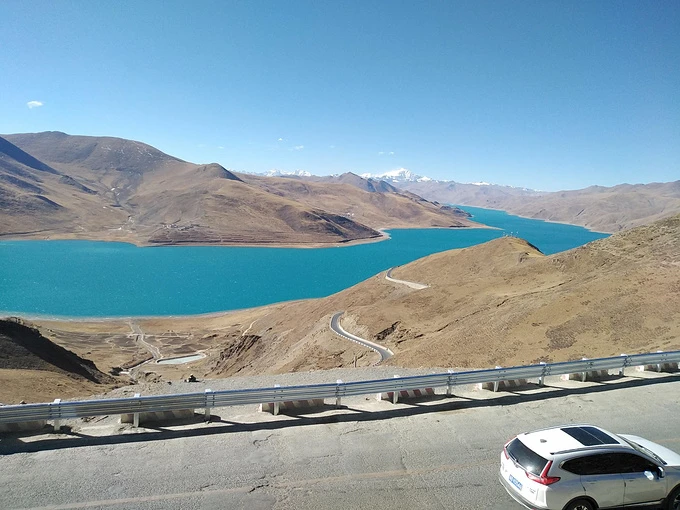
We reached Yamdrok Yumtso Lake. At the viewing platform, I took pictures: the lake water caught by the lens shimmered like emeralds under the blue sky. No matter the angle or pose, the human in the photo could never outshine the lake. Driving along the lakeside road, the green-blue water stretched boundlessly under the heavens, its end invisible. Along the way, countless mountains and valleys surged toward us, with distant snow peaks standing sentinel. The sunlight skimmed over the lake, leaping with golden ripples. This Yamdrok Lake, nourished by countless streams and especially cherished by heaven, was so limpid and crystalline. Between the mountains, ravines and gullies channeled water trickling down to gather into the lake, a body of water born from the contest between supreme softness and supreme rigidity!
Plateau gem: Yamdrok Yumtso Lake
Sweeping my gaze over the surrounding ridges, fully exposed in their winter yellowness, they too composed a spectacular sight—but the lake and sky merged into such a brilliant gem that the mountains merely served as its foil.
Bare mountains in company, lake leaping with golden waves
The wind was strong by the lake; occasionally sand and dust rose from the roadside, swelling as if to blot out the sky.
The lunch arranged by the guide was so-so. The young ladies’ faces looked pale, yet I finished two bowls—maybe due to hunger. I resolved to eat less from then on; using the toilet was miserable. The merciless wind scoured my backside as if peeling the skin. Odd smells rode the gusts, breaking through any barrier, and amid the howling wind and flying dust, I heard exclamations from the women’s toilet next door.
Red River Valley, beneath a kingdom of barley
The tour vehicle went off-road through the mountains and stopped at the Red River Valley.
Naikincang Sang Peak in Zhanang, Shannan, is one of the four sacred mountains of Tibet. Its shape is fantastically rugged, with a prominent top and white snow spreading on two flanks like a divine eagle ready to soar. The southern glacier cascaded down as if descending from heaven, linking the skies above to the wetlands below. Gleaming white peaks pierced the sky, and the high ice cap stretched downward into a frozen river, a flow of millennia sparkling in the sunlight, blazingly pure and imposing.
At the foot of Karola Glacier, it was only natural that the sweeping wind felt cold, but after a few steps I was panting—the air had become less friendly. The guide said the whole point of coming to the plateau was to experience altitude sickness!
Most of the tired passengers on the bus refused to step out for the view. My brain felt like it wasn’t attached to my skull—don’t even try shaking your head, or your brain might shake loose! At that moment, I just wanted peace.
Still, some in the group wanted to test the high-altitude climb. From the temporary parking point up to the highest viewing platform, the elevation rose from 4,980 to 5,170 meters—less than 200 meters’ difference. I didn’t use an oxygen bottle. On the way I panted like a winded ox, stopping three times to catch my breath, constantly encouraging myself: “Brother Yong, be brave!” With unrelenting effort, I finally reached the top.
The higher I went, the fiercer the wind. At the highest viewing platform, colorful prayer flags danced violently, sometimes bursting with a sharp crack that tore the air. The bitter cold gusted up from the valley head-on at high speed. But the prayer flags, carrying the faith of the Tibetans, fluttered unyieldingly. Gradually the cold wind seemed moved and slowly retreated, and the flags began to spread a devout melody in the air, launching into a gentle recitation.
Having seen one sacred mountain and one holy lake, feasting my eyes on the beauty of both, I was content!
Tonight we lodged in Shigatse.
Heavenly Tibet: Grand Beauty in the Journey – Part 5
Mount Everest Nature Reserve
December 19, 2019
According to plan we would reach Mount Everest today, seeking that verse: “The snowy wild has no end, the sky its shore; atop the highest peak, I’m madly free.”
Wheels rolling toward Everest, the car pushed through the vast, boundless (some adjectives must be repeated, just as life grows fuller through repetition) plateau. Plains, gorges, and ridges raced to the rear, as if we were driving through a time tunnel of oceans turning into mulberry fields. Traces of tectonic uplift lay across the mountains, silently recounting that long and violent history.
All along the way, my eyes met only a rugged, untamed wilderness. I recalled the view from the plane when we entered Tibet—those countless mountains and ravines stretching for a thousand li without a trace of habitation, equally vast and solemn. Traveling through such terrain, awe welled up in my heart. Lingering in this epic landscape, one easily tires. So I looked up at the firmament—the sky has nine tiers beyond sight. All the way I looked up, pressing on nourished by the deep blue.
Between the mountains there was open land like a little plain, dotted with cattle and sheep idling in the warm winter sun. Streams on the mountainsides and in the plain were frozen into white ribbons, adding some brightness to the scene. I wondered whether anything still trickled or surged beneath. Villagers gathered in their yards, drinking tea and basking in the sun, paying no mind to the animals. The winter days here were so harmonious. Not a sedan was seen on the roads—only off-road vehicles.
The blue sky and the mountains might already have become as common as air to the Tibetans. The spirit pagodas rising on the plains and the fluttering prayer flags were what guided their souls.
Sometimes, the things we care least about, treating them as invisible, are often the most worthy of cherishing and exploring. For example, who can live without air? Or close kin—how many truly value them? It is instead the deep blue sky and the unfathomable nature, half-understood, that generate mystery, giving rise to worship and faith. That was the beginning of the pre-Buddhist Bon religion in Tibet many, many years ago, and the source of all worship and belief.
Leaving the plain, we charged toward high mountains. The mountain road twisted in eighteen bends, making one dizzy. The higher we climbed, the gentler the slopes became—the peaks outside the window now looked like little earthen mounds. Only the ice formations in the rivers by the road reminded you that we were on a high plateau, climbing ever higher toward Everest. In the distance snowy peaks peeped out. At over 5,000 meters altitude, fierce winds howled, and the mountains stood wordlessly embracing it all. At a brief stop, I got off—awful! I took only a hasty snapshot. Back on the bus, I checked: haha, in the flurry I’d caught nothing at all.
Entering the Mount Everest Nature Reserve, we often hit stretches of “disco roads,” and there were frequent border and police checks. This was the period in my life when my ID card saw the most use.
The road made “108 hairpin turns,” sharp bends and steep slopes. Passengers were tossed around like sandbags. Some closed their eyes and blocked their ears, while others raised their heads in altitude stupor. The two girls in the front row excitedly counted the bends we passed. The “108 Turns” actually has more than 130, according to the driver. By number forty, the girls gave up counting. Swaying, swaying, till stars danced in my eyes and my soul wobbled. Rushing to Everest, harrowing turns blocked the way; every traveler in the car felt like throwing up.
We arrived at the Mount Everest viewing platform in Tingri County, Shigatse. Getting off, I once again experienced the difficulty of climbing at high altitude. Finally standing on the platform, I could see many sacred snowy peaks. The platform sat right in a wind gap; the gale was so strong I could barely stand, but I desperately held on to enjoy the scenery before hurriedly retreating down. Amid the roaring wind, sand flew with every step. The altitude left me oxygen-starved; walking felt like stepping on cotton, and the wild gusts almost knocked me over. Yet I amused myself imagining treading on lotus blossoms, graceful and graceful.
After a hasty photo in the fierce wind, we beat a retreat
Around six in the evening, the vehicle stopped at Quzong Village, Zhaxizong Township, Tingri County. We transferred to a shuttle bus for about five kilometers, reaching the Everest Base Camp viewing point. Here the altitude was 5,200 meters, temperature minus 16 degrees Celsius, with the same biting wind. Water on the ground had frozen; stepping on it, you slipped and crunched. Looking up, one could already see the main summit of Everest, but a bit more walking was needed for an unobstructed view. Despite the searing cold and difficult going, my long-suppressed passion flared even hotter. Step by step I moved toward the viewpoints.
Everest under a level-88 gale
When nearing the landmark, most people didn’t take photos right away but stood still and gazed into the distance.
The main peak through binoculars
The Earth’s ultimate coordinate, Qomolangma, means “Mother of the Earth” in Tibetan. Now the main peak stands at 8,848 meters; according to scientists, over 13 million years ago it once exceeded 12,000 meters. Gazing at Everest from afar, she was so ethereal, appearing and disappearing, adding even more mystery and purity. All around, subsidiary peaks surge toward the summit. Glistening snow on the great mountain gleamed golden under the sunset’s afterglow. The summit’s frozen breath had condensed into a cloud, blown to one side by a gale-force wind, looking like a golden banner fluttering in the sunset. Indeed, she is a banner, always summoning the awe and admiration of distant explorers, who come to compose immortal geographical legends—even trading their lives to draw close to her, embracing the pinnacle of glory. Life’s peaks are rare and elusive; I’m here to taste a geographical extreme!
That night we stayed in a Tibetan villager’s home in Quzong Village. Our group of nine, hailing from all corners, split into men’s and women’s rooms, each sharing one big room.
At eleven at night, my bunk-mate Li Junfeng, a photography enthusiast, dragged me out to view the starry sky. Out the door, all was still, only an occasional dog barking. Brother Li had a clever idea, mounting his lens on a telescope to capture the starry sky. The Big Dipper led the constellation, silently guarding this pure land in the deep night. Human affairs change, but the stars’ positions are eternal. The distant snow mountains showed a solemn outline under starlight. The sky blazed with countless stars, gorgeous yet tranquil. Meteors streaked by from time to time. Which of these fixed stars would be the next to fall? In the grand course of the Dao, change is the only unchanging constant in the world.
Heavenly Tibet: Grand Beauty in the Journey – Part 6
December 20, 2019
I knew the cold and warmth of the road myself; the beautiful sights all filled my eyes. I hoped this journey would lead me into an infinitely broad realm.
Today we were heading back to Lhasa. Our young guide said we’d set off before dawn to possibly catch the sunrise. In the shivering cold and pitch-black morning, with stars as companions, we rushed toward the hills where dawn light was breaking. How spectacular the gushing brilliance would be!
Here it came, the peaks seemed to catch fire! Stars, unable to rival the sun’s glory, bashfully faded. A line of summits looked like piled firewood being lit, already blazing. Yet the sun seemed to bear a heavy burden, or was it gathering energy for a skyward leap? My heart yearned for that instant of brilliance as it broke the horizon.
But even as daylight spread, I didn’t see that gushing picture. The young guide had fooled us a bit—rather disappointing. In these highland mountains and gorges without a sea of clouds, how could one witness such splendor? My mood rose and fell, but peering up at the blue sky, I relaxed again.
Descending the “108 hairpin turns,” we reached the plain again. By nine o’clock the sun was up; a straight asphalt road running across the plain shimmered like a golden carpet under the sunlight. The stern peaks also warmed, and the sun poured down gold, making everything glow. A layer of mist that had hung over the quiet village now seemed to draw energy from the sun, gently swaying and dancing. The land was so tranquil, peaceful, yet infinitely alive. Perhaps this was exactly the great wish of King Gesar when he rode across the Tibetan plateau, vanquishing demons and monsters; and today, the Communist Party might be the King Gesar of our time!
We dined at a roadside restaurant in Xielin. Two Tibetan children, Baima Luting and his little sister, had oil on their faces, and the redness brought by wind, sand, and sun bloomed into two tiny galsang flowers as they smiled.
The car continued through boundless mountains and barren wilderness; how tiny and helpless one felt in it. Cold, hunger, pain, sickness, primordial beasts, thunder and earth-fire—all had once lingered on this wild land. Which one of them didn’t terrify and bewilder people? One must admire the hardy folk of the plateau! The wind and sand were strong on the road; we all ran out of water.
My lips and tongue were parched and cracking all the way. Yu Yuesong generously shared an orange with each of us. The first bite was sweet and refreshing, the fragrance lingering on my teeth.
Along the way, the Tibetan-style houses in the villages were mostly very beautiful. Sunlight fully bathed the land; locals sat on the ground in groups of three or five, enjoying the sun. Cattle and sheep that hadn’t gone to pasture received the same treatment, some standing, some lying, lazily content. Every township had a golden prayer wheel, a rare sight! Speaking of houses, those in places with lush water and grass were upscale and lovely, while in less favorable areas, baked-mud houses dominated—the economic contrast was stark. The wind on the road had no hint of gentleness; a wild, rugged energy roamed the air. Over the bare plains, lacking vegetation, sand and dust often filled the sky and shrouded the land. Passing the Yarlung Zangbo Grand Canyon, there were many beautiful sand dunes by the river—some winding and twisting, some trailing off the bank, some resembling a thinker resting his chin, others a maiden gazing longingly. Their shapes could not be categorized. Beautiful as they were, you could well imagine how hard breathing and walking became when the wind blew the sand!
We passed a scenic wonder, the “Qilin Gorge,” also known as “Mucun Earth Forest Gorge,” located in Qiongzi Township within Dinggye County, Shigatse, Tibet.
River water had deeply cut through the landscape, creating unloading fissures on the slopes. The water then eroded along these cracks, causing the earth to collapse hundreds of meters, while the remaining parts formed earth pillars that pierced the air like spring bamboo. Nature’s uncanny craft, carved by wind and water, created a troop of sculptures—a forest of them, clustered in majestic confusion. At first glance, it seemed as if billions of years of change had condensed and halted in this strange, spectacular gorge.
At six in the evening, we returned to Shigatse. The altitude had dropped by 1,500 meters. Trees appeared again, but their branches were bare of leaves, showing little life in this winter. Galsang flowers would not bloom this season. Spotting a Tibetan woman’s bright skirt, I could only imagine it as a flower-like flame.
Heavenly Tibet: Grand Beauty in the Journey – Part 7
Yarlung Zangbo Grand Canyon
December 21, 2019
Today we returned to Lhasa, back to the Potala Palace, viewing the Yarlung Zangbo Grand Canyon along the way.
A song lyric came to mind: “Go to the top of the snowy mountains to awaken my soul; go to the Yarlung Zangbo River to cleanse my heart.”
Yesterday, before checking into the hotel, we went to Tashilhunpo Monastery to hear the chanting. Walking in the silent, solemn monastery, the sound of wind chimes rose and fell, each believer’s face full of devotion, the temple hall serious and dignified. In the yard, an ancient tree spread vigorously in all directions. Monks and devotees alike could not name the tree with certainty.
The nameless lush tree
This great tree has stood rooted for countless years, listening to the Buddha’s words, yet its name was unknown! I couldn’t help but stop and ponder, my muddled brain weary from the dusty world, longing for a ray of wisdom to unexpectedly appear. Immersed in this Buddhist atmosphere, I couldn’t help letting my imagination roam. The Dharma is boundless—can one find the upper limit of one’s own ability? God is omnipotent—can He cook a meal that He Himself cannot resist? A contradiction! How many wasted, ancient affairs, rises and falls, roil within my heart. Deep and intricate images emerge in my mind, in the starry sky of thought the moon sinks into the fields of stars. Fame, fortune, wine, lust, wealth, pride—sound, color, taste, sex, recognition, profit—sensory pleasures make people forget worry and pain. Fine food, wine, music, beauty—impossible to shun. To renounce, to escape the sea of bitterness, to live simply and humbly—is that the path of moderation and long vision? Unable to stop, where is the answer? In a foreign land feelings break free; the firmament never ages, yearning still lingers. A journey to cleanse my heart—dare I ask where the road lies? Unable to “awaken to emptiness,” I’ll just hum: “Softly sing of fleeting fame; wandering can slow the intoxication,” and let my heart fly free!
After several days of travel, last night I slept deeply. This morning on the bus, I couldn’t resist the exhaustion and slowly fell asleep. When I woke, the sun was already scorching bright.
On the way back we drove through the Grand Canyon. The altitude was dropping, yet I still felt some altitude sickness—heavy head, dry lips.
As we passed a sky burial site, our young guide said with a face full of seriousness: “That’s where the body turns to smoke and the soul soars!” I couldn’t help thinking of the Dunhuang murals: “Rainbow skirts fluttering like broad ribbons, floating and dancing in the sky.” But as an atheist, what awaited me in flight?
They were building roads now, so once again we endured dust and “disco dancing.” The car wound through the Grand Canyon. On both sides, the peaks carried snow on their brows wedged into the blue sky. The canyon was mostly wide open, giving a feeling of boundless flatness, so it wasn’t easy to sense the perilous steepness of the surrounding mountains. Yet this is indeed the highest and most dangerous canyon in the world. The Yarlung Zangbo River cuts over 2,000 kilometers across the Qinghai-Tibet Plateau, carving through mountains like an axe. Cliffs on both sides soar into the clouds—truly spectacular! Occasionally there were narrow spots where the slopes grew even steeper and the rushing water in the deep ravines even fiercer. In the open areas Tibetans gathered, and some houses were scattered by the ravines, dots of human habitation in this great chasm, adding a touch of bleak yet stubborn vitality in the winter.
The car raced on; the canyon twisted and turned. Under the sun, the Yarlung Zangbo River refracted multicolored light in the interplay of light and shadow—utterly mesmerizing!
We stopped for a checkpoint and again visited the toilet. Squatting briefly, the gale kissed my behind, dust blinded my eyes, and the shack’s boards rattled noisily. Good heavens, it was torment! Perhaps alternating between torment and beauty helps one fully appreciate the extremes of nature—thanks be to nature’s gifts!
A bridge spanned the great river, arching over the long flow, green waves rippling below. Human culture and geography shone together.
The long river surged now like fury, now slowly and tolerantly. All the way, wind still stirred the sand. Was this like the description in the Preface to the Sacred Teachings: “Accumulated snow flies in the morning, obliterating the road; startled sand rises at dusk, blinding heaven beyond the sky”? Wow, this trip counted as a sacred pilgrimage, then.
The driver was also our guide; he had to rest every two hours. Strangely, each time we paused he always stopped next to a scenic spot. So we got off to take photos. This spot was in a narrow canyon; stinging sand and fierce wind swept through. Standing by the river to enjoy the view, I felt I might topple down—thrillingly dangerous!
The scenery all the way was enchanting: high mountains reflecting snow, clear waves washing over ravines; peaks rose and fell in staggered heights, ranges clashed magnificently. When the wind rose, sand wrapped the misty trees and mist and sand locked the river. Looking up, the high heavens were crystalline; looking down, the emerald water meandered. In narrows the waters roared; in wide parts the waves sparkled and surged beyond the horizon. Truly one mile yields a dozen scenes, and over a thousand li the scenery constantly transforms. The beauty was ceaseless; the grandeur seemed delivered from heaven.
Wind dances in the great gorge, sand borrows its force;
A thousand mountains and ravines bring the flowing waters.
Golden rays pour down to speed the river on,
Galloping thousands of li, no end to its headlong rush!
That night back in Lhasa, I even caught the Butter Lamp Festival.
Heavenly Tibet: Grand Beauty in the Journey – Part 8
On the Lhasa–Lanzhou train
December 22, 2019
Goodbye, Potala Palace; goodbye, Lhasa. Today I boarded a train to leave, heading for the first city on the Yellow River—Lanzhou.
Finally seeing shared bikes
At the train station I finally spotted shared bicycles. In Lhasa, mobile navigation isn’t accurate, and information services and public conveniences are still rather lacking.
A week of rising and falling on the plateau had my bones aching and nearly falling apart. The scenery was infinitely good, the person terribly miserable. Looking up at the blue sky, my mood left no trace behind. Yet luckily the beautiful scenes are painted in my heart, opening vast horizons within!
Reluctantly, looking back at every step, I boarded the train.
From the train window I couldn’t spot any divine eagles—could they be hibernating?
Leaving Lhasa, the altitude rose again. The snow mountains drew near once more, the scene outside the window just as vast and desolate. Some rivers and small lakes had frozen solid. Oxygen in my lungs grew thinner. Far away, flakes of black spirits floated in the sky, their postures swift and smooth—they were the divine eagles guarding this land.
The train wheels rolled toward the Tanggula Pass, the world’s highest railway station. The train raced on, and the natural world shifted between snowy mountains and grasslands. In this boundless, endless earth, the eyes tired easily. I had grown numb to the grandiose beauty. The human presence along the way was as sparse as the plateau’s thin air. One by one, snow peaks showed their heads in the distance. Scanning around, I could ignore the train’s speed. The snow mountains, though visible, were much farther than they seemed, and looked as plain as the small hills back home. Without personal experience, it’s hard to believe that between where I stood and those little white-hat peaks there was a drop of thousands of meters!
Sunlight on the vast snow-strewn highlands. As the train sped, I could hear the sound of wind and thunder outside. Snowy white filled the eyes, impossible to tell mountain from cloud from snow. This frozen world stirred a heroic spirit. Clouds brocaded over peaks capped with snow, the sky poured down light, the earth grew ever whiter. Endless, it stretched beyond the horizon, fearing not the wind, thunder, or blaze of the sun.
After descending the Tanggula pass, the night deepened and the altitude kept dropping; breathing became easier—good news. The cold sky was heavy with haze as the sun set behind the train; I felt I was driving into darkness. The sun, carrying its afterglow, seemed to chase the train, seeing me off. Yet even a farewell that lasts a thousand miles must finally end. Goodbye, Lhasa; goodbye, Qinghai-Tibet.
Night fell. The sleeper carriage was quiet. Apart from sleeping, there was only sleep. I woke to find my dream gone, turned over, and the Duke of Zhou returned. I heard the train boring through tunnels, unaware how much lower the altitude had dropped. Idly dreaming that travel follows the heart truly begins with dreaming. Burying myself in the quilt, I fell back into a sound sleep. By noon we reached Lanzhou. Dusty and weary, I checked into the hotel first. While washing, I saw in the mirror that the years seemed to have carved a little more wear on my face, yet added some traces of where smiles had once lingered. After washing, I took a beautiful nap.
Heavenly Tibet: Grand Beauty in the Journey – Part 9
Downtown Lanzhou, White Pagoda Park, the Yellow River
December 23, 2019
A full seven days touring Lhasa and touching Everest. On the return trip I stopped at Lanzhou.
At 2 p.m. on the 23rd, I left the hotel and took a bus to White Pagoda Park. After so long away, I was a bit tired. Stepping off the bus, I walked slowly to the first bridge over the Yellow River—Zhongshan Iron Bridge. Pausing to look, smiles passed all around. Gazing over the long river, it seemed as if the ages were slowly unfolding, telling a vast narrative of the great beginning, the surging endless flow.
I moved to a platform in the park and looked out over Lanzhou city. Mist (or was it dust?) shrouded Jincheng, and under a purple sun, it was easy to imagine that Laozi might have passed this way en route to Hangu Pass. Haze steamed over Lanzhou, purple mist rising under the sun; the Old Lord rode through on his ox, the frontier vast. Was Lanzhou’s ancient name, “Jincheng” (Golden City), a reference to “the sun reflecting on yellow sands creating a purple aura”? Actually, the great warrior general Huo Qubing once stationed troops here, sealing the altar at Langjuxu Mountain; his whip chased away the Xiongnu, who howled like wolves. The garrison was named Jincheng at the time as well.
I slowly climbed to the White Pagoda. Each higher level offered a new panorama. The pagoda nurtured a grove with dappled light and shadows; the long river carried the wind with great momentum. In the valley a giant whale seemed to bellow, and the setting sun’s rays filled the Peony Pavilion.
Now the sun was setting. Jincheng, by the river, with its thousands of buildings and millions of dreams, watched the evening glow spill over the racing river.
At this moment, I didn’t see “a solitary column of smoke in the vast desert,” but witnessed “the sun, round as a wheel, sink into the long river.” Magnificent! I walked to the Stele Forest but found it closed.
Thousands of buildings, millions of dreams
Night fell, and I crossed back over Zhongshan Bridge. Looking back, White Pagoda Park was already lit by scattered lights. Atop the distant mountain, the “Caosheng Pavilion” (Pavilion of the Sage of Cursive Script) stood majestically—was it madness or genius? Not being able to see the true calligraphy was a pity! Then I noticed Caosheng Pavilion mirrored in the Yellow River, and a sudden insight relaxed my mind. The lofty pavilion dips deep into the Yellow River’s ink; the drunken madness of Xu and Su both reached sagehood. Why need to see their genuine works? Along the river flows the qi of sage calligraphy.
My stomach drummed its complaint and my legs felt sluggish, so I searched out a Halal feast for my taste buds.
Soon a plate of noodles and a hand-grasped mutton arrived. At the next table two fellows had each ordered a bowl. They sat up straight, lowered their heads, and all you heard was a swoosh-slurp, never raising their eyebrows. A rhythmic gobbling. I had just taken one bite of mutton when the sound next door stopped abruptly. I looked up in surprise—their bowls were already empty! Delicious food, the best of the whole week. The portions were so generous I was too stuffed to move. Their bench had long gone cold and been taken by new customers. So I grandly picked my teeth and ordered a cup of clear tea. I sat for ages and the boss didn’t push me to pay—could one skip out on the bill here? Yet such fine food; running off would be too shabby. Amitabha, what a sin. So I offered a compliment in thanks.
Golden broth adorned with green like heaped jade slices;
Floating fragrance meets the eye, no need for the nose;
In winter, a taste as fresh as spring;
No lingering sound around the rafters.
A vast water mirror on the pedestrian street
The next day, having slept my fill, I went to the pedestrian street. The morning was slightly chilly at minus six.
Laoma—A Bite of China
Unexpectedly, the Yellow River, beef noodles, skewers, and egg fermented glutinous rice all went down my gullet, filling my belly. Beautiful sights accompanied the feast on my tongue—look, then go taste the fresh delicacies. A journey that wore out my body, yet I devoured the flavors of my dreams.
Throughout the trip, I posted photos in our class WeChat group along with commentary and reflections, which is how I recorded the above words. Traveling alone, I may have been by myself, but sharing the scenery and exchanging thoughts made me deeply glad. Alone and far from home, I didn’t need to hide or worry about others, and I could indulge whimsically. This solo journey, unfettered and free, under the high clouds and open sky, let me truly experience carefree delight!
All along the way, dust and striking beauty went hand in hand. The Lanzhou stop was the journey’s end and the starting point for home, like the hexagram “Ji Ji” yet not quite completed. Sitting quietly on a street in the first Yellow River city, basking in the sunlight, I bid farewell to the Yellow River with warm thoughts. So much has been said about the Yellow River by past writers, but could anyone’s feelings on beholding it be the same? Stirred by emotion, I eulogized and released my heart!
On the Qinghai-Tibet highlands, Bayan Har was born;
The Yellow River comes from the sky;
Ranging across thousands of miles,
Its mission points to the east.
Wild sands fly up with the river’s rage,
A thousand cliffs rush near;
From the west it bursts through the Kunlun Mountains,
Eastward it leaps past the Dragon Gate.
Great flood gathers a hundred streams,
Roaring with the breath of a dragon;
Nourishing the spirits along its banks,
Etching the grand blueprint of the divine land’s soul.
The river races through the wilds,
Striking terror in the hearts of demons!
It surges into the vast ocean,
Its glory flowing throughout the universe!!


