You Poked Your Bestie for Shoton Festival: Yogurt & Tibetan Opera in Lhasa
What does Tibet have in abundance? Locals jokingly tell you: “Festivals!” And just like that, the annual Shoton Festival is here again.
Shoton Festival, translated, means “yogurt-eating festival.” Sounds tempting, doesn’t it? Although autumn has already begun, the summer heat hasn’t faded and the power of the lingering heat is still fierce. At this time, people on the plateau love to find a shady spot, sit beneath it, and savor delicious yogurt while enjoying performances such as Tibetan opera. When tired, they lie on the green grass, simply gazing at the blue sky and white clouds, doing nothing — pure bliss. You could say it’s the perfect festival for gathering with family and friends.
How did Shoton Festival originate? According to records, under the rules of the Gelug school of Tibetan Buddhism, from the 15th to the 30th day of the sixth month in the Tibetan calendar each year is a closed period. Monks in monasteries across Tibet are forbidden from going outdoors to avoid accidentally stepping on small insects and causing harm. During this time, monks practice purification and observe the summer retreat until the ban is lifted. When the first day of the seventh month arrives and the ban ends, they come down from the mountains. By then, the grass is tall and the cattle are strong; female yaks produce rich, plentiful milk, yielding yogurt that is mellow and fragrant. Farmers, herders, and their relatives and friends offer them prepared yogurt — this is the origin of Shoton. The monks take deep breaths of fresh air outside the monasteries, gather in groups and head to the lingka gardens, to the riverbanks, to reunite with loved ones, chatting happily and fully enjoying nature’s gifts. Because Tibetan opera performances and the Buddha-unveiling ceremony take place during this period, some also call it the “Tibetan Opera Festival” or “Buddha Exhibition Festival.”
The highlight of Shoton is the Buddha-unveiling on the 30th day of the sixth month in the Tibetan calendar. Before dawn on that day, citizens and tourists from all directions head towards the same destination — Drepung Monastery. A gigantic appliqué thangka embroidered with a Buddha image on brocade, dozens of meters tall, is carried in a long single file by hundreds of young and middle-aged lamas, accompanied by a religious band. It is then hung on the steep hillside behind the monastery to the northwest, drawing tens of thousands of monks and laypeople to pay homage and worship. For many first-time visitors to Tibet, the spectacle is almost beyond words — only firsthand experience can convey its impact.
That day, roads to Drepung Monastery are largely closed, so you have to rely on your own two feet. But you can turn it into a leisurely stroll, walking with friends and taking in the views of Lhasa.
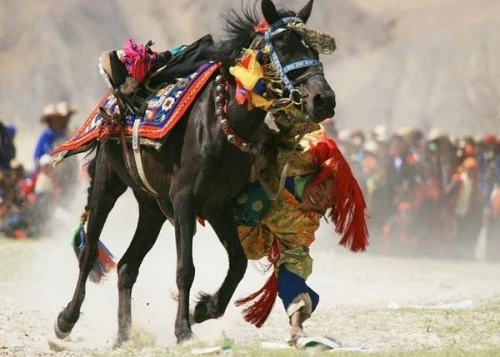
Now, the festival has become richer in content. After the Buddha-unveiling, there are Tibetan opera competitions, traditional folk art performances, traditional ethnic equestrian events, Tibetan chess shows, trading and exhibitions of quality goods, photo contests, and much more. Every day of the seven-day festival is varied, fulfilling, and joyful. “Last year I followed my local friends and experienced it,” says Bai Juanjuan. “Not only did I get to immerse myself in the local ethnic culture, but I also ate lots of delicious food. It was amazing. I highly recommend friends from inland China to come and feel it.” Now in her second year in Tibet, Bai Juanjuan is eagerly looking forward to this year’s Shoton Festival.
Speaking of food, the must-eat at Shoton is yogurt. The yogurt here isn’t quite the same as what we’re used to in inland China. The choice of ingredients and production techniques in Tibetan yogurt make a big difference. The biggest difference is that the raw material is yak milk. Tibet’s vast grasslands, with low oxygen and cold temperatures, have nurtured the celebrated yak, known as the “ship of the plateau.” Their grazing environment has natural, uncontaminated pastures and pristine air, so the milk is purer, richer, and more fragrant.
Moreover, unlike the runny yogurt often found in supermarkets, this yogurt has to be scooped with a spoon — its texture is a bit like jelly. Locals are used to mixing in “ginseng fruit” (Himalayan root) and stirring it until smooth; it’s extremely nutritious.
Where to eat yogurt during Shoton? If you get a chance to visit a local’s home, that’s definitely the best. Of course, during the festival, many herders bring the purest homemade yogurt and sell it among the crowds.
“What I love most is eating yogurt with friends in this season; it’s cooling and refreshing,” says Bai Juanjuan. “This year, my best friend is coming to Tibet.”
Before arriving, her best friend’s biggest worry was altitude sickness. “Before I came to Tibet last year, I had the same concerns. But with me here, I definitely won’t let her have that problem. I’m going to take her to experience an unforgettable Shoton Festival in Lhasa.”
It turns out the final reassurance that convinced her friend to come was two bottles of Gaofanling that Bai Juanjuan sent her. “I came to Tibet at the start of spring last year. At that time, Lhasa had little rain, the air was much drier than in summer, and oxygen levels were lower. My altitude sickness wasn’t severe, but I had a headache every day and couldn’t sleep. My appetite wasn’t great either. I saw an ad for an altitude sickness product on the street and bought it. They said it’s ‘medicine and food share the same source,’ safe and reliable. I tried it, and the effect was surprisingly good.” The ad she’s talking about is for Gaofanling; its signs are in the most prominent spots in downtown Lhasa. In Lhasa city proper, after placing an order, the merchant delivers within two hours — very considerate.
“She arrived in Golmud yesterday. I had her take Gaofanling early, and she said she had no reaction along the way, even when she reached Tuotuo River,” says Bai Juanjuan. “Now I just wait for her to arrive in Lhasa on the afternoon of the 17th. After a day’s rest, we can kick off our Shoton Festival trip. Just thinking about it makes me happy.”
Meeting your best friend in the city where you live, meeting in Tibet — perhaps that’s one of the most romantic things in the world. (Text: Zhang Feifei)


