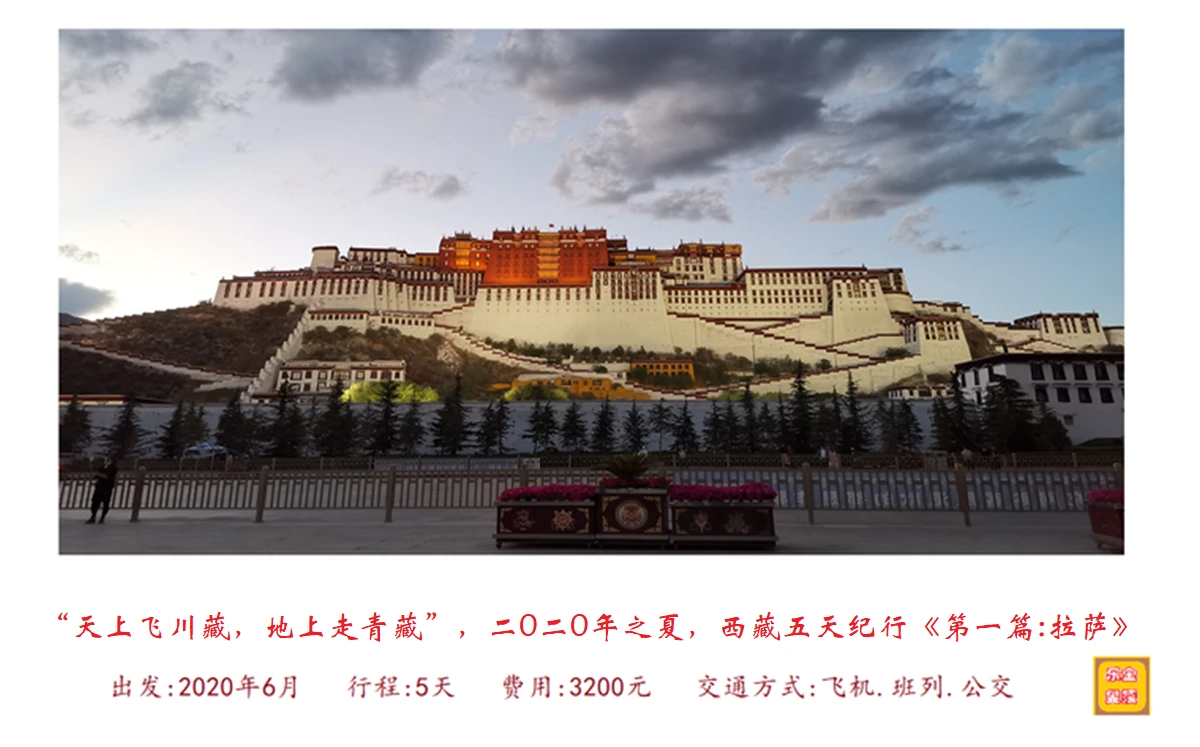
Flying over Sichuan-Tibet, Walking over Qinghai-Tibet: Summer 2020, Five-Day Tibet Travelogue, Part One: Lhasa
"Blue sky and white clouds are a beautiful invitation, snowy mountains and lakes are distinctive calling cards. How vibrant the prayer flags in the wind, the ancient Potala stands for a thousand years. ... How pure white the long khata scarves, how fragrant and sweet the rich butter tea. ... Once you set foot on this magical plateau, you will be captivated by it, dreaming and longing for it." ... "Waiting for you in Tibet, Tibet touches the sky." — From Waiting for You in Tibet
Tibet possesses an indescribable beauty and mystery. If you never go to Tibet, Tibet will forever remain a dream! You must visit Tibet at least once in this lifetime—a promise I made ten years ago. For me, Tibet seemed like an unfulfilled appointment, always feeling as though it was there waiting for me.
Time flew by in the blink of an eye, and we are now in early summer of 2020. Inter-provincial tourism was gradually reopening across the country; Tibet was welcoming its finest season of the year; the Potala Palace opened on June 13; flights to Lhasa were discounted to around 80% off, and train tickets from Lhasa to Xining, once very hard to get, were now easily available. Having been cooped up at home for over half a year, I simply wanted to get out and spend my money on the motherland's soil. One could say, the opportunity was not to be missed—if not now, then when? On the morning of June 15, 2020, after finishing my trip to Leshan and Mount Emei in Sichuan, I immediately took Chengdu Airlines flight EU2747 from Chengdu Shuangliu Airport, heading westward to Lhasa. Ten years of anticipation realized in a single day!
This time, I was traveling to Tibet alone, so I had to act within my limits. To shorten the journey as much as possible, I changed my inbound and outbound transportation to flights. To avoid altitude sickness, I eventually gave up visiting places like Karola Glacier and Namtso, which my heart desired. And I scaled down my grand Tibet itinerary—once encompassing the 'Great Ngari Circuit + Nyingchi and Lhoka'—to a brief sightseeing glimpse: an aerial overview of the Sichuan-Tibet Highway + seeing the culture of Lhasa + viewing the 'Sky Road' via train.
Rushed and scaled-down as it was, this was after all my first trip to Tibet, and a new starting point in my many years of travel. I remained full of anticipation. The plane flew westward, heading to Tibet, to this most mysterious, highest, and closest-to-the-sky place in our motherland.
My goal for this Tibet trip: to see Lhasa's 'One Palace (Potala Palace), One Street (Barkhor Street), One Temple (Jokhang Temple), One River (Lhasa River), One Mountain (Chakpori Hill).' Tibet's timeless beauty, its silent and vast beauty, its pristine, pure-blue, and holy beauty... it all began from the airplane!
Looking down at the white clouds and continuous snowy peaks outside the cabin, China's most beautiful highway, National Highway 318, the Sichuan-Tibet Road, was undoubtedly down there. Here, mountains piled upon mountains, rivers twisted and turned. There was the picturesque scenery of the West Sichuan Plateau and the high mountain gorges of Eastern Tibet; countless pure and azure lakes and millennia-old glaciers; rich ethnic customs and colorful cultural landscapes. Although you cannot see these sights from the airplane, you can feel their real presence beneath you!
The flight skimmed over the Northern Tibet Grasslands, flew across the Yarlung Tsangpo River, and after over two hours in the air, arrived punctually at Lhasa Gonggar Airport around noon that day.
Lhasa Gonggar Airport sits at an elevation of 3,600 meters, described by many travelers as 'a place where altitude sickness makes you doubt your life.' Stepping out of the airport, looking up, I saw the drifting white clouds and the unforgettable, bone-deep Tibetan blue. At that moment, I couldn't help but feel excited. Tibet, which I had longed for, I had finally arrived! At that moment, I stood firmly on the solid ground of Lhasa, Tibet!
I took the airport shuttle bus (departing on a rolling basis) to downtown Lhasa, a 62-kilometer trip costing 30 yuan. The route was: Lhasa Airport — Lhasa Railway Station — Norbulingka.
On the way to Lhasa, watching the rivers and mountains flit past the bus window was so pleasing to the eye and refreshingly novel; every inch of land here shone with such brilliance. This was my first time seeing Tibet, a Tibet that captivates hearts and minds, a Tibet brimming with visual beauty!
After over an hour's ride, the bus arrived at the Norbulingka Bus Park (terminus). Alighting, I walked about 450 meters, then boarded city bus L2 from in front of the Tibet Museum. About 35 minutes later, I got off at East Gama Gongsa Road station, walked about ten minutes, and reached the Lhasa Shengtu Hostel booked through Ctrip.
The Lhasa Shengtu Hostel embodied the essence and style of a youth hostel. Things could be kept simple here: you could make your own bed, take care of your own tidying, stay in various multi-person dorm rooms with shared bathrooms, at prices generally ranging from 30 to 50 yuan per bed. I booked a 4-person dorm at 42 yuan per bed. That day, the hostel upgraded me to a 3-person dorm, still at the original price (for three days in my 3-person dorm, I was actually the only occupant).
After checking in and taking a short rest, I immediately headed to the Potala Palace. My plan for the afternoon was to start at Zongjiao Lukang Park behind the Potala, see the palace's reflection on the water, then follow the circumambulation path on the western side of the Potala, walk to the viewing platform on the South Square, and see the full frontal panorama. This was a route I'd planned long before, allowing for the shortest walk to view the Potala's exterior from multiple angles.
Zongjiao Lukang Park in Lhasa (locally called Dragon King Pond Park) is an open public park located behind the Potala on Red Hill. Ancient trees tower in the park, green shade abounds; it's a place for Lhasa residents' entertainment, leisure, fitness, and dancing. Inside the park is a man-made lake, always full of water, directly facing the back of the Potala Palace—a superb spot for viewing the Potala's reflection in the water.
To reach Zongjiao Lukang Park, you can take Lhasa city bus 1 / 9 / 13 / 14 / 20, etc., get off at the Lhasa Aviation Company bus stop, enter the park's east gate, follow the footpath inside, and walk westward about 800 meters to reach the lake and see the Potala's reflection. The best times for viewing the reflection are early morning and dusk when the water is calm. It's said that seeing the Potala at night from here is also wonderful.
The Potala Palace was first built in the 7th century AD, constructed by Songtsen Gampo to welcome Princess Wencheng. On Red Hill in Lhasa, over 3,700 meters above sea level, he built a palace-fortress complex dominated by the Red Palace and White Palace, with a total of 999 rooms. The entire complex is built into the hillside, covering an area of 410,000 square meters, with a building area of 130,000 square meters. The main building has 13 stories, rises to a height of 115 meters, and is entirely of Tibetan-style stone and wood construction. The Potala Palace epitomizes the essence of Tibetan architectural art. Among its structures, five palace roofs are covered with copper gilded tiles, glittering with gold and of magnificent presence.
Beyond the Red and White Palaces, the Potala Palace includes many ancillary buildings, such as monastic schools and quarters, courtyards, a printing house, stables, and gardens. For over 1,300 years, the Potala has collected and preserved an extremely rich array of historical relics. Among them are several thousand square meters of murals, nearly a thousand stupas, tens of thousands of statues, over ten thousand thangkas (scroll paintings), and various precious scriptures and classics. Historical items bestowed by the central government and emperors of the Ming and Qing dynasties include gold albums, gold seals, jade seals, as well as a large quantity of exquisite crafts in gold, silver, porcelain, enamel, jade, and brocade. These cultural relics are magnificently colorful and all extremely rare treasures.
All the way under blue sky and white clouds, looking at the Potala on Red Hill; all the way past white stupas, prayer flags, and prayer wheels, I walked southward for about 40 minutes, arriving at the bustling Beijing Road below the front of the Potala. Crossing Beijing Road, I reached the Potala viewing platform at the foot of Chakpori Hill in Lhasa.
Following the steps before me, I climbed upward to the topmost level of the viewing platform. This is the number one photo spot for countless sightseers and photography enthusiasts visiting Tibet! If you travel to Tibet, you will certainly come to Lhasa; if you come to Lhasa, you will certainly come to the Potala Palace; if you come to the Potala Palace, you will certainly come here!
'The Foremost Palace on the Qinghai-Tibet Plateau.' Climbing to the top viewing platform, the majestic Potala Palace instantly bursts into view. Before, it had only existed in your imagination; now, it was truly displayed right before your eyes!
The ancient and mysterious Potala Palace stands on Red Hill before you. It is the world's highest palace building, lauded as the 'Foremost Palace on the Roof of the World'; it is the largest and most completely preserved ancient palace-fortress architectural complex in Tibet to date. The Potala Palace is now a national AAAAA-level scenic spot, and was inscribed on the World Cultural Heritage list in 1994.
Someone said: 'The Potala Palace is so beautiful that you want to look at it just a few more times.' When you have passed through one mountain pass after another, crossed over snowy mountains, forded great rivers, and arrived before this majestic palace, perhaps then you can grasp the meaning of being here. Maybe, as a traveler, this place is a new coordinate in the trajectory of your life's journey; you have fulfilled a dream about travel! And derived immense pleasure and happiness from it!
The top level of the Potala viewing platform offers an unobstructed panoramic view of the Potala Palace's façade. Amid the twilight, above the Red Hill of Lhasa, surging clouds raced across a sky that felt vast and fleet. The Potala Palace appeared particularly solemn and dignified, displaying its cohesive grandeur as the 'Foremost Palace on the Roof of the World.' Every component of this majestic red-and-white structure is engraved with its extraordinary historical and cultural heritage.
This is the second level of the viewing platform, where the white stupa can be included in the frame of the Potala Palace. Handsome guys and pretty girls wanting to take personal, artistic-style photos mostly enjoy lingering here.
Lhasa's weather changes in an instant. One moment it was blue sky and white clouds, the next, dark clouds gathered and large raindrops fell fiercely. Just as people hurriedly fled the Potala viewing platform, in the brief interval after the wind and rain subsided, a rainbow immediately appeared. Moreover, a rare double rainbow appeared at the foot of the Potala!
The rainbow quietly emerged mid-hillside on the Red Hill of the Potala. Like two gorgeous seven-colored chains arcing towards the sky, they stretched bit by bit towards the South Square in front of the Potala, traced two beautiful arcs in the air, gracefully spread out, and finally, disappeared behind the mountains beyond the Tibet Liberation Monument.
'I like the rainbow, like its gorgeous seven colors. No matter how it changes, it remains in my heart. It departed gently, just as it had come quietly. It waved softly to me, and finally turned into a cloud on the horizon.' One early summer in June, we watched a rainbow together at the Potala Palace.
The rainbow before my eyes once again verified a truth: as long as you resolutely set out, the distance is no longer far, and the present moment holds unexpected surprises! If you feel unhappy, just go out and walk around. The world is vast, the scenery beautiful, and wonders plentiful. Life may not always be all rainbows, but may the rainbow come quietly after the storm, bringing you a surprise, and then float away gently, a frequent visitor that comes and goes!
On the morning of June 16, I took city bus 20 from the hostel gate. For 1 yuan, I rode about 30 minutes, got off at Lhasa Tsuomilin station, and walked to the Jokhang Temple. At that time, the Jokhang Temple had not yet opened its doors to visitors. It is said that tourists here must observe local customs and circumambulate the temple along the 'Sacred Path' of Barkhor Street. I was certainly no exception and immediately began my own circumambulation experience.
'First there was the Jokhang Temple, then there was the city of Lhasa.' The Jokhang Temple is the earliest monastery built in Lhasa, with a history of over 1,300 years, holding supreme status in Tibetan Buddhism. It pioneered the architectural style of flat-layout Tibetan temples, becoming a paradigm for Tibetan religious architecture. Barkhor Street was originally the circumambulation path around the Jokhang Temple and is also the oldest urban area in Lhasa; the heart of Barkhor Street is the Jokhang Temple.
Barkhor Street was once the gathering place for religion, economy, culture, and ethnic handicrafts of Lhasa. Today's Barkhor Street consists of four main streets—East, West, South, and North—with numerous branch lanes, totaling 35 streets and alleys and 199 residential courtyards. Barkhor Street is not only a famous commercial center in Lhasa but also preserves the traditional appearance and living patterns of ancient Lhasa. Today, Barkhor Street has become a must-visit check-in spot for tourists traveling to Lhasa.
Barkhor Street is the most charming district in Lhasa. When you come here for the circumambulation, you may lose your direction and feel unsure. There are too many lanes here, but don't worry: every alleyway leads towards the Jokhang Temple. As long as you keep walking, you will surely return to the circumambulation path. Along this path, you can successively see the famous sights of Barkhor Street: the Office of the Qing Dynasty's Grand Minister Resident in Tibet, the Gendun Choephel Gallery, the Makye Ame Bar, and the Puntatsok Compound.
The Gendun Choephel Gallery on Barkhor Street was not open that day. It is said that the gallery houses rich and varied paintings and photographic works featuring elements of Tibet.
The Office of the Qing Dynasty's Grand Minister Resident in Tibet on Barkhor Street, a witness to history. It has now become an educational base for learning about Tibetan history and promoting patriotism.
The famous Makye Ame Bar on Barkhor Street, a place with a story.
The Puntatsok Compound on Barkhor Street, a renowned aristocratic mansion. Its ancient portico columns, wrought-iron balustrades, and luxurious aura show typical Tibetan architectural style. It is said that here you can feel the extravagance of Tibetan nobility of bygone days. Due to time constraints, I didn't go in to check-in.
It is said that the Tromsikhang Market on Barkhor Street has a history of 800 years and is still full of vitality. It is a distribution center for small commodities and daily necessities, as well as a residential area for Lhasa's Hui people, with numerous Hui-style eateries and restaurants. Life in Barkhor Street is so ancient, and yet so vibrant.
Elderly people tired from the circumambulation taking a short rest here. I wonder where they all come from.
Beautiful Tibetan women, making wishes for the goodness in their hearts.
Vegetable markets, tea houses, restaurants, grocery and fruit stalls, clothing, shoes, hats, utensils, and trinkets. Daily life on Barkhor Street continues as usual. Besides circumambulation, some are busy, some are leisurely, some live plainly, some live refinedly. This is the ancient city of Lhasa I witnessed, the Barkhor Street that has continued to thrive and flourish vibrantly for a millennium.
Appliqué thangkas, one of the three unique Tibetan arts.
Exquisite handcrafted ornaments, full of rich Tibetan style.
Delicate crafts, uniquely styled, glittering and intricately designed—I really wanted to buy one to take home.
Following the flow of people on the 'Sacred Path,' I circled back to the front of the Jokhang Temple. Only when preparing to enter the temple did I learn that the Jokhang Temple was still closed. 'A millennium-old city, a single temple.' Walking around the Jokhang Temple and strolling Barkhor Street, I fully experienced the ancient simplicity of old Lhasa and its modern prosperity. Today, its traditional customs persist, with strong Tibetan flavor coexisting with contemporary features.
After finishing my visit at the Jokhang Temple and Barkhor Street, I walked to the front of the Lhasa Maternal and Child Health Hospital and boarded city bus 33. For 1 yuan, five stops later, I got off at the Lhasa 308 Regiment bus stop (intersection of the Sichuan-Tibet Highway and Lhasa River Bridge), a total of about 40 minutes. Afterwards, I followed Chidring Boulevard next to the Lhasa River, enjoying the beautiful Lhasa River. Ten years ago, I read a beautiful travel essay, 'Beautiful China, My Heart is in Tibet,' and was deeply moved by the beauty of the Lhasa River. I made a silent promise then: if I ever went to Tibet, I would definitely come to the Lhasa River!
Here is the intersection of National Highway 318 and the Lhasa River Bridge. A single location, two landmarks: where the south end of the bridge meets the Sichuan-Tibet Highway. Today, I finally had the chance to experience National Highway 318 in my own way. Some say beautiful scenery is the result of both nature's creation and the soul's inspiration. Only when your relentless pursuit from afar meets the scenery you've longed for, exactly as envisioned, can there be that deeply touching, heart-stirring sensation. 'Faraway Lhasa has a river. Some call it 'happiness,' some call it 'joy.' It bathes in sunlight every day, laughing and singing all the way as it flows towards the beautiful Yarlung Tsangpo River!'
By the beautiful Lhasa River, rapeseed flowers blooming in early June herald the arrival of the finest season of the year on the Qinghai-Tibet Plateau! The road before my eyes is the renowned National Highway 318, a coveted route in the hearts of countless travelers! Starting from Shanghai's People's Square, its endpoint is the Sino-Nepal Friendship Bridge in Nyalam County, Shigatse. The total length is 5,476 kilometers, passing through Shanghai, Jiangsu, Zhejiang, Anhui, Hubei, Chongqing, Sichuan, and Tibet—eight provinces/regions—making it the longest road traversing China from east to west. It is also called 'China's Scenic Avenue.'
The Lhasa River, called 'Kyichu' in Tibetan, means 'the river of happiness and joy.' It originates from Mt. Lopu Rula in the Nyenchen Tanglha mountain range, flows through Maizhokunggar and Dazi counties, and finally merges with the Yarlung Tsangpo River in the southern suburbs of Lhasa. The Lhasa River is 568 kilometers long, with a drainage area of 31,760 square kilometers, making it one of the world's highest-altitude rivers. The Lhasa valley features a mild climate, flat terrain, fertile soil, and abundant water sources. It not only boasts beautiful scenery but also rich animal and plant resources and is one of Tibet's main grain-producing regions.
The birch groves on the Lhasa River's beaches. Imagine how much more beautiful their golden hue must be in autumn.
'Magnificent Tibet, the great river of the plateau.' Why do people say that one must visit Tibet at least once in a lifetime? Perhaps it's because this magical plateau, with its pervasive pristine and azure purity, brings immense solace to the soul, clears away your worries, and lifts your spirits. It prompts you to appreciate the fresh, wonderful present with an innocent heart! It refuels your life! To walk on such beautiful land is a rare karmic blessing in life!
Distant mountains like darkly painted brows, a gentle breeze brushing the face. The uniquely Tibetan blue sky floats with pure white clouds. Beautiful birch trees dot the smooth riverbanks sporadically, now silver-white and luminous, now mixing with pure-blue water. The river, sparkling and meandering, flows past your eyes. The Lhasa River—this ancient and picturesque river—today, with its distant sky and low-hanging clouds, radiated brilliance and vitality. One glance, and it was planted in my memory from then on!
June 17, my last day in Lhasa for this trip, and there were still many pending plans. I originally hadn't intended to visit the Potala Palace (couldn't get a reservation), but now I felt conflicted, thinking I should go and try my luck at the gate. After that, I planned to visit the Chakpori Hill rock carvings, then the Tibet Museum and Norbulingka in the afternoon, and finally return to see the Potala at night. In short, I wanted to make one 'last effort.' As it turned out, I couldn't complete the plan at all.
The Potala Palace officially opened for the year on June 13 this year. Visiting requires time-slot reservations. If there are few tourists, you can queue to enter without a reservation. Looking at the long snake of visitors queuing from the halfway-up-the-hill entrance all the way down to the square below, I had no confidence whether I could get in. Moreover, the daily visitor cap was 2,300 people, with only 200 allowed to enter at a time. Opening hours were from 9 a.m., and the doors weren't open yet. So, I decided to go to Chakpori Hill first to see the rock carvings, postponing the Potala Palace visit to the afternoon.
The Chakpori Hill southwest of the Potala, famous for its hillside rock carvings, is considered a unique wonder of Tibet.
The straight-line distance from the Potala Square to Chakpori Hill is about 2 kilometers. Walking was quicker than taking the bus. Following the map navigation, I walked for about 40 minutes and first arrived at the Chakpori Temple at the foot of the hill (neither the temple nor the rock carvings charge an entrance fee). To see the rock carvings, you must pass through the temple.
Chakpori Hill is 3,725 meters above sea level. At its foot is a temple housing a statue of the Medicine Buddha, hence the name Chakpori Temple. After passing the temple, before climbing the hill, there is a magnificent stupa. Following the stone-step path behind the stupa, climbing upward, you reach the hillside where the rock carvings can be seen.
The majestic stupa before me is called the 'Kangyur' stone scripture stupa in Tibetan. It is said there is a cave within the stupa enshrining statues of Songtsen Gampo, Princess Wencheng, and nine chief ministers of the Tubo Kingdom. Currently, the cave is not open to the public.
Following the circumambulation path before me, around the stupa, led to the stone-step path ascending the hill to view the rock carvings.
Along the way, I could see layers of stone-slab statues and scriptures enshrined on the outer walls of the stupa. It is said each slab statue represents a story related to Chakpori Hill.
It is said that Lhasa's Chakpori Hill is the birthplace of Tibetan medicine. The rock carvings and murals spread across the hillside are diverse in style, famous far and wide for their broad subject matter and rich content. The quantity of carved statues is the highest in Tibet. According to preliminary statistics of existing carvings and murals, there are no fewer than 5,000 figures, and this art has continued here for over a millennium. Even today, new works appear almost daily.
Upon reaching the hillside, vast expanses of irregularly distributed carved statues and painted murals come into view. The most widely distributed and numerous groups are the mural clusters before one's eyes.
Some statues and scriptures are carved directly onto the cliff faces of the mountain.
It is said that a single stone carving of scripture represents a classic of Tibetan medicine.
After turning the largest prayer wheel beside Chakpori Temple, I concluded my visit to Chakpori Hill and retraced my steps down the mountain.
The history of Chakpori Hill dates back over 1,300 years to the 7th century. It is said that when Princess Wencheng came to Tibet, she brought a medical book from the Central Plains, the Complete Compendium of Medicine. Later, Princess Jincheng, upon her marriage to Tibet, brought another medical text, Yutog Nyingthig. This allowed Chinese medical theories and methods to gradually integrate into Tibetan medicine. Afterwards, the famous Tibetan physician Yutog Yonten Gonpo further developed Sino-Tibetan medicine, authoring The Four Medical Treatises. From then on, the Chakpori Temple gathered a group of Tibetan physicians specializing in treating illnesses. By the 17th century, it had evolved into a school of Tibetan medicine, its medical value becoming increasingly prominent and famed throughout Tibet.
This is a workshop dedicated to the stone carvings of Chakpori Hill. Those slab carvings on the cliffs successively originated from here, from the hands of artisans in such workshops.
The hurried trip to Chakpori Hill left me with an impression both classical and modern, where history continually extends. Though its rock carvings and murals have been passed down for a millennium, they are still refreshed and renewed to this day!
Probably due to days of non-stop walking, coupled with the fading excitement after first arriving in Tibet, my body felt utterly fatigued now. After descending from Chakpori Hill in the afternoon, I didn't feel like going anywhere; I just wanted to sleep. I immediately returned to the hostel and had a wonderful sleep until past seven in the evening. 'Sichuan folk conquer the world' has been my dining experience over many years of travel. I carefully selected a Sichuan restaurant near the hostel and, for 18 yuan, had a decent bowl of rice in a wooden bucket—my only proper meal of the day. Feeling somewhat content, after dinner, I again went to the Potala Palace to see the night scenery and bid it a final farewell.
At that moment, the Potala viewing platform was crowded with people, all casting their eyes on the Potala Palace atop Red Hill, anxiously awaiting the moment when its lights would first shine!
Here, take out a 50-yuan RMB note, hold its reverse side up against the Potala before you, and you'll feel a sense of déjà vu.
At dusk, the sky around the Potala was suffused with blue tones.
At 9 p.m., the lights on the Potala Square were lit first. From another angle on the South Square, the Potala Palace, surrounded by flowers, looked even more majestic and beautiful.
At 9:30 p.m. sharp, the Potala's lights came on in full splendor. The eagerly awaited night view of the Potala Palace appeared before my eyes!
At this moment, the Potala Palace on Lhasa's Red Hill, illuminated by soft lighting that contrasted red and white, displayed itself beautifully and elegantly to the world. It illuminated the night sky of Lhasa, and also lit up the hearts of Tibet and every Chinese person. This is the Light of the Potala Palace! You can only have this profound feeling if you have come here and witnessed this very moment!
The Potala Palace at night is a pursuit cherished in the hearts of countless travelers. It is a famous landmark plus a wonderful moment. On a night flowing with light and color, I came here and saw the Light of the Potala Palace! Tomorrow, I will leave you, to seek out this plateau illuminated by your light, to fulfill my 'Heavenly Road' appointment!
End of Part One (to be continued). Jinling Lesou
Travelogue Contents: 1. [Ten Years' Expectation, Realized in One Day] 2. [Viewing the Potala's Reflection, and Serendipitously Encountering a Rainbow] 3. [Circumambulating Barkhor Street, Circling the Jokhang Temple] 4. [Checking in at Lhasa's 'River of Happiness and Joy'] 5. [Viewing the Cliff Carvings at Chakpori Hill] 6. [The Light of the Potala Palace]
Travel Information | Hotel Index | Travel Tips Index | Flight Index | Website Navigation | Travel Index | Cruise Index | Corporate Travel Index | Joining & Cooperation | Distribution Alliance | Friendly Links | Corporate Gift Cards | Insurance Procurement | Agency Cooperation | Hotel Joining | Destination & Scenic Spot Cooperation | More Joining & Cooperation | About Ctrip | About Ctrip | Ctrip Hot Topics | Contact Us | Talent Recruitment | User Agreement | Privacy Policy | Business License | Security Center | Ctrip Content Center | Intellectual Property | Trip.com Group Algorithm Disclosure


