Notes from an 8-Day Solo Journey in Tibet (Part 3): Onboard the Train (Part 1)
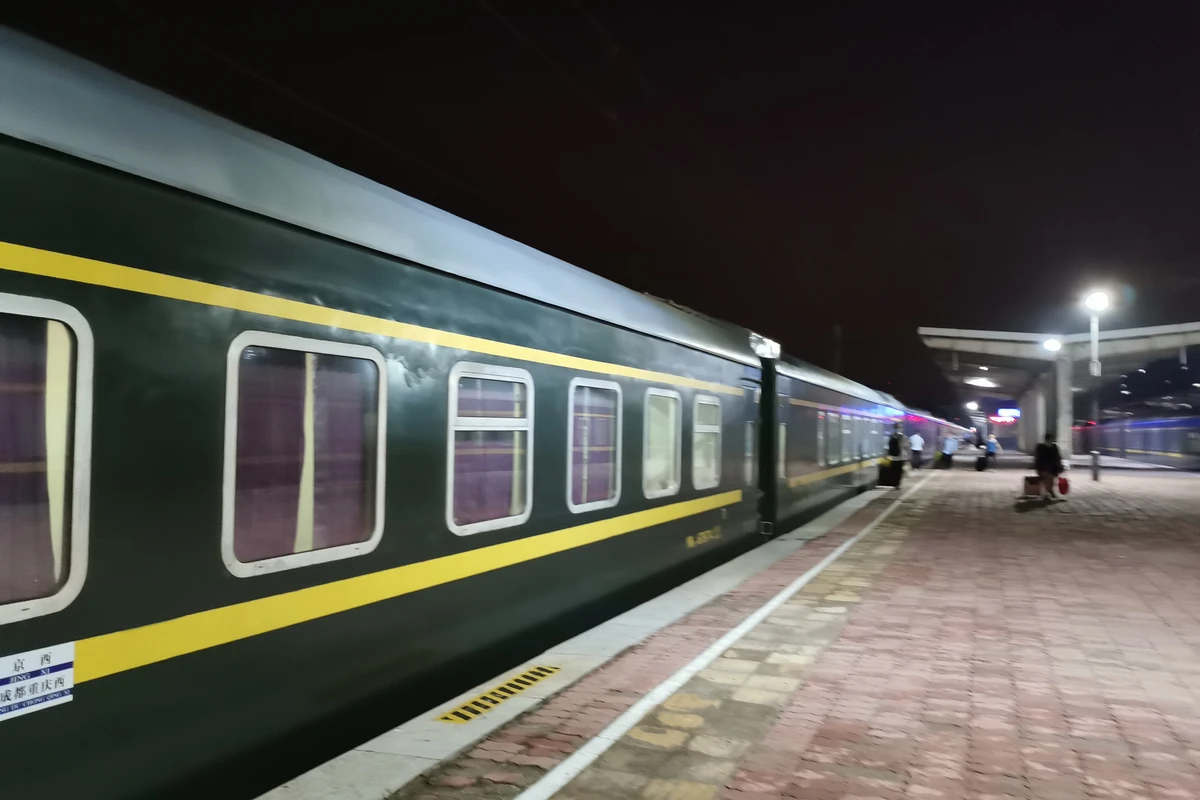
As passengers with large and small bags stepped onto the platform, the dark green Z21 was already waiting under the orange light, like a fully assembled troop ready to depart. The white nameplate on its waistline reading "Beijing West – Lhasa" stood out like a guardsman’s armband, hinting at its special mission. Thinking that after a night’s sleep this troop would charge into the vast desert and head for the snowy plateau, I couldn’t help but feel a slight chill in the summer night breeze. I found my berth, stowed my backpack and luggage, nodded politely to fellow passengers who were still awake, and soon the overhead lights were turned off as the train entered night mode. The 38-hour train life had begun.
(Z21 makes a stop at Shijiazhuang North)
(The upper berth is too low to sit up straight)
On the morning of the 21st, just after 5 a.m., everyone began to stir from sleep. If you ignored the arrhythmic snoring from the upper berth across the aisle, overall the first night on the train was decent enough. Outside the window, the scenery was already different from my hometown: sparse trees and a much broader vista. At 7 a.m. the train was about to arrive at the third station since our departure – Zhongwei. Back in October 2015, I drove with friends from Yinchuan on a northwest road trip and visited the Shapotou scenic area in Zhongwei. What impressed me most then was riding the zip line across the Yellow River at Shapotou. As I was lost in thought, a familiar scene flashed by – it turned out the train was passing right by the entrance to Shapotou, followed by a big bend in the Yellow River. I never expected the train to pass Shapotou like this! The train stopped at Zhongwei for 11 minutes, and everyone got off to stretch their limbs. As luck would have it, the "Snoring Bro" on the upper berth across from me got off at Zhongwei with his luggage. A quiet joy rippled through everyone, and we stretched our arms and legs a bit more vigorously, while silently praying that the next passenger would be quieter at night.
(Passing by Shapotou scenic area)
The Z21 departs from Beijing West Station at 8 p.m., passes through Shijiazhuang North, Taiyuan, Zhongwei, Lanzhou, Xining, Delingha, Golmud, and Nagqu – eight stations in total – and arrives in Lhasa at 12:45 p.m. on the third day, a journey of 40 hours. The stretch from Zhongwei to Delingha runs during daytime, so you can fully enjoy the ever-changing scenery outside the window, and except for Delingha, each stop is at least 10 minutes long, enough to get off and stretch. The train was due at Golmud Station at 10:10 p.m. The broadcast announced that Golmud is the true starting point of the Qinghai-Tibet Railway: from there southward, the route crosses the Tanggula Mountains at over 5,000 meters and enters high-altitude territory. So at Golmud, an extra locomotive is added for more pulling power, and the cars begin diffusing oxygen. We all dozed off while waiting to witness the grandeur of the great Qinghai-Tibet Railway’s first station and to see with our own eyes what the locomotive that would carry us across the snowy plateau looked like.
(At Golmud Station)
At night, the temperature in Golmud was only around a dozen degrees Celsius, and a light drizzle made it feel like early winter back home. Everyone put on jackets, got off the train, and headed toward the front, some posing for photos under the sign that said "Golmud." When we reached the front, we didn’t see the grand scene we had imagined; instead, staff in different uniforms were busy at the coupling. The newly added locomotive was also green, the same color as the train cars, with no visible special "powers." As the saying goes, "The connoisseur sees the art, the layman watches the show." This ordinary-looking machine is actually the trailblazer for the highest-altitude train in the world! Doesn’t that reflect a philosophy of low-key, down-to-earth living? Haha, realizing such life lessons made the late-night chill worthwhile.
(Adding an extra locomotive)
After Golmud, everyone retreated to their bunks. The overhead lights went off again, and the second night on the train began. After "Snoring Bro" got off at Zhongwei, the upper berth across from me had a new companion board at Lanzhou. This was a 38-year-old Dongxiang man who worked in Tibetan areas. Along the way, he told us many local customs. Although he was a big, burly man’s man, he slept as quietly as a little girl. In that precious silence, we quietly crossed the famous Tanggula Mountains. By the time it got light again, we had reached the station before the terminus – Nagqu, a name that already sounded far from the interior, signaling that we were traveling through the long-admired Tibetan land. After a brief stop at Nagqu, on the opposite track stood a flatbed train carrying camouflage-painted military vehicles, a reminder that we were near the country’s border. More passengers boarding at Nagqu wore ethnic clothing, making it feel like a scene from a movie.
At 12:45 p.m. on the 22nd, the train arrived on time at the terminal – Lhasa. Newly acquainted fellow travelers bid each other farewell and set off on their own journeys. The soaring melody of "Qinghai-Tibet Plateau" echoed across the platform. The sky was a deep tile-blue, the clouds hung low, and the sunlight was dazzling – a scene rarely seen in the Beijing-Tianjin-Hebei region. I took a deep breath and savored the pure, unpolluted air. Maybe it was psychological, but I did taste a hint of sweetness. Following the staff’s instructions, we lined up for health code checks and temperature screening. Here, in this remote frontier, pandemic prevention was carried out meticulously, reflecting the Party’s centralized and unified leadership and keeping everyone healthy. While waiting in line, I made video calls to a few close family members to let them know I was safe and to show them the blue sky and white clouds of Lhasa. And so, the 38-hour train journey came to an end.
(Queuing for temperature checks at the exit)


