October 2020: Seeing the Potala Palace in Lhasa and Crossing the Qinghai-Tibet Plateau by Train
The story of first encountering the Potala Palace in October 2020
2020 was such a special year. The pandemic that began at the start of the year changed the world and changed everyone's life. For me, a travel lover, the pandemic shackled my free-roaming feet—I couldn’t go anywhere.
In the blink of an eye, golden October was just around the corner, with crisp autumn air and perfect travel weather. Seeing how well the domestic epidemic situation was being controlled, one day in late September, I said to my feet: “Alright then, it’s time to go out and frolic!”
On September 23, I made a quick trip to Shanghai to let my body get back into travelling mode, visiting the Sihang Warehouse, Jing'an Temple, and Qibao Old Street.
On September 28–29, I flew to Nanjing to quickly get into the travel rhythm. I visited Jiming Temple (the foremost of the 480 temples from the Southern Dynasties), the Ming City Wall (still standing from the Ming Dynasty), Xuanwu Lake (China’s largest imperial garden-style lake), Meiling Palace (the No.1 villa in the Far East), the Ming Xiaoling Mausoleum (eternal resting place of Zhu Yuanzhang), the Nanjing Museum, Zhan Garden (one of the four great gardens of Jiangnan), and Yuhuatai.
Back from Nanjing, the eight-day Golden Week holiday arrived immediately. Based on years of travel experience, travelling during Golden Week is a bit painful—huge crowds really dampen the joy of travel. So I told my restless feet, “Don’t be impatient. After the holiday I’ll take you to a place I’ve always wanted to go.”
Yep, Lhasa.
I don’t know if everyone has a few must-visit places in life. I certainly have such dreams—seeing the Louvre and Arc de Triomphe in Paris; Rome and Venice in Italy; St. Peter’s Basilica in the Vatican; the pyramids in Egypt; Tokyo and Kyoto in Japan; Mayan ruins in Mexico; Niagara Falls in Canada; the Moai statues on Easter Island—and more. Although these are incredibly difficult to achieve, they remain my future travel dreams.
Relatively speaking, there was one place I wanted to visit that was less difficult—Lhasa. But due to the long distance and high altitude, I had never gone. Originally I planned to wait until after retirement to go, but then I thought carefully: if I was in my seventies or eighties, I could probably grit my teeth and still manage a trip to Jiangnan, but I would definitely not be able to go to Tibet. So, while my body is still strong, I might as well fulfil this wish now.
Lhasa is not a place you can just up and go to on a whim. Situated on a high plateau, you need to be well prepared psychologically and physically, and craft a thorough travel plan before carrying it out.
I had already read plenty of Tibet travel tips before the holiday and researched routes suited to me. The original plan was to fly to Xining first, then take the train to Lhasa, and finally fly home from Lhasa—the aim being to acclimate gradually to the altitude via the train ride and reduce the impact of altitude sickness. That’s also the mainstream advice in most travel guides.
However, I came across an article with the opposite viewpoint, written by an expert from a hospital in Beijing. To put it simply, he argued that when entering Tibet by train, the train first has to cross high-altitude areas like the Kunlun Pass and Tanggula Pass, quickly reaching elevations above 5,000m. More than 70% of travellers will suffer altitude sickness, and if the condition becomes critical, timely medical help cannot be obtained on the vast plateau—making it quite dangerous. Lhasa, on the other hand, sits at only 3,650m. If you fly to Lhasa first, even if altitude sickness causes discomfort, you’re in the city and can get prompt medical attention, which actually makes it less risky.
After reading this subversive viewpoint, I was convinced, so I started planning my route based on it.
This trip would be my second time on a high plateau. Many years ago I’d been to Shangri-La, which I remember was at 3,900m, and then to Pudacuo National Park at 4,100m—I had altitude sickness back then, too, so I had a bit of experience with high altitudes. Lhasa is only 3,650m, so the psychological pressure about this trip wasn’t too great.
After putting together a detailed route plan, I went to the pharmacy and bought rhodiola rosea and glucose powder, starting to take rhodiola a week in advance as preparation. Rhodiola is a common medicine for preventing altitude sickness; it can temporarily increase the oxygen-carrying capacity of red blood cells. Even though I still got altitude sickness in Shangri-La last time despite taking it, this time I decided to give rhodiola another chance.
Considering factors like flights, ticket prices, and departure times, plus the advice in travel tips to arrive in Lhasa in the morning if possible, I decided to fly to Xi’an on October 12, then catch a morning flight to Lhasa the next day.
On the morning of October 12, before leaving, I checked Dalian’s weather forecast: 9–16°C, with a blue gale warning, north winds at force 6–7 and gusts of 8–9.
Oh boy, the wind was picking up!
The flight to Xi’an was smooth. I took the airport shuttle to Xishaomen. Since I had to catch an early flight the next morning, for convenience I booked a hotel right at the shuttle stop in Xishaomen.
After checking in, I first visited the Dayan Pagoda. I’d climbed it before, so this time I didn’t go in—just came to see if the monk Xuanzang statue in front still looked as dashing as ever.
Leaving the Dayan Pagoda and walking east for 10-odd minutes, I arrived at Tang Paradise. I noted that with advance online reservation you could enter for free—just swipe your ID card. At the entrance, I also saw a sign for the Tang music and dance drama "Dreaming Back to the Tang Dynasty"; VIP tickets were 518 yuan, regular tickets 298 and 398 yuan. I contemplated my identity as a person of modest means and decided to skip it.
Inside, I walked around and saw quite a lot. The place was huge and beautifully done, with landscape design full of character—a strong Tang dynasty atmosphere and a vivid presentation of Tang culture. Perfect for a leisurely stroll ??.
When I reached this spot, a fine rain began to fall, so I sat in a pavilion to rest a while and watch the wild ducks and fish tussle for food.
There were many sculptures in the garden. This one’s theme is "Grinding an Iron Pestle into a Needle."
The theme of this sculpture is ??
After wandering around Tang Paradise for about two hours, I left and headed to the Grand Tang Dynasty Ever Bright City.
Since it’s called Ever Bright City, it’s meant to be at its finest and most lively at night.
Because of the rain, there weren’t many visitors, but the lights still shimmered beautifully. The light show with a predominantly red palette effectively evoked the prosperity of the great Tang.
This statue is Li Shimin, with the four characters "Reign of Zhenguan" inscribed below.
After roaming the Ever Bright City, I kept walking north and soon reached the North Square of the Dayan Pagoda. I timed my visit because this is home to the largest musical fountain in Asia, with scheduled performances every day, especially stunning at night.
I watched for over ten minutes; it was truly impressive and majestic. The only thing was the choreography of the fountain patterns felt a bit stiff—like a public square dance. Wouldn’t it be wonderful if it were like Swan Lake! ???
After the fountain show, I went to the popular spot for the Xi’an viral “Tumbler” street performer, but despite a big crowd, there was no performance. I asked the security guard and found out “all performances are cancelled when it rains” ???.
Leaving the North Square, I decided to take the metro to see Xi’an’s Bell Tower and Drum Tower. I’ve seen bell towers and drum towers in many places—Beijing, Kaifeng, Datong, Luoyang, Xi’an, to name a few—each with its own character. I have a deep impression of Xi’an’s Bell Tower and Drum Tower, and I especially love seeing them illuminated at night. So every time I’m in Xi’an and have the time, I pop over to see them; they always feel familiar and dear.
Next to the Drum Tower is the famous Muslim Street snack area. I’ve had roujiamo and yangrou paomo there before, so this time I didn’t eat anything, just strolled around. Thanks to the rain, the street wasn’t shoulder-to-shoulder, but the aroma of grilled meat still wafted through the air.
The next day I got up very early, boarding the 5 a.m. airport shuttle to Xianyang Airport. Breakfast at the airport: stewed egg + beef noodles = 35 yuan.
After boarding the plane, I noticed it was still raining outside. Not heavy, but hazy, with reduced visibility. A slight twinge of worry.
I also noticed that, unlike other flights, apart from the female purser, the entire cabin crew was male. I guessed the main reason was that this is a high-altitude route requiring higher physical fitness, so the crew was predominantly male.
Takeoff was smooth. I put on my headphones, closed my eyes, listened to my favourite songs, and felt the sunlight slant warmly through the window onto my neck—as if the world was only filled with beauty and joy. ???
Once we were over Tibet, the clouds gradually parted. Through the gaps I could see mountains densely covering the land below, with barely any sizable flat areas to be found. Occasionally, I caught sight of lonely, proud snow-capped peaks standing out among the mountains, their regal aura absolutely unmistakable. ??
After a smooth landing, the cabin announced a ground temperature of 25°C—much hotter than Dalian ??.
Checking the map, the airport was 96 km from downtown, probably the farthest airport from a city centre I’d ever encountered.
I took an airport shuttle bus and reached the city centre about an hour later. Along the way I paid close attention to my body’s reactions: just a slight shortness of breath, nothing else.
This was my hotel, in Tibetan style—good service.
After checking in, I left the hotel and headed straight toward the Potala Palace, eager to see that sacred place as soon as possible.
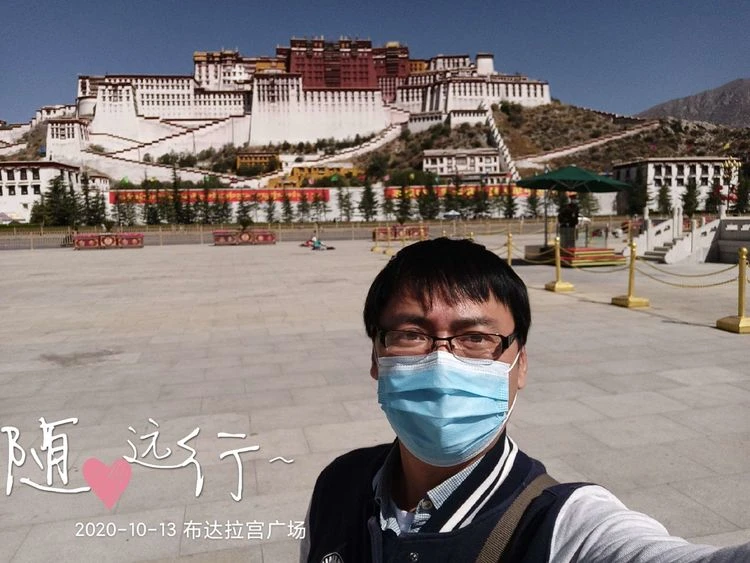
A bus ride of about ten minutes took me to Potala Palace Square. The square was large and wide open, and the majestic, holy Potala Palace revealed itself right before me.
Seeing the Potala Palace stirred my emotions. My brain cells quickly cobbled together a prose poem, which I consider not half bad.
"First Glimpse of the Potala in Lhasa"
Deep in my heart,
a place has always existed,
an inexplicable yearning,
persistently lingering.
With a devout heart,
I travelled a thousand miles to stand before you,
just for one look.
At the moment I lifted my gaze upward,
a feeling welled up,
one called hot tears in the eyes.
(Original work)
Because visiting inside the Potala Palace requires advance booking, I decided to go inside tomorrow morning. In the afternoon, I’d first see the renowned Jokhang Temple.
Leaving the square, I walked east for over 20 minutes to the famous Jokhang Temple.
Among Tibetan Buddhist believers, Jokhang Temple holds the highest status; it’s the culmination of all Tibetan Buddhist schools. Not visiting Jokhang Temple is like not having visited Tibet.
I went inside and had a look. The interior wasn’t large, but you could truly feel the sacredness.
Here, monks were engaged in debate, a method of mutual learning. The guide said it’s always one-on-one between teacher and disciple: the standing one is the teacher, the sitting one the student.
After more than an hour at Jokhang Temple, I wandered outside along Barkhor Street, a historic ancient street with a thousand-year legacy, offering all sorts of distinctive Tibetan produce and souvenirs, truly unique in style.
After Barkhor Street, I walked back to the Potala Palace square and ate at a yak-meat hotpot buffet nearby. The grilled yak meat was exceptionally tender and delicious.
By the time I finished dinner, night had fallen. Back at the square it felt a bit chilly; because of the wide day-night temperature swing in Tibet, the nighttime temperature had already dropped below 10°C.
Under the night sky, the Potala Palace stood silently, quietly gazing at the people coming and going.
Back at the hotel, I started feeling a slight headache. Most likely altitude sickness, I thought, and quickly went to rest.
After midnight, the headache worsened, disturbing proper sleep. It wasn’t excruciating, but I tossed and turned, deeply worried.
The next morning, the headache persisted, and it got worse when I moved around.
Comparing my resting heart rate and blood pressure before entering Tibet with those after arrival, the differences were large—clearly due to altitude sickness.
The original plan was to visit the Potala Palace and Drepung Monastery in the morning, then Sera Monastery and Norbulingka in the afternoon. But considering my discomfort, I decided to rest at the hotel for the day.
After resting most of the day, by noon I felt slightly better; the headache had subsided a little, so I checked out and went early to the train station to rest while waiting for the train.
In the waiting room, a Tibetan man sat next to me, maybe in his forties or fifties. The whole time he was reading a distinctive Tibetan Buddhist scripture, murmuring prayers continuously—he looked very devout.
There are no high-speed trains on the Qinghai-Tibet Plateau yet, only regular green trains. To experience the extraordinary Qinghai-Tibet Railway, I chose to cross the plateau by train and see the magnificent plateau scenery.
Since flights from Xining to Dalian didn’t suit me, I opted for the Lhasa–Xining–Lanzhou train route, costing 550 yuan in total—probably the most expensive train ride I’ve ever taken.
Given the unique nature of the Qinghai-Tibet Plateau, passenger trains on the railway all have oxygen supply facilities to alleviate altitude sickness symptoms.
After leaving Lhasa, the train headed north, struggling through the mountains. From time to time yaks could be seen leisurely grazing on hillsides or in fields; occasionally, snow-capped peaks peeped through the surrounding ridges, flashing into view—beautiful scenery.
After dark, the outside landscape was completely swallowed by night, and people in the carriage began to warm up to each other.
In the bunk opposite me was a young man in his twenties, from Hunan, occupation unknown, carrying an oversized suitcase and looking sharp. I guessed he might be military. Throughout the journey, aside from sleeping, he was looking at his phone and occasionally taking out a thick notebook to write in—probably essays or travel notes, his handwriting a bit sloppy.
In the middle bunks were two people. One was a plump middle-aged woman in her forties from Xi’an, an acupuncture professional with a cheerful disposition who could chat with anyone around her, mainly about the hardships of starting her business and some of her experiences in Tibet.
The other middle-bunk occupant was a skinny young man around thirty who basically didn’t speak—either asleep or leaning by the window gazing outside, a tiny topknot on his head. Probably an artsy guy.
In the upper bunks were two Sichuan men who looked in their fifties, carrying a large empty paint bucket stuffed with instant noodles, bagged chicken feet and the like, plus tins of beer and bottles of baijiu—likely migrant workers. Throughout the journey, they were the most uninhibited. Although I couldn’t fully understand Sichuan dialect, I caught a few phrases. These two were eating and drinking while shooting the breeze, going from why the Qinghai-Tibet Railway was built to the current situation in the US—they could go deep on everything. I really like that state of mind: when you’re out travelling, happiness is what matters. Life is so short; getting angry is truly a waste of life.
After midnight, the train reached the highest point along the Qinghai-Tibet line: Tanggula Pass, at 5,231m—much higher than Lhasa. This is where altitude sickness hits hardest. The headache returned, now with many more points of pain; not excruciating, but clearly disturbing sleep.
In the darkness, I could only take deep breaths to actively increase oxygen intake and ease the altitude sickness. Inside the carriage it was relatively quiet, with the occasional release sound of the oxygen supply equipment. With nothing better to do, I tried to figure out the oxygen release pattern, but after listening for a long time, I realised there really was no pattern. The oxygen would just be released at random. The sound was a bit like the pressure release of a pressure cooker—piercing in the silent night, yet I wished it would come more often.
After a somewhat difficult night, we arrived in Golmud the next morning. Here, the altitude was already lower than Lhasa, and the altitude sickness had faded unnoticed. A check of the temperature: it was only -4°C in Golmud—equivalent to going from Lhasa’s summer to Golmud’s winter overnight ???. What a magical Qinghai-Tibet Plateau.
With the altitude sickness gone, the atmosphere in the carriage became lively again. The two Sichuan guys resumed their hard-to-follow chatter, while the plump middle-aged woman started actively looking for more people to talk to, this time venturing into the neighbouring compartment for a heated chat.
That’s the advantage of high emotional intelligence. Not long after, a small crowd had gathered around her, the topic shifting to acupuncture treatments. A little later, the woman returned to her bunk, grabbed a few things, and went back. I started hearing startled exclamations coming from there. I walked over to look and saw she’d already started giving acupuncture to people. Her EQ was so high that a few words of chat and she’d be sticking needles in you.
I watched for a while; three people had already been treated. One was an elderly woman in her seventies who’d had some kind of surgery and needed a few needles to clear something—upper jiao or middle jiao, I think. Another was a 62-year-old from Zibo who said his spleen and stomach were weak, so he needed needling. The third was a 28-year-old makeup artist from Fujian who needed her qi and blood regulated—and got needled.
Done with the hubbub over there, I returned to the window and my scenery. After Golmud, meadow landscapes became more frequent, with groups of cattle and sheep occasionally flashing past the roadside.
At one point, I saw three shiny spots in the distance; at first I thought it was sunlight reflecting off windows or something. As we got closer, I understood: it was a concentrated solar power installation using reflected sunlight. I’d only seen them in books and online before; this time I witnessed it with my own eyes.
Nearing Xining, we passed the beautiful Qinghai Lake—a boundless expanse of water with gentle ripples. It felt like you’d been staring at endless desert and suddenly the channel switched; a completely different kind of scenery.
The train arrived about ten minutes late at Lanzhou Station around 7:40 p.m. To make my flight the next day easier, I’d booked a hotel near Lanzhou West Station, so after getting off I bought another ticket and took a train to Lanzhou West Station.
On boarding, I found someone lying across my seat, face completely covered by the hood of their jacket—seemingly asleep. Judging by the shoes, it was probably a child. Sitting opposite were an elderly couple in their sixties, explaining something to me in almost incomprehensible Lanzhou dialect. I roughly understood: the child was 14, had some weird illness, was sleeping, and they hoped I could change seats.
I looked into the two old people’s eyes—they seemed sincere—and said it was fine. Then the couple chattered on with gestures, most of which I couldn’t understand. At one point the girl woke up, lifted her hood, and quietly looked at me. She had a large, slightly puffy pale face. After a few glances, I couldn’t bear to look into her eyes anymore. Life is truly not easy. I hope she recovers soon.
The next morning, I took a high-speed train to Lanzhou Airport. I had wanted a bowl of authentic Lanzhou lamian, but couldn’t find any—only all sorts of beef noodles, egg noodles, etc., so I gave up.
The flight from Lanzhou to Dalian took about two hours, and I dozed off nicely on the plane. Near Dalian, I was jolted awake by turbulence; I even heard a woman’s startled cry. It was probably the most violent turbulence I’ve ever experienced, though it lasted only about two minutes.
In the end, the plane landed steadily. Stepping out of the airport, I saw it was drizzling in Dalian. Checking the weather forecast, there was still a blue gale warning that day, with maximum gusts of force 7.
Oh boy, the wind was picking up again.
1. According to the information I’ve read, altitude sickness is nothing to fear. Normal people living at low altitudes will experience some altitude sickness when reaching above 2,700m; it’s the body’s normal stress response, actively warning you of oxygen deficiency. People with no altitude sickness either have bodies already acclimatised to high altitude or have a problem with that stress response.
2. If you have hypertension, heart disease, or cerebrovascular conditions, I don’t recommend going to high altitudes—it’s quite risky. First-time high-altitude visitors should reduce strenuous exercise to lower the body’s oxygen consumption and mitigate altitude sickness. Also, rest more, drink plenty of hot water, and whatever you do, don’t catch a cold.
3. Next: DL—WH—SY—XA—BJ—DL.
THE END
Thank you for watching!!


