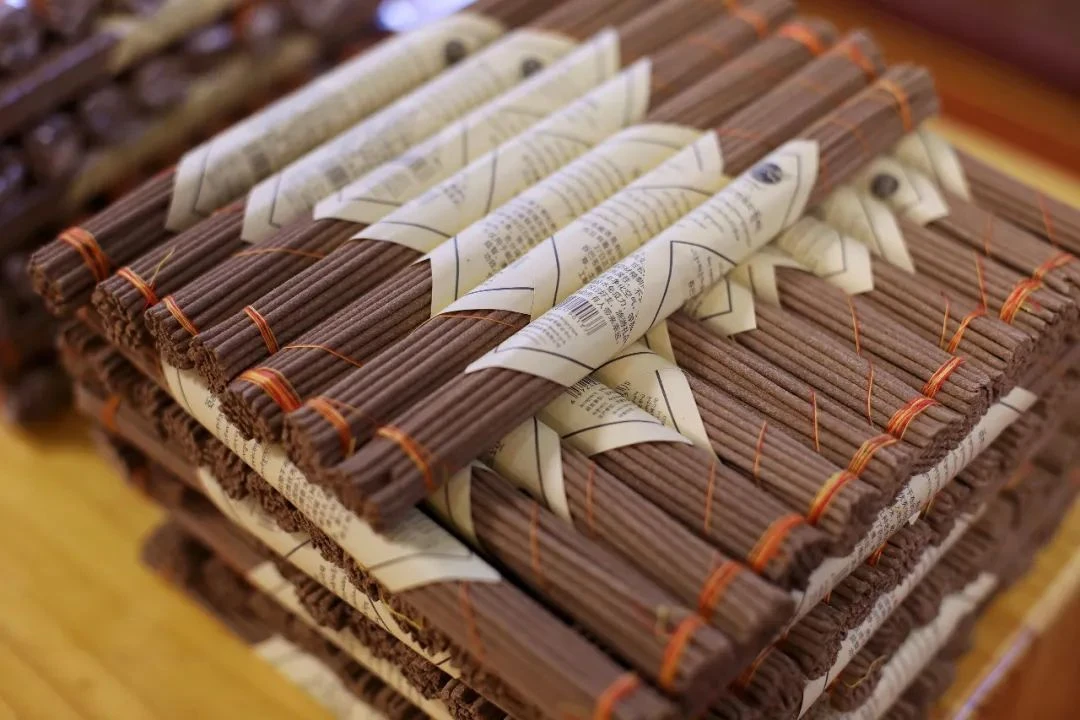
Over 30 Tibetan herbs? Entirely handmade? Step into the birthplace of Tibetan incense to uncover the story behind it
This is the birthplace of Tibetan incense, and also the birthplace of Tibetan script. This is Nyemo, Tibet.
While traveling in Tibet, I had the opportunity to observe the production process of Nyemo Tibetan incense. On the way back from Shigatse to Lhasa, it took about two hours by car to reach Nyemo County, under Lhasa City.
Nyemo Tibetan incense is one of the most famous origin sites for Tibetan incense in all of Tibet, and it is also a national-level intangible cultural heritage.
The incense-making in Nyemo County has a long history of 1,300 years. It is cherished for its unique ingredient formula and because no living creatures are harmed during production, making it popular among the masses.
Nyemo Tibetan incense, made with over 30 Tibetan herbs that are unique to the pure and pollution-free Qinghai-Tibet Plateau, is solely beneficial and harmless to the body. It is an ethnic specialty of the snowy highlands, rich in Tibetan cultural heritage.
Come along and see how Nyemo Tibetan incense is made.
That day, a local friend from Nyemo County took us to Tibet Xiangyu Tibetan Incense Co., Ltd., which also serves as the Nyemo Tibetan Incense R&D Center and the Nyemo County Tibetan Incense Association.
In winter, Nyemo basks in brilliant sunshine with not a cloud in the sky. Although the temperature reads minus 2 degrees Celsius, a sweater is enough at noon.
As soon as you enter, in the sunlight by the wall, several Tibetan workers are hand-sorting incense sticks while chatting about daily life—a very cheerful work atmosphere.
One woman, leaning against the wall, is patiently folding black incense packaging boxes.
In the sunlight, an older Tibetan man is vigorously mixing the raw materials for the incense. This pile of earthy yellow materials contains over 30 Tibetan herbs, and the air is filled with the distinctive scent of Tibetan incense.
Moving to the handcrafting workshop, the mixed materials are divided into portions, and several Tibetan men, with their backs to the sunlight, quietly start making incense.
I spoke with an incense master wearing a white hat; he has been making Tibetan incense for over 20 years. Unfortunately, he didn't speak Mandarin, so we couldn't converse. I simply watched quietly as he drew straight, precise line incense sticks, time slipping away.
These neatly arranged rows are a true delight for the obsessive-compulsive!
I asked the person in charge of Xiangyu Tibetan Incense Company, and he said each incense master can make about fifty bundles of incense per day.
Once the boards are full, the incense master uses a tool to trim the excess, ensuring all the sticks are the same length.
These Nyemo incense sticks are taken to the drying room next door to dry. It is said that handmade incense is laid on the ground to dry in the shade, while machine-made Nyemo incense is placed on racks to dry in the sun.
Looking at these handmade Nyemo incense sticks in the sunlight, uniform yet with subtle differences, I can't help feeling that only handmade things have a soul.
Some boxes of Nyemo incense are neatly stacked in the corner. I really like the packaging colors—so distinctly Tibetan.
Upstairs, there is a Nyemo incense experience area where you can try making it yourself. It turns out a small hole is made in the base of a yak horn, and the incense paste is extruded through that hole.
It looks easy, but it's incredibly difficult to do yourself! How many years of practice does it take to squeeze out such a straight line?
We also visited the product display area of Tibet Xiangyu Tibetan Incense Co., Ltd., showcasing various packages of Nyemo incense, Tibetan bags, incense burners, and more.
The incense produced here comes in stick incense, cone incense, loose packs, gift boxes, and more, catering to different consumer needs. The cheapest bundle of incense sells for just over ten yuan.
Throughout Nyemo County, there are many incense-making workshops; the Tibetan incense industry here is huge.
Thanks to the ancient craft techniques and multiple pure, natural Tibetan medicinal ingredients, it is supremely authentic with a naturally enchanting fragrance. It is increasingly beloved by incense connoisseurs from beyond Tibet.
In the small villages of Nyemo County, the sky is a deep blue, streams babble gently, yaks roam freely, and the air is filled everywhere with the scent of Tibetan incense.
Nyemo Tibetan incense—the scent of Tibet, fragrant for a thousand years.
When visiting Nyemo, one cannot overlook one person: Thonmi Sambhota. Without him, there would be no Nyemo Tibetan incense, nor Tibetan script.
In the afternoon, I visited Thonmi Sambhota's former residence. On the wall at the entrance, many irregular stones bore large, colorful Tibetan inscriptions.
Entering Thonmi Sambhota's former residence, there is a modest inner courtyard. I imagined the master of the house—had he ever stood at this doorway, gazing at the enclosing walls, the sky, and the mountains, pondering the ingredients for Nyemo incense?
In the 7th century, Thonmi Sambhota was born in Tunba Town, Nyemo County. Following the order of King Songtsen Gampo, he endured countless hardships to create the Tibetan script, later honored as one of the 'Seven Wise Ministers of Tubo.'
After achieving fame and returning home with honor, Thonmi Sambhota combined the Tang Dynasty incense culture brought to Tibet by Princess Wencheng with Tibetan medicinal fumigation therapy, thus inventing the 'Sacred Incense of Tibet,' Nyumo Tibetan incense.
The first floor of the former residence is dimly lit, comprising stables, storage rooms, and servant quarters.
Climbing an old wooden staircase to the second floor, the space opens up to a square patch of sky.
On the corner wall, there are two colorful murals, their hues still vivid.
The second floor has a combined kitchen and dining area. With no smoke extraction system, the ceiling and walls are blackened with soot, and the floor is of packed earth.
One of the rooms on the second floor was where Thonmi Sambhota once lived.
Facing away from the window, there is a statue of Thonmi Sambhota, draped with white khatas, and on the table before him lie the Tibetan letters he invented.
Leaving Thonmi Sambhota's former residence, I was filled with many thoughts. The wheel of history rolls forward; after many years, some are forgotten while others are remembered.
Sitting on a wooden bench by a small river, a flock of sheep passed by along the bank, bleating.
This is my eighth trip to Tibet, and each time I discover something new, deepening my understanding of this snowy plateau.
I know I will return.
If you want to buy Nyemo Tibetan incense, you can purchase it at the 'Nyemo County Rural E-commerce Public Service Center' in Nyemo town, straight from the source. They have a wide variety at various price points to meet all needs.
Inside, you'll also find other local specialties from Nyemo County, such as handwoven woolen blankets, Tibetan paper, and Nyemo wood carvings. There is also a small shop where you can buy various travel supplies.
For accommodation in Nyemo, I recommend Nyemo Xumai Hot Spring Resort. It is located in Angang Village, Xumai Township, Nyemo County, Lhasa, 26 kilometers from the county seat.
The environment at Nyemo Xumai Hot Spring Resort is lovely, backed by green mountains and facing a vast wetland. Room rates are 198 yuan per room, with free breakfast. If you stay at the resort, you can also enjoy the hot spring baths for free.
Another piece of good news: local residents of Nyemo County can bathe in the hot springs for free with their ID cards; civil servants working in Nyemo can also enjoy free hot spring and steam baths with their work permits.
The hot springs here are natural. In front of the resort, I happened upon some locals collecting hot water, steam rising. The spring water can reach temperatures over 80 degrees Celsius.
Nyemo County in Lhasa, Tibet, is known not only for the famous Nyemo Tibetan incense, but also for handcrafted wood carvings from Pusong Township and Nyemo Tibetan paper, which carries a thousand-year history of Tibet. 'Nyemo Tibetan incense,' 'Xuela Tibetan paper,' and 'Pusong carvings' are known as the 'Three Treasures of Nyemo.'
In summer, Nyemo, being not far from Lhasa and blessed with beautiful natural surroundings, attracts many people who come to enjoy 'Linka' (outdoor picnicking). I hope to have the chance to visit Nyemo again in a different season.


