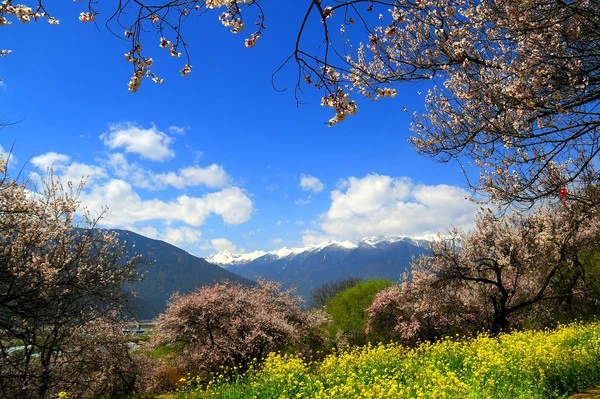
A Date with Spring: Nyingchi Peach Blossom Season Car Rental Self-Drive Travel Guide (Part 2) – March 2021
Nyingchi – Bayi District – Gala Village Peach Garden
Nyingchi – Mainling – Yarlung Zangbo Grand Canyon – Sossong Village – Namcha Barwa
Nyingchi – Gongbo'gyamda – Ouba Village
Nyingchi – Bayi District – Gala Village Peach Garden
Nyingchi – Bayi District – Gala Village Peach Garden
Nyingchi – Mainling – Mainri Township
Nyingchi – Mainling – Yarlung Zangbo Grand Canyon
Nyingchi – Mainling – Pai Town – Yarlung Tsangpo Riverside
Nyingchi – Bomi – Galang National Wetland Park
Nyingchi – Bomi – Bomi Peach Blossom Valley – Galang Village
Chamdo – Baxoi – Palong Zangbo River
The peach blossoms of Nyingchi in Tibet have long been renowned. Due to its special geographical location, in past years not many people came for the peach blossom season. In recent years, riding the wave of Tibet’s tourism boom, the media have intensified promotional efforts, and local authorities have added fuel to the fire. Nyingchi’s Gala Peach Blossom Village and Bomi Peach Blossom Valley have become must‑see hotspots that people flock to. During the peach blossom season, visitors converge from all directions to encounter China’s most beautiful spring.
Although I have been to Tibet many times before and always wanted to see the unique snow‑capped peach blossoms in this “Jiangnan of Tibet,” the season was never right and I never had the chance to glimpse their intoxicating beauty and experience their enchanting charm.
This time, in this lovely period of the Nyingchi peach blossom season, I made a special trip to Nyingchi to see the blossoms and fulfill a long‑held wish. Setting off from my hometown Shantou, Guangdong on 26 March, I returned to Shantou on 4 April – ten days in all.
The brief itinerary was Shantou – Lhasa – Nyingchi – Mainling – Bomi – Ranwu Lake – Lulang – Lhasa – Shantou, with flights for the Shantou‑Lhasa‑Shantou legs; touring in Nyingchi and around was by rental car self‑drive, covering about 2,200 km. In just a few short days, I visited all four main peach blossom viewing spots in Nyingchi: Laru Peach Blossom Village (Gongbo'gyamda County), Gala Peach Blossom Village (Bayi District of Nyingchi), Sossong Village deep in the Yarlung Zangbo Grand Canyon (Mainling County), and Bomi Peach Blossom Valley (Bomi County). Although the cold had not yet faded, these places had already become a sea of flowers. It was a “short, quick, and effective” trip – eye‑filling and immensely rewarding.
1. The weather in Tibet in March is still very cold. Due to the season and climate, scenery elsewhere is mostly unremarkable. Thus, a special trip to Nyingchi for the peach blossoms is usually necessary.
2. Because of different geographical positions and altitudes, blooming times differ greatly among viewing spots. The peak bloom in most places is generally from mid‑to‑late March to early April.
3. If you’re coming just to admire the peach blossoms, one week is quite enough.
Nyingchi – Mainling – Yarlung Zangbo Grand Canyon – Sossong Village – Namcha Barwa
Nyingchi – Mainling – Yarlung Zangbo Grand Canyon – Sossong Village – Namcha Barwa
Nyingchi – Bayi District – Gala Village Peach Garden
Nyingchi – Bayi District – Gala Village Peach Garden
Nyingchi – Bayi District – Gala Village Peach Garden
Nyingchi – Bayi District – Gala Village Peach Garden
Nyingchi – Bayi District – Gala Village
Nyingchi – Mainling – Mainri Township
Nyingchi – Bomi – Galang National Wetland Park
Nyingchi – Bomi – Bomi Peach Blossom Valley – scenery along the way
Chamdo – Baxoi – Palong Zangbo River
D1, 26 March (Friday, sunny, temperature 1‑8°C). First day in Tibet. Flew from Shantou to Lhasa (stopover Luzhou) on Tibet Airlines, flight 19:15‑00:55. The plane landed at Lhasa Gonggar International Airport at 1 a.m. and it took nearly half an hour to get our luggage. Fortunately the hotel I’d booked offered 24‑hour airport transfer (excellent service, truly deserves a thumbs‑up), so we quickly reached the City Comfort Inn (Lhasa Gonggar Airport branch). We quickly tidied up and went to sleep – tomorrow we still had to drive over 500 km to Nyingchi while sightseeing along the way.
1. For viewing peach blossoms, flying directly to Nyingchi is of course the best choice. But flights to Nyingchi are few, and during the peach blossom festival tickets become very expensive. Lhasa, after all, is the provincial capital with more flights and routes, and ticket discounts are greater.
2. In Lhasa, you have more choices for car rental, and prices are somewhat cheaper than in Nyingchi. Although Lhasa to Nyingchi is over 400 km, the Lhasa‑Nyingchi Expressway is there, with light traffic, beautiful scenery, and no tolls – truly convenient.
3. During the Nyingchi peach blossom season, rental cars are in high demand. If you need one, be sure to book well in advance. Road conditions in Tibet are now very good, making self‑driving easy.
D2, 27 March (Saturday, sunny, temperature 3‑9°C). The most important thing today was completing the rental car formalities. Over 20 days earlier I’d reserved a Toyota Highlander 2.0T SUV through Ctrip with Anda Car Rental. The agreed pickup was delivery to Gonggar Airport, but since we were staying at the City Comfort Inn near the airport, I contacted the rental company to have the car brought directly to the hotel – even more convenient. They happily delivered it on time. The car was in great condition, tyres newly replaced, washed spotlessly clean, and the paperwork was straightforward. Thumbs up!
We got behind the wheel of the Highlander, set the GPS on the phone, and headed straight for Laru Peach Blossom Village in Gongbo'gyamda County, over 400 km away. From the moment we entered Nyingchi, peach blossoms accompanied us all along the road – a feast for the eyes, utterly delightful. We stopped now and then to admire the views and take photos.
Today we visited the Xiuba Millennium Ancient Watchtower Complex (Gesar Ancient Fortress), Ouba Village, the Nyang River, and other scenery and sights along the way. A slight regret was that the peach trees on the hillsides of Laru Village had only just begun to bud, so the spectacle was ordinary. But the landscapes en route, together with villages already showing some blossoms in full bloom, offered such an overwhelming rush of beauty that we simply lingered and couldn’t tear ourselves away. We didn’t feel the extra dozen kilometres were wasted at all.
In the evening we stayed at the Vienna Hotel in Nyingchi (Riverside branch near the municipal government), which I’d also booked over 20 days in advance. But rooms were already extremely tight – we couldn’t even get the same room for two consecutive nights and had to switch rooms the next day, a bit of a bother. Still, getting any booking was already pretty good.
1. Laru Village lies on the road to Basum Lake, just a few kilometres from the lake. The scenery along this stretch is magnificent, especially around Ouba Village. It’s well worth turning off the Lhasa‑Nyingchi Expressway to go and look (nearly 100 km round trip, good road).
2. Basum Lake is extraordinarily beautiful and a place worth a short stay of a day or two. Since we’ve been there before, we didn’t schedule time to enter the scenic area this time.
3. During the Nyingchi peach blossom festival, hotel and guesthouse rooms everywhere are in great demand – bookings must be made well in advance.
4. The blooming time at Laru Village is much later than at the other spots mentioned. I heard that this year’s peach blossom festival launch ceremony there is on 15 April, more than half a month later than the Gala Peach Blossom Village ceremony.
Nyingchi – Gongbo'gyamda – Lhasa‑Nyingchi Expressway
Nyingchi – Gongbo'gyamda – Lhasa‑Nyingchi Expressway
Nyingchi – Gongbo'gyamda – Xiuba Millenium Ancient Watchtower Complex
Nyingchi – Gongbo'gyamda – Ouba Village
Nyingchi – Gongbo'gyamda – Ouba Village
Nyingchi – Gongbo'gyamda – Ouba Village
Nyingchi – Gongbo'gyamda – Laru Village
Nyingchi – Gongbo'gyamda – Laru Village
Nyingchi – Gongbo'gyamda – Laru Village
D3, 28 March (Sunday, sunny, temperature 4‑12°C). Today we set aside a full day for the most celebrated peach blossom spot in Nyingchi: Gala Village Peach Garden.
Gala Village Peach Garden lies along National Highway 318, just over a dozen kilometres from downtown Nyingchi. It is the main venue of the 19th Nyingchi Peach Blossom Tourism & Culture Festival (2021) and is renowned as “The Number One Peach Blossom Village of Nyingchi, Tibet.” It’s an enviable paradise on earth: peach trees so dense they cover hills and fields; blossoms in full riot, assuming a thousand postures. At the foot of the mountains and on the slopes, they layer and overlap in charming disorder. Beneath the tree shade and in open spaces, rape‑seed plants alternate yellow and green, bursting with life. In the distance are fields, villages, rivers, and snow‑capped peaks, crisscrossing mountains – a uniquely Tibetan landscape. Climb a sightseeing platform several storeys high, let your gaze wander, and dreamlike panoramas unfold – a rich visual feast that leaves you exhilarated and wide‑eyed.
In the afternoon we still had some time, so we visited nearby Jiemai Village and Duodang Village. Returned to Nyingchi in the evening and stayed at the same Vienna Hotel.
1. Gala Village Peach Garden is right beside National Highway 318, close to the city and easy to reach. Tourists throng here, including tour groups; it’s the liveliest peach blossom viewing spot.
2. There are two or more large car parks; parking is convenient and free, but if you arrive late they’ll still be jam‑packed.
3. There are no restaurants inside the garden or nearby, only a small stall near the entrance selling drinks, fruit, instant noodles and the like. At lunchtime we could only make do with a tub of instant noodles apiece.
Nyingchi – Bayi District – Gala Village Peach Garden
Nyingchi – Bayi District – Gala Village Peach Garden
Nyingchi – Bayi District – Gala Village Peach Garden
Nyingchi – Bayi District – Gala Village Peach Garden
Nyingchi – Bayi District – Gala Village Peach Garden
Nyingchi – Bayi District – Gala Village Peach Garden
Nyingchi – Bayi District – Gala Village
Nyingchi – Bayi District – Gala Village Peach Garden
Nyingchi – Bayi District – Gala Village Peach Garden
Nyingchi – Bayi District – Gala Village Peach Garden
Nyingchi – Bayi District – Gala Village Peach Garden – King Peach Tree
Nyingchi – Bayi District – Duodang Village
D4, 29 March (Monday, overcast to cloudy, temperature 2‑9°C). Today we would drive from Nyingchi to Sossong Village, over 100 km away, deep in the Yarlung Zangbo Grand Canyon (one of China’s top ten most beautiful gorges) in Mainling County. Known as “The First Village of Namcha Barwa,” it is both another excellent spot for peach blossoms and a superb place to gaze at Namcha Barwa Peak (one of China’s top ten most beautiful mountains).
We drove along the northern bank of the Yarlung Tsangpo River, visiting the Yani National Wetland Park, Mainri Township, Pai Town, and the Buddha Palm Sand Dune viewing platform. When we reached the edge of the Yarlung Zangbo Grand Canyon scenic area on the way to Sossong Village, we were told we needed to buy a scenic area ticket just to pass through. So we also detoured to Tunbai Village and the Namcha Barwa viewing platform, sightseeing all the way to Sossong Village.
In Sossong Village, whole patches of peach trees grow beside the Yarlung Zangbo Grand Canyon – fields and the gorge nearby, snowy mountains in the distance, all set off against one another like a fairyland, stunningly beautiful. At this point in time, however, the season was still a little early: the peach blossoms were only about half in bloom. No matter – the scenery was already gorgeous.
That evening and the next morning, we were fortunate to catch a tiny glimpse of the “sunshine on golden mountain” spectacle on Namcha Barwa. Although the clouds were still thick, visibility not very high, and the view not very clear – and it lasted only a few seconds – it was already far from easy and quite exhilarating.
We stayed overnight at the Milin Guanfengju Inn in Sossong Village – the most expensive accommodation of the trip, without any doubt.
1. Because Sossong Village lies deep in the Yarlung Zangbo Grand Canyon and offers an excellent vantage point for looking at Namcha Barwa, it’s eagerly sought after by travellers. Though hotels and guesthouses abound, the full peach blossom season lasts only about ten days, and hordes of visitors pour in every day, making lodging precious. Prices are typically three to five times normal, and even a very ordinary guesthouse room easily costs over a thousand yuan a night – and must be booked and paid in full well in advance.
2. The advantages of staying in Sossong Village: first, if you’re lucky you stand a better chance of seeing Namcha Barwa and the “sunshine on golden mountain” spectacle; second, you have more ample time to explore and enjoy the peach blossom beauty beside the Yarlung Tsangpo River. The biggest drawback, of course, can be summed up in one word: “expensive.” Two words: “very expensive.” Three words: “especially expensive.”
3. Sossong Village is on the north bank of the Yarlung Zangbo Grand Canyon, while the official scenic area is on the south bank. Having already visited the scenic area on a previous trip, we didn’t schedule time to enter it this time. According to the innkeeper, if you have the time, the scenic area on the south bank is worth a visit.
Nyingchi – Mainling – Yani National Wetland Park
Nyingchi – Mainling – scenery along the way
Nyingchi – Mainling – Mainri Township
Nyingchi – Mainling – Mainri Township
Nyingchi – Mainling – Yarlung Tsangpo River – Buddha Palm Sand Dune
Nyingchi – Mainling – Yarlung Zangbo Grand Canyon – Sossong Village
Nyingchi – Mainling – Yarlung Zangbo Grand Canyon
Nyingchi – Mainling – Yarlung Zangbo Grand Canyon – Sossong Village – Namcha Barwa – sunset
D5, 30 March (Tuesday, cloudy to overcast, 2‑7°C). Today’s drive would cover about 300 km, transferring from Sossong Village to Bomi, where the last peach blossom spot on our itinerary lay.
At daybreak, we were fortunate to catch another small glimpse of the sunrise spectacle over Namcha Barwa from the hostel roof terrace. Around 8 o’clock, after breakfast, we left the inn and drove deeper into the Yarlung Zangbo Grand Canyon towards Daling Village, all the way to the banks of the Yarlung Tsangpo River. The road bridge over the river had previously been destroyed by a flood, so we had to turn back the way we came.
In the morning, the weather wasn’t bad and the sun peeped out now and then. Namcha Barwa, towering over 7,700 metres, appeared and disappeared, and we finally got to see her entire countenance! Though the weather could hardly be called good and visibility wasn’t high, it was already extremely lucky and hard to come by. One must know that Namcha Barwa is shrouded in cloud and mist all year round, revealing itself on only 60‑odd days a year, which is why it’s also called the “Shy Maiden Peak.” On our three visits here, it was only on this occasion that we saw her full face. The first time, we saw nothing; the second time, only a tiny bit; this third time, the whole view. Heaven has been very kind to us. We feel happy, content, and deeply grateful from the heart.
En route we came upon a place called Gongzun Demu Farm in Mainling, right on the bank of the Yarlung Tsangpo. It enjoys an excellent geographical position – wide, open, and spacious. Along the river there are large sandy beaches where you can play in the sand and paddle, and also gaze over at Namcha Barwa. The beauty there made us linger and dawdle until nearly noon before we reluctantly left. After lunch near the scenic area, we continued via the Sejila Mountain Pass viewing platform and the Tongmai Bridge viewing platform. It was past 8 p.m. and getting dark when we finally reached Bomi County, our destination.
We stayed at the Bomi Yunbo Grand Hotel, where we would lodge for three consecutive nights.
1. This year the full blossom at Sossong Village should have been around the end of early April. By coming now, only about half the flowers were open.
2. Currently, Tibet does not have petrol stations in basically every township, as other provinces do. So whenever you have access to a station, fill up promptly. When refuelling, you absolutely must have your ID card, driving licence, and vehicle registration – all three are essential.
3. Plan your driving schedule and try to avoid driving at night, for safety.
Nyingchi – Mainling – Yarlung Zangbo Grand Canyon – Sossong Village – Namcha Barwa – sunrise
Nyingchi – Mainling – Yarlung Zangbo Grand Canyon – Daling Village
Nyingchi – Mainling – Yarlung Zangbo Grand Canyon
Nyingchi – Mainling – Yarlung Zangbo Grand Canyon – Sossong Village – Namcha Barwa
Nyingchi – Mainling – Yarlung Zangbo Grand Canyon – Sossong Village – Namcha Barwa
Nyingchi – Mainling – Yarlung Tsangpo Riverside
Nyingchi – Mainling – Yarlung Tsangpo Riverside
Nyingchi – Mainling – Yarlung Tsangpo Riverside – distant view of Namcha Barwa
Nyingchi – Mainling – scenery along the way
Nyingchi – National Highway 318 – Sejila Mountain Pass
Nyingchi – National Highway 318 – Tongmai Bridge
D6, 31 March (Wednesday, overcast with light rain, 4‑9°C). Today in Bomi we would head to the Bomi Peach Blossom Valley Scenic Area, almost 20 km from the county seat – another hotspot for Nyingchi peach blossom viewing.
In the morning, a fine drizzle fell and clouds swirled among the mountains. Passing through the Galang National Wetland Park, the lovely scenery drew many tourists to stop by the road and on bridges to admire the view and take photos.
Reaching the Peach Blossom Valley scenic area, we started from Galang Village and followed township roads all the way to Ru’na Village (the Peach Blossom Corridor), Baiyu Village, Linqiong Village, Yuxu Township, and beyond. The peach valley is over 50 km long, home to nearly 200,000 wild peach trees, most of them 300 to over 600 years old. However, peach‑viewing tourists mostly concentrate around Galang Village and Ru’na Village, where the internet‑famous “Peach Blossom Corridor” is also located. Local houses are faintly visible half‑hidden by the blossoms; villages and wheat fields are dotted with pink peach trees – a colourful scene. I’d say the scenery in this area is a bit better. The local tourism is still basically undeveloped, retaining a natural, unspoilt simplicity. Because of the light rain, and because the peach blossoms here were actually already past their peak, the overall impression didn’t live up to the promoting publicity and imagination.
At midday, we had noodle soup at a small eatery in Ru’na Village, then returned to Bomi for the night.
1. Originally, on this route there was also Qiongduo Town, which is said to be another excellent spot for peach blossom viewing, where you can overlook and photograph the valley’s blossoms from a high vantage point. Unfortunately, a bridge leading to that town was washed away by a flood, so now if you want to go there, you’d have to backtrack to National Highway 318 and take a detour from the other side.
2. Entering the Peach Blossom Valley scenic area is free of charge, but many places with peach trees along the way have been enclosed in large chunks by local farmers. If you want to go inside a fenced area to admire and photograph the blossoms, it costs 5 yuan per person.
3. The full blossom here should have been in mid‑March.
Nyingchi – Bomi – Galang National Wetland Park
Nyingchi – Bomi – Galang National Wetland Park
Nyingchi – Bomi – National Highway 318
Nyingchi – Bomi – Galang National Wetland Park
Nyingchi – Bomi – Bomi Peach Blossom Valley – Galang Village
Nyingchi – Bomi – Bomi Peach Blossom Valley – Ru’na Village
Nyingchi – Bomi – Bomi Peach Blossom Valley – Ru’na Village – Peach Blossom Corridor
Nyingchi – Bomi – Bomi Peach Blossom Valley – scenery along the way
Nyingchi – Bomi – Bomi Peach Blossom Valley – scenery along the way
Nyingchi – Bomi – Bomi Peach Blossom Valley – scenery along the way
D7, 1 April (Thursday, overcast to cloudy, scattered light rain and snow, temperature 2‑7°C). Since Bomi is only about 100 km from Ranwu Lake in Baxoi County, and although we’d been there before, we wanted to see how this well‑known scenic spot looked in different seasons. So we set aside a whole day today to go there.
We drove along National Highway 318 towards Sichuan. Many places had just had snow the night before, and the scenery along the way was breathtakingly beautiful. We played and stopped as we went, so the 100‑odd kilometres took us until noon. After lunch at a roadside eatery, we made straight for Ranwu Lake. Unfortunately, the weather didn’t cooperate; at the viewing platform the wind was strong and it was very cold, and the scenery was just so‑so – somewhat disappointing. The saving grace was that the landscapes en route were so gorgeous; otherwise the 280 km round trip wouldn’t have been worth it.
We returned to Bomi and again stayed at the Bomi Yunbo Grand Hotel.
Nyingchi – Bomi – National Highway 318
Nyingchi – Bomi – Palong Zangbo River
Nyingchi – Bomi – Palong Zangbo River
Chamdo – Baxoi – Palong Zangbo River
Chamdo – Baxoi – Palong Zangbo River
Chamdo – Baxoi – Ranwu Lake
Chamdo – Baxoi – Ranwu Lake – viewing platform
Chamdo – Baxoi – Ranwu Lake
D8, 2 April (Friday, overcast to cloudy, scattered light rain, 1‑7°C). From today we began our return journey, heading from Bomi to Lulang Town. In the morning we had some time and went to visit the Gangxiang Spruce Forest Scenic Area, rated “fifth of China’s top ten most beautiful forests.” At midday, after lunch in Gang Village, we set off for Lulang Town.
We’d originally expected the coldest accommodation on this trip to be Sossong Village deep in the Yarlung Zangbo Grand Canyon, but arriving in Lulang Town, perhaps because of the rainy, overcast weather, it turned out even colder. It was said to be snowing on the mountain (only about 20 km from the Sejila Mountain Pass at 4,728 m). The room had no heating; it was as cold inside as outside, and at night we relied entirely on electric blankets to keep warm – you can imagine what that was like. Fortunately, it was only for one night.
Stayed at the Lulang Lianhua (Lotus Dew) Homestay.
Nyingchi – Bomi – Gang Village
Nyingchi – Bomi – Gang Village
Nyingchi – Bomi – Gang Village
Nyingchi – Bomi – Gangxiang Spruce Forest
Nyingchi – Bomi – Gangxiang Spruce Forest
D9, 3 April (Saturday, cloudy, 2‑9°C). According to the itinerary, today we would drive nearly 500 km, returning from Lulang to Lhasa. We’d already heard the day before that it was snowing on the mountain (Sejila Mountain, the only way back to Lhasa via National Highway 318), and traffic jams with traffic control had caused massive congestion.
As soon as we got up, we hurried to the front desk to find out the situation. The bad news: the jam on the mountain the previous night had been severe – some guests at the same inn who had set off from the direction of Nyingchi the afternoon before had only arrived at 5 a.m., and others even later at 7 a.m. The good news: it was no longer snowing, the weather was gradually improving, and the snow on the road would gradually melt after midday. By that time, it would be possible to cross relatively safely, but snow chains must be carried.
On learning this, we quickly made preparations: first, fill up the car at the petrol station; second, buy snow chains as a backup. But early in the morning, the small shops’ snow chains had already been swept clean. Fortunately, with the help of a kind‑hearted person, we eventually managed to buy a set.
While waiting for the snow chains to be delivered, we strolled around the nearby Lulang Alpine Pasture and Zhaxigang Village, taking a few photos. As soon as we got the chains, we set off immediately from Lulang, hoping to reach Lhasa before 4 p.m. and then go to the Potala Palace square for our traditional commemorative photo – each time I come to Tibet, I take a photo there.
But things didn’t go as wished. This huge traffic jam not only wiped out today’s plan entirely, but forced us to drive several hours into the night just to get back to Lhasa. Well before 11 a.m., we were already on the mountain, where vehicles had lined up in a long queue. Sometimes we inched forward, but then soon came to a complete standstill. Over the next six hours, we covered barely 20 km in fits and starts. Thankfully, not far beyond the Sejila Mountain Pass, we finally left the jammed section.
By the time we descended the mountain, it was already 5 p.m. In other words, around the 4,700‑metre Sejila Mountain Pass, we had been stuck for nearly six hours – how tough that was. If anyone had shown symptoms of altitude sickness, it would have been terrible. Fortunately, for ten days before departing for Tibet we had been taking nuodikang capsules (the main ingredient is rhodiola) every day, and everyone came through safely. Reaching a small town at the foot of the mountain, we quickly found a restaurant and had lunch – but it was already 5 p.m. Then we hit the Lhasa‑Nyingchi Expressway and finally arrived safely at our lodging in Lhasa, the Vienna Hotel Potala Palace branch, at 11 p.m. When travelling, unexpected things can sometimes be really serious.
D10, 4 April (Sunday, cloudy, 4‑10°C). Today was the last day of this special peach blossom trip to Nyingchi. We flew from Lhasa on Air China, 11:05‑13:35 to Chongqing, then transferred to Air China 18:15‑20:40 back to Shantou.
Yesterday’s huge jam had thrown a wrench into the plan to take photos at the Potala Palace square. In the little time before heading to the airport this morning, we managed to squeeze in that plan. Everyone got up extra early; before breakfast started at 7 a.m., we had loaded luggage into the car. After breakfast, we immediately called a Didi to the Potala Palace square, spent about half an hour completing the ritual I always do on every visit to Tibet, then hailed another Didi back to the hotel. Just then, the master from the rental company arrived in the lobby for the scheduled vehicle return. We completed the simple return formalities, went to the car park together for an on‑the‑spot vehicle check, and then he drove us to the airport. That evening, we arrived safely back in Shantou, wrapping up a satisfying Nyingchi peach blossom journey.
Nyingchi – Lulang – Lulang Town
Nyingchi – Lulang – Lulang Town
Nyingchi – Lulang – Lulang Alpine Pasture
Nyingchi – National Highway 318 – Sejila Mountain Pass – traffic jam section
Lhasa – Potala Palace
This Nyingchi peach blossom trip was short in time, but full in harvest. On the whole, I feel both satisfaction and regret, plus an extra “interlude.”
By satisfaction, I mean: first, the whole itinerary was practical and feasible – we went where we wanted to go and saw what we wanted to see; second, the weather was generally good – though we did encounter some rain and light snow, it hardly affected the sightseeing; third, the rented Toyota Highlander 2.0T SUV was a real trooper – in excellent condition, powerful, ensuring the entire self‑drive tour was smooth and safe.
As for regret: the main thing was that the blooming periods didn’t perfectly align with our hopes. This is an objective phenomenon: Nyingchi’s main blossom‑viewing spots differ greatly in distance and altitude, and under the influence of elevation and climate, peak bloom naturally varies enormously. Within such a short time frame, it’s simply impossible to hit peak bloom at every spot simultaneously. So when you choose the time to come, you can only focus on certain places.
The “interlude” refers to the unexpected huge traffic jam. Not only did it waste a precious six hours, but even worse, it forced us to drive late into the night to return to Lhasa. One must realise that although this was a last resort, it’s also a major taboo in self‑drive travel. Driving at night reduces the safety factor considerably. Luckily, we got onto the Lhasa‑Nyingchi Expressway before dark – much better than National Highway 318.
1. Although late March in Nyingchi is the end of winter and early spring, the weather is still very cold. During this trip in Tibet, temperatures were roughly 1‑10°C. So you absolutely must bring enough warm clothing. Also, it often rains during this period, so be sure to bring rain gear.
2. Though the altitude along this route isn’t extreme (Lhasa 3,600 m, Nyingchi 2,800 m, Bomi 2,700 m; National Highway 318 crosses the Sejila Mountain Pass at 4,728 m, but under normal conditions you pass it in a very short time; previously you also had to cross the over‑5,000‑metre Mila Mountain Pass, but now a tunnel has been opened), you should still take some high‑altitude sickness prevention medication in advance to be prepared. This time, being stuck for so long on a mountain above 4,000 m – had we not taken preventive measures, the consequences could have been dire.
3. Nyingchi’s peach blossom spots are scattered over long distances. Current public transport can’t possibly deliver you to every place you want at any moment. Therefore, the best way to enjoy the peach blossoms in Nyingchi is by self‑driving or chartering a car. That way you can stop and go as you please, admiring and photographing at will.
4. Based on this year’s on‑the‑spot observation, the peak bloom at these four main Nyingchi peach blossom sites runs roughly in sequence: Bomi Peach Blossom Valley in mid‑March, Gala Peach Blossom Village in late March, spots along the Grand Canyon like Sossong Village in early April, and Laru Peach Blossom Village in mid‑April. Peaks will vary with weather and other factors each year.
5. If time is limited and you crave convenience, visiting only Gala Peach Blossom Village in Bayi District and Bomi Peach Blossom Valley for Nyingchi peach blossoms will suffice. Both spots are along National Highway 318, with convenient transport, and their blooming times are relatively close and locations relatively concentrated. For Bayi District’s Gala Peach Blossom Village, you just need to see the Gala Peach Garden; for Bomi Peach Blossom Valley, just drive from Galang Village to Ru’na Village – a mere few kilometres. The peach blossoms at these two spots are arguably the largest, most representative, and most famous in Nyingchi.
Nyingchi – Bomi – Bomi Peach Blossom Valley – Ru’na Village
Nyingchi – Bomi – Bomi Peach Blossom Valley – scenery along the way
Nyingchi – Bayi District – Gala Village Peach Garden
Nyingchi – Bayi District – Gala Village Peach Garden
Nyingchi – Bayi District – Gala Village Peach Garden
Nyingchi – Bayi District – Gala Village Peach Garden
Nyingchi – Bayi District – Duodang Village
Nyingchi – Bayi District – Gala Village Peach Garden


