May Day Holiday Travel Guide | Lhasa’s Food and Fun Highlights: Don’t Miss These Spots!
The May Day holiday is coming. Have you made your travel plans? Although this year’s May Day mini-holiday, after deducting weekends and compensatory time off, is actually just one day off, once pieced together it still gives you five days—enough for a little trip. Today, I’ll recommend a few travel destinations so you can fill in any gaps and have a happy journey. A five-day mini-holiday is just the right length, if a bit awkward!
If you’ve already set aside enough time off, I recommend taking the Qinghai-Tibet Railway into Tibet. Not only will you enjoy the high-altitude scenery along the way, but more importantly, it allows your heart to gradually adjust from low to high altitudes. Plus, you’ll meet like-minded travelers on the train. If you’re short on time, just fly!
Once in Lhasa, there are plenty of taxis, even more convenient than using ride-hailing apps like Didi. Also, Lhasa is relatively small, so buses are very handy. For those who love self-driving, there are numerous car rental companies, making getting around easy.
Note: For the train, I recommend a hard sleeper ticket—it's the best value. You can sleep, sit, and charge your devices! Otherwise, a hard-seat ticket for over 30 hours will be an unforgettable experience, just like I had!
As a tourist city, Lhasa offers extremely convenient accommodation. Besides hotels and guesthouses near the Potala Palace, Xianzu Island is another place with a cluster of guesthouses. It’s backed by the Lhasa River and Cijiaolin Bridge, not far from the Potala Palace, making it a relatively nice spot. Meanwhile, the guesthouses and hotels on Niangre Road are more bustling, with various dining and entertainment options, many bus routes, and well-connected transport. Also, because Lhasa’s urban area isn’t large, wherever you stay is a good choice, and it feels more welcoming compared to other cities.
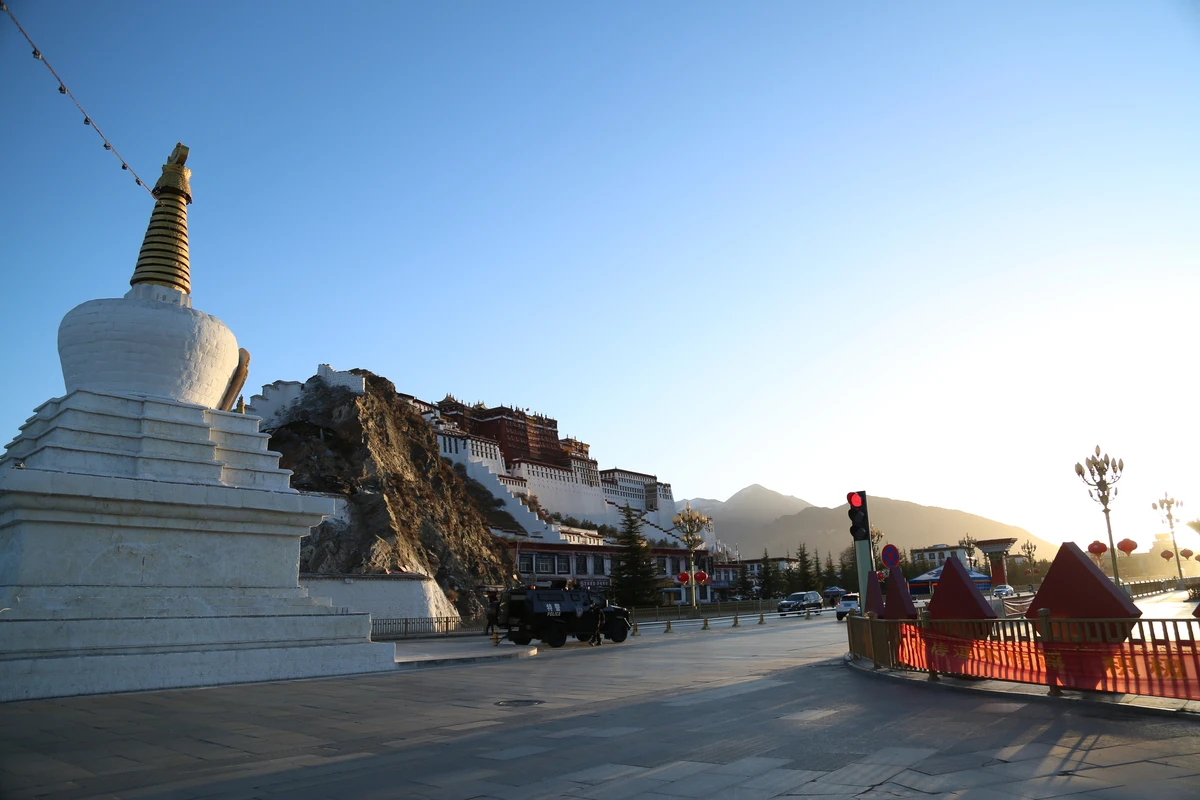
Known as the jewel on the roof of the world, the Potala Palace is arguably the most unmissable 'sacred site' in Tibet. With 1,300 years of history, it holds numerous legends of Princess Wencheng, Tsangyang Gyatso, and countless precious relics. The Potala Palace was first built in the 7th century, then rebuilt and expanded in the 17th century, with continuous renovations, alterations, and expansions ever since. Inside, the sacred statue of Avalokiteshvara, Ayalo Geshar, is said to have naturally grown from the heart of a glowing white sandalwood tree in a forest on the border of India and Nepal, where King Songtsen Gampo sent a monk to find it. Above the door of the Sacred Avalokiteshvara Hall hangs a gilded plaque with the inscription 'Blessed Field of Wonderful Fruit,' handwritten by the Qing Tongzhi Emperor. The Potala Palace is not only a key national cultural relic protection site but also a UNESCO World Heritage Site. Tip: Before visiting, follow the official Potala Palace cultural creative account for plenty of historical and artifact introductions, so you’ll understand every spot when you tour.
Location: City center.
Ticket: 200 yuan.
Getting there: Just walk.
Remember: Always carry your ID card!
Unlike any other cultural creative store in the country, the Potala Palace Cultural Creative Experience Shop (Cave Store) is located in a cave at the foot of the Potala Palace, sharing its origins with the palace. Legend has it that this cave is a secret passage in Tibetan Buddhism leading to Shambhala (the divine kingdom), shrouded in mystery. The shop sits along the Potala Palace’s kora path, next to the white stupa. Inside, apart from a wide variety of creative products, the decorations of thangkas, palm-leaf scriptures, and the eight-petal lotus Yamantaka mandala give the cave store a distinctive character and cultural ambiance. They also serve Tibetan specialties like sweet tea, yogurt, and butter tea. During peak tourist season, over 2,000 people visit daily—a true internet-famous spot.
Location: At the foot of the Potala Palace.
Ticket: No ticket required.
Getting there: Just walk.
Apart from the Potala Palace, another unmissable 'sacred site' in Lhasa is the Jokhang Temple. Legend has it that in the 7th century, after Princess Wencheng came to Tibet, she divined that Tibet resembled a supine snowland demoness, and the ancient Wutang Lake was the demoness’s heart. Later, Songtsen Gampo and Princess Chizun united the Tibetan people, using white goats to carry earth and fill the lake to build the Jokhang Temple. Originally, the Jokhang Temple housed the 8-year-old life-sized statue of Shakyamuni, but due to historical changes, it was swapped with the 12-year-old life-sized statue brought by Princess Wencheng, which was then enshrined in the Ramoche Temple. This attracted a flood of pilgrims, who began circumambulating the Jokhang Temple, forming what are now the famous Barkhor Street and Lingkhor Road in Lhasa. The Jokhang Temple is the best place to witness devotion; pilgrims are seen here year-round. The Barkhor Street outside the temple is also the most bustling street in Lhasa.
Location: City center.
Ticket: 85 yuan.
Getting there: Just walk.
Remember: Always carry your ID card!
If you haven’t been to Drepung Monastery, you don’t know the awe-inspiring grandeur of sacred mountains embraced by hills and the magnificence of the temple. Take a bus from Lhasa city center for about half an hour to reach the monastery gate, then walk uphill to enter. Drepung Monastery is the largest monastery in Tibet, built in 1416 and capable of accommodating 10,000 monks. It is one of the 'Three Great Monasteries of Lhasa' along with Sera Monastery and Ganden Monastery. Every year in late August, during the Lhasa Shoton Festival, a giant Buddha thangka is displayed on the hill behind the monastery, drawing crowds of monks, pilgrims, and tourists to pay homage. The monastery also has many stories and legends about Tsangyang Gyatso, adding a touch of charm, and it’s a great place for photos.
Location: On the outskirts of the main city.
Ticket: 50 yuan.
Getting there: Direct bus.
Remember: Always carry your ID card!
The Potala Palace is the 'Winter Palace,' while Norbulingka is the 'Summer Palace,' akin to the Chengde Mountain Resort of Tibet. You can reach it by bus from Lhasa city center, or walk in about 40 minutes. Built in the 18th century, Norbulingka is known as the highland botanical garden and is the largest, most scenic, and most historic man-made garden in Tibet, featuring numerous murals and cultural relics. It also serves as one of the main venues for Tibetan opera performances during the Shoton Festival around August each year, attracting many Tibetans and tourists. The garden is quite spacious, so you can take a leisurely stroll.
Location: City center.
Ticket: 60 yuan.
Getting there: Direct bus.
Remember: Always carry your ID card!
In Lhasa, the debate sessions at Sera Monastery draw a large number of tourists and pilgrims every day. The debates take place Monday to Friday at 3 p.m., with big crowds and lively scenes. The only catch is that if you don't understand Tibetan, it can be a bit puzzling. Sera Monastery was built during the Yongle period of the Ming Dynasty, and at its peak housed over 5,500 monks. It preserves tens of thousands of Buddhist statues from both Han and Tibetan traditions, making it the second largest monastery in Tibet. Along with Drepung Monastery and Ganden Monastery, it is one of the three great monasteries of Lhasa, and it’s also a great spot for photography.
Location: On the outskirts of the main city.
Ticket: 50 yuan.
Getting there: Direct bus.
Remember: Always carry your ID card!
There are two must-try foods in Tibet, one of which is yogurt. Yogurt holds a significant place in the lives of Tibetans; for example, the grand Shoton Festival in Lhasa at the end of the sixth month of the Tibetan calendar literally means 'Yogurt Festival.' On par with yogurt, sweet tea is even more beloved. Unlike butter tea, sweet tea tastes more like plain milk tea, making it easier for first-time visitors to Tibet to accept, and it’s a favorite beverage among Tibetans.
Zanba + Highland Barley Wine: In Lhasa, you must try zanba (roasted barley flour). It’s rich and smooth. Friends traveling in Lhasa can order a portion at any Tibetan restaurant to taste. Also, highland barley wine is indispensable, especially the low-alcohol variety. Generally, the barley wine sold in restaurants tends to be slightly sweet, while farmhouse-brewed versions are more on the sour side.
Tibetan flatbread is baked by cooks until the surface is slightly golden, the overall color a floury white, with air pockets from expansion. It’s crispy yet not dry, soft and moist with a hint of sweetness. Not too sweet, not too plain—just comfortably delicious.
After reading this travel guide, do you have a clearer idea for your own itinerary? Share your Tibet travel tips in the comments, and one random person will receive a Potala Palace Tibetan incense worth 98 yuan.
Travel Directory: 1. Transportation 2. Accommodation Recommendations 3. Sightseeing Recommendations 4. 1. Potala Palace 5. 2. Potala Palace Cultural Creative Experience Shop 6. 3. Jokhang Temple 7. 4. Drepung Monastery 8. 5. Norbulingka 9. 6. Sera Monastery 10. Food Guide
Travel Information Hotel Index Guide Index Flight Index Site Navigation Travel Index Cruise Index Corporate Travel Index Affiliate Partnerships Distribution Alliances Friends Links Corporate Gift Cards Insurance Agent Agent Cooperation Hotel Affiliates Destination and Scenic Spot Cooperation More Affiliate Cooperation About Ctrip About Ctrip Ctrip Hot Topics Contact Us Careers User Agreement Privacy Policy Business License Security Center Ctrip Content Center Intellectual Property Trip.com Group Algorithm Disclosure


