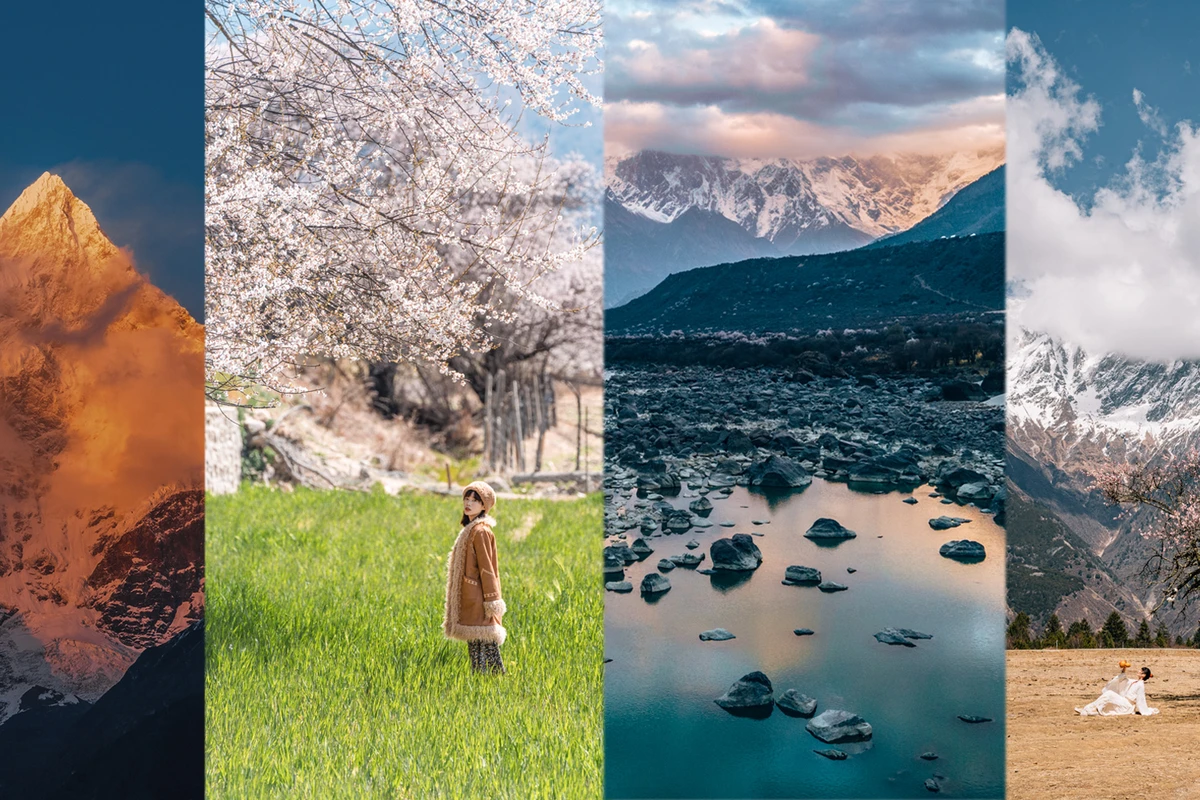
April’s Finest: A Reunion with Tibet’s Peach Blossoms
On March 15, George submitted his resignation.
On March 22, we decided to go see the peach blossoms in Nyingchi.
On April 3, the third day after George quit without a backup plan, we set off for Tibet.
The resignation wasn’t a spur-of-the-moment decision, but chasing peach blossoms was totally on a whim.
Why Tibet?
Because many say it’s a place starved of oxygen but never of faith.
Sometime in your life, you must visit Tibet at least once.
With a period of no income looming, I wondered if faith could ease the anxiety of “being broke.”
Maybe five years ago I’d have said yes, but now I know it can’t.
So this trip wasn’t a healing journey for George’s resignation.
Rather, it was the start of us dabbling in freelance life together.
This was my second time in Tibet and George’s first.
My first visit was a graduation trip I planned for myself. Back then, though I had little travel experience, I had a fervent heart that longed for mountains, rivers, and seas.
That June, I excitedly asked on my social media if anyone wanted to join a graduation trip. George replied, and our story began. We traveled the Qinghai-Gansu loop together. Afterwards, I continued by train into Tibet with other friends, while George turned back home.
So George said this Tibet trip was “continuing our former fate,” completing our graduation journey.
The whole trip’s good omen came when Namcha Barwa, which “nine out of ten people never see,” gifted us a glorious “sunshine on golden mountains” scene.
“Rosy clouds lingering in the snowy valley, pink mist veiling the wheat fields.” Suosong Village, with its wild peach blossoms blanketing the mountains, captured the most beautiful spring of April.
In Dalin Village at the foot of snowy peaks, lying beneath the loneliest peach tree and sipping a pot of unrefined wine, I felt the carefree life from martial arts dramas.
At Nanyi Valley — the “highest green secret realm on Earth” — we used a drone to discover inaccessible wonderlands, where marshes dotted the meadows like scattered gemstones.
Lulang, whose Tibetan name means “Dragon King Valley,” is also a place that “makes you forget home.” Here we encountered the deepest forest, the cutest cattle and horses, the most distinctive houses, and the warmest campfires.
At the emerald-green Basum Tso, a pleasure boat gliding past the lake’s islet left ripples on the silky water — I’d call it paradise.
In the outskirts of Lhasa, there’s Ganden Monastery, even more spectacular than the Potala Palace. Battling altitude sickness, I climbed to 3,800 meters, believing that sincere prayers would be heard by the sky.
Prayer flags fluttering among the mountains carry people’s wishes; the “heavenly ladders” painted on rocks are yearnings for departed loved ones.
Of course, we also spent a full day admiring the solemn Potala Palace from every angle — I even found six perfect photo spots for you.
Setting off from Hangzhou with a transfer in Kunming, the journey was tiring, but as we neared our destination, excitement rose again.
Tibet’s scenery begins right from the plane. Overlapping snow-capped ridges, with ravines on nearby mountains clearly visible, and distant peaks gradually blurring into the far horizon.
We landed in Lhasa around 6 p.m. The sky was still bright, but bad weather and thick clouds blocked the sunset.
Both sides of the highway into town even looked like a sandstorm was brewing — a gray, hazy mist everywhere.
On my first Tibet trip, I prepared thoroughly: I drank Rhodiola rosea for half a month beforehand and took the train to gradually adapt to altitude sickness. Back then, my friend suffered badly, but I felt fine. This time, we only brought some glucose and cold medicine, no Rhodiola, because I think its psychological effect outweighs any real benefit.
Probably because we arrived at high altitude so abruptly, I still felt breathless after landing. George carried all the luggage. On the taxi ride to the hotel, I relied on my “magic pills” — Maltesers really saved me.
While I was groggy, I got a message from Jamie Jiang. She invited us to dinner — finally meeting an online friend in person. Jamie is also a travel blogger; she’d been on a self-drive trip for half a month from Hangzhou through Chongqing, Guizhou, Sichuan, to Tibet. She was cooking with friends at a Lhasa guesthouse.
So we dropped our bags at the hotel and took a taxi to find Jamie. As luck would have it, we not only tasted Jamie’s cooking but also met two photography gurus from 8KRAW. A delicious Hangzhou-style meal wiped away the fatigue of a day’s travel.
Let me introduce: from left to right are Jamie Jiang, George, me, Bao Kalia, and Da Vinci Code.
They had already been in Tibet for several days and gave us plenty of tips. Just in the past couple of days, the Serkyim La pass had seen heavy snow, causing severe traffic jams — some people were even stranded on the mountain at night. They said you must carry snow chains at Serkyim La, or the traffic police won’t let you up. They also showed us big shots’ peach blossom photos and told us about the bloom status around Nyingchi and recommended photo spots.
After a leisurely chat after dinner, we went back to our hotel. Our hotel was lovely, in Tibetan style. George specially booked an oxygen-supplied room. Although they don’t recommend using oxygen right away, an occasional sip helps a bit. The first night, altitude sickness disrupted our sleep — we both spent it half-awake, half-asleep. So I suggest not planning any activities on your first day in Lhasa; rest well to adjust, then explore the next day.
The next morning, we picked up our rental car and headed straight for Nyingchi. Leaving Lhasa, we were greeted by blue skies and white clouds — a world apart from yesterday’s dust storm. After a night’s rest, the altitude sickness had eased a lot. Actually, as long as I don’t walk, I won’t get sick.
The newly built Linla Highway between Lhasa and Nyingchi makes the journey much smoother, no need for the old 318 National Highway, and no traffic jams at all. The scenery along the way is nice, with stretches of snowy mountains.
Passing through Maizhokunggar County, the clouds thickened, and suddenly fat snowflakes began drifting against the windshield.
Last year, due to the Shanghai lockdown, we had to cancel a trip to see snow in Xinjiang. We never expected to see snow in Tibet in April — we were thrilled.
The snow got heavier, and visibility dropped. In such bad weather, I didn’t dare let George take over driving. I’d been driving for over two hours straight and wanted a break. So we briefly stopped to stretch and snap a few snowy photos.
We marveled at the beauty of the snowy mountains — dark green hills with silver snowcaps. It’s more intriguing when only the peaks are dusted white rather than the whole mountain covered.
Still absorbed in the gorgeous mountain views, our navigation suddenly turned red with severe congestion ahead, and then we saw cars slipping by the roadside. We’d arrived at the Mila Mountain pass. Snow had iced the road, making conditions treacherous.
We originally planned to buy snow chains in Bayi Town at the foot of Serkyim La, but we never expected Mila pass to be icy too. Yolo called to tell us to bring chains, but it was too late.
It was my first time on an icy road, and I had no experience. Remembering what Jamie and the others said the night before — don’t slam the brakes — I drove cautiously at 20 km/h. But the car kept skidding to the right; I had to brake, and then heard the tire alarm. When I gently pressed the gas again, the car wouldn’t move — we were stuck on ice. Meanwhile, 4x4s cruised past effortlessly, and some well-prepared cars pulled out snow chains. All around us were vehicles skidding just like ours, stranded in the middle of the road.
Panic set in. My first thought was: what if we can’t make it to Suosong Village in time for the peach blossoms? Helpless, with no one to turn to, George got out to check. Then, by chance, we found a thick piece of paper in the passenger seat. George put it under the right front wheel to increase friction, and the slipping wheel actually gripped — we were moving again! George steadied the front to help steer as we inched forward. Luckily, there was a tunnel 300 meters ahead, presumably snow-free. After the tense ordeal, we safely reached the tunnel.
After this test, I felt my driving skills had improved immensely, adding to my self-drive experience. That short 3-kilometer stretch took nearly an hour, leaving my legs weak and my nerves finally relaxed. We pulled over again to really give my legs a rest.
As we neared Nyingchi, the snow on the mountains thinned, the landscape less barren. Peach trees started appearing scattered along the roadside — spring was more palpable. This whole trip centered on peach blossoms, so the moment I saw the first peach tree, my excitement was unstoppable. Even roadside ones made me click the shutter nonstop.
Suosong Village lies within the Yarlung Zangbo Grand Canyon. Although the map shows a short straight-line distance, there are many winding roads. From Lhasa, it took us nearly seven hours to reach Suosong.
After exiting the Linla Expressway, we first passed Yani National Wetland Park. We didn’t go in specially, just took photos by the roadside. Inside, you could apparently take a boat ride. Although it’s a wetland, it was a sandy, windy day, and the distance looked a bit hazy.
The closer we got to Suosong, the more towering snow mountains we saw. Each one made us wonder: is that Namcha Barwa? We’d see people taking photos and want to ask if it was Namcha Barwa. Finally, we checked the map and realized it wasn’t.
At the Suosong Village ticket office, entry was 150 yuan per person; a combo ticket for Suosong and the Yarlung Zangbo Grand Canyon was 240 yuan. But they say the Grand Canyon scenic area isn’t that special, so it’s not worth entering — you can see the canyon from Suosong anyway.
At last, the Namcha Barwa we’d been longing for truly appeared. Its main peak, at 7,782 meters, is the 28th highest in the world. Because the summit is a giant triangle perpetually snowcapped, often shrouded in clouds, it rarely shows its full face — hence its nickname, “Shy Maiden Peak.” The rainy season is May to August; March, April, and October are the best months to see it. Morning is the easiest time; by afternoon, wind and clouds rise in the canyon, greatly reducing visibility. The golden sunset on the peak is the most spectacular and rarest sight.
We were incredibly lucky. Yolo had spent days in Suosong without seeing the full peak, but right after we arrived, we saw the main summit. However, that first afternoon it was only brief; by sunset, clouds again hid the mountain.
We weren’t too greedy, because the valley full of peach blossoms was already breathtaking enough. George had looked at online photos and thought they weren’t that impressive, but seeing the scenery with our own eyes truly left us speechless, only able to exclaim “so beautiful.” And the camera completely failed to capture the awe and vastness our eyes witnessed!
Because Suosong Village is perched on cliffs, and the vast peach forests grow down in the valley, a drone offers the best perspective — peach blossoms in the foreground, Namcha Barwa as the backdrop.
Drones can easily lose signal when flying into the valley, so be very cautious. Apart from peach blossoms, you can also use the Yarlung Zangbo River as foreground, flying the drone close to the water to capture reflections of the mountains.
Actually, the opposite peak, Gyala Peri, is also very beautiful. At 7,294 meters, it’s shorter with fewer clouds, so the whole mountain is often visible. At its foot are vast peach groves — perfect for framing both snow peaks and blossoms together.
Despite thick clouds that first evening, many photography die-hards persisted on the cliff waiting for Namcha Barwa to fully emerge. We joined the crowd, setting up our tripod for a time-lapse, but only caught golden afterglow clouds.
We had dinner with Zhang Li, Yami, and a group of friends. Zhang Li had entered Tibet from Lijiang, passing Ranwu Lake and Bomi, and arrived at Suosong the same day. So many people on my social feed were in Nyingchi that we met group after group. During dinner we learned that the peach blossoms in Bomi had already mostly withered, so we had to change our original plan to go there. A local guide recommended Nanyi Valley, so we decided to check it out.
Suosong Village is deep inside the Yarlung Zangbo Grand Canyon, the best spot to view Namcha Barwa — only 10 km away as the crow flies, closer and more spectacular than Serkyim La pass on National Highway 318. Many hotels in the village have views of Namcha Barwa right from the curtain; the scenery is incredible.
It’s also the prime spot for enjoying peach blossoms in the Grand Canyon, with wide vistas and large cliff drops, offering panoramic views of the opposite canyon. The peak bloom in Suosong is around April 5; in Bomi, it’s around March 25.
Most visitors plan to stay multiple days in Suosong because photographers want to capture satisfactory shots of Namcha Barwa. This year, during peach blossom season, rooms were incredibly scarce and expensive — over 1,000 yuan a night. So we planned to stay just one night and then leave.
We woke at 6 a.m. the next morning to no sunrise, only a sea of clouds swirling around the mountains. We went up to the hotel rooftop, thinking aerial shots of the clouds would still be good. But then snowflakes began to fall.
April snow seemed to say it still clung to winter. Yet the pink “Yaoyao” peach blossoms were calling for spring.
We thought we’d have to leave with regret, but around 10 a.m., the sun finally appeared. Blue sky and white clouds lit up the valley, rekindling our hope.
The densest peach blossoms in Suosong are in a barley field between the Milin Jimei Nanfeng Taoyuan Hotel and the Taohuayun Hotel, roughly 300 meters long. The area is fenced with nets, with two entrances: one on the roadside near Taohuayun Hotel, the other through the Milin Jimei Nanfeng Taoyuan Hotel.
After breakfast and freshening up, I put on my carefully prepared “Shrine Maiden” outfit — finally time to photograph those long-dreamed peach blossom portraits.
【Tips for photographing peach blossoms in Suosong Village】:
1. Peach trees are tall, so it’s better to shoot the whole tree with the person from a distance, otherwise the branches look messy.
2. Use a wide aperture for portraits to blur the background — no more clutter, and a dreamier look.
3. Blossoms are concentrated at the treetops, so if you want close-ups, you have to shoot from a low upward angle.
4. Early morning and late afternoon light is softer, producing the richest pink; strong afternoon light makes the flowers look whitish.
【Photo spot recommendations for Suosong Village】:
【Spot 1】— Taohuayun Hotel
The road outside the hotel is elevated. Standing by the edge, you can get photos with nothing but peach blossoms as background, like the image below.
There’s a distinctive door on the outer wall of the hotel; standing in the doorway, Namcha Barwa is to the right.
【Spot 2】— Large rock on the cliff
Enter via the Milin Jimei Nanfeng Taoyuan Hotel; a small path leads to a large rock on the cliff edge. There’s a ladder to climb onto the rock for aerial shots of people and the Yarlung Zangbo Grand Canyon. I didn’t climb it myself, so I’ll show you with a photo from Teacher Zhang Li.
There are quite a lot of visitors in the barley fields. To avoid crowds, it’s better to walk a bit north — far fewer people. Actually, midday also has fewer people because the harsh light sends experienced photographers off to rest. One really unpleasant thing: while I was shooting, some of these “old masters” would sneakily photograph me from afar with long telephotos, which I can’t control. But some even yelled at me from behind to turn around for them — unbelievable.
I made a point of bringing my red robe this time; it photographs beautifully, but it’s really, really heavy — I had to carry it on my shoulder while walking.
【Spot 3】— Rapeseed flower field
There are some rapeseed flowers mixed into the barley fields. Use a low angle and the rapeseed as foreground for combined person-and-scenery shots.
【Spot 4】— Under a dense peach tree
With the props I prepared — a gourd, a fan, a flute — the ancient-style portraits under the peach trees were simply perfect! Lying on a rock pretending to drink wine, I felt I was finally living the carefree, free-spirited martial arts life. Best to use a 70-200mm telephoto for stronger compression and denser blossoms.
【Spot 5】— Cliff edge
From the cliff edge, you can capture the peach blossoms on the opposite canyon with a telephoto of 180mm or more. You can also have the model and photographer stand on two separate hilltops for a grand scenic mood.
【Spot 6】— Prayer flags
There’s an area on the northern cliff with many prayer flags — perfect for photographing flags and snowy peaks together.
After shooting Suosong in the morning, we headed to Dalin Village in the afternoon. Dalin doesn’t have many peach trees, but there’s one solitary peach tree beneath the snowy mountains — very special.
Search for Dalin Village in your navigation; when you’re close, look to the right and you’ll spot it easily. Actually, a local does business here: he brings a yak as a prop. Riding the yak for photos costs 30 yuan; just photographing the peach tree is 10 yuan. When we arrived, he happened to be absent, so we got our shots for free.
After lunch, we decided to leave Suosong. I was torn, as the weather was beautiful and we might see sunset, but George felt we needed to move on to the next stop. Driving to the Suosong ticket office, I suddenly remembered a spot I’d seen online for capturing Namcha Barwa’s reflection. I quickly looked it up and decided to get the reflection before leaving.
The place is at Gongzun Demu Manor. Turn left after exiting the Suosong ticket office, and you’re there — 10 yuan per person. It’s basically at the valley of the Yarlung Zangbo Grand Canyon, with an RV campsite by the river.
The Yarlung Zangbo’s water is a pale green, and surprisingly there’s a very fine sandy beach by the river. Peach blossoms on the opposite bank and Namcha Barwa in the distance — a camping setting like this is absolute top-tier.
Along the river are many small mani piles. Tibetans believe stones are spiritual, so they build mani piles at crossroads, lakesides, or on mountains for blessings. When passing a mani pile, walk around it clockwise and add a stone; over time, the pile grows higher.
The river itself can be too empty as a foreground, so you can find rocks standing in the water near the shore to use with a wide-angle lens.
Seeing the excellent weather with very few clouds, we spontaneously decided to wait for sunset here. We had plenty of time in the afternoon: flying the drone, looking for different angles and foregrounds to photograph Namcha Barwa.
Don’t think we looked all relaxed sitting on the rocks; the afternoon sun dimmed, the wind by the river was fierce, and we shivered from the cold. Even worse, our ears and faces were surrounded by buzzing mosquitoes. They don’t bite, but they can accidentally fly into your nose or mouth, impossible to shoo away, and repellent didn’t work. A beekeeper’s veil would’ve been perfect. We had to wrap ourselves tightly with hats and masks.
Three other photography enthusiasts were with us, all setting up tripods and waiting for dusk. Honestly, none of us were sure we’d see Namcha Barwa’s main peak — a stubborn thick cloud lingered on the summit. Silently, I kept praying: we’d traveled over 3,000 kilometers just to glimpse this holy mountain. I hoped it would respond, blessing our journey with a lucky start.
Finally, the moment golden sunlight touched the peak, the valley wind seemed to hear our prayers and gradually blew the summit cloud away. The tip of Namcha Barwa appeared — everyone cheered.
Such beautiful sunset moments are always fleeting; in less than five minutes, the golden glow vanished, and night eagerly took over.
After sunset, we rushed to Bujiu Township. It was completely dark now; mountain roads at night were pitch black, no light at all. I focused 120% on driving. Suddenly, I vaguely noticed a huge bright spot in the sky ahead. Looking closer, it was a sky full of stars. I couldn’t help exclaiming “Wow!” Though my eyes were sore and my body tired, seeing the boundless Milky Way accompanying us and lighting the dark mountain road made the whole universe feel romantic. Sunshine on golden mountains and a sky full of stars — there couldn’t be a more perfect day of scenery.
Around 10 p.m., we finally reached our guesthouse. The owner was still waiting for us; we’d been on the road without dinner, and the chef had long gone off duty. Good thing we had instant noodles. We borrowed a bowl from the owner and had our dinner. It was pretty pathetic, but taking a bite of undercooked noodles still soothed the day’s fatigue.
In the morning, the owner had breakfast ready — the joy of eating carbs! The guesthouse wasn’t a star hotel, but the owner was warm, the room decent, so we decided to stay an extra night.
Over breakfast, we chatted with the owner, who told us there was a peach blossom valley nearby with great blooms. Although we’d missed Bomi’s Peach Blossom Valley, Duodang Peach Blossom Valley in Bujiu Township gave us an unexpected surprise.
This Duodang Peach Blossom Valley was just behind the guesthouse. Plenty of blossoms, distant snowy mountains, and best of all, few tourists — no need to trek all the way to Bomi. Navigate to Duodang Village Committee in Bujiu Township. Turn left onto a small road, then right, and you’re at the valley entrance. Tickets: 20 yuan per person. You can drive in and park anywhere. It’s not huge, but enough for us to shoot.
Unlike Suosong, which has the dramatic Grand Canyon and Namcha Barwa, this place is better suited for portraits and close-ups.
【Photography tips】
1. Find an angle with dense blossoms for an aerial group shot. Avoid standing in tree shadows — the light and shadow from branches are too complex and unflattering.
2. Stand under a peach tree and find an angle where light falls on the face. For men, a back-view shot works.
3. Locate a super-large peach tree with snowy peaks as backdrop, and shoot a back view. This tree had the most blossoms I’ve ever seen.
4. Stand in the barley field — blue sky, pink blossoms, green barley — the whole frame bursts with spring vitality. Be careful not to trample the barley; walk along the earth paths.
5. Pick up fallen peach blossoms and hold them near your face for a close-up. It recalls the poetic line, “Her face and peach blossoms reflect each other’s glow; the peach blossoms still smile at the spring breeze.”
Leaving the valley, we headed to explore Nanyi Valley. Driving along Provincial Road 306 by the Nyang River, the scenery was beautiful all the way.
Nanyi Valley is about 80 km from Nyingchi city. It’s known as the “Valley of Medicinal Kings” and “the highest green secret realm on Earth.” During peach blossom season, most self-driving tourists head north of Nyingchi, so fewer come here.
Nanyi Valley truly surprised us. It’s the largest settlement of the Lhoba ethnic group, the smallest minority in population. With minimal human damage, the valley is rich in vegetation, lush with water and grass, and its primeval forest is well-preserved. Waterfalls, meadows, snowy peaks, and glaciers are all found here.
But it was early spring; vegetation hadn’t turned fully green — summer is the best season. Inside, ethnic performances and shops were all closed, feeling a bit desolate.
Self-driving is the best choice. You can spend about half a day inside. Combo ticket: 120 yuan (entry 40, sightseeing bus 80; even self-driving, you have to buy the bus ticket — a bit of a rip-off). Driving in from the main gate, the road is bumpy and dusty; tourists on the bus suffer.
The first half of the road has no stops worth lingering, as the Lhoba Folk Village is closed. About 8 km in, you can stop and walk to a stream. Behind you are snowy peaks; at your feet, clear spring water flowing from the mountains.
You can sit on the rocks to take photos, but the water is very clear and fast-flowing, so be cautious.
Further in, there’s a wooden walkway and a wetland. “Usnea,” called the “air quality detector,” hangs from the trees, dancing in the wind, light and graceful. It’s said to only grow where the air is clean, but it also sucks the nutrients and moisture from its host tree until it dies — indeed, people unaware are easily fooled by its delicate appearance.
We saw a pond with a thick layer of moss on the bottom, a furry texture, like green ink spreading in water.
In the forest, there were tree stumps left after logging, now surrounded by moss, with small saplings even sprouting from the roots — nature’s vitality is so resilient.
Driving on past Seabuckthorn Island, at a small bend in Nanyi Valley, we stopped and sent up the drone. We were amazed to find a marshy meadow behind the hill, like gemstones scattered across the mountains. This was the day’s most unexpected discovery. If I hadn’t decided to fly the drone and survey the surroundings, we’d never have found this mysterious wetland — pity it’s impossible to set foot on.
The deepest part of the scenic area, 18 km in, is Tianshan Pasture at an altitude of 3,145 meters — an indisputable high-altitude pasture. Snow peaks encircle it, lush grasses stretch out, cattle and horses roam leisurely. With the primitive settlement, forest, wooden huts, and an ethereal mist at the horizon, it feels dreamy and mysterious.
Nearby is a 1.2-km boardwalk surrounded by upright green oaks, spruces, cypresses, and birches, with moss like a carpet and ancient trees towering overhead. Strolling through this natural forest oxygen bar, full of negative ions, is a genuinely refreshing experience.
Beside it is a “Yin-Yang tree” — it has five kinds of trees and four kinds of flowers. The five trees are divided into male and female: the male is a wild walnut that only flowers, no fruit; the female is seabuckthorn that only fruits, no flowers. On the seabuckthorn grow wild pepper, cherry, and hawthorn trees.
Near the Yin-Yang tree, we finally spotted locals selling food — we were starving. Grilled meat skewers 10 yuan each, butter tea 5 yuan a cup, roasted potatoes 3 yuan each, plus instant noodles and milk tea. The beef skewers were the best. If you continue along the main road deeper into the area, you’ll reach the border, but tourists must stop here.
By late afternoon, we exited Nanyi Valley. On the way back, we passed a lovely house; its walls and gate had strong local character, and a peach tree grew beside it.
On the return, we paused briefly by the Nyang River. The current was swift, the wind strong, sand whipping in the distance — too bad there was no sunset that day.
Today we headed to the famous Serkyim La. Having learned our lesson at Mila Pass, we bought snow chains early in Bayi Town.
The shopkeeper recommended the simple type, which is segment-style and easier to put on — suitable for beginners. Regular iron chains cost 100 yuan, the simple ones 190.
George learned how to use snow chains for the first time — another skill added. But later, Serkyim La had no icy roads and was very clear, so we never used them. The chains were too heavy to bring back to Shanghai. When we returned to Bayi Town, we went back to the shop; the owner was kind and agreed to refund us 100 yuan when we returned the chains.
Driving up the mountain road, we could still see towns at the foot, with some lookout points for parking and photos.
While self-driving in Tibet, you encounter many drivers with terrible road manners — I won’t even mention littering out the window. A few off-road vehicle drivers, relying on high chassis and strong engines, change lanes and overtake at high speed. I encountered a Toyota off-roader that suddenly braked at a bend just as a large truck came from the opposite direction; luckily I braked in time, or it could’ve been a crash. On winding mountain roads, this is really dangerous.
As we neared Serkyim La pass, the landscape turned into endless white snow. Because Serkyim La is high and cold, it has snow year-round; no matter the season, bring snow chains.
The sunlight was intense today, prickling the skin almost painfully, and the snow glare was blinding — make sure to wear sunscreen and sunglasses.
The yak-head signboard marking Namcha Barwa’s 7,782-meter altitude is an iconic photo spot; you must get a tourist shot there.
Another landmark sign to photograph is the “Serkyim La station” on National Highway 318.
There was a hill nearby covered with prayer flags. I wanted to take photos, and though it wasn’t high, a few steps at altitude left me breathless.
Around noon, we grabbed food at the viewpoint platform to refuel. I found the prices quite reasonable.
Serkyim La pass is also a vantage point for shooting Namcha Barwa. Pity the cloud cover was too thick to see the full peak.
A little past Serkyim La pass is Lulang Forest. It’s a vast expanse of emerald forest stretching along the mountains, mainly vertical spruce and pine — deep, dense, and magnificent. Ticket: 30 yuan. A wooden walkway leads down to a circular two-story observation deck overlooking the forest on three sides. But I felt there was no need to enter the scenic area, since such scenes are visible roadside; we simply stopped and used the drone.
Before reaching Lulang Town, we came to Lulang Flower Meadow Pasture. It’s a wide open natural pasture with gentle meadows surrounded by forests and mountains — a very fresh environment. Every June–July, all kinds of flowers bloom, making it unforgettable. Besides enjoying the meadow and forest views, horseback riding is a nice option. Right by the national road, herders offer rides, about 100-plus yuan per time.
In April, the pasture was still barren, so we didn’t enter the area; we just took photos on the grass outside. A few yaks and brown horses dotted the meadow, each with a different coat color. They looked so robust I was a little scared when approaching.
There were many tiny purple wildflowers on the ground, really pretty, like miniature hydrangeas.
The wooden fence by the road was perfect for pastoral-style photos, with lush woods behind — lean on the fence and shoot from the side.
When I ran around on the grass, the cows kept staring at me, probably wondering, “What is this person doing?”
At last, we arrived at Lulang Town, nicknamed “Little Switzerland.”
George had studied in Switzerland for three years. I asked him, “Does this place really look like Switzerland?”
He said, “Probably in summer. Switzerland’s sky is a bit bluer, the trees a bit greener.”
If not for the pandemic, we’d planned a ski trip to Switzerland the year before last. George always says Switzerland is Europe’s most livable country and kept selling me on it.
This season indeed isn’t the most beautiful — summer is better. Still, I quite liked Lulang Town: the white houses were built neatly and prettily, with mountains and water around. The setting was lovely and life felt easy. The only discomfort: our guesthouse had no air conditioning, and the room was cold. The owner explained that no tourists come in winter, so they never installed it.
In the afternoon, we went to Zhaxigang Folk Village — a settlement with strong Tibetan character, blending Tibetan, Han, and Monpa styles, nestled harmoniously among alpine pastures and fields, peaceful and serene.
The area around Zhaxigang is also a highland pasture. If you skip Lulang Flower Meadow Pasture, come here. Ticket: 15 yuan per person, driveable inside. You can also ride horses and see a large expanse of prayer flags. Following the small road inside, you can reach Lulang Flower Meadow Pasture, but we looped back near Lulang Town.
The specialty food in Lulang Town is stone pot chicken. The area is rich in “palm ginseng,” and the stone pots are crafted from locally quarried mineral-rich stone. Simmered over low heat with palm ginseng and free-range chicken, the dish has a unique flavor — a faint medicinal fragrance in the broth, tender and springy chicken. There are over a dozen types of mushrooms, many we’d never seen, some looking odd and a bit gritty. My favorite was the soup, incredibly savory. Price: over 100 yuan per pot, a bit expensive.
In the evening, there was a bonfire party at the town square. Dancing at the foot of snowy peaks was special, and since the altitude is relatively low, there were no altitude sickness issues. We joined in briefly.
At the guesthouse, I spotted a pink beer — had to taste it just for the look.
Today we turned back. Driving from Lulang to Basum Tso took nearly four hours, so we only planned one stop.
Basum Tso, also called Tso Go Lake, means “green water” in Tibetan, and it’s Tibet’s first natural scenic 5A-rated spot. The lake is about 18 km long, with a surface area of roughly 27 square kilometers, and at its deepest reaches 120 meters. The lake surface sits at 3,480 meters above sea level, making it the lowest-altitude large lake in Tibet. This was my second visit to this scenic area — a standard popular site with lovely views.
Ticket: 60 yuan, sightseeing bus: 50 yuan. You must transfer to a shuttle bus upon entry. While queuing, two tourists argued with staff: many buses were parked but passengers couldn’t board. Apparently, buses must operate in number order — if bus No. 2 hadn’t arrived, we couldn’t board No. 3.
The bus only stops twice: Jieba Village for 20 minutes, and the Lake Islet with no time limit — the most superficial sightseeing style. For deeper exploration, you must stay overnight inside, which allows self-driving entry; some areas can be explored on foot.
First stop: Jieba Village — only 20 minutes, then back on the same bus. So tourists don’t have time to actually walk into the village; they can only climb to the hillside viewing platform. But trees block the view, so it’s better to just use a drone. “Jieba” doesn’t mean stuttering; in Tibetan, it means “forgotten.” Legend has it a pilgrim circled the lake alone and left his saddle here, taking it as Buddha’s sign, so he settled.
Inside the area there are many “smart trees” — their lower leaves are thorny to deter livestock, while the upper leaves are round.
Second stop: Lake Islet, where you can explore freely. Pick any returning bus to go back.
Basum Tso’s water is crystal clear, surrounded by snow peaks, like a gem set in a high mountain canyon. The lake’s color changes with the seasons, from sapphire blue to emerald green. The guide said this season is the most beautiful.
The island temple is Tsodzong Gongba Monastery, a famous Nyingma (Red Sect) Tibetan Buddhist temple built in the late Tang Dynasty, over 1,500 years old — a very ancient site. It closes early, so go early.
You can take a sightseeing boat or speedboat on the lake; we simply strolled the nearby boardwalk and then left.
In the parking lot, we saw a long-haired plateau cat, strutting imperiously.
On the road away from Basum Tso, we encountered a small village with a unique name: Ouba Village. From a distance, we spotted peach trees by the river and got out to look. The living environment seemed nice, with mountains and water.
Not wanting to drive further at night, we stayed in Bahe Village just outside the scenic area. It’s only good as a stopover; lodging conditions are mediocre.
In the morning, we drove back to Lhasa along the Linla Highway. The scenery today was completely different from when we came — no icy roads, blue skies and white clouds all the way. It felt surreal; the scene of being stuck on ice seemed so vivid.
An hour and a half from downtown Lhasa lies Ganden Monastery, perched on Wangbori Mountain at 3,800 meters. The mountain resembles a crouching giant elephant carrying a massive cluster of buildings. Ganden Monastery is built into the slope, with overlapping halls — grand and imposing.
Ganden is the most special among the six great monasteries of the Gelug (Yellow Hat) sect. Founded personally by Tsongkhapa, the sect’s founder, in 1409, it can be called the ancestral monastery of Gelug. The Qing Emperor Shizong once named it Yongshou Monastery. Its full name is “Ganden Namgyeling”; “Ganden” means “Tushita Heaven,” the realm taught by the future Buddha Maitreya. The monks here believe in “Maitreya’s Pure Land.” Summer is peak season for visits and photography; during Shoton Festival, there’s a Buddha unveiling ceremony.
Ganden is grouped with Drepung and Sera Monasteries as Lhasa’s “Three Great Monasteries,” but because it’s farthest from Lhasa, fewer tourists visit. Yet everyone who sees it is stunned — I think it’s even more spectacular than the Potala Palace.
At the foot, buy tickets and register — 50 yuan per person. Then climb a twisty mountain road with countless 180-degree hairpin turns. I could see Ganden atop the mountain, yet it took half an hour to reach. Later I counted from photos: 18 hairpin bends.
The main buildings at Ganden are the Lhima Chapel and two Zhacang (colleges): Shartse and Jangtse. The original three-story main hall was built in 1409 with funding from Dazi Zongben Suolang Duoji. Around 1720, the Tibetan king added a golden roof. The overall color scheme is white, red, and yellow — a classic monastery palette, clean, sacred, and solemn.
Drones are prohibited here, so the mountaintop parking lot is the best spot for panoramic shots. Though the panorama is spectacular, I felt the camera couldn’t capture its majesty; telephoto close-ups of details looked better.
Today I wore my own Tibetan robe for photos. Standing by the parking lot edge with the layered monastery as backdrop gave a strong Tibetan atmosphere. The robe’s color matched Ganden perfectly.
These days, monks happened to be on holiday, so Ganden was a bit quiet. We occasionally saw a few passing by, but couldn’t capture many “human interest” shots.
Walking further along the main path at high altitude left me panting — altitude sickness again.
We arrived late, and the temple interior had closed, so we could only wander outside and take photos.
While shooting, a yak suddenly walked up from behind. I quickly had George snap the moment.
Next we headed to Drak Yerpa Temple, but it was late — after 4 p.m., entry is closed. We only shot from afar.
Drak Yerpa is built on cliffs at 4,500 meters, another breathtaking temple. About an hour’s drive from Lhasa, it’s relatively off the beaten path.
It’s a Nyingma monastery, one of Tibet’s four great meditation retreats. Founded in the 7th century, it has 1,500 years of history. Originally a meditation temple built by King Songtsen Gampo for his consort, Princess Mangsa Chidun, it was later expanded, nestling tightly into cliff crevices — its hallmark is temple built into caves, cave and temple as one.
On Provincial Road 202 from Drak Yerpa back to Lhasa, we passed the largest prayer flag expanse we’d ever seen, blanketing two hilltops.
There were also many “heavenly ladders.” In Tibet, when a loved one passes, family members paint white ladders on the mountainside to help them reach paradise sooner. The ladders represent Tibetans conveying their wishes and blessings to relatives in heaven, a distinctive plateau tradition.
We rushed back to Lhasa at dusk and headed straight to the footbridge at Balang Trendy Culture Plaza — this year’s hottest spot for photographing the Potala Palace at night with traffic trails.
Go early in the evening, and definitely bring a tripod — the light trails at night are stunning. A lens around 200mm is needed; I used a 70-180mm. Longer is better. The footbridge’s position is limited: only the spot closest to the mall avoids signposts and buildings, and it’s fiercely contested. So consider going to the mall’s 4th floor, where an open-air restaurant called Xingyue Puti Coffee House currently doesn’t stop photographers. The glass floor on the terrace vibrates when people walk, causing blur; set up your tripod on the concrete at the very edge, but be safe.
Afterward, we found a barbecue nearby. The grilled yak meat was delicious — a place called Bawang Niu Smokeless Grill & Hot Pot. A ring of barbecue around a central hot pot, fresh beef.
Tonight we stayed at a highly Tibetan-style hotel nicknamed Tibet’s “Spirited Away”: Guzang Shuhua Oxygen-Supply Inn. I was worried this trendy place might disappoint, but it was a pleasant surprise. The inn is truly beautiful, with a rooftop view of the Potala Palace. The room had a pleasant fragrance, like incense, and the decor was striking. Though exhausted, we still photographed a lot.
Everyone who visits Tibet goes to Lhasa, and everyone in Lhasa must see the Potala Palace. So on our last day, we spent the entire day photographing it from different angles.
【Jicang Rizhui Temple】— hardest to reach
This spot on the back hill of Lhasa shows the rear of the Potala Palace — small but special. It also overlooks the whole city. The view is nice, but the road up is tough: an hour’s drive from the Potala, unpaved dirt and gravel mountain road with no guardrails. If your car lacks power or you’re not a confident driver, best skip it.
I changed into my Tibetan robe again for another shot.
【Nanshan Park】— for reflections
Nanshan Park is opposite the Potala, quite a distance — 30 minutes by car. Inside is the Potala Mirror Lake, which can produce reflections, but only when there’s no wind and the water is calm. We were lucky: it was windy when we arrived, but after waiting a bit, the wind died down and we captured faint reflections. Go early in the morning — Lhasa’s wind is calmer then. Bring a neutral density filter. Navigate to Lhasa Pengchu Ecological Park; Nanshan Park is free, with a paid parking lot.
At noon, we went to Barkhor Street and had lunch at Tongji Kangsang, an authentic Tibetan restaurant with good taste. We shared a table with an elderly Tibetan man. He chatted with us about his life; he had studied finance and visited cities like Shanghai, Beijing, Guangzhou, and Chaozhou — a widely traveled man of his generation.
He said it’s trendy now to do Tibetan costume photoshoots at Jokhang Temple, but those outfits aren’t what locals wear daily; they’re more like stage costumes. He’d observed that after the pandemic, 25 more Tibetan costume shops opened, none run by Tibetans.
From the conversation, you could tell he was thoughtful and forward-looking. He viewed attractions and travel styles dialectically, saying, for instance, not to go to Makye Ame because the food is bad but it’s fine for photos, rather than simply calling it a tourist trap.
Jokhang Temple is a Tibetan Buddhist monastery built by King Songtsen Gampo. With over 1,300 years of history, it holds supreme status. It’s the most splendid surviving Tubo-era building in Tibet, the earliest timber-and-earth structure, and pioneered the Tibetan flatland temple layout. The innermost circumambulation around the central Sakyamuni Hall is called “Nangkhor”; the middle circuit around the temple’s outer wall is “Barkhor”; the streets radiating outward are “Barkhor Street.” The large circle centered on Jokhang, including Potala Palace, Chakpori Hill, and Ramoche Temple, is “Lingkhor.” These three concentric rings are the routes for Tibetan pilgrims’ circumambulation rituals.
Due to the pandemic, Jokhang no longer allows worship. The scene is completely different from my first visit; the cultural atmosphere has faded. Now it’s just an ordinary tourist spot, with streets full of Tibetan costume studios. Seeing so many people doing costume shoots, I lost interest — I still think Ganden Monastery is better for photos.
【Chakpori Viewpoint】— 50 yuan bill
A lateral viewpoint of the Potala Palace, the exact scene on the 50 yuan note. At night, you can also capture traffic trails. Though it’s been famous for years, it’s still a must-visit photo spot.
At sunset, the row of prayer wheels around the Potala gleams golden.
【Potala Palace Square】— the classic viewpoint
The most head-on vantage point. Many people splash water on the ground for reflections; I counted dozens of puddles in the square. Actually, bringing a small mirror is more convenient. The back of a phone is curved and tricky, and you have to lie on the ground — too awkward.
My sweater even matched the Potala’s color scheme.
In the evening, go to the artificial lake near the square’s east gate for lights and reflections.
To sample different Lhasa hotels, we switched again tonight. This one was definitely the most trendy: you open the curtains and see the Potala Palace — practically lying in bed with a view. It can be considered one of the best photo spots for the Potala. And in every aspect of our stay, it was the best hotel of the trip — well worth it.
The last day, leaving Tibet — the trip was pretty much perfect. On the return flight, remember to choose a seat on the right side, away from the wing. With good weather, you might even see Namcha Barwa from the plane. We didn’t, but the continuous snowy mountains were still spectacular.
Because we were limited by weekend flight schedules, we could only arrange nine days; any more would mean 14 days.
There are three places to see peach blossoms in Nyingchi: Bomi Peach Blossom Valley (blooming period March 15–April 10); Suosong Village is the most beautiful (blooming March 19–April 10); and Gala Village peach blossoms, which are just average and not recommended.
Since Bomi blooms earliest, an itinerary going from Bomi to Suosong makes sense. Ideally, enter Tibet from Lijiang, passing Midui Glacier, Ranwu Lake, Bomi, Suosong, and exit via Lhasa — no backtracking.
Because we needed to rent a car, we could only do a Lhasa round-trip; one-way rental fees are too high. This meant some backtracking. We really wanted to see Ranwu Lake, but time was too tight, so we had to skip it and focus on photographing Suosong’s blossoms.
No matter the season, bring a down jacket, thermal wear, and a windbreaker when going to Tibet — the temperature varies greatly.
To save money, we rented a cheaper car for seven days (excluding pickup/drop days) — 2,626 yuan total. But I strongly recommend renting a more powerful vehicle. The high altitude means thin air, less oxygen for the engine, incomplete combustion, and reduced power. We struggled — acceleration was painfully slow, mountain roads were brutal, and my legs ached. High ground clearance isn’t critical since roads are decent, but power definitely needs to be higher. The Linla Highway is free; no tolls the whole way.
Total per person: 6,220 yuan for 9 days.
1.【Hotels】Total 5,169 yuan for two:
Apr 3 - Lhasa Zhaxi Quta Style Hotel 363
Apr 4 - Milin Taohuayun Hotel 1,546
Apr 5-6 - Nyingchi Taohua Xiangli Inn 652
Apr 7 - Lulang Qishu Lianhua Guesthouse 480
Apr 8 - Gongbogyamda Honghui Business Hotel 175
Apr 9 - Guzang Shuhua Oxygen-Supply Inn 593
Apr 10 - Pingcuo Kang Sang View Hotel 1,360
2.【Tickets】Total 475 yuan per person:
Suosong Village 150
Gongzun Demu Manor 10
Duodang Peach Blossom Valley 20
Nanyi Valley Ticket 120
Lulang Alpine Pasture 15
Basum Tso ticket + bus 110
Ganden Monastery 50
3.【Car rental + fuel】Total 3,521 yuan.
Our accommodations this time were pretty good, though each had minor flaws, so I’ll review each for reference.
Because it was Nyingchi peach blossom season plus Qingming Festival, room rates were high, especially in Suosong — extremely hard to book.
We stayed in Lhasa for three nights, choosing three different trendy hotels just to test them for you. All were decent.
🌟🌟🌟🌟🌟 The best hotel in Lhasa — worth the price. Perfect view, attentive service, new room hardware, above-average breakfast. No parking lot, but parking fees are reimbursed. Everything was great. Our room was almost the best view room, facing the Potala Palace directly, room 8511. If you want to photograph in the restaurant in the morning, go early to grab a spot. Even without staying, you can eat at the hotel restaurant and still see the Potala.
Evening: silhouette shots with the Potala.
Morning: no sunrise, but bathrobe photos work.
Restaurant view: pick a directly facing spot for the best shots.
🌟🌟🌟🌟🌟 Great scenery, wonderful Tibetan style, claimed Tibet’s “Spirited Away.” Rooftop terrace with Potala view, attentive staff, great room hardware, oxygen generator, and a faint pleasant fragrance. Simple breakfast (eggs, porridge, etc.). Only downside: no parking lot; a lot a 3-minute walk away cost over 20 yuan per night. Supposedly the hotel will have one later.
🌟🌟🌟🌟 Tibetan-style hotel, pleasant setting, varied breakfast. Oxygen-supplied rooms available. Decor a bit old, cleanliness acceptable. But the room had a cigarette smell, not pleasant odor-wise.


