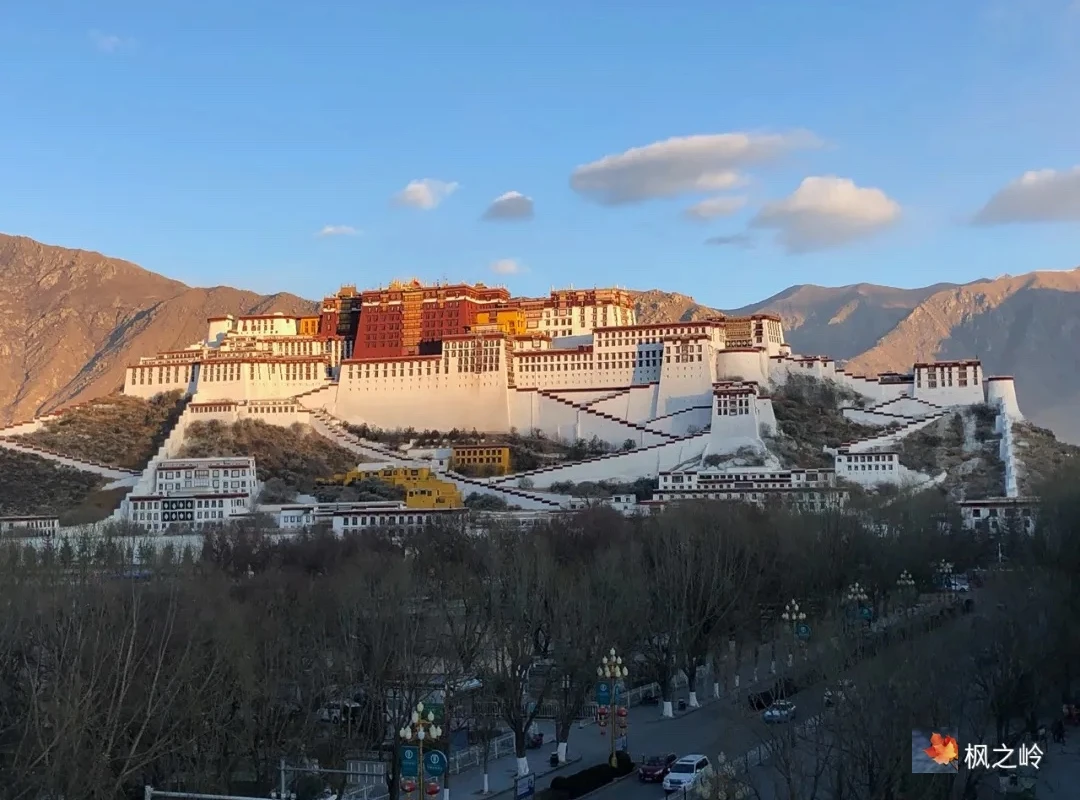
Impressions of Tibet: Potala Palace and Zongjiao Lukang
Waking to the first light of dawn, I saw Lhasa’s morning sun already gilding the Potala Palace. I hurried to wash up, ate breakfast, and rushed out to catch up with the kora procession on the streets.
By the time I reached the front of the Potala Palace, streams of people were converging from all directions, moving from east to west. Everyone walked briskly with purpose. I had no idea where the start or finish was, so I simply merged into the crowd and tried to keep pace.
In the procession, some chanted aloud, others murmured to themselves, but hardly anyone conversed—all were focused on walking. Some held prayer wheels aloft, spinning them as they moved, their lips reciting what might have been sutras or mantras.
It is said that in old Tibet, only monks trained in monasteries could read. To overcome the difficulty of reading scriptures, ordinary people would place written sutras inside a cylinder. Each full rotation was considered equal to reading the sutra once—hence the origin of the prayer wheel. I am sure Buddhism offers a deeper explanation, but this one is easier to grasp.
The kora procession circled the Potala Palace clockwise. Now and then, some would stop, face the palace on the hill, and pray.
For Tibetans, the Potala Palace holds a place in their hearts akin to the Forbidden City for Han Chinese—a building that has become a totem, imbued with spiritual meaning.
Among those doing the long circuit from the square past Yaowang Hill, some perform full prostrations. There, the crowd is thinner and there is enough space, so they don’t block the flow of walkers.
By following the kora crowd, you can observe the Potala Palace from many angles around Red Hill, each offering a different impression.
From the street corner by the white stupa at Yaowang Hill, the Potala Palace looks much like an ancient European castle.
The rear side is equally imposing, with tall, steep stone walls that are nearly impossible to scale.
In the age of cold weapons, this stone-built castle-palace would have been truly impregnable.
On the north outer wall are exquisite painted images of Buddhas.
Lacking sufficient Buddhist knowledge, I could not interpret their meanings.
As I walked with the crowd, I somehow drifted away from the kora procession and entered a park.
The park was dotted with many stupas, said to be for subduing demons.
This area was originally part of the Potala Palace grounds. When the Fifth Dalai Lama rebuilt the hilltop palace, large amounts of earth were dug from the back of the hill. Because the water table on the Lhasa plain is high, the pit filled with water, forming a pond.
In winter the lake was partly frozen, beautifully dotted with wild ducks and geese.
It was a delightful surprise to see so many wild ducks and geese gathered here in the deep of a high-plateau winter.
During the time of the Sixth Dalai Lama, to further improve the pond, an island was built up with earth in the lake and linked to the shore by a five-arched stone bridge.
On the island, a three-story pavilion was erected and named “Zongjiao Lukang,” meaning “Dragon King Pond Temple” in Chinese.
This pavilion was constructed according to the Buddhist “mandala” design. The first and second floors are perfectly symmetrical cross-shaped halls, while the top floor is a hexagonal shrine housing deity statues.
Along the shore and on the island are many ancient willow trees with twisted shapes, over a hundred years old. The willow is a truly remarkable tree—whether north or south, it can thrive by rivers or in deserts. As the saying goes, a carelessly planted willow grows into a grove; it survives even the harsh conditions of the high plateau.
After the “Democratic Reform” in 1959, the Potala Palace returned to the people, and Zongjiao Lukang was renamed “Liberation Park” and opened to the public.
From then on, this once forbidden garden of the nobility became a place of secular recreation. No longer was it merely a playground where aristocrats rowed yak-skin boats on the lake; now it is filled with ordinary people doing morning exercises and kora pilgrims. Today, “Liberation Park” has been renamed back to “Zongjiao Lukang Park.” To the north are residential areas built after the 1980s, home to Lhasa’s new generation of wealthy residents.
On a clear winter day, following the crowd around the Potala Palace on the kora, one feels not the least bit cold.


