Mysterious Lhasa, Majestic Scenery: Self-driving the Lhabei Ring Route to Experience the Rich Landscapes and Culture of the Qinghai-Tibet Plateau
How far is Lhasa? Six hours flying above the clouds.
I always have so much to say about Lhasa, this city of sunlight that holds so many of my beautiful imaginings. This autumn, I finally set foot on this soulful land again, to embark on an in-depth self-driving journey along the Lhabei Ring Route. The road is long, and gentle things are bound to happen; taking it slow is also a kind of sincerity. Passion and excitement have taken my travels further and further, and this deep exploration of Lhasa's surroundings is a journey I have long awaited.
The Lhabei Ring Route strings together the most magnificent landscapes around Lhasa, gathering its finest cultural and natural sights. Experts hail it as a golden scenic route on the Qinghai-Tibet Plateau, with the richest landscapes in a compact loop.
【About the Lhabei Ring Route】
The Lhabei Ring Route consists of one main line, two auxiliary lines, and four branch lines. It is a golden scenic loop around Lhasa, roughly forming a rectangle oriented northeast, and administratively covering all districts and counties of Lhasa.
The main line starts from Lhasa, follows the Lhasa River downstream to Qushui, enters the Yarlung Tsangpo Valley, goes upstream to the mouth of the Nyemo Maqu River, then follows that river through Nyemo and Majiang to near its source, crosses the Xogula Pass (5,454 m), and enters the southwest-northeast trending Yangbajain–Damxung wide valley basin. Then it turns southeast at Damxung Nyingzhong, follows the Wulong Qu (Dam Qu) downstream to Lhundrup Pangduo, then down the Drigung Tsangpo to Maizhokunggar Nyimajangre, where it turns southwest. It continues down the Lhasa River through Maizhokunggar and Dagze back to Lhasa.
The main line is about 800 km long. Route: starting from Lhasa, heading west, leaving Doilungdêqên, passing Qushui, Nyemo, reaching Damxung, then southeast through Lhundrup and Maizhokunggar, via Dagze, returning to Lhasa.
There are also four branch lines: one from Damxung to Namtso at the east end of the northwest section; two in the northeast: one from Pangduo along the Reting Tsangpo to Reting Monastery, and one from Drigung Tsangpo to Maizhokunggar Nyimajangre along the Xuerong Tsangpo to Drigung Til Monastery; and one in the southeast from Maizhokunggar along the Maizho Qu and National Highway 318 east to Mira La Pass.
Inside the loop, there are two auxiliary lines: one from Lhasa to Yangbajain and one to Lhundrup.
Since the whole route revolves around Lhasa, transportation is very convenient. On this trip, I sometimes returned to Lhasa for the night and continued on other auxiliary routes. Endless mountains and undulations, dedicated to my beloved Lhabei Ring Route.
【Pre-trip Preparations】
1. Before departure, be sure to bring sunscreen (SPF 50+ recommended) and sunglasses. If you get carsick, don't forget motion sickness pills; also mosquito repellent balm, band-aids, and cold medicine.
2. The Lhabei Ring Route's elevation ranges mostly between 3,600 and 5,500 meters. For first-time visitors to high altitudes, it's advisable to take Rhodiola rosea in advance and carry altitude sickness medication. On the first day in Lhasa, avoid strenuous exercise and you can skip showering.
3. Autumn in Lhasa has a large temperature difference between morning and evening. Besides regular fall clothing, bring a windbreaker or down jacket. For snowy mountains and glaciers, trekking poles are recommended.
4. Ladies, remember to wear bright-colored clothes for better photo poses.
5. Essential photography gear: camera, phone, tripod—they will enrich your travelogue. I brought a Sony A7II with two lenses (24-240mm and 16-35mm), and an iPhone.
Vast mountains and rivers, life’s hustle and bustle—the most beautiful scenery is on the road. This autumn, come to Tibet for a journey of love and dreams, and encounter the unique natural beauty and cultural charm of the Tibetan land along the Lhabei Ring Route.
The road is long, and gentle things are bound to happen; taking it slow is also a kind of sincerity. Lhasa is a poetic dreamland for many, with an altitude of 3,650 meters and over 3,000 hours of sunshine a year, earning it the name 'City of Sunlight.' Many say Lhasa is a city short of oxygen but never short of faith. When traveling to Lhasa, everyone heads to Barkhor Street first thing.
Since my first visit to Barkhor Street, I've fallen in love with its atmosphere. Every time I come to Lhasa, my first stop is always Barkhor Street. Walking among the circling pilgrims, sunlight warming my skin, I feel an indescribable sense of freedom and ease.
Barkhor Street has a long history. Over 1,300 years, this old street has developed a unique Tibetan charm. Originally just a circumambulation path around the Jokhang Temple, Tibetans call it the 'holy road.' It has gradually expanded into a large area of old neighborhoods around the temple, a must-visit for every traveler.
Barkhor Street is Lhasa's famous pilgrimage circuit and commercial center, where classic Tibetan culture blends seamlessly with modern shops. Devotees and tourists coexist without intrusion. You'll see many people doing travel photoshoots in Tibetan costumes—a dream for many travelers.
After scanning our ID cards, we first entered Jokhang Temple Square. There are so many pilgrims; in the late afternoon, the circumambulation is quite a spectacle. The correct way is to walk clockwise around the Jokhang Temple, honoring the statue of Sakyamuni enshrined inside. Walking among the devotees gave me a special feeling—a solemn and reverent devotion.
Barkhor Street is a must-visit pedestrian street in Lhasa, full of stories. Many artsy souls fall in love with it. One classic spot is 'Dabing's Little House.'
I don't know how many have heard of it—this tiny bookstore on Barkhor Street offers a unique tranquility. Through a long corridor, it basks in sunlight, with open shelves of books favored by literary youth and a whole wall of postcards. If you wish, you can just zone out here all day.
The bustling Barkhor Street has many unique little shops. I personally love Thangka (also called Thang-ga). Stepping into one of these shops, the outside noise is shut out. Thangka, a transliteration from Tibetan, refers to religious scroll paintings mounted on colored silk for hanging and worship. It is a distinctive painting art form in Tibetan culture, covering themes from history, politics, culture, and social life. Painting a thangka requires immense patience, and in that moment, the mind is surely at peace.
Many visitors to Barkhor Street make a point of coming to Makye Ame, known for a love story between Tsangyang Gyatso and Makye Ame that embodies the ideal romance many yearn for. Most buildings on Barkhor are white, but only at the southeast corner stands a two-story building painted entirely yellow—not only a popular eatery but also a favorite spot for photoshoots with its yellow walls.
On the third floor of Makye Ame, I chose a window seat to watch the street below. I was with two friends, and we ordered dishes recommended online. Dining at Makye Ame is about nostalgia, and the food didn't disappoint.
Enjoying authentic Tibetan cuisine, butter tea, and the passing scene—such moments are leisurely and lovely.
The story goes that the Sixth Dalai Lama, Tsangyang Gyatso, traveled all over Tibet in search of the supreme savior Tara. One day, while resting in a small tavern on Barkhor Street, a maiden as beautiful as the moon lifted the curtain and peeked in. That enchanting sight stayed with him, and he wrote the timeless verse: 'On the eastern mountain top, the bright moon rises; the face of Makye Ame gradually emerges in my heart.' This beautiful tale gave birth to the Makye Ame restaurant. Many travelers come here to dine, enjoy the view, and feel the connection—creating your own story with Makye Ame. It's all about sentiment.
As dusk falls and lights flicker on, the blue hour is the best time to photograph Barkhor Street. Every afternoon, pilgrims begin their strict clockwise circumambulation.
At 10 p.m., walking on the long stone-paved street, my shadow stretched long, the evening breeze gentle, my heart quiet and content. I love walking in such serene calm; time here slows to a crawl.
Guangming Teahouse is another place everyone visits in Lhasa. Here you can experience authentic Tibetan life. A bowl of butter tea costs just one yuan, warming you right up. With a few friends, order a pot for ten yuan and sip for hours. Prices are low, and many locals love to chat over tea here.
Barkhor Street is endlessly charming: blue skies, white clouds, and the circling pilgrims—a living canvas. It retains the original look of old Lhasa, with streets paved by hand-hewn stones and traditional Tibetan houses. You can never take enough photos; it looks beautiful from any angle.
Sitting quietly in a corner of Barkhor, basking in the sun, I looked up to meet the smiling face of an elderly Tibetan across the way. That moment is why I love Lhasa. Ask me how far the horizon is—I think this is what Lhasa looks like right now.
When I dwell in the Potala Palace, I am the greatest king of the snowland.
When I wander the streets of Lhasa, I am the most beautiful lover in the world.
In September, a light drizzle fell as I entered the Potala Palace to fulfill a long-held dream. Every encounter needs time to mature before it can be complete.
Back in Lhasa, back to the Potala Palace. Everyone who loves Lhasa has a special feeling for it. When traveling here, it feels like you haven't truly been to Lhasa without a photo in front of the palace. So what's the story behind it?
This autumn, I entered the Potala Palace for the first time—a long-anticipated fortress-like palace complex. Built in the 7th century, it's an iconic landmark and the tallest building in Lhasa. Initially, it was constructed by King Songtsen Gampo of the Tubo Dynasty to welcome Princess Wencheng of the Tang Dynasty. The main structures are the White Palace and the Red Palace.
Tickets to the Potala Palace must be reserved in advance. Only with a reservation can you exchange for an official ticket. Remember to dress appropriately: no short sleeves or shorts. Photography is prohibited indoors, and hats must be removed. Follow the rules.
Despite the rain, we were thrilled to get tickets. Off-season (Nov.1–Apr.30) tickets cost 100 RMB per person, with concessions at 50 RMB. Peak season is 200 RMB, concessions 100 RMB. Special promotions happen occasionally, such as free admission earlier this year before March.
Many take a photo in front of the Potala Palace to prove they've been to Lhasa, but you really should go inside to feel its grandeur. The total building area exceeds 130,000 square meters, with the main structure standing 117 meters tall across 13 floors, containing palaces, stupa halls, scripture halls, monks' quarters, and courtyards. It's the world's highest and largest fortress-style complex and the tallest building in Lhasa.
I highly recommend listening to a guide's explanations; otherwise, you'll miss the deeper stories behind everything.
Over 1,300 years, the Potala Palace holds an irreplaceable place in people's hearts. Walking through the Red Palace, the solemn atmosphere, huge gilded canopies, and red prayer flags exude strong Tibetan style, all full of mystery. What amazed me most were the Buddha statues and stupas made of gold and jewels.
The toilets here are called the highest in the world, built at 3,700 meters with a drop of about 60 meters. Once they were pit toilets, jokingly said to have a 'cascade.' Now, modern facilities make them very clean.
Many wonder why the Potala Palace always looks so vividly colorful. Every year around Tibetan New Year, it gets a fresh coat of paint. It's called the 'Sweetest Palace' because the paint mixture includes milk, sugar, honey, and brown sugar.
The Potala Palace houses countless treasures and precious historical artifacts: over 2,500 square meters of murals, nearly a thousand stupas, tens of thousands of statues, and tens of thousands of thangkas. There are also rare palm-leaf scriptures, the Kanjur, and other canonical texts; Ming and Qing imperial documents, gold and jade seals granting titles to Dalai Lamas, and vast collections of gold and silver objects, porcelain, enamelware, jade, brocades, and exquisite handicrafts. These artifacts are dazzling and diverse. That's why people say gold is the cheapest thing in the Potala Palace. Walking through the solemn halls, the jewelry is astonishing—even the butter lamps are made of pure silver.
The annual repainting involves not only professionals but also local Tibetan volunteers who sign up in advance. The white paint for the White Palace is primarily lime from Yangbajain in Damxung, known for being pure, smooth, adhesive, quick-drying, and resistant to rain and sun.
Seeing the White Palace up close was thrilling. The annual 'dressing' tradition has lasted over 300 years, not only for aesthetics but mainly to protect the walls from summer rain erosion, preserving this precious old Tibetan architectural complex. That's why the palace always looks so vibrant.
In the Potala Palace, I met a cat. Because it rained when I came, runoff from the Red Palace walls had dyed its fur a cute pink. It wasn't shy at all, just leisurely enjoying its time—utterly adorable.
From the outside, the Potala Palace appears to have 13 floors, but actually only 9. At 3,700 meters, its main structure is 117 meters tall. In the high altitude, we took safety seriously and climbed stairs slowly. As Lhasa's tallest building, it offers a panoramic view: rows of houses with snowy mountains and clouds in the distance, a pristine lake below. Standing quietly, breathing deeply, you feel the charm of the Sunlight City.
The whole visit takes about three hours. Because of the crowds, time inside the White and Red Palaces is limited—usually one hour. Indoor photography is prohibited, but once outside, you can take plenty of photos.
The profound history and unique Tibetan style give the Potala Palace deep meaning. It has many stories, and only when you arrive will the answers slowly unfold.
On this stop of the Lhabei Ring self-drive, I visited Dadong Village, nestled in a valley, drawn by its reputation. Endless mountains and hills pay tribute to this secluded, paradise-like hamlet.
Dadong is a thousand-year-old village, still keeping a leisurely pace amid long history. You feel its serenity and rustic charm, with ancient houses built on slopes beside the valley, surrounded by mountains and water—a true retreat from the hustle.
Dadong is a storied ancient village, hailed as Lhasa's most beautiful. Tsangyang Gyatso once lived here for three years, and his estate remains among majestic green mountains, with Gesang flowers blooming at the gate.
Dadong's hot springs are famous within a ten-mile radius. I was surprised to find them here. At 138 RMB per person, sitting in a valley, enjoying blue skies and white clouds, a mountain breeze—what greater joy in life?
The story of Tsangyang Gyatso made me curious about the village. His former residence is now in ruins, stubbornly silent in the vast nature, bearing witness to his past presence. Today, an ancient walnut tree stands in Dadong, under which he wrote a heartfelt love poem. If you admire him, come search for this tree.
Autumn Gesang flowers were especially beautiful. Dadong, a hidden Tibetan village in Lhasa's southwest valley, is one of Tibet's best-preserved ancient villages. I especially loved its pristine natural environment, so pure and simple it makes you want to slow down.
Celebrating Linka in Dadong is pure joy. The white tents by the mountain stream are set up by locals for this purpose. 'Linka' in Tibetan means garden or grove. After the long plateau winter, the brief summer arrives with bright sunshine and gentle warmth—the most precious season. Tibetans cherish nature's gift, so they head outdoors with food to the leafy linkas to enjoy time with family.
Linka is Tibetans' favorite way to relax. Sitting together in tents by a clear stream, they sing and dance Guozhuang. Visitors to Dadong can join the locals or rent a white tent for themselves and friends. When I arrived, I saw Tibetan children playing by the stream. They were happy to take photos with me and eagerly came to see the pictures on my camera afterwards.
White clouds drifted among the rolling mountains. After a thousand years, Dadong still keeps a quiet, slow rhythm, like a paradise quietly blooming. The autumn scenery—high skies and faint clouds, unchanged homes—presents a serene pastoral idyll.
Tibetan travel always brings surprises. On this Lhabei Ring trip, as we approached Qushui County, a secluded village caught my interest—Junba Fishing Village, near the confluence of the Yarlung Tsangpo and Lhasa rivers.
Many find Junba unfamiliar because in the past, it was isolated by poor transportation. I was curious because Tibetans, following Tibetan Buddhism with water burial customs, revere fish as ancestors and deities, thus never eating fish. So why did Junba live by fishing?
On a sunny day, I explored the village paths. It looked like a typical Tibetan hamlet: white walls and red-tiled courtyards, with people living leisurely.
In a corner, an oxhide boat piqued my interest. Locals said these are traditional water vessels for Tibetans on the plateau and vital for Junba's survival. The oxhide boat dance of Junba is a unique folk dance, now a national intangible cultural heritage. Finding joy in harsh conditions—this is how people live harmoniously with nature.
When I arrived around 1 p.m., the local kids were curious about a stranger. When I took out my drone, they crowded around excitedly, asking if it was a drone. With the completion of 'two bridges and one tunnel,' Junba is no longer isolated; children go to school, connecting with the outside world. They happily agreed when I asked to take their photos.
Flying my drone over 300 meters high for an aerial view, I saw a temple on a distant hill. The kids said they often climb to the top to overlook the whole village.
White clouds drifting through the mountains, quiet Junba changes greatly year by year. I hope after seeing the world's hustle, they can still keep their simple nature—that's the peaceful life we hope for.
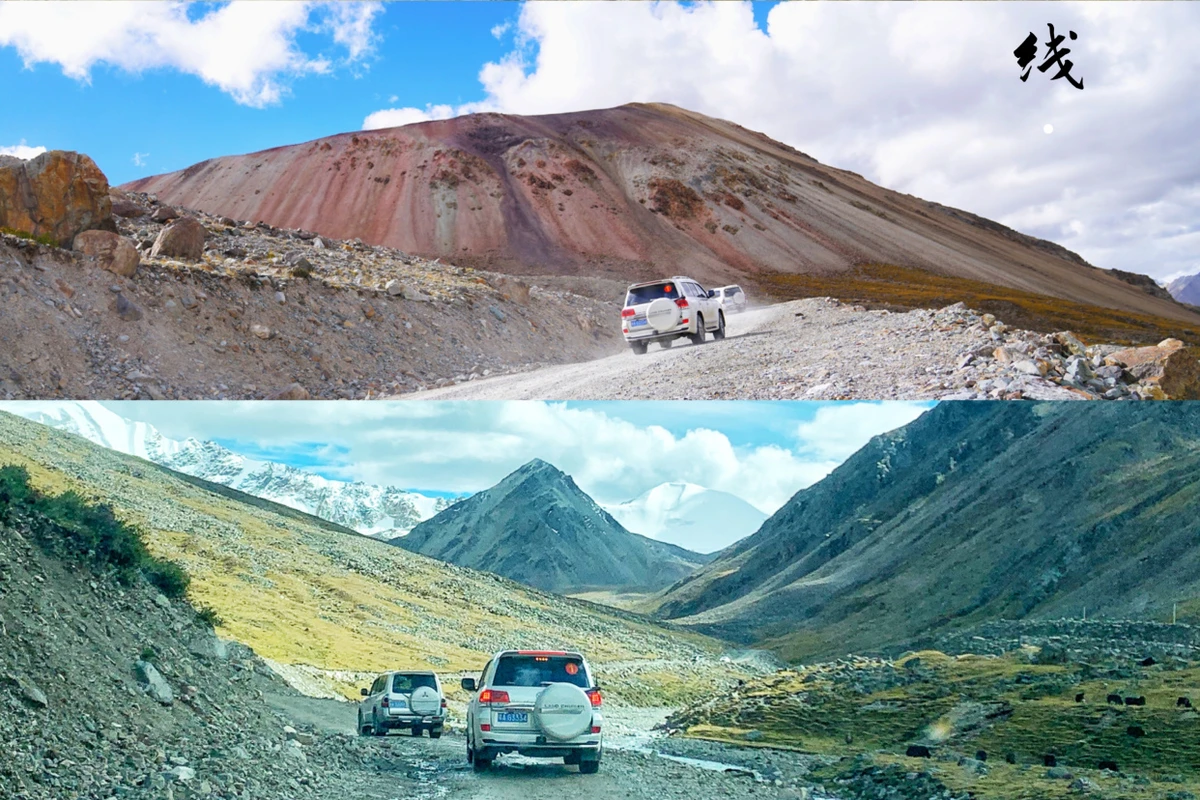
Self-driving the Lhabei Ring Route is both fun and challenging. You'll encounter completely different landscapes: snowy mountains, glaciers, winding roads, and Tibetan villages hidden among the peaks. Not to mention the attractions—the road itself is thrilling. That endless vast distance, seemingly boundless, brings inner peace. This feels like what travel should be.
Today we reached a snow mountain in Majiang Township, Nyemo County: Qiongmugangga. Tibetans revere it as a sacred mountain, but many travelers don't know about it—a easily missed, off-the-beaten-path gem, and free of charge. If you're on the Lhabei Ring Route, don't miss it.
Fortunately, the weather was clear when I arrived. In Tibet, good weather means great views. Qiongmugangga means 'Goddess of Wisdom' in Tibetan. At 7,048 meters, it's the last high peak of the southern Nyenchen Tanglha range, one of China's 12 sacred mountains, about 140 km from Lhasa. Even at the base, the scenery is striking.
Few tourists come here; many monks from Lhasa monasteries make pilgrimages for kora. The 7,048-meter altitude is a huge challenge even for mountaineers. According to records, since the 1990s, there have been only four successful summits. Ordinary visitors like us usually hike around 5,500 meters, higher than Everest Base Camp's 5,200, making the ascent quite tough.
The beauty of high-altitude Tibet lies in its pristine clarity. This autumn, withered grass stretched everywhere without a hint of bleakness. Over the rolling snow mountains, a few clouds drifted leisurely, as if adding a touch of brightness to my lens. I climbed toward the snow peak; though it was tough, my heart was full of joy.
Along the path, I saw mani piles built by locals—some inscribed with the six-syllable mantra, others just stones from the mountain, common at sacred peaks and lakes for prayers and blessings. Clouds hung so low they seemed within reach. Occasionally, a drizzle came as I hiked; the mountain microclimate was unpredictable, but it didn't dampen my mood at all.
Qiongmugangga's terrain is complex—ice walls, mixed ice and rock, rock faces, snow bridges, cornices, hanging glaciers, and dangerous avalanche zones. Shooting a time-lapse here is super cool but requires patience. Sometimes travel isn't about a quick glance but about calming the mind to feel and enjoy—that's the true meaning.
Hiking at 5,500 meters isn't easy, but when the views appear, every step feels worth it. Deep within Qiongmugangga lies a clear blue lake, formed by melting snow and ice. Here, the four water systems—Lhasa River, Nyemo Maqu, Xiangqu, and Namtso—converge. Snow mountains and sacred waters nourish each other, creating a unique blue-ice wonderland, only visible to those with the right karma.
I also met monks who had come specially from Lhasa for the kora. They were well accustomed to high-altitude trekking. Their red robes under fluttering prayer flags looked sacred. I smiled and greeted them, and they resolutely headed onward.
Standing on the vast plateau, the wind blowing across my face, my heart felt utterly free. You forget all worldly worries, empty yourself, take a deep breath, and enjoy the warm sunshine and the plateau's unique beauty.
The journey takes you farther, and you meet like-minded friends along the way. We get excited over a photo or a time-lapse. People who love travel are probably big-hearted, eager to share, and at ease with comings and goings.
The beautiful Qiongmugangga Snow Mountain is a shining gem on the Lhabei Ring Route, silently waiting in a corner of the earth for more self-drive enthusiasts to discover.
True travel isn't about going to new places, but about having eyes to see beauty. This autumn, departing from Lhasa and driving the Lhabei Ring, I sought encounters on my own path. Namtso has always been a place I yearned for. I think everyone who dreams of distant places has a Namtso in their heart—a clear, pure blue.
Even before arriving, I prayed for good weather. Namtso is the world's highest large lake, a poetic dreamland, at 4,718 meters. On a clear day, it's stunningly beautiful.
Autumn Namtso, magical and dreamy, with the Nyenchen Tanglha mountains to the south reflecting in the turquoise lake. Seagulls, yaks, huge clouds—time seems to stand still.
At Namtso, we took the scenic shuttle bus to Tashi Dor Peninsula, stopping at the Black Tent viewpoint for photos on the way. Namtso, in central Tibet, is the second largest lake in Tibet and China's third largest saltwater lake.
Seeing the classic Welcome Stone on Tashi Dor Peninsula tells you you've arrived at the shore. We all know Tibet has three sacred lakes: Manasarovar, Namtso, and Yamdrok. Manasarovar at nearly 4,588 meters is one of the highest freshwater lakes, while Namtso is the world's highest saltwater lake. Many visitors offer katas and make wishes here.
Standing by Namtso, gazing at the distant snow mountains, seagulls were unruffled by visitors, leisurely playing. The scene was intoxicating.
Namtso is called the Plateau Goddess, its purity and tranquility emblematic of the highlands. For travelers, Namtso now refers to two areas: Tashi Dor Peninsula, the must-visit spot, and the Holy Elephant Door, a recently popular Instagrammable site. Tickets for Tashi Dor are available anytime; Holy Elephant Door requires booking three days in advance. I chose Tashi Dor this time.
The yaks by the lake are eye-catching, specially decorated by locals for tourist photos. It costs about 10 RMB per person, and you can strike any pose. Behind, the rolling Nyenchen Tanglha peaks with clouds drifting year after year—everything is dreamily beautiful.
I specifically took a spherical aerial shot of Namtso—looks cool, right? Namtso's history is extremely long. Geologically, the lake area belongs to the Lhasa terrane, with a basement of Precambrian continental crust at least a billion years old. Over eons, it accreted onto parts of the Qiangtang terrane in the Late Jurassic. Conversing with such deep time, in this moment I just want to empty myself, walking along the azure shore.
To truly appreciate Namtso's beauty, consider staying overnight. With luck, you can capture the golden sunrise on the snowy peaks. Sunset brings golden skies that are breathtaking. At night, the starry sky sparkles; the vast land is magnificent. The lake is over 70 km from east to west, with endless scenery along the way.
If time allows, drive around the lake. The circular road is about 300 km, much of it rough like the northern Ali route, but the scenery is stunning. Due to time, I didn't do it this trip, leaving that for next time.
Because of Namtso's high altitude, it's best to acclimate in Lhasa first. It can be very windy, so dress warmly. If you want a yak photo, agree on the price beforehand with the local herder.
When we arrived, the weather was splendid. After taking photos, as we got back to the car, it suddenly hailed—the climate here is truly magical. Lhabei Ring self-drive, next stop, see you on the road.
True beauty in this world never shouts or seeks attention; it waits to be found, captured, and seen. Like this September, I encountered the Kuoqiong Gangri Glacier. On this Lhabei Ring trip, I explored many scenic spots around Lhasa; many offbeat places are stunning but not crowded.
Kuoqiong Gangri Glacier is the closest glacier to Lhasa, reachable by car. It's in Geda Township, Damxung County, near National Highway 304, 160 km from Lhasa. As our car bumped along to the scenic area, I knew nature's awe would far outweigh the hardship of the journey.
After entering the scenic area gate, we still had a stretch of very rustic mountain road. The distant snow mountain and glacier seemed near yet far. Bumping toward it, I was full of anticipation, wondering what surprises awaited.
On the way, we saw blue sheep—the first little surprise. Herds were scattered on the slopes, their coats blending with the rocks unless you looked closely. This camouflage evolved over millennia. They didn't mind tourists, just grazing and playing. Nature's pure beauty gains infinite charm with these animals.
When the glacier came into view, I felt incredibly thrilled. Kuoqiong Gangri combines glacier, lake, and meadows into a unique natural eco-tourism area—a glacier you can drive right up to. Many travel enthusiasts even come here for wedding photos.
Nature is truly amazing. The glacier has clear demarcations. Climbing along previous footprints, the cold wind made me shiver. Looking around, everything was a pristine white. At 5,500 meters, first-time high-altitude visitors might feel unwell; adjust quickly, relax, and you'll be fine. A down jacket is a must.
Climbing on the glacier is tough, but I still wanted to push higher. I have an innate love for vast natural scenery; the higher I went, the more my heart opened. What surprised me most was that aerial photography is allowed here.
Arms wide, I joyfully greeted the glacier wind. This autumn, while many cities still wore short sleeves, I stood on a glacier at 5,500 meters in a down jacket, under blue skies and white clouds. Gently cupping glistening snow, it felt uniquely cold. At this moment, some words are left unspoken. Lightly I sketch the long days, softly hum vague tunes. Longing spills over the Dagu Glacier, drifting toward where you are.
The ticket is 149 RMB, and you can return the same day. Honestly, the glacier is quite challenging to climb, so bring trekking poles. High-altitude activities should be within your limits. If you feel unwell, descend early. One important note: on the glacier, I saw cigarette butts and oxygen canister caps. I hope everyone pays attention to environmental protection, starting with ourselves, to preserve nature's gifts. Beauty needs our collective care.
Descending from the glacier, we headed to the next stop. The pure natural scenery on the Lhabei Ring Route draws us into nature's primal beauty. Just feel it with your heart, and you'll have a unique journey.
Zhayeba Temple in Lhasa was built in the 7th century, with a history of 1,500 years. In the rain, climbing from 4,200 to 4,400 meters to reach the temple takes courage. I watched clouds drifting past the white stupa; the temple perched on the cliff had the beauty of a hidden paradise. Zhayeba is tightly nestled in a crevice, said to be a meditation temple built by Princess Mangsa Chijang, a consort from Songtsen Gampo's lineage. Here you can also see the cave where Songtsen Gampo meditated.
Halfway up, the paths around the temple are narrow. Building such a temple in these mountains required great perseverance and time from the ancients. Zhayeba brims with natural energy, an architectural marvel created by nature and human hands.
Amid misty mountains, chilly air, and the yellow-and-white temple, Zhayeba feels secluded and solemn. As one of Tibet's four great hermitage temples, it still keeps ancient customs, detached from the world. In the 11th century, the Indian master Atisha wrote texts and taught here; his former dwelling and meditation cave remain. Lhari Ningbo Mountain gains its spirit from Zhayeba Temple.
The Lhabei Ring self-drive journey is about courage and dreams. When I gaze up at the snowy mountains, my heart feels clear and serene. Such quiet moments are an inward journey. The days of travel are wonderful and fascinating—this kind of walking is not only intimate contact with the world but also an adventure to become a better me.
Tibet travel: at this moment, I'm on the road.


