Seasoned Beauties Brave the Sichuan-Tibet Northern Route G317 (Sichuan Chapter)
Itinerary: Guangzhou – Chengdu – Panda Breeding Research Base – Chengdu – Yingxiu 5.12 Earthquake Ruins – Ganbao Tibetan Village – Zhuokeji Tusi Official Fortress – Jinchuan Guanyin Bridge – Seda – Donggar Monastery – Ganzi County – King Gesar’s City – the G317 Internet-famous Old Man – Xinluhai – Dege County – Dege Printing House – Jomda in Tibet – Chamdo – Qiangbalin Monastery – Zizhu Monastery – Dengqen – Buga Snow Mountain – Baqen – Zandan Monastery – Sapu Sacred Mountain – Biru County – Biru Skull Wall – Nagqu City – Shengxiang Tianmen – Damxung – Lhasa Wandering – Drepung Monastery – Potala Palace Night View – Xining – Guangzhou
The Sichuan-Tibet Northern Route, National Highway G317, is a highway of cultural landscapes, another route from Sichuan into Tibet after G318. Because G318 is so famous, its glory completely overshadows G317, and one rarely hears or sees any travel photography of this route. It was only in 2016 when I was traveling in western Sichuan, due to our driver taking a wrong turn and detouring over 100 extra kilometers onto G317, that I happened upon a local Tibetan event in Zamtang and got a tiny taste of the Tibetan culture along this route. Not until 2020, when internet-famous spots such as Zizhu Monastery, Sapu Sacred Mountain, and Shengxiang Tianmen began to emerge one after another along this line, did the idea of traveling the G317 northern route firmly take root in my heart—impossible to shake off. Seize the moment, go while you still have the impulse and your health allows. I worry that as I age, I’ll be even less likely to dare such a tough high-altitude route later. This was my second trip into Tibet this year and my fifth overall. Tibet always holds a magic for me!
Originally planned to charter a car, but we couldn’t gather three people, so we switched to joining a group tour. A colleague recommended an online route; though not ideal, we were on our way at last! Three of us in one car, plus the driver-guide, made a perfect four—the best combination!
An early morning flight whisked us from Guangzhou to Chengdu. The forecast: ground temperature 22°C, overcast with light rain.
I remember my last visit to Chengdu was in June 2016 on a photography trip through western Sichuan—what a delightful journey that was! Everything is still vivid in my mind. The timing was perfect, the scenery perfect, the company perfect. Now, coming to Chengdu again, that joyful feeling eludes me.
Today Chengdu was overcast. The driver who picked us up told us that Chengdu’s weather is pretty much the same most of the time, rarely sunny. We were arranged at the Biji Hotel Apartment (Chunxi Road branch) at 53-57 Taisheng South Road, Jinjiang District—the conditions were okay.
With only half a day in Chengdu, we chose to visit the Panda Breeding Research Base. Though I’ve been to Chengdu many times, this was my first time inside the panda base. The environment is wonderful—lush groves of green bamboo—such a blessed life for these adorable giant pandas! Some pandas contentedly munched on a bamboo feast by themselves, some climbed trees, their chubby bodies seemingly no obstacle at all, while others snored away sound asleep. Whatever they do, whatever sounds they make, their naive charm endears them to everyone. No wonder they are national treasures.
Just then, news from Guangzhou of a positive COVID-19 nucleic acid test broke our sightseeing mood. We knew what lay ahead on the journey. Immediately we hailed a taxi and sped back downtown, getting tested at Chengdu Third People’s Hospital before closing time to prepare for any unforeseen circumstances. Meanwhile, word came that Xinjiang was imposing a 14-day quarantine on residents from Guangzhou, and tourists flying to Xinjiang that day were all being turned back.
Our journey thus began at such a special moment.
Savoring local cuisine is an indispensable part of travel. That evening, in a nearby alley, we found a restaurant—Huifu Xiaoyuan—and several specialty dishes were truly delightful: Specialty glutinous rice duck: a layer of crispy duck skin on top, a layer of fragrant rice crust on the bottom, with soft glutinous rice mixed with a few Sichuan peppercorns in between; Braised pork with taro: the aroma of meat and taro perfectly intertwined; Handmade tomato noodles: the tomato and cucumber soup was fresh and the noodles had a great chewy texture. We ate to our hearts’ content, then slept soundly—ready to hit the road tomorrow.
Driver-guide Jiang Wei picked us up at the hotel before 8:30. Our vehicle was a Nissan Qirui 2.5T. The travel agency had switched from the originally advertised Prado to a Pajero, and now to a Qirui? Well, our driver-guide was a likable, handsome young man, the car was fairly spacious, and most importantly, it accommodated us three seasoned beauties. Four in one car is the optimal setup.
Today being the weekend, the highway was heavily congested—supposedly many city folk heading to Wenchuan to pick cherries, right in cherry season.
[Yingxiu 5.12 Earthquake Ruins]
The Wenchuan Yingxiu 5.12 Earthquake Ruins was a spur-of-the-moment stop. I simply wanted to see the remnants of that devastating Wenchuan earthquake on May 12, 2008—the most destructive, widespread, and difficult-to-rescue disaster since the founding of our country. The site is at the former Xuankou Middle School in Yingxiu.
Entering the memorial park, my breath caught instantly. That frozen clock, forever marking the moment the quake struck, stands there. Most buildings on campus had collapsed; the fallen schoolhouses surround the one remaining tower, where a national flag flutters.
The ravaged classrooms were too heartbreaking to behold—tilting, leaning, some completely collapsed, some half-down, others laced with cracks. What a horrific scene it must have been back then! The earthquake not only destroyed buildings but claimed countless precious lives. Mist and clouds wreathed the green hills, paying silent tribute. The dead have passed; the living must carry on!
Visiting the ruins and mourning my compatriots brought back memories of the condolences trip right after the Wenchuan earthquake 13 years ago—bits and pieces I witnessed then. In the background, that blue clock in the distance is the prototype of the time-frozen clock.
Lunch was in Xuechen Town, around 1 p.m., having covered only a third of the day’s distance.
[Ganbao Tibetan Village – an ancient village over 2,000 years old]
Today’s itinerary had three villages: Taoping Qiang Village, Ganbao Tibetan Village, and Zhuokeji Tusi Official Fortress, each with its own charm, covering the three major Tibetan architectural styles of the region. Due to time, we opted for the latter two.
Ganbao Tibetan Village, in Li County of Aba Prefecture, is over two millennia old. Nestled against cliffs by water amid mountains, the village we saw was rebuilt after the 5.12 earthquake, largely restored to its original appearance.
Approaching the village gate, I was immediately captivated by its unique architectural style. The mountain gate, built of local stone, is a sight in itself—solemn, imposing, facing the green mountains. Through the gate, tier upon tier of classic Tibetan homes, connected building to building and house to house, rise like a massive stone castle. It’s hailed as the “No.1 Village of the Gyalrong Tibetan Area.” In Tibetan, ‘Ganbao’ means ‘village on the hillside,’ and locals used the very stones at hand to create this thousand-year-old fortress.
Climbing the stone steps, I came upon a statue of a Gyalrong Tibetan couple with a little dog, standing guard before a prayer wheel. I gently turned the semi-circular prayer wheel to bless our journey. A sculpture of ‘two oxen shouldering a yoke’ depicted the local way of plowing with yaks. Looking up at the facing stone wall, a huge gold-foil portrait of King Gesar shone resplendently in the sunlight. Prayer flags fluttered on the mountaintop, and a watchtower rose prominently above the clustered houses.
Ganbao Tibetan Village had very few visitors and no entrance fee—well worth a leisurely savoring.
[Zhuokeji Tusi Official Fortress – where the Red Army once passed]
This was my second visit. The last time was in October 2015 on an autumn photography tour to Daocheng Yading; we arrived too late and only saw the exterior, never getting inside.
Today the weather was exceptionally fine. Even after 5 p.m., the sun was still up, and with few visitors, we could take our time examining the fortress carefully.
This is an extremely majestic and imposing, entirely wooden structure, uniquely crafted, standing on a hilltop. Construction began in 1718 during the Qianlong reign of the Qing Dynasty. The fortress is enormously famous because, besides being wonderfully preserved, it is also the prototype for the story in the Mao Dun Literature Prize-winning novel ‘Red Poppies’ by renowned Gyalrong writer Alai, and the filming location for its TV adaptation. The novel and series introduced many to the tusi system, cloaking the fortress in mystery. Even more importantly, the Red Army on the Long March passed through here and held the crucial Zhuokeji Conference. Mao Zedong, Zhou Enlai, and Zhang Wentian all stayed here—red stories indeed happened in this place.
In June 1935, the Central Red Army, during the Long March, passed through Barkam, crossed Mengbi Mountain, and entered the Zhuokeji area. They were blocked by local tusi soldiers and forced into a battle, winning and occupying the fortress. Eventually the tusi agreed to let the Red Army rest and reorganize here, vacating rooms. On July 3, Mao Zedong, Zhou Enlai, Zhang Wentian and other central leaders along with the central authorities moved into the fortress and stayed for a week. In 1988, Zhuokeji Fortress was listed by the State Council as a Major Historical and Cultural Site Protected at the National Level. Inside, the Red Army conference room and Zhou Enlai’s quarters are still preserved.
Climbing a flight of stone steps, we reached the fortress gate, a strikingly distinctive gateway. Behind it stands a screen painted with a tiger. There is a legend: when the construction of the first Zhuokeji Tusi Fortress was nearing completion, a tiger came down from the mountains, lay by the main gate for a whole day and night, then quietly left. Tigers are extremely rare in that area. Thus, besides meaning ‘supreme’ or ‘topmost,’ the name Zhuokeji is also said to be ‘a place of hidden dragons and crouching tigers.’
A tall Tibetan-style flagpole stands before the gate, topped with a sun-and-moon emblem. A long mani prayer banner billows mightily in the wind, warding off all harmful spirits.
Zhuokeji Tusi Fortress is large in scale and exquisite in construction, showcasing almost all the architectural features of Gyalrong Tibetan art. It was both the residence of the tusi and his family and his administrative office. Wood, stone, and clay are the three primary elements of traditional Tibetan architecture. The main body of the fortress comprises four tall stone-and-timber buildings connected without a single iron nail. Through stone walls, winding corridors, and lattice windows, it blends the superb architectural arts of Tibetan and Han peoples, a classic example of their profound integration.
It follows a Han-style courtyard layout. The northern main building is a faux six stories; the eastern and western wings are five stories, with a central courtyard, totaling 63 rooms large and small. Standing in the courtyard and looking up at each floor gives a feeling of awe and a slight eeriness! The ground floor focuses on Gyalrong culture, the second floor on red culture, the third showcases tusi culture, and the fourth displays religious culture.
Climbing the Tibetan-style building isn’t easy; you must grip the round wooden handrail to ascend, and the stairs are narrow and steep, requiring great caution. I slowly browsed from room to room, visiting at least 40. A tusi indeed had many treasures—both precious items in Gyalrong Tibetan style and classics from Han culture.
This is truly a blessed place; inside and outside the fortress, I saw colorful auspicious clouds in the sky several times.
That night we stayed at Miaoxin Lianshe Hotel in Guanyinqiao, a small hotel by the Suomo River—a triple room. Because Seda was closed to visitors, the once bustling, lively Guanyinqiao Town was now deserted; only the newly opened Tibetan Red-themed inn had a bit of character. We slept to the rush of the river.
Waking up and opening the window in the morning: a wide river with rolling waves, clouds and mist wreathing the mountains. The most famous local Guanyin Temple sits atop the hill. On the opposite mountain, there’s a huge prayer wheel, with Tibetan houses along the riverbank.
Off again. Traveling the G317 along the Cheng-Na Line through green mountains and clear waters is a sheer delight. Last night’s rain made the hills on either side even more lush; the Zhuosijia River bounced and leapt joyfully alongside. White clouds and mist occasionally appeared over distant ranges, and Tibetan dwellings popped into view on the slopes. Sometimes we’d see stretches of road painted in different colors—rainbow roads.
We stopped before the beautiful No.1 Bridge in Shangzhai Town. This bridge, from body to piers, is steeped in Tibetan style—absolutely gorgeous. I loved it. Just as we arrived, two Tibetans walked across, giving me a chance to snap a candid photo. Beyond the bridge lay the colorful rainbow road; sitting in the middle of it, I captured the beautiful moment.
So far, the road conditions on the G317 were good overall, with only a few spots of landslides or roadworks.
The junction for Zamtang and Luhuo counties presented a sight: a giant promotional wall for Zamtang County on the entire mountainside, strikingly eye-catching, along with rainbow-colored roads and rainbow guardrails—compelling you to stop.
Driving on, a glittering golden monastery came into view in the distance, especially notable for its long ground-floor prayer corridor, I’d estimate a full 200 meters long. This is Jine Temple in Wengda Town, with a viewing platform. Above it sit more temples. Along G317, temples follow one after another, all resplendent. The local Tibetans really put their money into temples.
Shortly after, we saw a heap of prayer flags and a white stupa—nothing unusual in Tibetan areas—but a troop of Tibetan macaques caught our eye, so we stopped at once. It turned out to be a Tibetan macaque conservation and viewing area. Dozens of macaques were leaping and chasing excitedly. Several mothers with their babies jumped from spot to spot; the little ones clung tightly to their moms and darted around them. So amusing! Some bigger macaques ran toward us, chattering loudly as if we’d invaded their territory. These macaques were truly entertaining.
Next stop was Seda. Seda Larung Wuming Buddhist Academy was on the itinerary and a place both companions especially wanted to visit. Xiao Wei asked around and heard that some people could sneak you in for a fee, but whether you’d be discovered and sent back—no guarantee.
We passed through Seda county town, a small modern city that had sprung up thanks to tourism driven by the Buddhist Academy. With the academy closed to the public, this once lively town was now deserted.
We passed a man-made scenic spot, quite magnificent, but didn’t stop.
Seeing my two companions so fascinated by the Seda academy, Xiao Wei took us to the Luoruo Viewpoint for a distant look at the Larung Wuming Buddhist Academy. From afar, we could see the white stupas in front of the gate in the valley and red houses dotting the slopes, but sadly we couldn’t enter. We fully understood these pandemic measures—for everyone’s safety and for that of the practitioners.
[Donggar Monastery – a resplendent temple on the hill]
Knowing the academy was closed, our fallback was Donggar Monastery. About 10 km from Seda, we arrived quickly. This is another glittering monastery on a hill, facing a vast grassland and mountain range with superb views. A rectangular enclosure of prayer wheels adorns the meadow; in summer, wildflowers would bloom all over—what a beautiful picture that must be.
From a distance, the monastery is quite sizable. Built in 1686, its remote location means not many worshippers come. Moreover, a dharma assembly was underway at Seda Monastery these days, so reportedly everyone had gone there; we saw only one lama. At the entrance, the temple was unusually quiet—only the drip-drip of a leaky spot could be heard. After getting the lama’s permission, I tiptoed in. A sudden, extraordinary calm and detachment swept over me, all distracting thoughts cleared away, and I couldn’t help but press my palms together before my chest.
The architectural decorations in the main hall are the most beautiful and splendid I’ve ever seen in any temple—that ornate yet refined beauty I’ve never encountered elsewhere, beyond words. Alone, I circumambulated the hall level by level from lower to upper, admiring every exquisite detail under the dim light.
Outside the main hall, I met a nun (jomo) and together we circled the hall twice as she told her story of ordination and basic Buddhist principles, making the profound teachings feel more accessible to ordinary people.
Beside the monastery is a circular mani stone mound, where several Tibetans were making kora. Leaning on a cane with one hand, spinning a prayer wheel with the other, deeply bent, they circled the mound slowly step by step, over and over—for a steadfast faith in their hearts.
Across the road from Donggar Monastery seems to be a lama school; a few young lamas were playing basketball. Seeing us taking photos, they waved their hands to stop us. Fine, respect their wishes.
Leaving Donggar, we headed for Ganzi. Since the Seda academy was off-limits, we asked the travel agency to change our accommodation from Seda County (3,980 m) to Ganzi County (3,200 m). The key reason: Ganzi’s altitude is several hundred meters lower! For the companion already suffering altitude sickness, this was crucial. We passed Nailong Mountain Pass at 4,580 m.
Along the way we saw a cluster of red houses resembling Seda. Perhaps it will become a second Seda someday?
We stayed that night at Yongkang Hotel in Ganzi instead, altitude several hundred meters lower.
[King Gesar’s City – a platform to showcase Gesar culture]
‘The Epic of King Gesar’ is hailed as the last epic still sung in the world today, and Ganzi is its place of origin and transmission. King Gesar’s City serves as a window and platform for displaying and experiencing Gesar culture. Of course we had to see it. Located southeast of Ganzi county town, we arrived early, and the palace had not yet opened. No entrance fee, but no guide either.
Entering the gate, the first thing we saw was a sheepskin map depicting the legendary relics and sites of Gesar. Gesar represents the pinnacle of ancient Tibetan folk culture—complete in transmission, long in history, vast in volumes, profound, grand in scale, and rich in content. Even if we couldn’t fully grasp or understand it all, we were deeply curious about this ancient Tibetan culture.
This is an archaized architectural landscape zone, surrounded by snow mountains and built on the site of the ‘Hor-Ling War’ from the Gesar epic. It fully recreates the original king’s city in every dimension—grand, stately, and elegantly antique. The city is divided into the Cultural Zone, Wetland Leisure Zone, Grassland Experience Zone, and Epic Sightseeing Zone. It’s said that cultural elements drawn from the epic can be traced throughout the city in the form of the narrative thread.
The most prominent buildings inside are the epic protagonist King Gesar’s main palace “Senzhu Dazi Palace” and the “Thirty Great Generals’ Fortresses.” The palace museum is the highlight, but unfortunately without a guide, we missed the chance to deeply understand the legendary stories of King Gesar.
King Gesar is a valiant, invincible national hero in the hearts of Tibetans; statues of him are found in many places in Tibetan areas, as are buildings and squares named after him.
In the scenic area’s fortress compounds, before every group of houses you’ll see a statue of a warrior with a sword astride his horse.
There are many vignettes reflecting Tibetan culture throughout. Stroll and observe closely—you’ll find plenty of discoveries.
This area is probably the Wetland Leisure Zone and Grassland Experience Zone. The sunshine was glorious, bringing us a small delight.
Some say this is a commercial district where you can find dining, lodging, transport, sightseeing, shopping, and entertainment—hence no entrance fee. But since it was Monday and early, visitors were few, so we couldn’t fully savor the charm of these replica buildings. After the museum opened, we took a quick glance and hurried out.
[The G317 Internet-famous Old Man]
Driving near Laima Village by the Yalong River, Xiao Wei stopped the car. We saw an old Tibetan with a white beard sitting on a small hillock, swinging a large prayer wheel. Xiao Wei said, ‘That’s the internet celebrity of G317—he’s here almost 365 days a year turning his prayer wheel. Rare to catch him today.’
We hopped out, snapped a few shots from a distance, then climbed the hillock to chat and take photos up close.
The old man’s surname is Wang, 63 years old, living in a nearby village. He has been coming here to turn the prayer wheel for 23 years. Except in heavy rain or snow, he’s here almost every day, letting his chanting drift with the prayer wheel’s spin across the Yalong River toward the distant snow peaks. Twenty-three years of sun and rain have tanned his face dark; his body is sturdy, his speech hearty, and he even showed us his ID card. To spend a whole life doing one thing and be remembered for it—truly rare and precious.
With his consent, we took photos and videos up close, plus a group picture with him.
Continuing on, next stop: Xinluhai.
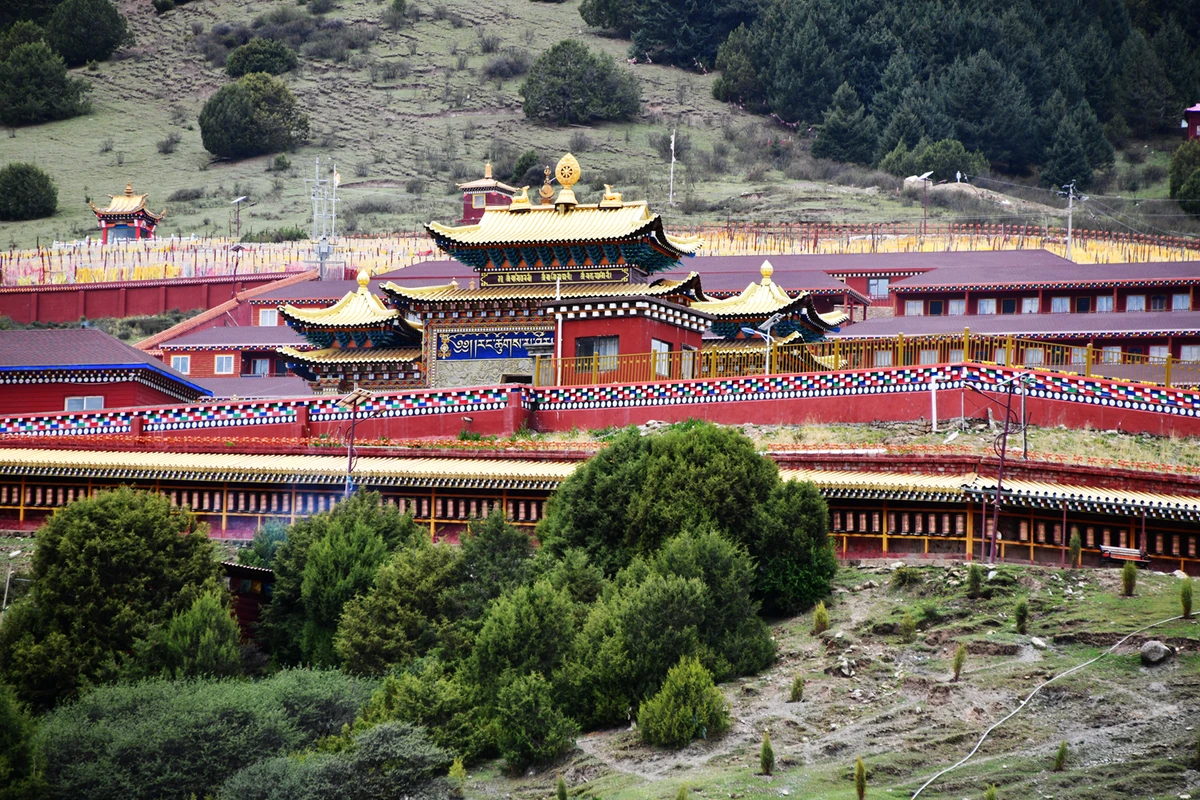
En route we passed a sizable monastery complex built into the hillside, red walls, gold roofs, awe-inspiring. We only knew it was within Ganzi Prefecture, but what place? What temple? We didn’t know.
Tier upon tier of white stupas encircling the main temple—quite spectacular.
[Xinluhai – like Tianshan in Xinjiang]
Xinluhai was closed for maintenance, so we couldn’t go in; we just took a few long-distance shots from the roadside. This was the only lake we encountered on the whole journey. Seen from afar, the lake was a clear blue beneath snow mountains, ringed by green pines—beautiful, with a hint of Tianshan in Xinjiang.
In the river flowing out of the lake, mani stones large and small have been washed by the water for years. The colored patterns have slowly faded, but the prayers in Tibetan hearts still drift slowly away with the current.
[Que’er Mountain – ‘the whip lashes the sky’]
Passing Que’er Mountain Viewing Platform at 4,300 m, where once you had to drive over an hour on winding mountain roads to cross Que’er Mountain, now with the Que’er Mountain Tunnel it takes just 7 minutes to zip through.
Que’er Mountain is a long-familiar name. Located in Dege County, its highway pass on the Sichuan-Tibet road sits at 4,889 m, the highest road pass in Sichuan and a famously dangerous spot. The mountain’s highest peak reaches 6,168 m, with three peaks surpassing 6,000 m! Hence the local saying: ‘Climb Que’er Mountain, and the whip lashes the sky.’ Now that the tunnel has been completed, the tunnel itself has become an attraction, at an altitude of only 4,330 m.
Que’er Mountain is snow-covered year-round, dazzlingly white, towering and majestic; most peculiar are its jagged rock peaks and serrated ridges.
Moving on, a tourist area sign indicated we’d entered Dege in Ganzi. This might be a less-visited spot, as even our driver-guide wasn’t quite sure where it was. The signs read: Damadong Viewpoint, Bona Great Stupa, Shakyamuni Statue. It’s a gorge—a peculiar Buddhist structure stands high on a mountain edge, with two long crimson pillars reaching to the cliff top supporting a golden, resplendent roof. The rock face held several finely carved and painted Buddha images.
Across the river, that Bona Great Stupa looked remarkably like Nepal’s Boudhanath Stupa. The Buddha eyes on the stupa seem to see through all the joys and sorrows of the world.
[Dege County – the last county in Sichuan]
We arrived in Dege County before 5 p.m. This small town is built along the mountainside, with narrow streets lined by houses that all look alike, each street lamp intriguing me.
With half an hour before the Dege Printing House closed, we drove straight there to look around outside first. The printing house sits in the county town and is a sacred site in many Tibetans’ hearts, its status comparable to the Jokhang Temple. It’s said that if you can’t make it to Jokhang in this life, paying homage at the Dege Printing House is still a complete merit.
That night we stayed at Shandi Hotel in Dege, another hotel perched by mountains and waters. The mountain wall in the sunlight looked like a granite ink wash painting; the river rushed on endlessly. The hotel seemed recently opened, with good facilities.
Dege County was our last county stop in Sichuan; beyond Dege, we’d enter Tibet.
[The Mysterious Dege Printing House]
Today’s highlight, and the whole trip’s highlight, was the Dege Printing House. After breakfast we returned; outside its vermilion red walls, the kora crowds were shoulder to shoulder—so many people. Kora is a major part of Tibetan life, going from dawn to dusk, rain or shine, never ceasing. Wherever you go in Tibetan areas, wherever there’s an iconic Tibetan structure, someone is doing kora.
The Dege Printing House is hailed as ‘the encyclopedia of Tibetan culture,’ ‘a brilliant cultural pearl of Tibetan regions,’ and ‘a treasure trove beneath the snow mountains.’ It’s a treasury of Tibetan culture; virtually all scriptures and texts in the whole Tibetan region originate here, and it still preserves the most ancient woodblock printing technique. In 2009, the Dege printing skill was inscribed by UNESCO on the Representative List of the Intangible Cultural Heritage of Humanity.
This printing house, built by four generations of tusi over 30 years, has always fascinated me—always been a mystery in my heart. For years I’d wanted to see it; this trip fulfilled that wish.
Gazing at this vermilion building from a distance and height, its gold rooftops glittered under the sun. On the slope behind, rows of beautifully arranged red houses seemed to transport one to Seda. Perhaps that’s a feature of Tibetan settlements. The endless stream of kora practitioners added motion to this enigmatic printing house.
Entering the gate—a large door with two iron rings hung with prayer flags—a staff member told me no cameras were allowed inside and had me put my camera in a locker. But mobile phone photography was permitted. What a strange rule!
The first thing I saw was the washing of printing blocks: several workers at running water, cleaning off the ink from the blocks, chanting scriptures as they worked.
Climbing an almost vertical wooden staircase to the second floor, I faced complete darkness, unable to see a thing. After a brief adjustment, I realized it was a block repository—like a library, room after room, shelf after shelf, filled with printing blocks. In the dim light, I tried to make out the blocks I could never hope to read or understand, stacked very neatly by category. Each block seemed the same length; these slender blocks had a handle. Staff moved them up and down—amazing how they find anything.
Up one more floor, it brightened considerably—this was the printing room. An open space with good light. Several teams were busy at work. When printing, one person shuttled back and forth fetching and sending blocks, while two sat opposite each other, one higher, one lower, with the block between them. One applied ink with a pad, the other placed the paper and rolled it with a roller, then peeled it off—a page printed instantly. It resembled the woodblock prints I’d seen before.
The printing paper is specially made using ancient Han handcrafted papermaking techniques, very durable. I heard it’s made from wolfsbane grass, which contains a slight toxin, so insects won’t bore, rodents won’t gnaw, and it won’t deteriorate in long storage.
The scriptures are printed in two ink colors: vermilion red and black. The printing house rules that the ‘Kangyur’ (Buddhist canon) must be printed in vermilion ink (ground cinnabar mixed with glue to make red ink) as a sign of respect; other texts use black ink.
Then I came to the block-carving workshop, where three craftsmen were carving with tools. The wood is carefully chosen; a book ‘Tibet, Tibet’ says it must be oak—tough and hard. One craftsman told me he was doing restoration, showed me a scripture page with a red checkmark indicating a mistake that needed correction. He was quite the character, asking where I was from. ‘Guangdong,’ I told him. He immediately pulled two finished stamps from a plastic bag—one carved with the six-syllable mantra, the other with ‘Tashi Delek’—saying he could sell them to me. I politely declined; not being a Buddhist, I knew little about such things.
Across from the block-drying corridor, a small room stores scripture paintings. Two craftsmen sat by the window, printing paintings one by one in natural light. I watched a while and was about to leave when one suddenly said, ‘Why leave? Stay and watch a bit more.’ So I stayed and chatted. He told me they print over a thousand pictures a day, used on white stupas. Except for the winter months of November and December when work stops, they’re here every day. He’d been here 20 years.
The most beautiful spots in the printing house are the rooftop and the block-drying corridor. Under the sun, the whole building is a kaleidoscope of colors, splendid and golden. I lingered, reluctant to leave.
The Dege Printing House is truly a mysterious place; though I covered nearly every corner, without a guide’s explanation it remains mysterious in my heart.
[Farewell, Sichuan! Hello, Tibet!]
At about noon, we crossed the Jinsha River Bridge and left Sichuan, entering Jomda in Tibet. On the Sichuan side, a large stone engraved with ‘西藏’ (Tibet) stood by the tunnel entrance. Farewell, Sichuan!
The Jinsha River is the natural boundary between Sichuan and Tibet. The G317 Jinsha River Bridge on the northern Sichuan-Tibet route is a vital link, connecting Dege County in Ganzi, Sichuan, to the east and Jomda County in Chamdo, Tibet, to the west. It’s the strategic gateway to Tibet from Sichuan. As we drove over the bridge, we saw ahead a large, special billboard: ‘Tibet’s Main Gate – Jomda Welcomes You.’ The character for ‘gate’ was deliberately large—amusing, as if entering from elsewhere wasn’t through the main gate. We had arrived at the eastern gateway of Tibet, at Gangtuo Village, known as ‘the first village liberated in Tibet.’
Approaching the village, the first thing catching the eye was a gate bearing the plaque ‘The First Village Liberated in Tibet.’ On the left side of the gate, three large maroon flags were carved, depicting the 18th Army entering Tibet and Tibetans celebrating. Beside the gate stood an unyielding watchtower, as if guarding this beautiful village where Tibet’s first five-starred red flag was raised. Everything told me this is a place with history and stories.
Over 70 years ago in autumn, the 18th Army of the People’s Liberation Army was ordered to enter Tibet. With the Tibetan government refusing peace talks and massing troops along the Jinsha River, they decided to cross it by force. In the early hours of October 6, 1950, when the path of peace was blocked, the 18th Army forced the crossing and fired the first shots of the Chamdo Campaign. By that evening, Gangtuo Village was liberated, becoming the first place in Tibet to raise the five-starred red flag. Little did we know that we would enter Tibet along the very route of its liberation.
After crossing the bridge, we reached the Jinsha River checkpoint on the Tibetan side. We three from Guangdong were carefully questioned, registered, and photographed. Required: travel data, ID card, and a nucleic acid test report. Fortunately we did our test in Chengdu on the 21st, got the result on the 22nd, so we still had 3 days left within the 7-day validity. It looked like we’d need another test before entering Lhasa, as Lhasa requires a test taken within 3 days.
[To be continued]
Travelogue Contents
1. May 21: Guangzhou – Chengdu – Panda Breeding Research Base
2. May 22: Chengdu – Yingxiu 5.12 Earthquake Ruins – Ganbao Tibetan Village – Zhuokeji Tusi Official Fortress – Jinchuan Guanyin Bridge
3. May 23: Guanyinqiao – Seda – Donggar Monastery – Ganzi County
4. May 24: King Gesar’s City – G317 Internet-famous Old Man – Xinluhai – Que’er Mountain – Dege County
5. May 25: Dege Printing House, Sichuan – Jomda, Tibet
Travel Information
Hotel Index Strategy Index Flight Index Website Navigation Travel Index Cruise Index Corporate Travel Index
Join Cooperation Distribution Alliance Friendly Links Corporate Gift Card Purchase Insurance Agent Agent Cooperation Hotel Join Destination and Scenic Spot Cooperation More Cooperation
About Ctrip About Ctrip Ctrip Hot Topics Contact Us Job Openings User Agreement Privacy Policy Business License Security Center Ctrip Content Center Intellectual Property Trip.com Group Algorithm Announcement


