2021 Winter Trip to Tibet: A Solo Budget Travelogue
After years of working
my desires have gradually faded,
prompted by life’s pressures and my own laziness.
I dislike socializing, dislike crowds, and more often just want to be alone quietly.
During these recurring pandemic times,
solitude has found an even better excuse.
Tibet had been a long-held dream of mine.
Actually, I didn’t have a particular place I longed to see,
just wanted to catch a glimpse of the Potala Palace,
to see the blue sky and white clouds over the plateau,
to see people of a different ethnic group,
their faith and their way of life.
By chance, I came across the news that many scenic spots in Tibet were offering free admission as part of the “Winter Tour of Tibet” campaign.
I checked Ctrip for flights – Chengdu to Lhasa, round trip around 1000 RMB.
Booked a ticket in 10 minutes. A dream I’d nurtured for years, finally coming true because it was “cheap”.
There are many reasons to set off, but mine was simply “I want to go”.
I looked up Lhasa’s weather and asked friends who had been there or lived locally. Mid-October Tibet is still quite cold, so the key is warmth and comfort. Most of what I packed were winter clothes, plus some travel essentials.
Packing list:
Clothes: two sets of cotton long johns, one fleece-lined thermal set, one down vest, one lightweight down jacket, one fleece-lined softshell jacket, one medium-thick hoodie, one sweater, one loose long-sleeved base layer, one fleece-lined legging, one pair of jeans, one pair of casual trousers, one pair of fleece-lined ankle boots, one pair of sneakers.
Small items: five pairs of medium-thick socks, one scarf, one pair of gloves, one pack of disposable underwear (10 pieces), three bras, two hats (one knitted beanie, one baseball cap).
Miscellaneous: 20 face masks, one thermos, 20 body warmers, one U-shaped pillow, skincare (facial cleanser, hydrating toner and cream, face oil, sheet masks, body lotion, lip balm, hand cream, sunscreen, hair protection/anti-frizz spray), one pair of sunglasses, one box of chocolates, a power bank, a small hand warmer, an umbrella.
Medication: ibuprofen, 999 Ganmaoling (cold remedy), banlangen (isatis root granules), oral glucose liquid, Rhodiola oral liquid, motion sickness patches.
I had done some research before – people say flying into Tibet makes you prone to altitude sickness, but after landing I didn’t feel it strongly (I’m the kind who gets altitude sickness even in Xinduqiao, western Sichuan). Maybe it was a good state of mind – since I was here, there was nothing to fear.
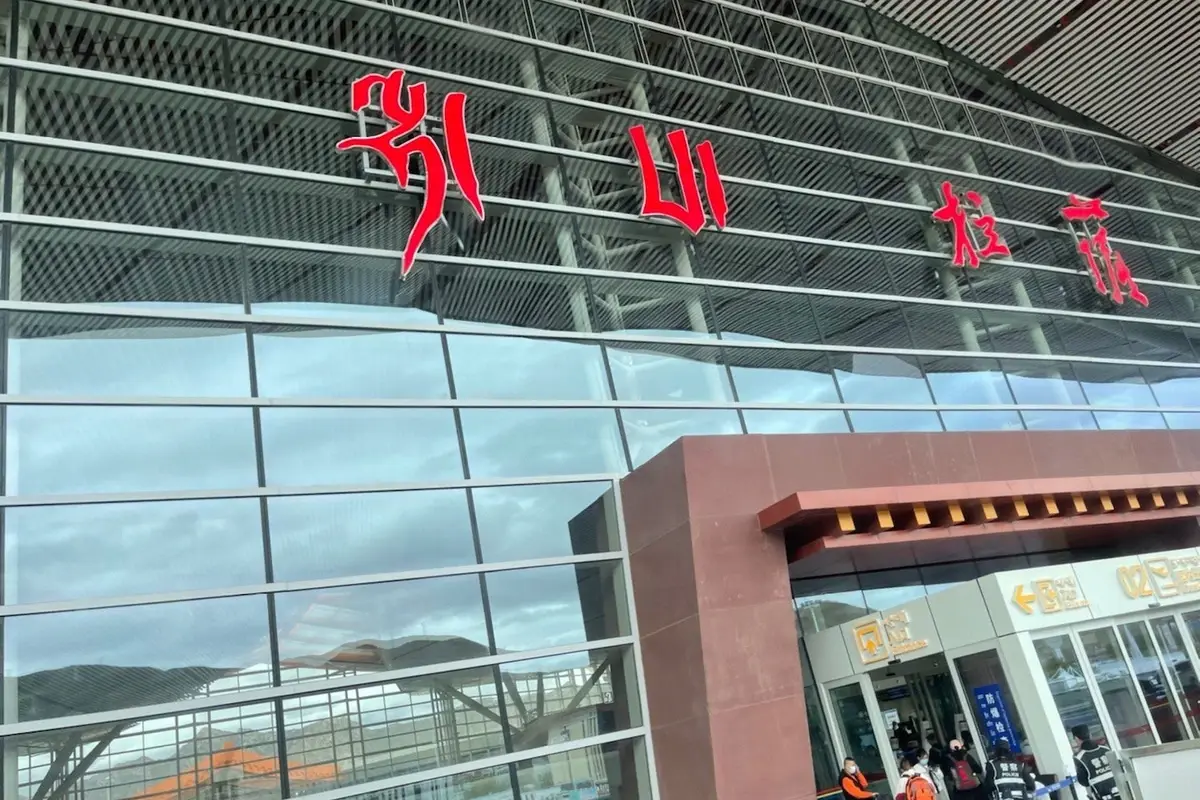
Lhasa Gonggar Airport is not in Lhasa, but in Gonggar County, Shannan City. Take the airport bus for 30 RMB per person, about 1.5 hours to the city center.
On the first day, I arrived in Lhasa early but with the altitude already over 3,000 meters, I didn’t plan to head out immediately. I rested at the hotel, ordered takeaway, and took a nap. The hotel had oxygen supply. I had a slight headache, bearable, altitude sickness not obvious.
Walking the streets of Lhasa,
I saw what Tsangyang Gyatso once described as “circling mountains, circling waters, circling stupas”.
On Barkhor Street, outside the Jokhang Temple, in every alley and lane, devout believers were everywhere. We travelers followed their steps, moving forward bit by bit. Perhaps we cannot grasp what their life-protecting faith truly means, but we respect this faith and admire a people with such belief.
Maybe because of free admission, the Potala Palace was still pretty crowded. You just need to reserve a ticket one day in advance for free entry.
This world-famous palace – only those who have truly seen the Potala understand what “magnificent splendor” means. They say gold is the least valuable thing here. It is not only a symbol of Tibet, but the holy land in every pilgrim’s heart, and the very reason so many of us simply want to catch a glimpse of Tibet.
“Is there a way in this world to reconcile both, not betraying the Buddha nor failing you?”
After coming out of the Potala, I went to the famous Makye Ame restaurant. Legend says this was where Tsangyang Gyatso’s love story began.
I also wanted to touch the yellow walls, to trace back to the girl who once moved the poet’s heart. It was a kind of longing for love in me. No matter what reality is like, if even hope and longing are gone, then living might be just existing.
A travel buddy I met by chance said the weather in Nyingchi had been good lately. If you want to see autumn in Tibet, you should go to Nyingchi. The top reasons I chose it: first, it’s quite close to Lhasa; second, the altitude is lower. Perfect for a beauty born in the ’90s like me who fears death and cold!
Although I’ve often seen people call Nyingchi “the Jiangnan of Tibet” online,
and I’ve been to Jiangnan many times,
this place is totally, totally different from Jiangnan!!!
Jiangnan has no snow mountains, no sky this blue.
What set Basum Tso apart this time were its red autumn leaves, probably only seen in recent days of fall.
It’s said to be a “fairyland forgotten by time”. In Tibetan, the name means “green water”. Nestled among the high mountains and valleys of Gongbo’gyamda, it is also a sacred site of Tibetan Buddhism.
Going deeper, there are villages and homes, and another lake – I don’t know its exact name, and couldn’t even find it on a map. Locals just call it “New Tso”, such a simple name.
To get there, you start from Basum Tso, bump along for over 30 kilometers, then hike for about an hour. Pastures, meadows, forests stretch ahead, horses and yaks everywhere, streams crisscrossing the fields. The beauty of New Tso is hard to describe in words.
It was only after arriving that I learned: many people choose to visit Tibet in winter just to see Namjag Barwa’s “Sunshine on the Golden Mountain”, one of “China’s Top 10 Most Beautiful Peaks”. To this day, it remains a “virgin peak”, unclimbed, and the highest mountain in the Nyingchi area. Known as “nine out of ten visitors miss it”, it is Tibet’s “most difficult to see”, “meeting it depends on luck”, “encountering it hinges on fate” snow mountain. It’s said some people wait in Nyingchi for a whole month just longing for Namjag Barwa, only to leave disappointed.
The world’s largest canyon – the Yarlung Tsangpo Grand Canyon – is the longest, deepest and highest canyon river on earth.
Lulang lies north of the Yarlung Tsangpo Grand Canyon, east of Nyingchi city. Lulang means “place where immortals dwell”. A local saying goes: “When you reach Lulang, you’ll forget your hometown.” Looking at the Lulang Forest, I truly felt it was a divine dwelling. The close view is like a watercolor painting; the distant view becomes a Chinese ink-wash scroll. When sunlight breaks through clouds into the valley, the forest is gilded with silver light – surely a fairyland!
After three days in Nyingchi, I returned to Lhasa. I figured since I’d come to Tibet, I ought to visit at least Yamdrok Lake or Namtso. But Namtso would take a 7-8 hour round trip, so I gave it up and chose the closer Yamdrok Lake.
Yamdrok Lake’s altitude was probably the highest I reached on this trip, over 4,700 meters, and the wind at the pass was fierce. Luckily I wore my softshell jacket and hat – didn’t feel too cold. Just as legend says, Yamdrok is like a quiet maiden, its emerald water unchanged through the seasons, like an olive branch on the plateau. Standing by the lake, feeling the breeze blow across the water, watching other visitors, making a wish by this holy lake – this was what I most wanted to do on this journey.
Travel doesn’t need too much planning. Go when you want to go, leave when you want to leave. Whatever the weather, once you choose to set out, embrace every single day on the road.
On my last day in Tibet,
I slept in, then went to a lane on Barkhor Street. I had a cup of sweet tea and a bowl of Tibetan noodles with the locals.
Boarded the return flight.
Goodbye, Tibet, goodbye, Lhasa.
Joining a group: For a 10-person small group tour – 3 days Nyingchi + 1 day Yamdrok Lake, pure sightseeing, 1000 RMB per person (including 3 nights’ accommodation, 4 days’ meals, transport, scenic area shuttle buses, etc.)
Accommodation: 3 nights in Lhasa, total 600 RMB (staying alone is pricier; a four-star hotel with breakfast was very comfortable).
Food: Miscellaneous including snacks and fruit, about 500 RMB.
Admission: Potala Palace free; basically all tickets were free, I only strolled around the outside of Jokhang Temple, so admission costs = 0.
Total: 3260 RMB.
In summary: I traveled in Tibet for about a week for around 3000 RMB, didn’t skimp on myself, ate well, slept well, played well. The reason it was so cheap was mainly the “Winter Tour of Tibet” policy – I saved about 1000 RMB on admission tickets alone, and flights and hotels were about 50% off peak season. Normally, such a trip would cost seven or eight thousand.
Travelogue Contents
1. Foreword: Why Tibet
2. Preparations (my packing list)
3. DAY 1 Arrival in Lhasa
4. DAY 2 Lhasa wandering: Potala Palace, Barkhor Street, seeking Tsangyang Gyatso
5. DAY 3 Nyingchi, Basum Tso, New Tso
6. DAY 4 Namjag Barwa, Yarlung Tsangpo
7. Lulang Forest, Kading Valley
8. DAY 6 Yamdrok Lake, Yamdrok Yumtso
9. DAY 7 Return journey
10. Postscript: Travel expenses
Travel Information Hotel Index Travel Guide Index Flight Ticket Index Website Navigation Travel Index Cruise Index Corporate Travel Index Join & Partner Distribution Alliance Friendly Links Corporate Gift Cards Insurance Agents Agent Partners Hotel Partners Destination & Scenic Spot Partners More Join & Partner About Ctrip About Ctrip Ctrip Highlights Contact Us Careers User Agreement Privacy Policy Business License Security Center Ctrip Content Center Intellectual Property Trip.com Group Algorithm Announcement


