2020 Autumn Journey (Part 1): Enchanting National Highway 317
Autumn's brilliant Euphrates poplar forests glow with enticing radiance, yet their prime viewing period lasts only about twenty days, so I had never dared to imagine witnessing that splendor firsthand. However, with some free time this year, and reading online that the best time for southern Xinjiang's poplars is around October 25, I set off from Shenzhen in early September, planning to travel via National Highway 317 and 219 on a grand loop to see them.
The thought of driving on the world's highest and most treacherous plateau highway was simply exhilarating.
The entire journey took over fifty days, with a rough itinerary as follows:
1. Shenzhen to Longsheng in Guangxi, then via Anyue in Sichuan to Rilong Town at the foot of Siguniang Mountain
2. Follow the Northern Sichuan-Tibet Highway (G317) westwards, passing through Ganzi and Dege to enter Tibet
3. Travel via Qamdo and Dengqen to Sog County, then join the Qinghai-Tibet Highway (G109) at Nagqu and reach Shigatse
4. Take the Xinjiang-Tibet Highway (G219) westward, passing through Saga and Purang to Zanda
5. Continue on G219 to Yecheng in Xinjiang, then turn south from Shufu County to Taxkorgan
6. Taxkorgan to Kashgar, then via Wensu and Kuqa to Tekes
7. From Yining to Nilka and Künes, then via Hejing to Korla
8. Cross the Taklamakan Desert from Luntai to Ruoqiang, then take G315 out of Xinjiang to Mangya in Qinghai
9. Golmud via Huashixia to Baima, then exit Qinghai
10. Arrive at Sertar in Sichuan, explore Xinlong and Litang, and leave Sichuan at Xiangcheng
11. Take G214 to Shangri-La in Yunnan, then via Tiger Leaping Gorge to Jianchuan
12. Chuxiong to Anlong in Guizhou, then return to Guangdong
After packing the car with supplies, we left Shenzhen early in the morning and reached Longsheng, Guangxi, by 2 p.m. After checking into the hotel, we rushed to Ping'an Village in the Longji Rice Terraces scenic area. The terraced fields undulated in endless sweeps, the rice seedlings lush and vibrant—a serene sea of green. Unfortunately, the drone accidentally crashed into the terraces. Although we managed to retrieve it after some time, dusk had already fallen, bringing the first day's journey to a hasty close. Back at the hotel, we ordered chicken soup to calm our nerves.
The city of Zunyi is essentially built around the Zunyi Conference Site. The area was swarming with crowds; many people wore People's Liberation Army uniforms, making it feel like a movie set at Hengdian. The remarkable thing was the impenetrable high wall enclosing the site, revealing not a single hint of what lay inside. The management seemed rather stuck in their ways.
Pilu Cave in Shiyang Town, Anyue County, is famous for its 'Water-Moon Guan Yin', so we made a point of visiting. This grotto was carved during the Song Dynasty. Right at the entrance gate, you are greeted by the Liu Benzun's Ten Austerities Cultivation Chart, a well-preserved relief combining images and text.
The Water-Moon Guan Yin sits within a prominent cliffside niche, her robes flowing gracefully—a breathtaking sight.
We raced to our guesthouse in Rilong Town, where the courtyard overflowing with succulents left a vivid impression.
In the afternoon, a light rain fell as we strolled the surrounding hills, gazing at the villages.
At Changping Valley in Siguniang Mountain, you can take a shuttle bus and then walk down section by section, which is not tiring at all. Pity about the weather—we left with some regrets, but I'm sure we'll return another time, perhaps to explore Shuangqiao Valley and Haizi Valley as well.
Barkam is the capital of Aba Prefecture in Sichuan. With clear skies in the afternoon, we went to visit Changlie Monastery. In Tibetan, 'Changlie' means 'place of retreat', and indeed it is hidden high up on Mount Changlie, with a vertical rise of over 900 meters. The mountain road is steep and treacherous, winding back and forth from the valley floor like the teeth of a comb.
On the road leading to the monastery, there is a mani wall—built up gradually by faithful devotees who chisel scriptures onto stones and stack them one by one.
The monastery was still under construction, but the main hall already exuded a majestic presence.
Suddenly, a heavy downpour struck. We sheltered inside the temple, and within minutes the skies cleared, revealing a rainbow.
By the time we left, the monastery's little dog had become our friend.
Driving on G317, shortly after leaving Barkam, you can see two watchtowers by the roadside—the Zhibo Watchtowers, built in the early Qing Dynasty and listed as a key national cultural heritage site.
The Luhuo area boasts the most beautiful Tibetan-style architecture in the region, with neat forms and vibrant colors.
The sculpture in Huo'er Square is likely the landmark of Luhuo.
Following the endless prayer wheel corridor can lead us to Shouling Monastery.
The platform in front of Shouling Monastery's main gate offers a panoramic view of the entire Luhuo town.
The Tibetan houses nestled close to the monastery belong to the wealthy and notable.
Kasa Lake lies right beside G317, its crystalline waters set against a backdrop of mountains.
This is a high-altitude freshwater lake. Every day, many local Tibetans bring boxes of instant noodles or bags of steamed buns, chanting sutras as they feed the fish. With such devoted care, the lake's surface teems with them.
Manigango means 'place of carving mani stones' in Tibetan. This small town has just one main street lined with impressive houses, yet at high noon, there were hardly any people around—perhaps that's the legendary atmosphere of the Wild West.
Passing the glacier viewpoint, we could see Chola Mountain towering at 6,168 meters.
After crossing Chola Mountain, Yilhun Lhatso (Xinlu Sea) came into view—the highest and largest glacial lake in Sichuan. Unfortunately, the scenic area was closed. Seeing that we had come all this way, a staff member told us about a prime viewing spot near a small shop up the hill, which consoled us. The water was crystal-clear like jade, embraced by forests and grasslands, with a meandering stream gently lapping against stones inscribed with scriptures.
Monasteries and stone carvings along the way.
Dege is the last town on the Sichuan section of G317. The Dege Sutra Printing House is the largest existing scripture printing house and foremost among the three great printing houses of Tibet (the other two being at the Potala Palace and Labrang Monastery).
Walking up the mountain along the boardwalk, we were accompanied by magnificent white stupas and exquisite mani stones.
After passing Gonchen Monastery, you see the hillside dotted with densely packed red wooden cabins—the monks' dwellings.
Then, following a mountain trail back to the square, we found a step to sit on in the sunset glow, quietly watching Tibetans ceaselessly circumambulate and pray, truly feeling the power of the Buddha.
Modern Tibetan houses near the monastery.
Dege town is built on a narrow river valley, with streets not very wide. Interestingly, there are arcades (qilou), exquisitely crafted and imbued with strong Tibetan character.
Dinner was at a Tibetan restaurant. The owners, a Tibetan couple, didn't speak Mandarin. Their lovely daughter, in second grade, was doing math homework with a calculator nearby. I couldn't help but chat with her and offer a bit of tutoring—I guess I have a knack for playing teacher.
Qamdo means 'confluence of waters' in Tibetan.
Here stands one of Tibet's largest monasteries: Qiangbalin Monastery. On the day we visited, there happened to be a Buddhist activity. Large numbers of monks were resting and chatting outside the main hall. When the sermon began, they removed their shoes and entered the hall, leaving behind rows of identical boots—apparently, they don't distinguish whose shoes are whose.
Soon, the monks rushed in again carrying buckets of porridge, only to emerge with empty buckets ten minutes later—all barefoot and in high spirits.
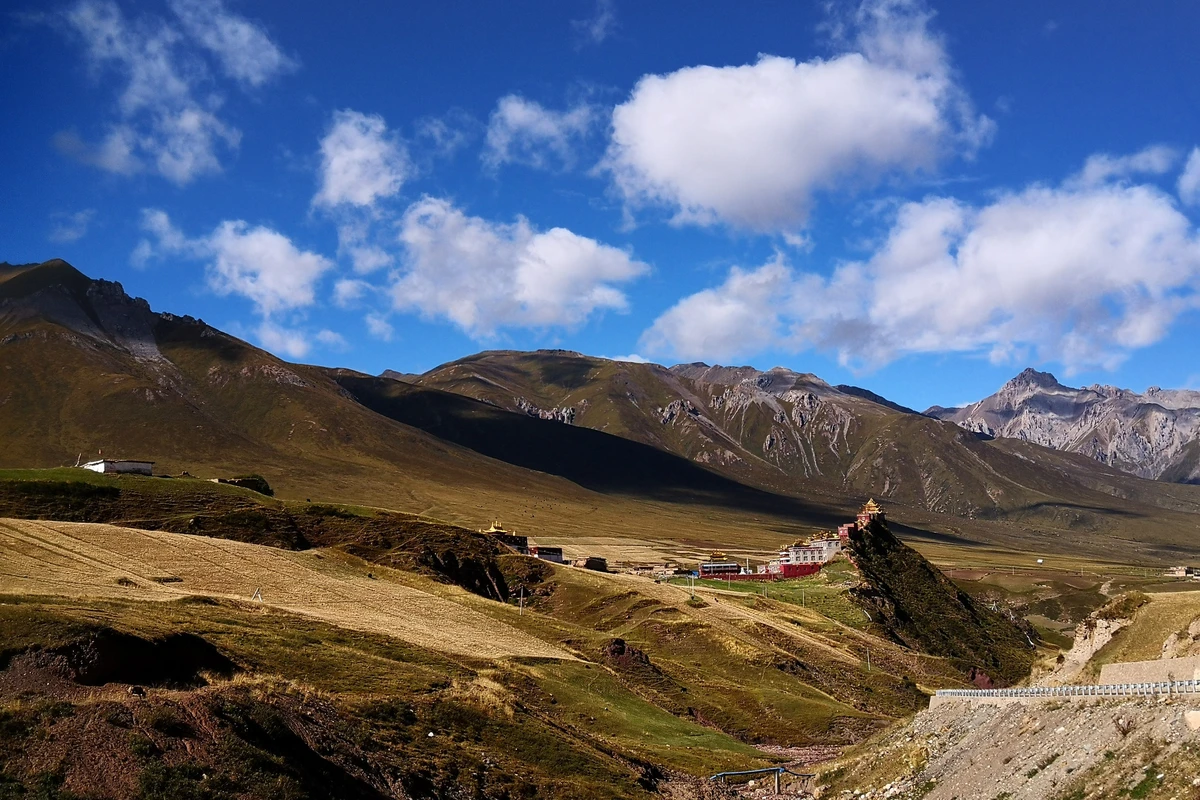
The road to Dengqen was a scenic thoroughfare, with Tibetan houses and temples making us stop time and again to admire the view.
Courtyards were piled high with freshly harvested highland barley.
In the afternoon, we reached Zizhu Mountain. To get to Zizhu Monastery, you must climb 12 kilometers of zigzag dirt mountain road, ascending abruptly from 3,500 meters to 4,450 meters. At the summit, the temperature plummeted and the wind was bitingly cold. Jagged rocks littered the landscape, creating an atmosphere of pure yet menacing spiritual practice.
From Dengqen to Baqên.
We passed Chongcang Monastery. An elderly man at the gate was eager to chat, but he only spoke Tibetan and couldn't understand Mandarin. After much gesticulation, we realized he wanted to buy our nearsighted glasses—he thought they were reading glasses. The deal fell through, but it reminded us to bring several pairs of reading glasses next time we visit Tibet.
Upon reaching Sog County, we spotted Zandan Monastery from afar, its silhouette strikingly similar to the Potala Palace. Built into the mountainside and approachable only via a long walkway, it is grand and imposing.
This chair invites deep reflection.
We launched our drone for a bird's-eye view, which drew curious monks over. After a cheerful group photo, one monk insisted on showing us the monastery's treasures, unlocking and locking doors along the way as we toured many hidden temple areas.
With reluctant farewells, and seeing that it was still early, we drove out to see the plateau meadows. Suddenly, the weather turned again, and as we reached a hilltop, another rainbow appeared.
Passing through Nagqu Grassland.
Leaving Damxung, we reached Ghochung Gangri Glacier. The entrance gate was rather simple. After buying tickets and driving in for a dozen kilometers, we could see the glacier up close. The scenic area was still building boardwalks up the mountain, but the glacier had visibly receded.
On the way in, we were so focused on the glacier that we completely overlooked the beautiful scenery along the road. On the way out, we leisurely took it all in.
Entering the Shigatse region, we saw gentle river valley plains and vast fields of highland barley by the roadside. It was harvest time, and in the breeze, they swayed like a golden ocean.
Arriving in Shigatse, we were about to embark on the alluring Xinjiang-Tibet Highway (G219) journey. See you in the next installment!
Travelogue Contents
1. Day 1: Shenzhen to Longsheng
2. Day 2: Longsheng to Zunyi
3. Day 3: Zunyi to Anyue, Sichuan
4. Day 4: Anyue to Rilong Town
5. Day 5: Siguniang Mountain
6. Day 6: Rilong to Barkam
7. Day 7: Barkam to Luhuo
8. Day 8: Luhuo to Dege
9. Day 9: Dege to Qamdo
10. Day 10: Qamdo to Dengqen
11. Day 11: Dengqen via Baqên to Sog County
12. Day 12: Sog County to Damxung
13. Day 13: Damxung to Shigatse
14. Goodbye
Travel Information
Hotel Index
Travel Guide Index
Flight Ticket Index
Website Navigation
Travel Index
Cruise Index
Corporate Travel Index
Join Cooperation
Distribution Alliance
Friendship Link
Corporate Gift Card Purchase
Insurance Agency
Agency Cooperation
Hotel Join
Destination and Scenic Area Cooperation
More Join Cooperation
About Ctrip
About Ctrip
Ctrip Hotspots
Contact Us
Careers
User Agreement
Privacy Policy
Business License
Security Center
Ctrip Content Center
Intellectual Property
Trip.com Group Algorithm Announcement


