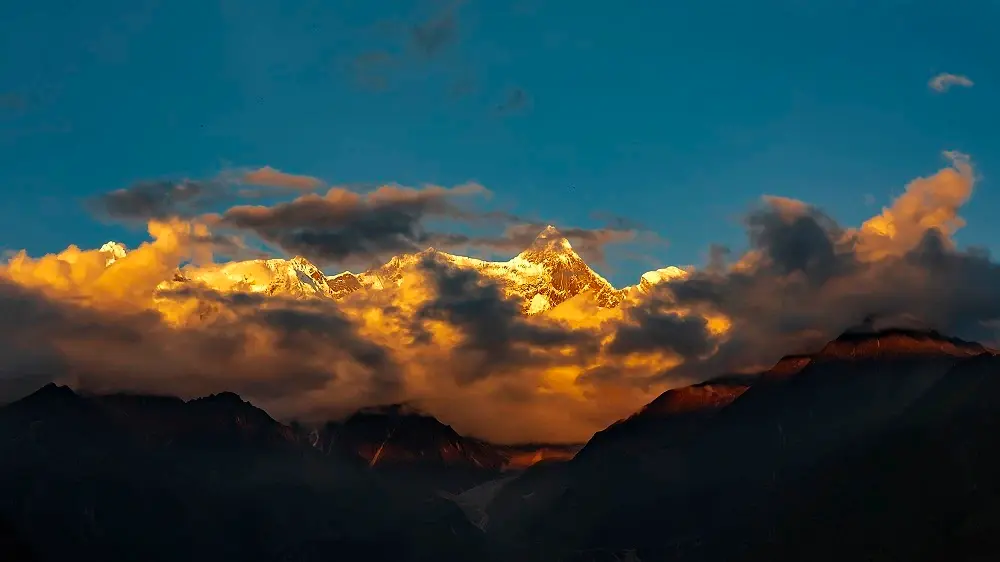
Golden October in Tibet: From Nyingchi to Lhasa
Tibet lies on the Qinghai-Tibet Plateau, where the thin air deters many who fear altitude sickness. Five years ago, at Yading Airport in Daocheng (4,411 m), I suffered from acute mountain sickness, and that heart-emptying feeling of oxygen deprivation still haunts me. After much hesitation and preparation, I finally set foot on this magical land of Tibet in the golden October sunshine. Over eight days from Nyingchi to Lhasa, we approached snow mountains and lakes, listened to Buddha’s wisdom in a millennium-old temple. On this trip, we spent long hours photographing at altitudes above 4,000 meters many times, yet my body showed no sign of altitude sickness. Instead, back in Beijing, I felt an unprecedented clarity of mind and body for over ten days. It was a strange and wonderful sensation.
【Itinerary】
Day 1 (Oct. 10): Arrive at Nyingchi Mainling Airport (2,949 m) – Yarlung Zangbo Grand Canyon (2,800 m) – Sosong Village (3,012 m). Stay: Milin Taohuayun Hotel, Sosong Village.
Day 2 (Oct. 11): Sosong Village – cross Serkyim La Pass (4,728 m) – Gang Spruce Forest Grass Lake (2,676 m) – Bomi (2,720 m). Stay: Renqing Guesthouse by Guxiang Lake, Bomi.
Day 3 (Oct. 12): Bomi – Midui Glacier (2,400 m) – Lulang Forest (3,700 m) – Lulang Town (3,300 m). Stay: Zhujiang International Hotel, Lulang Town.
Day 4 (Oct. 13): Lulang – Basum Tso (3,700 m) – Jieba Village (3,500 m) – Lhasa city (3,650 m). Stay: Jicai International Hotel Lhasa (Potala Palace branch).
Day 5 (Oct. 13): Barkhor Street – photo shoot in Tibetan attire; Potala Palace Square – time-lapse photography; street scene of Potala Palace from the footbridge. Stay: Xinhua Hotel Lhasa, with a viewing deck on the 5th floor (we stayed here for the rest of our time in Lhasa).
Day 6 (Oct. 14): Potala Palace Square and Zongjiao Lukhang Park – visit Jokhang Temple – Makye Ame Restaurant on Barkhor Street.
Day 7 (Oct. 15): Ganden Monastery (3,800 m).
Day 8 (Oct. 16): Yamdrok Lake (pass viewing deck at 4,998 m, lake surface at 4,441 m) – night photography of Potala Palace.
Day 9 (Oct. 17): Early flight back to Beijing.
【Packing List】
1. Waterproof clothing, down jacket, fleece jacket, wool sweater, long underwear, thick fleece pants, waterproof outdoor shoes, socks.
2. Sun hat, gloves, long scarf, sunglasses, slippers.
Medicines:
1. Rhodiola rosea oral liquid or capsules, Gaoyuan An (altitude sickness medicine), American ginseng lozenges.
2. Medicine for heart disease and hypertension, quick-acting heart rescue pills.
3. Anti-inflammatory, cold granules, isatis root (banlangen), ibuprofen (for headache), berberine (for diarrhea), domperidone, metronidazole for toothache, throat lozenges.
4. Sleeping pills, motion sickness medicine, band-aids, insect repellent, face masks…
Daily items:
1. Toiletries (towel, toothbrush and toothpaste, shampoo, skincare products…).
2. Alcohol wipes, sunscreen, hand cream, lip balm.
3. Thermal mug, foldable electric kettle.
Snacks:
1. Chocolate, pork jerky, small biscuits, preserved plums, ginger candy, etc. (small snacks).
2. Glucose oral liquid, coffee & tea, chewing gum.
Photography equipment:
Camera, memory cards, batteries, battery charger, tripod, power bank, power strip, flashlight or headlamp.
Others:
1. ID card, blood pressure monitor & charger, phone charger, phone strap, earphones.
2. Umbrella & rain poncho, face masks, two types of hand warmers (for body and feet).
3. Cash & small change.
【Tips for Preventing Altitude Sickness】
1. Two weeks before entering Tibet, start taking Rhodiola rosea oral liquid or capsules. If you still feel obvious hypoxia symptoms after arriving at altitude, take Gaoyuan An. Always carry American ginseng lozenges. Sometimes at high-altitude scenic spots, a lozenge can provide instant relief.
2. Bottled Coca-Cola or Sprite (I’m not advertising them) – this is a magic bullet for preventing altitude sickness. The high sugar and carbon dioxide content quickly replenish sugar and accelerate blood oxygen circulation. You can easily buy them at local shops. I kept one with me throughout Tibet and it worked wonderfully.
3. This time with a friend, we hired a local car and had the driver prepare a 15-liter medical oxygen cylinder in the vehicle. This oxygen is high-purity and very effective. Small portable oxygen canisters, available at local pharmacies, were also bought, a few to carry when getting off at scenic spots for emergencies.
4. Ensure sleep. Under hypoxic conditions at altitude, sleep quality will be affected. Poor sleep can lead to altitude sickness the next day. So before sleep, you can take 1/4 to 1 tablet of a sleep aid, but please consult a doctor for safe dosage based on your personal situation.
5. Travel light. Many photographers carry heavy gear, but at high altitudes, walking with a heavy load increases oxygen consumption and may trigger altitude sickness. Streamline your equipment and travel light.
Now, let the photos and videos do the talking – (a five-episode short video series at the end of the article).
【Let Images Record the Journey】
Early in the morning, we took the first flight from Beijing to Nyingchi. After over four hours, we landed safely at Nyingchi Mainling Airport in Tibet.
The car wound through the Yarlung Zangbo Grand Canyon. Since the canyon’s elevation isn’t too high, everyone was full of energy. Whenever we reached a pull-off viewing point, we’d hop out for a few snapshots. Honestly, the canyon scenery was just average.
Today’s destination was Sosong Village in Mainling County, Nyingchi.
Sosong Village, on the north bank of the Yarlung Zangbo Grand Canyon, sits at the foot of Namcha Barwa, making it a superb spot to see the peak. Many come in spring for the peach blossoms, but we came to witness the elusive Namcha Barwa, which nine out of ten visitors fail to see. In golden October, the sky was high and clouds sparse. Our luck was exceptional: on the very afternoon we arrived, we saw a rainbow draping the mountain’s flanks, and at dusk we beheld the rare sight of the sunlit golden summit.
We stayed at the Milin Taohuayun Hotel in Sosong Village. The hotel’s location and setting are excellent. The rooftop has a large viewing deck with tables and chairs, where you can sit leisurely waiting for the clouds to part or photograph Namcha Barwa without obstruction (if you’re lucky~~).
On the road from Sosong Village to Bomi county, we crossed Serkyim La Pass at 4,728 meters. On a clear day, Namcha Barwa should also be visible from here. But yesterday in Sosong Village, the sacred mountain had already given us such a huge surprise. So when we stood by the giant mani stone pile at Serkyim La, thick clouds in the distance restored the mountain’s mystique.
On the G318 national highway from Bomi to Lulang Town, two man-made landmarks left a deep impression.
One was the former Tongmai natural barrier, now replaced by the towering Tongmai Bridge—an abyss turned into a thoroughfare.
The other was the 4,000-kilometer milestone standing by the G318, marking exactly 4,000 kilometers from Shanghai People’s Square. Beside it, a sign with black background and yellow arrow says “Drive G318 Once in This Life,” its design radiating a sense of heroic tragedy amid the snowy mountains and plateau.
On the G318, you often see off-road vehicles adorned with the “Drive G318 Once in This Life” sticker, either parked along the road or roaring past. This eye-catching emblem is a self-awarded medal of honor, testifying to the countless hardships the drivers have endured on the highway. Most parts of the G318 are fairly flat, but landslides and falling rocks can happen. When they do, nearby excavators and bulldozers rush to repair the road. If the collapse isn’t too large, traffic may pass while repairs are underway—exactly the kind of situation that tests a driver’s skill. Can you imagine what it’s like to drive with your wheels hugging a steep cliff edge? That’s why every time I see that sticker, silent admiration wells up from my heart.
Gang Spruce Forest lies in Baka Village, Gu Township, Bomi County, Nyingchi, across the river from the G318. It’s one of China’s ten great primeval forests. Influenced by the southwest monsoon from the Indian Ocean, the climate here is mild and humid. The reserve is dominated by lush ancient spruces and firs, and deep in the forest, many rare wild animals are said to roam.
As we walked along the winding, tranquil paths of Gang Spruce Forest, suddenly everything opened up and a scene like a hidden paradise unfolded before us. This was the Grass Lake tucked deep within the forest. It’s said to be formed by the backflow of Parlung Zangbo River. In summer, when rainfall is abundant, the river waters inundate the grassy meadows, creating a wondrous sight: vibrant flowers and grass underwater with shimmering surface reflections. Hence the name Grass Lake.
Guxiang Lake in Bomi (2,720 m) was serenely beautiful in the early morning light.
The Renqing Guesthouse by Guxiang Lake, where we stayed, is built right on the lake shore. The lakeside restaurant has a terrace where a few groups of hikers had pitched tents to spend the night. The hostess was very warm-hearted; after check-in, she personally helped lug our suitcases up to the second floor.
Midui Glacier is located in Yupu Township, Bomi County, 103 km from Bomi town and 8 km off the G318. Its main peak reaches 6,800 meters, with the snowline at 4,600 meters, while the end viewing platform sits below 3,000 meters. Although the glacier is covered with ice and snow year-round, its tongue has retreated rapidly in recent years. The meltwater forms a small lake at the glacier’s foot, then meanders into the distance. There’s a dedicated viewing platform at the base. The distance from the scenic area entrance to the platform is about 2.5 km. You can walk, but there are two stretches with slopes steeper than 45 degrees, making the climb strenuous. So we opted to ride horses, paying 100 yuan per person for the round trip.
Lulang Town (3,300 m) lies on the Sichuan-Tibet highway, 80 km east of Nyingchi’s Bayi Town. Thanks to its lush meadows and beautiful mountains, it’s often called “Oriental Switzerland.” “Lulang” means “Dragon King Valley” or “place where gods dwell” in Tibetan. A local folk song says: “When you reach Gongbo Lulang, you’ll forget your homeland,” which speaks volumes about Lulang’s charm. The Zhujiang International Hotel where we stayed faces Gongbula Zhan Snow Mountain. Golden fields after harvest spread before us, several wild yaks grazed slowly on the grass, and wooden houses scattered at the foot of the mountain were wrapped in cooking smoke—a pastoral scene brimming with poetry.
Lulang’s stone-pot chicken is famous. The pot is carved from a kind of mica stone called “soapstone,” found only in Mêdog. The stone has to be carried out of Mêdog by hand, then carefully chiseled by craftsmen. Thus each pot is unique and very expensive. Rich in 17 mineral elements, the pot is used to simmer local free-range chicken with Tibetan ginseng and other herbs. The resulting soup has a delicate herbal fragrance and a uniquely delicious flavor.
Basum Tso, also known as Co Gho Lake (3,700 m), means “green water” in Tibetan. Located in the high gorges of Gongbo’gyamda County, Nyingchi, it’s a sacred lake and holy site of the Red Hat sect. In autumn, Basum Tso is a riot of color; the forests are dyed in myriad hues, the sky is spotlessly blue, and the lake is crystal clear. Snow mountains and white clouds are mirrored on its emerald surface—a beauty beyond words.
Jieba Village (3,500 m) means “forgotten” in Tibetan. Legend has it that a pilgrim once circumambulated the lake alone and forgot his saddle here. When he returned the next day, he was astonished to find the saddle still in place. Taking it as a sign from Buddha, he settled here. Whenever people asked the name of the place, he would smile lightly and say “Jieba ye.” From then on, the village bore this name. Today, Jieba Village is the core settlement within Basum Tso scenic area, home to the Gongbo Tibetan community. To visit or stay in the village, you need to take a special sightseeing bus from the Basum Tso entrance. When we came, the village road was under construction, so we couldn’t enter. We could only climb the viewing platform on the edge to overlook the whole village and the two great mountains across the lake: “The King’s Throne” and “Burning Flame.”
After visiting Basum Tso and Jieba Village in Nyingchi, we drove westward along the Lhasa-Nyingchi expressway to Lhasa. The previous four days at scenic spots in Nyingchi, with altitudes ranging from over 2,000 to nearly 5,000 meters, had gradually acclimatized our bodies. In the evening, we checked into the Jicai International Hotel in Lhasa, not far from Potala Palace and Jokhang Temple—just a ten-minute walk.
Spending 24 hours at 3,650 meters calls for extra caution for those of us born in the 1950s. Every move needed to be a little slower. It was already past 6 p.m., but the Lhasa sun was still dazzling. We dropped our luggage, rested briefly, and headed straight to Potala Palace Square. Standing there, looking up at the Potala Palace against the blue sky, the layered architecture appeared even more majestic. The red and white walls were striking; from any angle, the imposing figure compelled you to gaze upward for a long time.
Potala Palace was originally built by Songtsen Gampo, the king of the Tibetan Empire, to welcome Princess Wencheng. After reconstruction in the 17th century, it became the winter residence of successive Dalai Lamas. The entire structure is in Tibetan style, over 200 meters high. It looks 13 stories tall but has only nine. Rising high on the Roof of the World, with its awe-inspiring posture and status as a holy site of Tibetan Buddhism, it is a sacred symbol in the hearts of Tibetans. Many devotees prostrate themselves all the way from their hometowns, through wind, frost, rain, and snow, with Lhasa’s Potala Palace and Jokhang Temple as their ultimate destination. They change into clean clothes, wash away the dust of the journey, and stand reverently at the foot of the palace to silently send blessings for themselves and their families.
The two photos below were taken from the 5th-floor viewing deck of Xinhua Hotel Lhasa. On the evening of our arrival in Lhasa, on the way back from Potala Palace Square, we stumbled upon this hotel’s deck that directly faces the Potala Palace. For photography enthusiasts like us, this location was mouth-wateringly perfect. Luckily it wasn’t peak tourist season, and the hotel still had rooms, so the next day we moved our suitcases there. From morning till night, you can watch the Potala Palace change with the light—something truly worth looking forward to.
Barkhor Street, also known as Bajiao Street, lies in the old quarter of Lhasa. Originally a circumambulation path around Jokhang Temple, it’s called the “Holy Road” by Tibetans. Now it has become Lhasa’s famous commercial hub. In the old shops lining the street, traditional Tibetan clothing and accessories dazzle the eye, and prices are fairly reasonable. A bracelet made of red willow wood inlaid with three pieces of Tibetan silver cost only 20 yuan—a token full of exotic charm on your wrist.
At the southeast corner of Barkhor Street stands a legendary yellow building: Makye Ame Restaurant. “Makye Ame” means “unmarried maiden” in Tibetan. This little building is the site where the 6th Dalai Lama, Tsangyang Gyatso, met a girl named Makye Ame. Legend says that one starry, moonlit night, the Dalai Lama came to this Tibetan-style tavern and happened to see a young girl as pure as the moon. Her beautiful face etched deep into his heart. From then on, he frequented the tavern, hoping to meet her again. But the enchanting maiden never reappeared, leaving only longing and dreams in Tsangyang Gyatso’s poetry and heart. Such a romantic legend bathes the yellow building in a gentle, rosy hue. Many young girls in Tibetan costumes linger at its door and beneath its windows, lost in reverie. Perhaps one of them was, in a past life, that beautiful moon maiden. Immersed in this sweetness, we climbed the nearly vertical narrow wooden staircase to a window seat on the third floor to overlook the bustling Barkhor Street below—full of hope and deeply moved.
Jokhang Temple, with over 1,300 years of history, holds the highest place in Tibetan Buddhism. Tibetans gather here from all corners, having endured immense hardships, to worship before the sacred halls and pray for future blessings. They prostrate themselves, foreheads to the ground, at the temple entrance, gazing long and devoutly at the life-size statue of 12-year-old Sakyamuni brought by Princess Wencheng. Passing them, you feel their sincerity and unwavering faith.
Ganden Monastery sits on Wangbori Mountain at 3,800 meters, on the south bank of the Lhasa River. It was personally founded in 1409 by Tsongkhapa, founder of the Gelug school, and is one of Lhasa’s three great monasteries, alongside Drepung and Sera. The monastery clings to the hillside, composed of over 50 buildings, immensely majestic. I won’t wax poetic about its architectural beauty—the photos below speak for themselves. At nearly 200 meters higher than Lhasa, with very little flat ground, moving between halls involves climbing countless stone steps. Breathlessness and chest tightness are the norm, so move slowly and use those tips I mentioned earlier. Two words: They work!
Yamdrok Lake, one of Tibet’s three sacred lakes, was the final stop of our journey. Standing at the viewing platform on the mountain pass at 4,998 meters, we spent nearly an hour capturing time-lapse footage of the lake’s beauty. The scene before us was breathtaking—not from lack of oxygen, but from the exhilaration of feeling as if we were in heaven. That day, the lake’s surface was as pure blue as the sky. White clouds drifted from distant snow peaks, their shadows falling on the mountainsides. We busily framed shots and snapped pictures, completely unaware of any altitude sickness. At the lake shore, the elevation had dropped to 4,441 meters. Crystal-clear water lapped at our feet as we chatted with a Tibetan elder who kept Tibetan mastiffs by the lake. In that moment, it felt as if heaven was right underfoot, and our bodies had merged with paradise.
The Tibetan Plateau is just that magical—it tugs at your steps, nourishing your eyes. And the beauty of Yamdrok Lake, our last stop, drew a perfect and fulfilling close to our journey.
One more exclamation over these photos: Magnificent Tibet, it was so worth the trip!!
But not quite the end—here are a few bonus photos of snowy peaks among the clouds, taken from the airplane.
【Tip】If you want to shoot snow mountains from the plane, seat selection at check-in is crucial. On the flight to Nyingchi, choose a window seat on the left side; on the return from Lhasa, pick a window seat on the right.
And now, truly last: I compiled the videos gathered on this Tibet trip into a five-episode short video series. If you want to immerse yourself in the snowy plateau, click and enjoy ~~~
Travelogue of the West (I) – Scenery along the G318
Travelogue of the West (II) – Approaching Snow Mountains
Travelogue of the West (III) – Blue Lakes, One after Another
Travelogue of the West (IV) – Devout Pilgrimages
Travelogue of the West (Finale) – Potala in the Clouds
【Thank you for watching】


