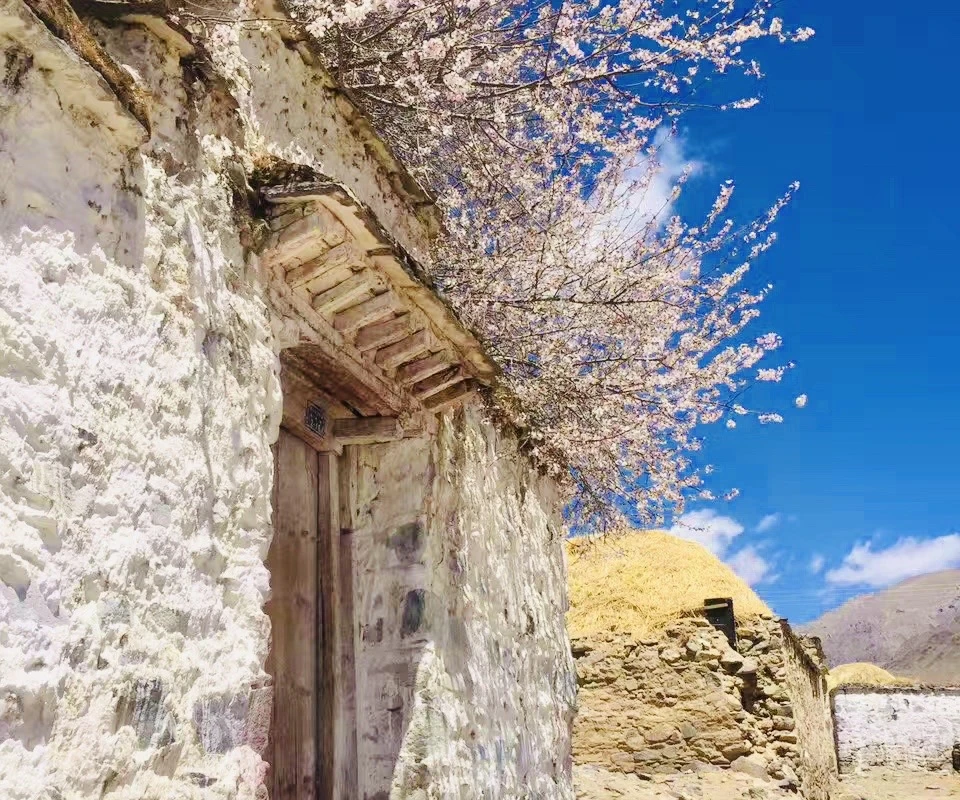
Lhasa! A City with a Unique Spirit
This must be what Lhasa looks like now—peach blossoms in full, blazing glory!
I count on my fingers: I've been to Lhasa four times altogether.
Some people go and never leave; others visit and say it's just a dirty, messy provincial capital.
To me, Lhasa is an exceptionally inclusive city. Even though tourism has over-commercialized it, it still holds onto a unique spirit that money can't buy. That spirit probably comes from its deep-rooted religious faith.
My first trip to Lhasa was in early April 2017, between two jobs and just before heading to Japan for a competition. Training had left me exhausted, and they said I needed rest before the event, so I quickly planned a trip. I looked at snow mountain treks, but the mountains were still closed for the season, and finding a group last minute was too much hassle. So I settled on Lhasa—surely I'd see snow mountains there...
And indeed, I did, right from the plane.
On how to first enter Tibet and altitude sickness
Many recommend taking the train in and flying out, to give your body time to acclimatize and avoid altitude sickness. From my own many bouts of altitude sickness, I've concluded that it's simply your body adapting to the high altitude. When air pressure drops and each breath contains less oxygen, your body puts its own emergency measures into play. A racing heart, headaches—these are normal. Just drink plenty of water, stay cheerful, and push through the adjustment period.
Of course, if you catch a cold, see a doctor right away. And never take a bath right after arriving at high altitude.
The airport bus passed the Potala Palace on the way into town, and the moment I saw it I was overwhelmed with excitement—probably because this landmark is so iconic.
I got off and went straight to find Yanyan, a friend I'd never met in person but felt I already knew well.
A friend I'd met on the Sichuan–Tibet Highway introduced me to a friend they'd made on the Xinjiang–Tibet Highway, and so my first time in Lhasa, I already had a base. At that base I met even more friends. Meeting for the first time, there was no awkwardness. We chatted away happily. That's the beauty of the open road, I guess...
On the Tibetan Plateau, I tasted my first-ever cold noodles and my first Xinghualou viral green rice cake.
And yes, I was the very first guest at the Ostrich Hostel~
I hadn't done any research, so I asked around and got a list of places to go:
the Potala Palace, Jokhang Temple, Ramoche Temple, sweet tea houses, Yamdrok Lake, Everest Base Camp...
Around the Potala Palace and Jokhang Temple
I started with the Potala Palace, but with my limited knowledge of history, religion, and culture, even with a guide I just went through the motions and wasn't deeply moved. I decided: maybe I'd skip the Jokhang Temple.
I wandered around the Jokhang Temple area instead. In early April, a light snow fell on Lhasa, and a pair of jeans did nothing against the post-snow chill. I ducked into a café to warm up. The café was tiny, and I was seated at a shared table. After ordering a ridiculously expensive Americano, I looked up and saw a Tibetan young man opposite me, with a bookshelf behind him—the scene was harmonious, vivid, beautiful.
After hesitating for a few minutes, I finally asked: 'May I take a photo of you?'
I was still thinking up an excuse, but he happily agreed right away.
We exchanged WeChats and names. Gengle said his hometown is Nianbaoyuze, and he was studying English at the Lhasa Academy of Social Sciences. He had to leave early that day, but we could explore together some other time.
(So even though foreigners can't enter Tibet on their own, there are foreign scholars doing research there.)
Further out from the Jokhang Temple, the old buildings still stood, and along the streets were many unique shops worth browsing. I went into a place selling jewelry, thangka, and cake, ordered a yak yogurt cake, and started chatting with the owner. The beautiful owner was from Anhui and a graduate student at Tibet University. She hadn't gotten into her first-choice school, so she'd settled on Tibet University and had stayed on ever since. She told me I absolutely had to visit the Jokhang Temple—that one of her friends had been moved to tears there. Could it really be that magical? I was half-believing, half-skeptical...
At Yanyan and Sister Ma's place, everyone raved about Zhayeba Temple. It was said to be not far from Lhasa, reachable by bike, and the starry sky there was stunning. Being the kind of person who can't resist a challenge when traveling, I immediately decided to give it a go. With Xiaofu's help, I borrowed a bike and set off. From 3,500 to 4,000 meters altitude, everything was wonderful: blue sky, white clouds, fluttering prayer flags. Along the way, someone even offered me barley cakes. But beyond Zhayeba Village, it turned into an all-out climb, from 4,000 to 5,000 meters... At that moment, I realized this kind of ascent was beyond me... >_<
Zhayeba Village was beautiful—the first photo in this post was taken there. Pink blossoms spilled over snow-white walls, a highland version of 'spring brimming in the garden, willows by palace walls.' I thought it would be nice to wander around, but there were too many stray dogs, so it wasn't safe to linger... After reading many stories about hitchhiking in Tibet, I mustered the courage to try it. I made it to Zhayeba Temple without much trouble. There was a small canteen at the entrance, so I had a bite to eat, left my phone charging at the shop, bought a ticket, and went in. Zhayeba Temple is built into a cliff face at 4,800 meters. I climbed the steps for about ten minutes before a headache set in. I rested on a bench, soaked up some sun, gazed at the distant prayer wheels, then headed back down.
When I went to pick up my phone from the shop, someone called after me. I'd left a glove there while eating. Going back to get it, I saw the staff gathered around a huge pot brewing sweet tea—made with fresh yak milk. They invited me to have a cup, and as I left, they filled my thermos with more to take along. I retrieved my bike in Zhayeba Village and prepared to head back to Lhasa.
No need to worry about leaving your bike around—it won't get stolen. You can leave your phone to charge without a care. Help is given freely, everywhere. That's Tibet.
Heading back, I hitched a ride in a small truck with my bike. I paid 50 yuan, and the driver, a cheerful guy, started chatting. He was from Jiangsu and worked construction in Lhasa. He and his wife earned over 20,000 yuan a month—much better than the few thousand they'd make back home. His smile showed he was more than happy with his choice. He'd been in Lhasa for twenty years, so I figured he counted as a first-generation 'Lhasa drifter.' He told me that before the Qinghai-Tibet Railway, you had to take a bus to Xining and then another bus up. Many couldn't handle the altitude and at Erdaoliangzi, they simply fell asleep forever. He also threw in a story about the unrest in Lhasa in 2008...
To be continued... The story goes on...


