April Lhasa and Nyingchi Peach Blossom Tour
In late March, I spotted a tour group in a chat: an April 3rd–10th Lhasa–Nyingchi peach blossom photography trip. With the Qingming Festival holiday, I only needed three days off. Suddenly, I was tempted. In just two days, I sorted out flights, and three days later, I set off on a truly spontaneous trip.
It was a boutique tour, originally configured with two guides, ten members, and one driver. Later, it seemed eight people signed up, but one had to cancel the day before departure because of the pandemic situation in Chengdu. Two others were whisked into quarantine just hours after arriving in Lhasa, all because a close contact was on their flight—they weren’t released until the 10th. But on the 5th, the group gained four more due to the pandemic: two were from Shanghai, working there, and they’d met the guide. When their job finished, they couldn’t return. The other two were a mother-daughter pair; the mother was 69. Originally, she and two male family members planned a free trip to Tibet, but the two men were sent back right after arriving in Lhasa, leaving just them. Since the men knew the guide, they joined our group.
Such a quirky mix, isn’t it?
I’ve been to high altitudes many times before and wasn’t worried at all before departure. But in Lhasa, altitude sickness hit me hard. On the 4th, I barely ate anything and threw up three times. However, once I reached Nyingchi, everything was fine. The altitude is under 3,000 meters, dense forests, abundant oxygen. If elderly people want to visit Tibet, flying directly to Nyingchi is a great choice.
Here’s an itinerary summary before I dive into each part.
Guangzhou–Lhasa (via Chongqing)
Hotel: Shengcheng Shuyuan
Potala Palace – Tibetan costume photoshoot
Hotel: Shengcheng Shuyuan
Lhasa–Laru Peach Blossom Village–Basum Tso–Tashi Island–Nyingchi
Hotel: Linzhi Jiayue Hotel
Nyingchi–Yarlung Zangbo River Grand Canyon Peach Blossom Village–Niyang River scenic peach blossoms–Sejila Mountain Viewpoint–Lulang International Town
Hotel: Lulang Lingyun Hotel
Lulang–Yigong Tea Plantation
Hotel: Guxiang Lake Renqing Zhijia Homestay
Bomi “Hidden World” Peach Blossom Valley–Wild Hot Spring–Sejila Mountain Viewpoint–Nyingchi
Hotel: Linzhi Jiayue Hotel
Nyingchi–Lhasa–Jokhang Temple–bar
Hotel: Vienna Hotel
Lhasa–Zaki Temple–Guangzhou (via Xi’an)
Anyway, just like the Great Wall, you can’t visit Lhasa without seeing the Potala Palace. And you absolutely must hire a guide to explain, otherwise you won’t understand anything.
The guide said Tibetans don’t need reservations or tickets to enter, so there’s no way to predict how many visitors or when they’ll come. On busy days, you might queue for two hours. So if you go, get there as early as possible. It’s best to visit the Potala Palace when you’re feeling good, because you’ll be climbing the equivalent of 13 storeys, and there’s nowhere to sit during the whole tour. Inside, it’s dazzling—gold and gems everywhere, as if they cost nothing. What stuck most in my memory was the enormous diamond on the Buddha statue’s forehead; I noticed it my first visit and spotted it again this time.
Let me cover all the Lhasa sights together. The Potala Palace, Jokhang Temple, and Zaki Temple are actually given specific classifications: the Potala Palace is a palace, Jokhang is a scripture hall, and Zaki is a temple—that’s what the guide at Jokhang told us.
If the Potala Palace is a must for tourists, Jokhang Temple is the heart of the universe for Buddhist devotees. Inside, it enshrines a life-size statue of Shakyamuni at age 12, consecrated by Shakyamuni himself and over 2,500 years old. Elsewhere in Tibet, there’s a statue of Shakyamuni at age 8, and in India, a statue at age 25, though that one is now submerged by the sea. Many believers make arduous pilgrimages to Lhasa, prostrating every three steps, and their final destination is the Jokhang Temple.
The guide told us to rub something we carry next to our skin against the wooden frame in front of the statue. This, he said, was like consecrating it and making a wish. In one hall, he asked us to think of departed loved ones and pray for them to enter paradise. At that moment, my eyes welled up.
Zaki Temple is said to be for wealth. To visit, you buy three things: a bunch of incense, a bottle of baijiu, and a khata scarf. Then you queue into a small hall to offer these to the Buddha and make a wish.
The photoshoot was arranged by the tour group: ¥399 for makeup and costume, set in Barkhor Street near the Jokhang Temple. The experience was good, but the long wait left me so hungry I felt sick, which triggered my altitude sickness.
This was our first peach blossom viewing spot. It wasn’t really a scenic area, just a valley full of peach trees. On the only road in, a villager blocked the way and charged a fee (they didn’t last year, we were told).
We had the whole village to ourselves. The trees were bursting with pinkish-white blossoms, with distant snow-capped mountains as a backdrop and a few cows grazing lazily. A genuine paradise. I’d always thought Nyingchi peach blossoms were like the ones in Guangzhou, but they’re actually more like cherry blossoms I’ve seen. We took endless photos here, giddy with the joy of discovering beauty.
Basum Tso – Tashi Island
Basum Tso and Tashi Island are in the same resort. You need to change to a park shuttle at the entrance, and the tickets are pricey. Apart from the bus, you can take a boat ride for an extra fee. The lake water shimmered a vivid turquoise under the blue sky. On the island, there’s a temple, a giant prayer wheel, and a few peach trees. Before we landed, the guide hinted that the temple was a bit risqué—and indeed it was! The island was very photogenic; everyone kept snapping away.
Yarlung Zangbo River Grand Canyon Peach Blossom Village
The Yarlung Zangbo River was in its dry season; without explanation, you’d think it was just a roadside puddle… But the peach blossoms along the way were truly picturesque, like flipping through a fairy-tale illustration. Yarlung Zangbo River Grand Canyon Peach Blossom Village is a proper scenic area with compulsory shuttle buses and outrageously expensive tickets. Though the peach blossoms were lovely, the real star here was Namcha Barwa. Our guide said many people visit ten times and fail to see the full peak nine times. We met a father and son who’d already been there three or four days, and only finally saw it the day we arrived. We were incredibly lucky.
Actually, the weather wasn’t good when we arrived. It got gloomier and gloomier, clouds piled up, and rain was moving our way from the direction we’d come. The guide took us to an outdoor terrace at a restaurant to drink tea. As we sipped, it started raining, then harder, with hail mixed in. But after the rain stopped, the sky cleared and Namcha Barwa gradually revealed itself. P.S. Later, at the Sejila Mountain viewpoint, we even photographed Namcha Barwa at sunset.
Sejila Mountain Viewpoint
The car climbed up to over 4,700 meters at Sejila Mountain. There was still snow on the ground and it was freezing cold. Two days later, on our way back, it wasn’t just snow—it was a heavy blizzard, fulfilling my yearly goal of seeing snow!
Lulang International Town
Lulang International Town is a newly built tourist town from a few years ago, a collaboration between Poly or Wanda and the government, so I heard. It has restaurants, hotels, guesthouses—all in good condition. We must mention the local specialty, stone-pot chicken, the best Tibetan food we had the entire trip. Everyone was thoroughly satisfied. P.S. Tibetan cuisine generally isn’t great; the Nepalese curry was okay. Most of the trip we ate Sichuan food, which was least likely to disappoint.
You wouldn’t expect it, but Tibet produces tea: highland black tea and green tea. In early April, they harvest the first batch of the year. We visited the Yigong Tea Plantation base for a tasting. The black tea was delicious—clean and smooth, with a long, sweet aftertaste. According to the manager, the tea’s selling point is high altitude and pollution-free. There’s a specialty store in Lhasa; the cheapest tea is ¥280 for 100 grams—I’m not sure if that’s pricey. I also learned a little: black tea can be kept for a year or two, while green tea is best as fresh as possible.
Bomi “Hidden World” Peach Blossom Valley
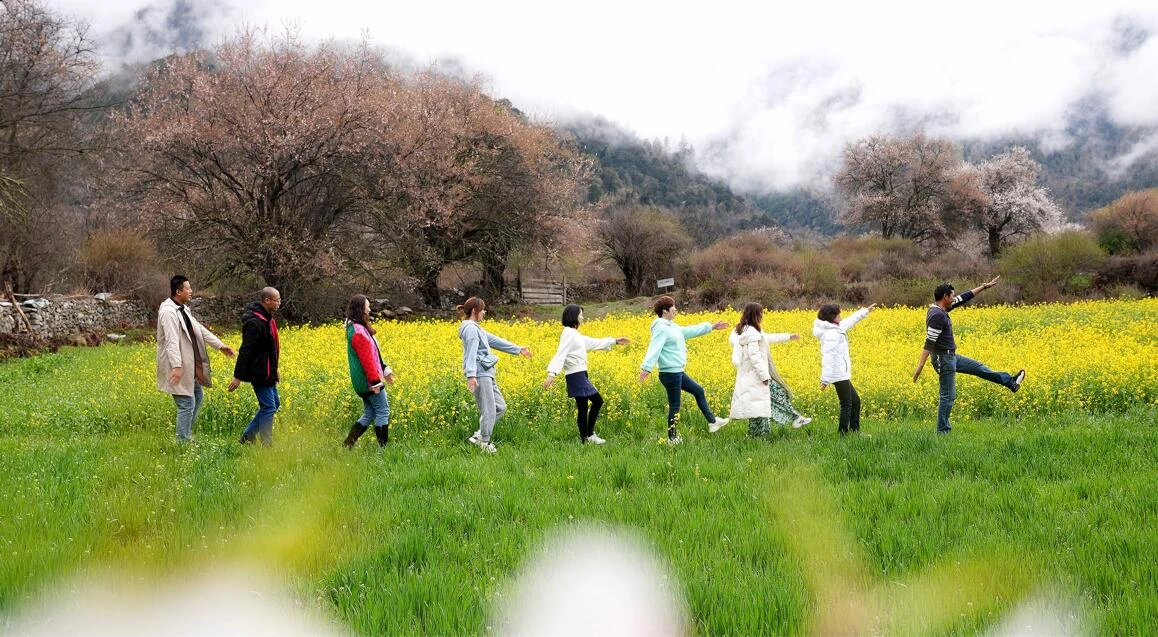
Because of heavy rain the previous days, when we reached the valley, petals carpeted the ground. Plenty of blossoms still clung to branches, but they looked ready to wither. We were a bit disappointed at first, but then realized the place was fantastic for photos. Peach trees lined both sides of the road, all behind fences. At peak bloom, herders would charge a fee to let people in; now, the gates were locked and unmanned. Further ahead, there was a rape flower field in full bloom, again with a local collecting tickets. The photos turned out so well, I later changed my WeChat profile picture to one of me in that field. Everyone thought I was in Guangxi! Who’d have guessed you’d see rape flowers in Tibet?
Another surprise: soaking in a hot spring in Tibet! It’s called a wild hot spring, but someone still charges admission, with both open-air pools and private rooms. ¥50 per person, plus ¥50 to open a room, ¥80 for a women’s swimsuit, and ¥15 for a disposable towel. The women shared a room, so I didn’t buy a swimsuit, just went in with a bra and underwear. The water had no strong smell, but after soaking, exhaustion hit me and I felt a sore throat, which scared me because usually that leads to a fever. Thankfully, I was fine the next day.
A few words about hotels.
Shengcheng Shuyuan is inside Barkhor Street, decorated with books. On the 4th floor, there’s a small reading room and a rooftop with a distant view of the Potala Palace. The hotel has underfloor heating and a heat lamp in the bathroom, so it’s very cozy.
Linzhi Jiayue Hotel is clean and comfortable.
Guxiang Lake Renqing Zhijia Homestay sits right by the lake, with an incredible setting. The restaurant is a glasshouse; sipping tea while looking out at the scenery was pure bliss.
To wrap up, this was a real stroke of luck. Even though it was pandemic times, the guide said last year Nyingchi was so packed you couldn’t get a room, and drivers slept in their cars. This year, there were almost no tourists, leaving hotels and restaurants empty. But for us, it was a blessing—everywhere was quiet, no “relatives” in the background of our photos. Still, the whole journey was nerve-racking. It wasn’t easy to depart, travel, and return smoothly. Both my outbound and return flights were canceled and delayed; every time I saw an airline text, my heart raced. At a checkpoint on the road, we were told that if our travel history showed Chengdu, we’d be quarantined immediately. Chongqing is right next to Chengdu, and I’d transited there, so I was especially worried. Even worse, just before the trip ended, Guangzhou had an outbreak and required mass testing. Our travel codes from Guangzhou were immediately starred, and I was terrified we wouldn’t be able to return. Anyway, travel is like that: it needs the right time, place, and people—miss the moment, and it’s gone. I’m truly grateful I saw that tour link, and even more grateful for my own impulse.


