My Journey Across Rivers and Mountains: A Self-Drive Tour of Tibet, Western Sichuan, Yunnan, Guizhou, and Anhui
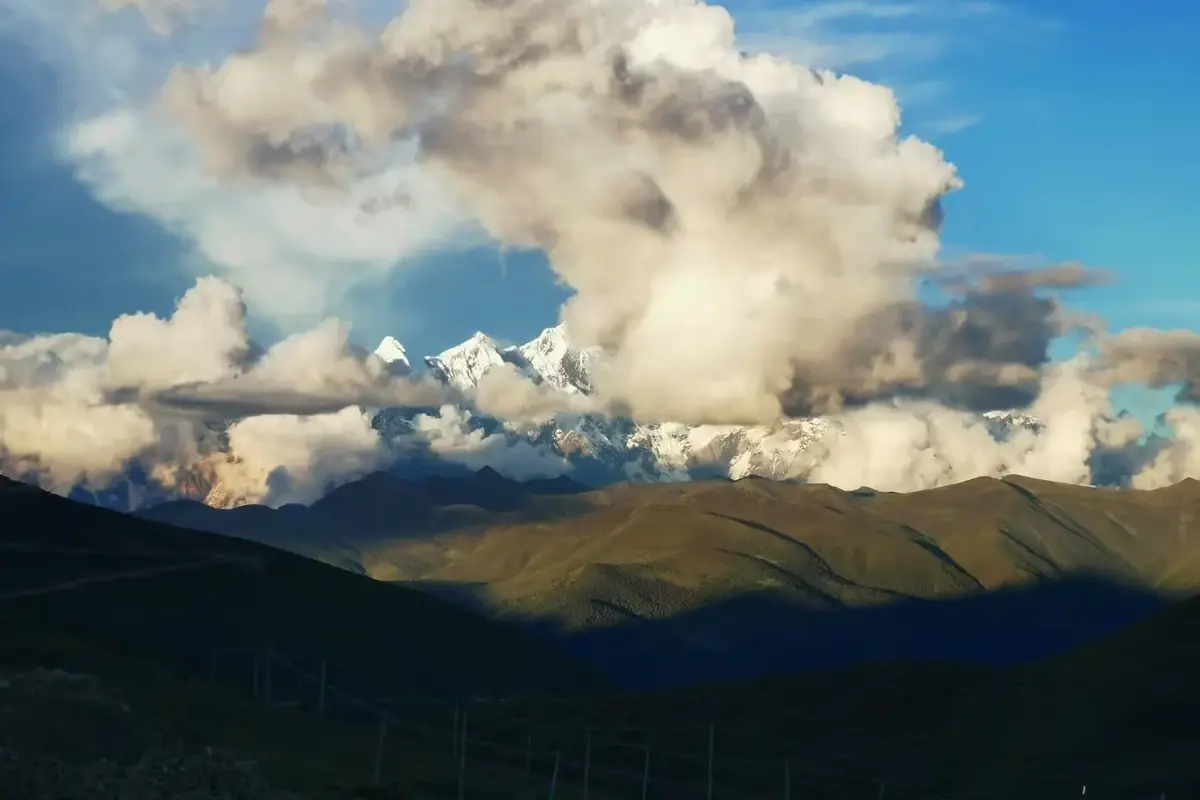
The pandemic has been going on for three years, and the signboard business is getting worse year by year. The overall situation makes it certain that the future will be even tougher. But every cloud has a silver lining—with more free time, I got the chance to take a long trip. On the morning of July 30th, I set off for Tibet, planning to enter via the Sichuan-Tibet route and exit via the Yunnan-Tibet route. Because outbreaks could happen anytime, anywhere, I wasn’t even sure I’d be able to enter Tibet, so I set a backup plan: if I couldn’t reach Tibet, I’d tour Yunnan, Guizhou, and Sichuan. To prepare for possible emergencies, I packed a lot. I brought clothes from short sleeves to down jackets, an inflatable mattress and a thick quilt, more than ten days’ worth of food and water, eight cans of portable oxygen just in case, and even an emergency tire repair kit. On the first day, I covered 1,060 kilometers, reaching Sandouping Town in Zigui County late at night. It’s just a few kilometers from the Three Gorges Dam. I took a nucleic acid test right after getting off the highway, and that put my mind at ease. From then on, getting a nucleic acid test was the top priority everywhere I went—some were free, some I paid for. On the morning of July 31st, my son and I released a Chinese stripe-necked turtle that we had brought all the way from home into the Yangtze River. Then we drove west along the Xiling Gorge. The limestone peaks on both banks framed the emerald-green river winding eastward, reminiscent of Guilin landscapes but less delicate and more imposing. We bypassed the Wu Gorge and headed straight for the mouth of Qutang Gorge. To the left, a mountain peak soared into the clouds; to the right, a sheer cliff hundreds of meters high stood guard. The river squeezed into a canyon less than a hundred meters wide, resembling a stone gateway holding the entrance to Sichuan. The saying ‘Kui Men is the most majestic under heaven’ lived up to its reputation; it’s also the image on the back of a ten-yuan note. Baidicheng lies just west of Kuimen—back when Liu Bei was defeated at Yiling, a hero in his twilight years, he entrusted his son to Zhuge Liang here. Since this trip was not focused on the Three Gorges, I passed by without stopping. I’ll save Baidicheng for another time. Then I drove straight to Guang’an, Deng Xiaoping’s hometown in Sichuan, arriving close to midnight and stayed at a budget hotel next to the railway station. On August 1st, we continued west to Luding County on the banks of the Dadu River. High mountains, deep valleys, and dense population made parking extremely difficult. We walked through a misty drizzle to the Luding Bridge. Dark iron chains spanned the Dadu River, with turbid currents rolling below—truly worthy of the term ‘natural barrier’. Leaving Luding, we passed through long tunnels and didn’t reach Kangding, at an altitude of 2,560 meters, until almost dark. After a bit of fussing, we finally found a place to stay. Since it was far from town, dinner was instant noodles. Although the altitude wasn’t too high, the water boiled at only 93°C. On August 2nd, we began crossing Zheduo Mountain in rain and fog. True to its name (‘Zheduo’ means ‘many twists’), hairpin turns followed one after another, with very steep slopes. Soon we were above 3,000 meters and altitude sickness kicked in—chest tightness, shortness of breath, racing heartbeat, dizziness, but still bearable. The car’s altitude sickness was even worse. When overtaking a truck on a steep slope, I floored the gas pedal, the RPMs screaming to five or six thousand before lurching forward. I started worrying: the road ahead is long, what if this old car leaves me stranded? At the Zheduo Mountain pass viewing platform, parking even charged a fee. With thick fog obscuring the view, I didn’t stop, just drove over the pass. After crossing, the clouds gradually parted. By the time we reached the Kangding Love Song viewing platform, blue sky and white clouds appeared, lifting my spirits. Sunlight streamed through cloud gaps onto the grassland, shifting light and shadow flowing rapidly over the rolling meadows—a beautiful moving picture. For someone seeing plateau scenery for the first time, it was a little exciting. Descending further, we entered a gentle river valley with lush vegetation—a pastoral idyll, almost like a hidden paradise. Following the valley east, we arrived at Xinduqiao Town. We replenished food and water there and wanted to get a nucleic acid test, but the queue was too long. The high-altitude sunlight was penetrating, making my back burn even through a short sleeve. I decided to push on to Batang. At noon, we hit a long traffic jam in Yajiang County. After more than an hour, the road finally cleared, but then I suddenly got a high-temperature alarm for the radiator. Several attempts didn’t help, so I found the nearest auto repair shop. It turned out the radiator fan on the left side was broken. The part had to be shipped from Chengdu and wouldn’t arrive until the next morning. So we spent the night in this smallest county in China, known as the matsutake capital—even the fruit shop across from the hostel sold matsutake. Built in the narrow valley of the Yalong River, parking here was unimaginably hard. At an altitude of only over 2,600 meters, it’s a very suitable rest stop on the Sichuan-Tibet Highway, and also the place with the most expensive guesthouses. On the morning of August 3rd, the fan finally arrived after nine. Once replaced, we immediately set off for Batang, the last stop in Sichuan. At the start, we drove through a valley within virgin forests. As the altitude rose, the vegetation changed from forest to grassland. At higher mountain tops, the distant clouds were below eye level—driving above the clouds is something you only understand once you experience it. Unknowingly, we reached Litang, the world’s high city. Apart from its altitude, the county town itself had no special scenery. However, the Maoya Grassland over thirty kilometers out of town was absolutely beautiful. A winding creek meandered peacefully across the vast green grassland dotted with cattle and horses. Mountains encircled everything. Through binoculars, I could glimpse the tip of a snow mountain behind the peaks. Though distant, it was thrilling as my first sight of a snow mountain. After the Maoya Grassland came Haizi Mountain. In a hollow below lay two lakes, one big and one small (Sister Lakes), their pale blue waters reflecting the snow mountain, making it even more beautiful. Suddenly an eagle circled overhead, instantly drawing the eyes of most tourists—a snow mountain, lakes, and an eagle forming yet another stunning, dynamic picture. Beyond the Sister Lakes viewing platform, it was downhill all the way. The road condition wasn’t great, and we arrived in Batang County, in the Jinsha River valley, by early evening. That was the last day in western Sichuan. Most of the day was spent above 4,000 meters. Although chest tightness and shortness of breath were less severe than the day before, my headache worsened. Batang is much larger than Yajiang and accommodation was cheaper. The hostel owner said if we had come a week earlier, it would have been packed, with people even fighting for a spot to sleep on the floor. I secretly felt lucky we’d come at just the right time. On August 4th, I got up at 5:30 a.m. to reach the Markam checkpoint in Tibet before 6:30, fearing long queues. Maybe because we went early, or maybe there just weren’t many people, we cleared the checkpoint in about half an hour and entered Tibet smoothly. My anxious heart settled. Climbing up along the valley, we passed the bumpy Haitong Gully, crossed 4,150-meter Zongla Mountain, and reached Markam, the first county in Tibet and the intersection of the Yunnan-Tibet and Sichuan-Tibet highways. Leaving Markam, we crossed 4,338-meter Lawu Mountain. At the top, a viewing platform funded by Chongqing offered a view of the village in the valley below. Following the national highway, we came to a volunteer service station next to Lawu Village Committee. My son and I filled several water bottles from the public bathroom for washing hands and fruit along the way. After a short rest and lunch, we continued to Rumei Town by the Lancang River. At an altitude of just over 2,600 meters, it’s another good spot for supplies and rest on the Sichuan-Tibet Highway with strong development potential. Leaving Rumei, we started climbing 3,911-meter Jueba Mountain. The elevation didn’t sound high, but the 20-some kilometers of road twisted up tightly against the Lancang River Grand Canyon, with an altitude drop of nearly 2,000 meters—in fact, one of the most dangerous sections of the Sichuan-Tibet Highway. Before reaching the pass, it started drizzling. I’d be lying if I said I wasn’t anxious; on such a section, heavy rain could easily cause rockfalls and mudslides. Unknowingly, we reached the Dongda Mountain pass at 5,130 meters, the highest point of the entire Sichuan-Tibet Highway. With the high altitude, it was only 4°C. What had been drizzle turned into sleet. After crossing the pass, we descended. Around a few bends, a couple from Yangzhou asked for help—their car had slid off the road on a sharp curve and nearly gone over the cliff. Wearing only shorts, a T-shirt, and a thin jacket, I braved the sleet and, with a driver from a Chengdu-registered car, helped push their car back onto the road. Down the valley, we arrived at Zogong County at 3,750 meters. This small mountain basin had surprisingly low altitude but good vegetation, with many trees on the mountains, blue skies, white clouds, and comfortable temperatures—you wouldn’t feel you were on the plateau. Then we followed the Yuqu River upstream, over a hundred kilometers of mostly flat road. After at least two hours, we reached Bangda Town, a small mountain basin at 4,300 meters. For first-time Tibet travelers, staying here carried a very high risk of altitude sickness. Though it was near evening, I chose to continue on to Baxoi, which is at a lower altitude. Soon after leaving Bangda, we began climbing. As the altitude rose, I once again drove above the clouds. Looking down at Bangda Town, the scenery was beautiful: the winding Yuqu River meandered quietly through the deep green grassland, while yellowish-green hills stretched endlessly like ocean waves. About 20 kilometers later, we reached the Yela Mountain pass at 4,658 meters. The viewing platform faced a very distinctive peak. The left side looked like a giant khaki dune, with some gray-white rocks poking out on top, while the right part was craggy and sharp, predominantly gray-white with streaks of yellow and red, creating a colorful spectacle. Unfortunately, power lines everywhere in front of the platform badly detracted from the view. Just down the road from the platform, there was a simple pull-off spot that offered an even better perspective. At that moment, the sun was setting, and to my surprise and delight, I witnessed a golden sunset on the mountain. As the sun slowly sank, the whole peak grew brighter and brighter—the left side shimmering gold, the right a riot of colors. It was breathtakingly magnificent. Though not a snow mountain, it was no less spectacular than alpenglow on one. Still reluctant to leave, dusk had already arrived by the time I finished drinking it in. The descent ahead was the famous 72 Turns of Nujiang. Shortly after, it was completely dark. Fortunately, there were still many cars, so I didn’t feel lonely or scared, but the road condition was poor—potholes lying in wait every so often, with the jarring thud anything but pleasant. A flat tire here would be a big problem. I could only drive with my nerves on edge, through bend after bend, large turns nested within small ones. After what felt like an eternity, I heard the roar of water crashing against rocks—I knew we’d reached the bottom of the Nujiang Grand Canyon. In the pitch-black, the high beams only lit up a narrow area ahead. The Nujiang River beside us was heard but not seen. The road along the river was even worse than the 72 Turns—long stretches of washboard road that shook my phone right off its navigation mount. The difficult drive made time feel agonizingly slow. When more and more lights appeared ahead, I finally breathed a sigh of relief—Baxoi was near. Though it was almost midnight, the streets weren’t lonely. The hotel owner was from Rugao, and meeting someone from Jiangsu in such a faraway place felt like finding a fellow townsman. Baxoi County sits at an altitude of 3,260 meters, just three hundred meters lower than Lhasa. I had thought it would be very cold at midnight, but the temperature was actually very pleasant, exactly 25°C. After a few days of acclimatization, we spent the night here without any discomfort. On August 5th, we had a relatively relaxed day. It was only a little over 200 kilometers from Baxoi to Bomi, the shortest distance since we’d started. The previous days had been tough, and we needed to recover a bit. Ranwu Lake’s water was a bit yellow, and the surrounding mountaintops had no snow left—summer is not its most beautiful season. Pine trees by the lake were covered in purplish-red pinecones I’d never seen before. Fresh resin on the cones was crystal clear, exactly like morning dewdrops. Past Ranwu Lake, we traveled west along the Purlung Zangbo River canyon. Though less vast than the Nujiang Grand Canyon, it excelled in depth and sheer steepness. At the narrowest point, the cliffs on both sides almost met. Many peaks shot up to the sky at near-vertical angles, truly awe-inspiring. Glacial meltwater formed the river, its white-capped waves surging and roaring through the narrow channel, spray splashing and sound thundering. As we neared Bomi County, the river valley widened slightly, the forests growing denser and more expansive. Above the forest sea, rows of towering snow mountains pierced the clouds. Millennia of snow gleamed dazzling white under the sun. The weather in Tibet is changeable—in a moment, it became drizzly and misty over here, while over there a snow mountain was still bathed in sunlight. The rain came suddenly and left just as fast; within half an hour, the sun was shining again. Seeing it was still early, I decided to turn onto the Medog road for a look. A fair bit of that road was rough and bumpy, often crossing channels where glacial meltwater rushed down. I was driving a sedan, so navigating this road was nerve-wracking. Worried about scraping the chassis, I could only inch along at a walking pace through the largest and most intact primeval forest in China. In the forest, tall, straight conifers were draped with strands of pale green beard lichen. Above the forest sea, snow mountains touched the clouds. Glaciers stretched down from the snow mountains into the dense forest through the grooves below. As the altitude rose, meadows appeared along the roadside, until we reached the entrance of the Galongla Tunnel. Once through the tunnel, we’d be in Medog in southern Tibet. The tunnel floor was wet, there were no lights at all, and it was foggy inside. Even the high beams only lit up about ten meters ahead; I was genuinely on edge. But once inside, there was no choice but to press on, hoping to get through quickly. After the tunnel, it was a different world: where there had been blue sky and white clouds, it was now drizzly and misty. I had planned to drive down to the border control checkpoint and then return, but after seeing the actual road conditions, I decided to turn around immediately and head back to Bomi. We reached Bomi County just at nightfall. At 2,720 meters, it’s known as the ‘Jiangnan of Tibet’ and the ‘hometown of snow mountains.’ The surging Purlung Zangbo River flows right through the town. Our hotel was by the river—looking up, snow mountains and glaciers; looking down, rippling water. The hotel owner had once stayed in Gangxia Town near my home, so he was quite friendly and gave us two breakfast vouchers. On August 6th, after our nucleic acid tests, we set off. We drove along the Purlung Zangbo toward Nyingchi. There was a lot of road construction, so the conditions weren’t great. Having seen so many forests and snow mountains the day before, the same scenery didn’t stir me much today. In Nyingchi we didn’t stop, getting straight onto the Linzhi-Lhasa Expressway and speeding west. The terrain was mostly flat and the scenery unremarkable. As the sun set, the rays shone directly into my eyes, illuminating the land and villages behind us and wrapping the mountains in a golden belt. Such beauty couldn’t be missed. I hurriedly pulled into a temporary parking area. When I got out and turned around, a double rainbow sprang into view. I excitedly banged on the window, calling my wife and son to come see this rare and wonderful sight. The lucky encounter with a double rainbow added brilliant color to an otherwise uneventful day. After dark, it took another two or three hours to finally reach Lhasa. We stayed in a hotel just one kilometer as the crow flies from the Potala Palace. From home to here, I had driven exactly 3,996.7 kilometers. On the morning of August 7th, after a bowl of noodles across from the hotel, we walked to Potala Palace Square. Passing by the People's Government of Tibet Autonomous Region, I wanted to take a photo of the building across the street. The moment I raised my phone, a loudspeaker from an armed police officer barked at me, leaving me very embarrassed. Soon, a plainclothes officer who looked like a tourist came over and asked if I had taken any pictures. I said I hadn’t even had time to press the shutter, then showed him my photo album to reassure him. I was a bit puzzled—anyone with other intentions could easily snap a picture; what was the harm in us tourists taking one? But since the government had its rules, there must be a reason. We just cooperated. Right next to the government building was Potala Palace Square. We got in after strict security checks. The magnificent Potala Palace stood on the hill opposite, solemn and awe-inspiring, radiating a natural sense of sacredness. Leaving the square, we went to Yaowang Mountain, the spot featured on the back of a 50-yuan note. Everyone was holding a banknote in one hand and a phone in the other, madly snapping photos of the Potala Palace. I couldn’t resist either. I squeezed into the crowd for a good spot, holding the note high with my left hand, stretching forward and back, up and down, until my arm ached, but I couldn’t get a decent shot. If the Potala Palace was clear, the note was blurry; if the note was clear, the Potala Palace was blurry. I recalled I had no such trouble when shooting the 20-yuan backdrop on the Li River. I could only sigh that perhaps the Potala Palace truly possessed some mysterious power. We went back the same way, had lunch, then rushed to Yamdrok Lake, one of Tibet’s three sacred lakes. Along the road, I saw many white ladders painted on rocks. I later looked it up and found they are “sky ladders” locals paint for deceased relatives. After climbing over mountains, we reached the Yamdrok Lake viewing platform. The lake below looked like a gemstone set in the plateau, its color constantly changing—starting as a pretty blue-green, turning into a serene, regal sapphire toward evening, and under the afterglow, giving off a silky soft luster. The 7,206-meter Ningjinkangsang Peak far away was reflected in the blue water. So entranced, I walked far along the lake alone, just to get a bit closer to admire this beautiful great snow mountain. I lingered in the lake and mountain scenery, unwilling to leave, until the sky grew dim and I reluctantly headed back to Lhasa. On the way to Lhasa, we were stopped. Car after car was asked if they’d been to Shigatse or Ngari. Those like us who hadn’t were let through, but we weren’t allowed on the highway—we had to take the back roads into Lhasa city. I sensed something major had happened, likely COVID-related. On the way back, I deliberately drove past the front of the Potala Palace. Illuminated by lights, it was even more beautiful than during the day. On August 8th, I woke to the news that asymptomatic cases had been found in Shigatse the day before, and Lhasa suddenly grew tense. After breakfast, we queued hundreds of meters to finally get our nucleic acid test, and then immediately set off on our long journey back home. I was initially worried we wouldn’t be allowed out of the city, but we left Lhasa with surprising ease, encountering no checkpoints along the way. For the time being, I felt a bit relieved. The goal now was to get out of Tibet as fast as possible. Like on the way here, we passed through Nyingchi without stopping—not because Nyingchi lacked scenery I’d want to see, but because according to my plan, I needed to cover both the Sichuan-Tibet and Yunnan-Tibet routes and get home in 18–20 days. Time was tight, so I had to be selective. Passing through Nyingchi town, we followed the Nyang River east to the end of the Linzhi-Lhasa Expressway at Zhenba Village, then turned onto National Highway 318. From the Nyang River valley at 3,100 meters, we climbed all the way to the Sejila Mountain pass at 4,728 meters, one of the best spots to view Namcha Barwa Peak from afar. There were two hours until sunset. At that altitude and cold temperature, wearing shorts, a T-shirt, and flip-flops, I quickly couldn’t take it anymore and fled back to the car to change into proper clothes and shoes. At 7,782 meters, Namcha Barwa is the highest peak in the eastern Himalayas and the 28th tallest in the world. Being on the Indian Ocean moisture channel, it’s shrouded in mist year-round, so very few ever get a clear view—nicknamed ‘nine out of ten miss it.’ In summer, saying ‘ninety-nine out of a hundred miss it’ is no exaggeration. A few days earlier, when passing here, it was drizzling and even the small nearby peaks were invisible. Today was a sunny, beautiful day. The viewing platform was packed with cars; everyone eagerly anticipated a glimpse of mighty Namcha Barwa. But the peak, hiding in the clouds, remained half-hidden, refusing to fully reveal itself. Truly, ‘only after endless calling did she appear, still holding her pipa half covering her face,’ which matched her nickname ‘Shy Maiden Peak.’ Even at sunset, clouds still covered more than half of its body. Still, this was already lucky enough—it was monsoon season, after all, and seeing Namcha Barwa even half-veiled was quite rare. As the sun set, most people left, disappointed at not seeing the full mountain. Only I and a few others lingered, hoping for a miracle. Perhaps the mountain god was moved by our persistence. Just a few minutes later, the crowd started exclaiming: the clouds lingering on the snow mountain gradually parted, and the highest tip of Namcha Barwa finally emerged. The silvery white ‘spear point’ thrust straight into the firmament, imposing and majestic. Then, a row of enormous snow peaks fully revealed themselves before us—grand, magnificent, breathtaking! No wonder National Geographic magazine chose it as the most beautiful mountain top in China! By the time I’d had my fill, it was already late, and there were nearly four hours of driving to Bomi. I really had to hurry. A string of snow mountains stood out even brighter against the black night sky. As the car moved farther away, they eventually vanished from my sight. The road from Sejila Mountain Pass to Bomi County wasn’t all good—there were several long construction sections that were quite challenging. Even past midnight on National Highway 318, at most every ten minutes you’d encounter another vehicle. Driving through the dark in such a remote place, seeing the lights of other cars gave a sense of security. It wasn’t until past one in the morning that we reached Bomi County, staying again at the ‘Jiaheng Glacier Theme Hotel’ where we’d stayed on the way to Tibet. The owner and his wife were waiting at the front desk for us and didn’t rest until we’d checked in. On August 9th, we got up a bit late. The hotel breakfast was over. Outside, the line for nucleic acid tests stretched as far as the eye could see. Luckily, we’d just been tested at noon the day before, so we went back to the hotel to eat. During the meal, we chatted with a grandfather and his two grandchildren at the next table. The old man had been a soldier here 50 years ago and was revisiting old haunts, marveling at how a poor mountain ditch had turned into a bustling town. The military camp he’d been in was inaccessible due to the pandemic. Though disappointed, at 70, he said he’d probably never come again. They had also planned to see the Potala Palace in Lhasa, but because of the sudden outbreak in Tibet, that was out. They decided to stay one night in Bomi and then detour to Qinghai. Our reservation that night was at the Baxoi Yaotai Business Hotel, run by the boss from Rugao again. With only 218 kilometers to cover and having driven it a few days ago, I was somewhat familiar with the road. I took my time, enjoying the scenery along the way. Unexpectedly, at the Ranwu Lake checkpoint, we were stuck for half an hour. Past the town, it was even worse—a traffic jam lasting three or four hours. By the time we reached Baxoi, it was again late at night. The streets were full of volunteers in red vests, and the atmosphere was off. In almost every hotel lobby, volunteers were stationed, checking that the hotels carefully examined guests’ health codes and test results. On August 10th, we got up late again. Luckily, the hotel restaurant still had steamed buns and eggs. We chatted with another table of travelers while eating. The hotel owner hurried in, saying he’d just been notified that all hotels in Baxoi must close immediately. He told us to leave as fast as possible, the faster the better, as policies could change at any moment and he didn’t know if we’d get out of Tibet smoothly. We thanked him and hit the road. Last time it was night; this time, we crossed the Nujiang River in daylight and then wound our way up the 72 Turns to Yela Mountain Pass. The scenery at different times is completely different. Today’s weather was worse than last time, and the view paled greatly compared to that golden sunset. Still, I gained something. With my 10x Celestron binoculars, I spotted a herd of deer grazing at the bottom of the valley, completely invisible to the naked eye from so far away. I quickly passed the binoculars to my son so he could see this rare wild animal, too. After the Yela Mountain Pass, we descended 20 kilometers to Bangda Town. From there, following the Yuqu River to Zogong, over a hundred kilometers, the terrain was mostly a flat river valley. Not very wide, but the scenery was beautiful. On the mountaintops, white rocks were exposed—at a glance, you might mistake them for snow. Large swaths of barley in the valley were turning from green to yellow, and wildflowers of every color competed with golden canola blossoms. It was no less scenic than Xinduqiao. After Zogong, we crossed the 5,130-meter Dongda Mountain Pass again. By about ten at night, we arrived at the pre-booked hotel in Markam County, but were stopped at the entrance to town. A staff member explained that all Markam hotels were closed; our booking would be automatically canceled and refunded. If we wanted accommodation, we’d have to go to Sichuan or Yunnan. No choice—we gritted our teeth and continued toward Deqin in Yunnan. On National Highway 214, the traffic was clearly much lighter than on 318. A long time would pass between vehicles. No matter how many beautiful sights there might be along the road, they were all swallowed by the boundless darkness. At 2 a.m. on August 11th, we finally reached the junction of Sichuan and Yunnan. A long line of cars stretched along the narrow 214—no one knew just how long. On our left were cliffs prone to rockfalls; on our right, beyond the cliff, the Lancang River roared below. Being trapped in such a place in the pitch-black night, fear was only natural. Having driven 16 hours from Baxoi with barely a break, I was truly exhausted. Half-reclined in the driver’s seat, I dozed off and on until dawn. When the car ahead moved, I slid into its former spot. A few minutes later, small stones started clattering down from the cliff face, bouncing off the road and pelting the left side of my car. Luckily, they weren’t big, so the car only got minor scratches. I quickly squeezed forward half a car length, praying no more rocks would fall. Until then, none of us knew how many cars were ahead, or what exactly had caused the jam. Everyone was speculating. After who knows how long, the traffic line finally started moving at a crawl. Inch by inch we crept forward for hours until we saw the reason: it was a nucleic acid test point. Around two in the afternoon, it was our turn. The 12-hour ordeal was over. Having got the test, it was basically our permit into Yunnan, and my spirits soared. Following the Lancang River valley south, the mountains on both sides were made of shattered, loose rock; in some places, ancient riverbed cobble layers stood exposed—extremely prone to rockfalls and mudslides. Driving here in the rain would be quite risky. After proceeding for a while, a line of beautiful snow mountains appeared on our right: the Meili Thirteen Peaks gradually unfolded before us. The first viewing spot faced Kawagebo, the main peak of Meili Snow Mountain. Below the pyramid-shaped peak, a huge glacier flowed, shining like a silvery Milky Way cascading down 3,000 meters into the forest sea below. From here onward until the famous Feilaisi viewing platform, we were accompanied by snow mountains; several small viewpoints along the way were also great for viewing Meili Snow Mountain. When we reached Feilaisi, we learned that all hotels, shops, and scenic spots in Deqin were closed. The Feilaisi platform was certainly off-limits. Still unwilling to give up, I wanted to try the Wunongding viewing platform to see Meili Snow Mountain from another angle. Entering Deqin County, the situation looked bad—a row of traffic police ahead. I feared that if I went forward, not only wouldn’t I reach Wunongding, but I might not be allowed to turn back, which would ruin the next morning’s chance to see the golden sunrise on the mountain. I decided to turn around. First, I found a parking spot for a short nap, because I was utterly exhausted. After a little rest, I regained some energy and backtracked to compare several viewpoints. I felt the best spot was the abandoned viewing platform next to Feilaisi, unfortunately closed off by a wall. It was possible to enter on foot but not by car, and the only space outside that could fit two cars was already taken. So we continued forward to another small viewpoint. On the mountain side, a few cars were already parked, two of them decked out with lights, having a lively time. On the cliff side, only one car was parked at the far end; I parked at this end. At an altitude of over 3,200 meters, it was very cold at night with strong wind. My wife, afraid our skinny son would be blown off the cliff, wouldn’t let him near the edge. The backup inflatable mattress finally came in handy, and the down jackets too. The moon, one day from full, was big and round, making the Meili Thirteen Peaks gleam even whiter and brighter. With the moon so bright, only the brightest few stars twinkled above the snow mountains. Down below, the road lights wound through the Lancang River Grand Canyon like a glowing yellow thread. The night deepened, and I was bone-tired. We slept safely in the car until daybreak. On August 12th, I woke just as the golden sunrise began. The very tip of the highest peak, Kawagebo, was the first to be bathed in light, tinged with a faint red. As the sunlight spread downward from the peak, the other snow peaks began their golden sunrise one after another. The sunlit tips changed from pale red to gold—majestic, dazzling, so beautiful it made my heart drunk. Objectively speaking, if judged solely on scenery, Meili Snow Mountain even slightly surpasses Namcha Barwa. What Namcha Barwa loses on might only be altitude and rarity. In the rainy month of August, to see both mountains in full within three or four days—Namcha Barwa at sunset and Meili Snow Mountain at sunrise—how incredibly rare, how lucky! No regrets on this trip! The golden sunrise process was brief but overwhelming. As the sun rose, the golden glow faded from the snow mountain, which returned to being pure white and bright. After packing up the mattress and bedding, we could set off for the next stop: Shangri-La. As expected, the fork past Deqin County to Wunongding was closed, so we continued along National Highway 214. Further along, we came across another viewpoint for photographing Meili Snow Mountain’s main peak. With a foreground slope, Kawagebo looked even more majestic. After that, Meili Snow Mountain disappeared from view. The scenery was ordinary until we reached Napa Lake, where there was something worth seeing. I drove partway onto the famous “over-water highway” but turned back—I didn’t want to risk being towed away trying to be a hero. Not far past Napa Lake, on the left side of Highway 214, there was a lush wetland. On the verdant grassland stood nothing but fine horses. From western Sichuan to Tibet, then from Tibet to Yunnan, I’d seen plenty of yaks, quite a few sheep (especially in Yunnan, where there are lots of goats), but herds of fine horses were rare. Every horse here had a glossy coat and was full of life. Some were galloping, some rolling, others grazing with heads bowed. They left a deep impression on me. Past here, we drove straight into Shangri-La County. For the first time in a while, we reached our destination before sunset. We went out for a good dinner, had a little drink, and went to bed early. On August 13th, we first visited Dukezong Ancient Town, where we also got our nucleic acid test done. We strolled around a bit; it didn’t feel very interesting—just a man-made tourist spot. For breakfast, we had highland barley noodles and barley cakes. They tasted okay and weren’t expensive. After eating, we set off for Baishuitai. The road was very good at first, but later a stretch was quite poor, which explained the sparse traffic. However, the scenery at Baishuitai was lovely—layer upon layer of travertine pools showing rich colors in the sunlight. After Baishuitai, on the way to Lijiang, we traversed the entire Tiger Leaping Gorge of the Jinsha River. Nestled between Jade Dragon Snow Mountain and Haba Snow Mountain, Tiger Leaping Gorge is one of the deepest gorges in China. Among Upper, Middle, and Lower Tiger Leaping, Middle Tiger Leaping is the most precipitous. Looking up, the peaks stabbed almost vertically into the clouds; looking down, the abyss dropped away to the yellow water roaring and rushing thousands of meters below. On this trip, I’d passed through the Three Gorges of the Yangtze, the Dadu River Gorge, the Yalong River Gorge, the Jinsha River Gorge, the Lancang River Gorge, the Nujiang Gorge, and the Purlung Zangbo Gorge. If judged purely on depth and steepness, Tiger Leaping Gorge ranks first. By the time we finished Tiger Leaping Gorge, it was getting dark. Following Highway 214, then switching to the Dali-Lijiang Expressway, in an hour and a half we reached Lijiang. The hostel owner, learning we’d come from Tibet, was put in a tough spot because the local community was sometimes saying you just needed to report, sometimes saying isolation might be required. But with a green health code and central government policy behind us, I wasn’t too worried. Once the room was sorted, we found a restaurant nearby for dinner. After a hearty meal and drinks, we went back for a solid sleep. On the morning of August 14th, we had a bowl of beef noodles at the breakfast shop in front of the hostel. Plenty of beef, great taste, and fair price. The owners were a family from Shaoxing and had been running the place for eight years. After breakfast, we made a habit of doing our nucleic acid test, then visited Lijiang Old Town. Anyone who’d been to Tibet could enter as long as they provided a negative test from within 24 hours. I have to say, Lijiang Old Town was buzzing with people—streets thronged, shops thriving. I’m never too keen on such commercial tourist spots, though—a cursory walk-around was enough. Leaving Lijiang Old Town, we drove two hours along the expressway to the historic city of Dali. Cangshan Mountain and Erhai Lake are as beautiful as a feast, while the “wind, flowers, snow, and moon” are left to the imagination. I drove halfway around the eastern shore of the lake. The broad lake rippled and sparkled under the sun, golden light shimmering. Across the lake, a row of dark blue-black mountains had to be Cangshan. Unfortunately, the strong afternoon backlight made the distant Cangshan look hazy, affecting the view somewhat. On August 15th, we took a turn around Dali Ancient Town. The scenery was much the same as Lijiang’s, but even more crowded—shoulder to shoulder. After the old town, we made a photo stop at the Three Pagodas of Chongsheng Temple. Opposite the main gate, there was a parking lot. Standing there facing west, you could take a head-on photo with all three pagodas backed by Cangshan; turning around to face east, you had a distant view of Erhai Lake. We said goodbye to Dali, made a brief stop at Kunming’s Dianchi Lake, and then went straight to a guesthouse by Fuxian Lake in Yuxi. Right at sunset, it started to rain. I ran to the lakeside and stood in the crystal-clear water, enjoying the bizarre sight of a sunset in the rain. Pitter-pattering drops broke the rose-tinted lake surface, splashing up countless crystal beads. The fields by the lake were planted with tobacco, which looked very much like the lettuce back home, only with thinner stalks and much larger leaves. There is a saying: “For tobacco in China, look to Yunnan; Yuxi is the home of Yunnan’s tobacco clouds.” The tobacco grown by Fuxian Lake must be of good quality. By chance, I noticed a huge clump of plantain (the kind we called “lawsuit grass”) growing in front of the guesthouse, with flower stalks at least a meter long. As kids, we used to pick these tough stalks to play a “lawsuit” game: two kids each take a stem, bend it in the middle, hook it through the other’s, and pull—the one whose stem breaks loses. The biggest plantains we’d ever seen were maybe twenty-something centimeters. A giant like this was a first. If we’d had one back then, we’d have ruled the roost. Perhaps it was a different variety, or maybe the climate and soil here suited it better. On the morning of August 16th, the first thing was to get a nucleic acid test at Haikou Town Health Center. After that, we found a random rice noodle shop for breakfast—they put in plenty of beef, a real bargain. We even packed some stinky tofu and fried potato sticks for road snacks. Originally, I wanted to visit Huangguoshu Waterfall, but online booking was only available for the next afternoon. So I switched to Fanjingshan, racing all the way to Jiangkou County in Tongren City, arriving at midnight. On August 17th, we got up and did another test at Jiangkou County Hospital. Breakfast was a local specialty, bean flower rice noodles, decent. After eating, we first checked into a guesthouse at the foot of Fanjingshan. The owner drove us to the scenic area entrance. We took the cable car up, then climbed several hundred more steps to reach the Mushroom Stone viewing platform. The Mushroom Stone was shaped exactly like its name—big on top, small on the bottom, like a mushroom, about ten meters tall and said to be over a billion years old. From there, a short descent and then queuing up to climb Red Cloud Golden Peak. In some places, the stairs were near-vertical and only allowed one person at a time, requiring you to pull yourself up with the railing. Once atop Red Cloud Golden Peak, I looked down over the boundless forest sea. Apart from Old Golden Peak, every mountain lay beneath my feet. Though the scenery couldn’t quite match super-classic spots like Huangshan, it was enough to rival most famous mountains. On the way down, we called the guesthouse owner to pick us up. Back at the guesthouse, we tried the owner’s cooking—on par with any hotel chef. At night, I took my son out for a walk. The stars were many, but the lights were a bit too bright to clearly see the Milky Way. On August 18th, we left Fanjingshan. The 1,145-kilometer drive from Guizhou to Anhui took 15 hours and 14 minutes. We reached Xidi at midnight. In the ancient village, the lights were sparse; all was still, with only the summer insects’ melodious chorus. The dark sky blazed with stars, and the Milky Way hung directly overhead. I’d been hoping to see a brilliant Milky Way on the plateau, but only got my wish here at the foot of Huangshan. A bit of a letdown, but far better than not seeing it at all. It was also my son’s first time recognizing the Milky Way—he said it was like a long, glowing cloud. We stayed in Xidi’s oldest house, “Anglo Hall,” built during the Ming Dynasty. On August 19th, I bought a combined ticket for ten scenic spots in Yi County on Ctrip; an adult ticket was 100 yuan and could also cover a child under 18—great value. First was Xidi, an authentic ancient village in southern Anhui, not overly commercialized, with well-preserved folk houses and ancestral halls. Then to Hongcun, the most famous ancient village in southern Anhui. Thanks to its water system, the scenery was even better, though the residential and ancestral hall architecture was slightly inferior to Xidi. After that, we visited Pingshan Village. Locals said it was once Yi County’s wealthiest village before 1949, and the surviving buildings—mostly tall and exquisite—showed its past glory. After Pingshan, it was getting late, so we settled on a guesthouse with a view over Tachuan Village. Pity the timing was off—Tachuan’s autumn colors were still a ways off. The guesthouse was perched on the mountainside, and our room had a balcony, a perfect place for stargazing. My son and I, comparing notes with online resources, identified the “Summer Triangle”—Altair, Vega, and Deneb. On August 20th, we toured Lucun. Its carved building represents the pinnacle of wooden carving in southern Anhui, though sadly most of the human faces were destroyed during that special era. Lucun was the last stop of our trip. From here, we drove straight home, arriving just at sunset. How familiar the sunset over Quanshan Bridge looked! The odometer read 9,817.7 kilometers—my new personal record for a single self-drive trip. It had been over 20 days since I last had dinner with my parents and my wife’s mother. Tonight, I could have a drink with my old father again. This journey was my longest self-drive trip so far, both in duration and distance, and likely the most profound experience. The spectacular scenery of western Sichuan, southeastern Tibet, and northwestern Yunnan gave me an immense shock. Among them, Maoya Grassland, the Medog Highway, Tiger Leaping Gorge, Namcha Barwa, and Meili Snow Mountain left the deepest impressions. Especially Namcha Barwa and Meili Snow Mountain—the beauty and the good fortune were beyond imagination. I’m already looking forward to the next trip to Xinjiang, hoping it will also bring me heart-stirring moments.


